
How to choose shoe production software? What environments should be paid attention to when using?
Managers who have been working in the footwear industry for many years often have complex feelings about the matter of "going to the system". On the one hand, it is the pressure brought about by fragmented orders, transparent costs, and extreme delivery times. On the other hand, there are too many failure cases around us where the system is broken, money is spent, people are tired, and problems still exist. The discussion on shoe production software in the market mostly stays at a horizontal comparison of function lists, as if selecting a product is like checking on a long menu. But what really puts shoe factories in trouble is never "missing out on a certain function", but rather not thinking clearly from the beginning: who's problem this software is supposed to solve, and how it will coexist with those old processes and habits that have been running for decades after entering the factory.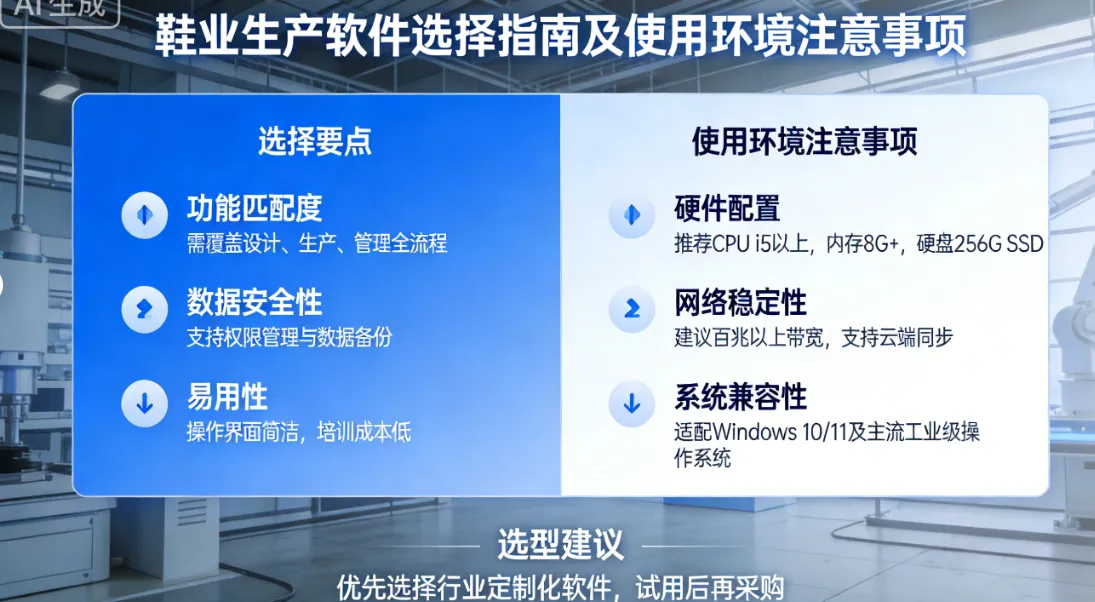
The selection of footwear production software is first and foremost a cognitive exam about the "industry specificity". A pair of finished shoes often goes through multiple processes from raw materials to factory production, including cutting, sewing, molding, vulcanization, or cold bonding. Within each process, there are dozens of combinations due to differences in size, color, material, and manufacturing path. This complexity is not a battlefield that general-purpose ERP excels in. The traditional ERP material list is often a single-layer structure, but shoe production naturally has a multi-level BOM - rubber raw materials are first made into semi-finished shoe soles, which are then combined with shoe uppers to form finished shoes. Each layer has independent material codes, process standards, and inventory accounting. If the system cannot support this multi-layer nested data model, the procurement plan will be distorted, the production material requisition will be chaotic, and the problem of long-term mismatch between inventory accounts and reality will be unsolvable. Therefore, the first watershed in selection is not the number of functions, but whether the underlying architecture truly understands the three-dimensional logic of the shoe industry's "color code" and the progressive relationship of multi-level BOM.
On this basis, enterprises need to break down the vague concept of "improving efficiency and reducing costs" into quantifiable technical indicators. The root cause of delayed order delivery in a fifty person casual shoe OEM factory may not be due to insufficient production speed, but rather the disconnect between raw material procurement cycles and production schedules. What they need is not a large and comprehensive supply chain collaboration platform, but two specific system capabilities: automatic association between BOM list and purchase order, and supplier delivery cycle warning. The root cause of frequent production plan errors in another sports shoe company is that the system cannot recognize that the upper seam of a certain shoe must be attached before the sole. This dependency on the process sequence cannot be configured in the general ERP, resulting in a pile of semi-finished products. The system they ultimately replaced has a drag and drop configuration function for process routes, and integrates a work hour calculation model that allocates processes based on worker skill levels. These cases reveal a simple yet often overlooked truth: the selection of shoe production software is not about choosing the one with the most functions, but about choosing the one that can accurately hit the current three core technological pain points of the enterprise.
The adaptability of the production management module is the core battlefield for selection. The material loss in the shoe upper cutting process, the lifecycle management of sole molds, and the rhythm balance of the molding production line are far more valuable validation features than broad labels such as "production planning" and "workshop management". The inventory management module is the same. A pair of shoes comes in three colors and five sizes, and the traditional ERP's one-dimensional inventory ledger inevitably leads to inventory on paper but actual missing sizes. A truly user-friendly system must have the ability to customize multi-dimensional inventory coding rules, and set safety stock thresholds and automatic replenishment reminders based on three levels of dimensions: style, color, and size. The cost accounting module is the ultimate test of the financial precision of the shoe factory. The price of rubber raw materials fluctuates frequently, and cutting losses vary from batch to batch. The general system's practice of sharing costs based on production volume can result in a profit deviation of more than 15%. The dedicated footwear ERP should be able to collect actual materials and losses according to production orders, and accurately allocate equipment depreciation and labor hours to each pair of shoes according to the process route.
In addition to functionality, the flexibility of technical architecture is becoming an increasingly critical decision variable. The product iteration cycle in the footwear market is measured in weeks. Today we produce vulcanized shoes, tomorrow we may add cold glue lines, and the day after tomorrow we may have to deal with an urgent order from a fast fashion brand. If the system has to pay customization fees to developers and wait for two weeks for scheduling every time the process is adjusted, digital transformation will become digital rigidity. Low code configuration capability has become a must-have - business personnel can add fields and adjust approval processes by dragging and dropping forms without modifying underlying code. Data security cannot be compromised. Customer orders, process drawings, and cost data of shoe factories are core business secrets, and the system must have fine-grained control of role permissions, traceable operation logs, scheduled backups, and disaster recovery mechanisms.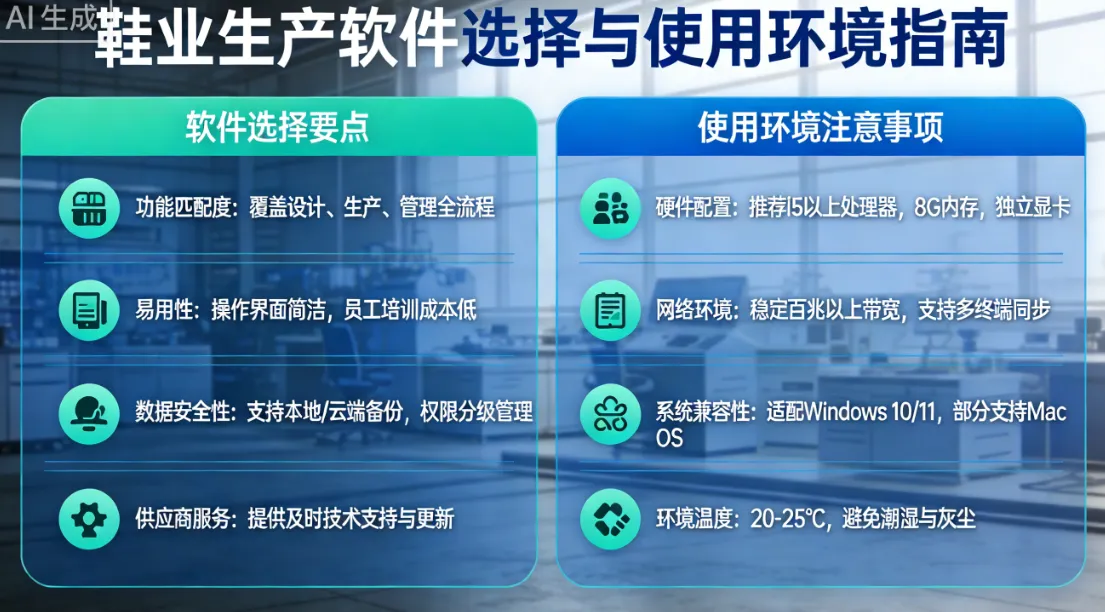
Supplier evaluation is the most susceptible link in the selection chain to interference from sensory factors. Some manufacturers' sales tactics are fluent and the functional demonstration interface is exquisite, but the landing team has only a superficial understanding of shoe-making technology. Suppliers with experience in the footwear industry will naturally respond when they hear words such as "cutting layout", "needle balance", and "vulcanization curve", and can proactively inquire about how material loss rates are calculated and whether mold management is included in the equipment ledger. They can provide implementation case reports of shoe companies of similar scale, rather than vaguely mentioning the story of general manufacturing. The standardization level of service implementation is also an important observation point. Reliable suppliers will provide clear requirements research, system configuration, employee training, trial operation, and formal launch stages and delivery lists, rather than putting everything into a "customized development" black box.
All the efforts in the selection stage will ultimately be handed over to the "use" of this real furnace for inspection. Many shoe factories have fallen into a passive situation after the system was launched, not because the software itself is not qualified, but because the prediction of the "usage environment" is too optimistic. The 'environment' here is not the temperature of the computer room or server configuration, but a complex field interwoven with organizational inertia, data foundation, and personnel mentality.
The biggest implicit risk comes from the data governance environment. The historical data accumulated by shoe factories over the years often has problems such as inconsistent coding rules, missing key fields, and multiple names for the same material. These management arrears of sedimentation will not be automatically cleared due to the launch of the new system, but will instead erupt in a concentrated manner during data migration. Some companies, in order to catch up with the schedule, directly import uncleaned historical orders and inventory ledgers, resulting in a mismatch between available inventory and physical items in the system, and financial cost accounting is always wrong from the beginning. Data migration is not a technical transfer, but a comprehensive audit and correction of historical accounts. The time saved in this process will be returned tenfold after going online.
The organizational cultural environment is a more subtle but decisive variable. The front-line employees of the shoe factory have an older age structure and generally have a fear of computer operation. If the training becomes a formality, with only one operation manual distributed and a two-hour centralized presentation, there will inevitably be delays in data entry, distortion of data, and even resistance after the system goes online. A more effective approach is to select pilot workshops and cultivate internal seed users, so that employees can see that the system can indeed help them reduce the hassle of reconciling with the warehouse and quickly find pending work orders, rather than monitoring everyone's work efficiency. The management also needs to adjust their expectations. The system is not a miracle tool that can generate benefits simply by plugging it in. It requires a three to six month adjustment period, during which there may even be temporary efficiency fluctuations due to process reengineering. Enterprises that neglect their systems in the second month of launch due to "no visible effect" often miss out on the dividends of continuous optimization.
The cost control environment also tests the determination of managers. The overall cost of ownership for footwear production software goes far beyond software license fees. Hidden expenses such as hardware procurement, implementation services, secondary development, annual operations and maintenance, employee training, and data cleaning often surface only after signing the contract. Some companies are attracted by low-priced solutions and only realize after going online that the inventory module does not support multi-dimensional accounting, the production module cannot customize the process route, and the upgrade cost is higher than the initial quotation. Other enterprises are at the other extreme, paying premiums for cross-border e-commerce management and supply chain finance functions that may not be used in the next three to five years. When the system is launched, one third of the modules are idle. The rational approach is to calculate the full cost on a three-year cycle and strictly divide the demand list into "must achieve" and "desired to achieve". The former determines the bottom line for selection, while the latter is used for long-term planning.
We also need to be vigilant about the environmental risks of 'system solidification and outdated processes'. Many shoe factories require software to fully adapt to existing approval processes, document formats, and job responsibilities when implementing ERP, citing the reason that 'this is how we have come all these years'. But the true value of digitization lies precisely in driving management evolution, rather than gilding redundant processes with expensive code. Successful practices often involve simplifying business processes before the system goes live - merging duplicate approval nodes, unifying material names and measurement units, and eliminating idle positions with information transfer properties. The system is the materialized carrier of management logic. If the management logic itself is chaotic, even the most powerful software cannot bear it.
The selection and use of footwear production software is essentially a long-term game about "adaptation". It is not a static adaptation of functionality and requirements, but a dynamic adaptation of system capabilities to the pace of enterprise growth; It is not a mechanical adaptation of technical and process parameters, but a gradual integration of digital logic and organizational inertia. Enterprises that turn selection into procurement bidding and use it as a transfer of responsibility often end up with an expensive electronic ledger. And only those enterprises that consider the launch of the system as the starting point of management change have the opportunity to make every inch of fabric, every minute of work, and every equipment operation precipitate as optimizable and reusable data assets.
This pair of shoes has gone through hundreds of processes from design drawings to wearing on the feet. The road to producing software in the footwear industry is not shorter than this pair of shoes.