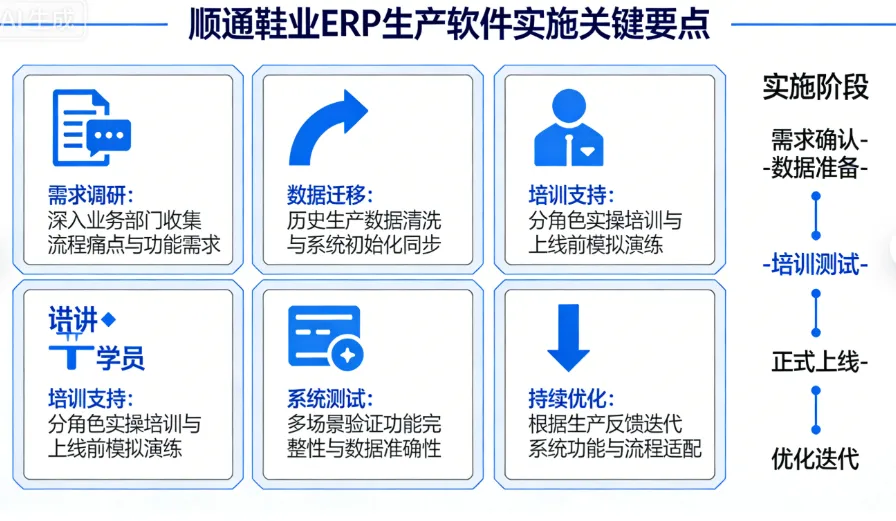
What are the most important aspects of implementing ERP production software in Shuntong Footwear?
What are the most important aspects of implementing ERP production software in Shuntong Footwear?
In the increasingly fierce competition in the footwear manufacturing industry and the accelerated iteration of consumer demand, Shuntong Footwear needs to improve production efficiency, achieve precise cost control, and upgrade process standardization. Introducing and efficiently implementing ERP production software has become an inevitable choice. ERP production software, as the core carrier connecting the entire production chain of Shuntong Footwear, including research and development, procurement, production, inventory, quality inspection, etc., its implementation effect directly determines the success or failure of the enterprise's digital transformation of production, and is also the key factor affecting the enterprise's core competitiveness. Unlike the ERP implementation in general industries, footwear production has the uniqueness of multiple styles, sizes, processes (cutting, sewing, molding, etc.), complex materials, and strict delivery times. This also determines that the implementation of Shuntong Footwear ERP production software cannot simply copy the general model, but needs to focus on core points and make precise efforts. Based on the production and operation characteristics of Shuntong Footwear, the following key points are the most important in the implementation process of its ERP production software, which directly determine the effectiveness and value of implementation. Each point has its own focus and does not overlap with each other, forming the core support for successful implementation.
The primary core points of implementing ERP production software in Shuntong Footwear areAccurate demand research and production process adaptationThis is the foundation of implementation work and a key prerequisite for avoiding the disconnect between software and production. Many enterprises fall into the misconception of "heavy software, light requirements" in ERP implementation, blindly introducing universal systems, ultimately resulting in software functions that do not match the actual production process, employee resistance to use, and the system being virtually non-existent. This not only wastes investment, but also affects production efficiency. For Shuntong Footwear, the production process covers the entire chain from shoe material procurement, cutting, sewing, molding, polishing, quality inspection to finished product warehousing and delivery, and involves parallel production of multiple styles and sizes. Material management (leather, shoe soles, shoelaces, etc.) is difficult, and the production schedule needs to balance delivery time, production capacity, and cost. Therefore, the demand research before implementation must be comprehensive, meticulous, and accurate.
The research work needs to cover all production processes and departments of Shuntong Footwear, and clarify the core requirements of each position: the production department needs to solve the pain points of chaotic scheduling, poor process connection, and difficulty in tracking production progress; The procurement department needs to achieve precise matching between shoe material procurement and production demand to avoid backlog or shortage; The warehouse department needs to address the issues of cumbersome material classification, outdated inventory data, and non-standard inbound and outbound control; The quality inspection department needs to achieve traceability of quality inspection data for each process and timely handling of non-conforming products. At the same time, it is necessary to clarify the core adaptation requirements of ERP production software based on the particularity of shoe production, such as supporting flexible product structure management (BOM), shoe last database, color and size classification management, cutting optimization and other exclusive functions, to ensure that the software can accurately fit the production process of Shuntong shoe industry, rather than forcing enterprises to adapt the software, laying a solid foundation for subsequent implementation work.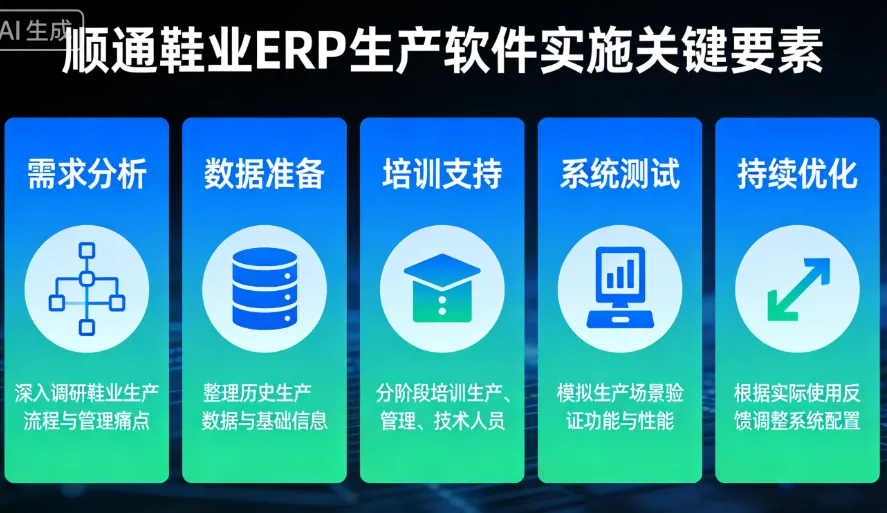
Secondly,High level attention and cross departmental collaborationIt is the core guarantee for the successful implementation of Shuntong Footwear ERP production software, and also the key to overcoming various obstacles during the implementation process. The implementation of ERP production software is not the work of a single department, but a systematic project involving multiple departments such as production, procurement, warehouse, quality inspection, finance, and administration. It requires collaboration and efficient linkage among various departments, and all of this cannot be achieved without the full support of the enterprise's senior management. For Shuntong Footwear, the emphasis of senior management is reflected in three core aspects: firstly, clarifying implementation goals and strategic positioning, combining ERP production software implementation with the company's strategy of cost reduction, efficiency improvement, and refined management, unifying the thinking of all employees, and making all departments aware of the importance of implementation work; Secondly, allocate sufficient human, material, and financial resources, establish a specialized implementation team, clarify team responsibilities, and coordinate the resolution of resource shortages during the implementation process; The third is to take the lead in promoting process change. For traditional production processes and management models that need to be adjusted during the implementation process, senior management needs to make decisive decisions and make full efforts to promote them, avoiding obstacles to implementation work caused by departmental interests and traditional habits.
Meanwhile, cross departmental collaboration needs to be implemented effectively. The implementation of the special task force should involve the core backbone of each department, clarify the implementation responsibilities and time nodes of each department, establish a normalized communication mechanism, and timely solve cross departmental connection problems during the implementation process. For example, the production department needs to provide feedback to the IT department on software adaptation issues in the production process, the procurement department needs to cooperate with the warehouse department to sort out material data, and the quality inspection department needs to provide quality inspection standards for each process to ensure data interoperability and process linkage between software modules. If there is a lack of high-level support and cross departmental collaboration, it is highly likely to lead to a situation of "each department fighting on its own", resulting in data synchronization and process connectivity issues, ultimately affecting the implementation effectiveness of ERP production software and even causing implementation failure.
Third,High quality data standardization and migrationIt is the core prerequisite for the normal operation of ERP production software and the foundation for achieving digital production control. The core value of ERP production software lies in achieving process optimization and decision support through data integration, and the accuracy, completeness, and standardization of data directly determine whether the software can play a role. For Shuntong Footwear, various types of data generated during the production process are complex, including material data (shoe material name, specifications, codes, unit prices, etc.), production data (process parameters, production progress, working hours, losses, etc.), product data (style, size, color, BOM list, etc.), inventory data (material inventory, finished product inventory, inbound and outbound records, etc.). If these data are not standardized, they are prone to data confusion, duplication, and missing problems, which can lead to software malfunction.
Therefore, in the implementation process, two key tasks need to be focused on: first, data standardization and sorting, combined with the production characteristics of Shuntong Footwear, to formulate unified data coding rules, data entry standards, and data classification specifications, comprehensively clean up various types of data, delete duplicate data, supplement missing data, correct erroneous data, and ensure that all data is unified, standardized, and consistent in caliber. For example, developing unique codes for various shoe materials, clarifying coding rules for different sizes and colors, establishing unified parameter standards for production processes, and ensuring that data entered by various departments can be interchanged and reused; The second is data migration, which involves accurately migrating standardized data from the old system (or manual ledger) to the new ERP production software. During the migration process, repeated verification is required to ensure the accuracy of data migration and avoid data loss and confusion. In addition, it is necessary to establish a data management system, clarify the responsible parties for data entry, review, and update, ensure that subsequent data can continue to maintain accuracy and completeness, and provide guarantees for the long-term stable operation of ERP production software.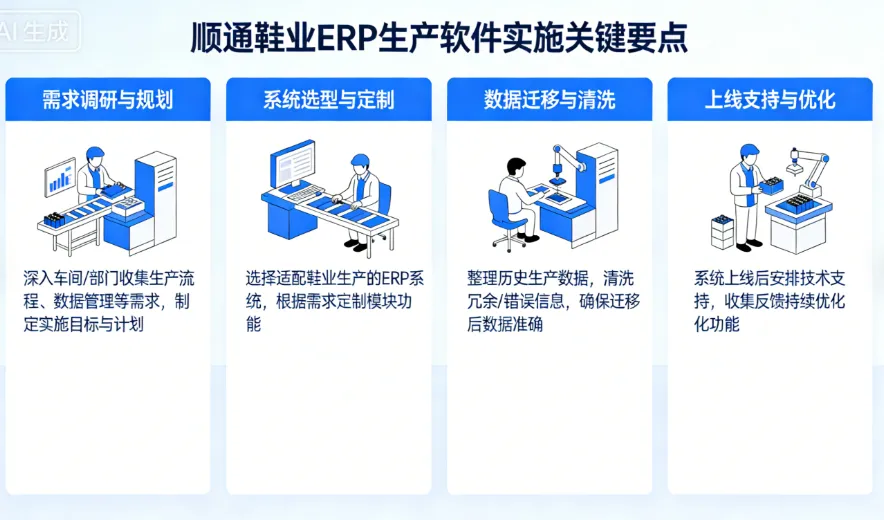
Fourth,Personnel training and implementation of hierarchical classificationIt is the key to the true implementation of ERP production software and the core to ensure that all employees are proficient in using the software. The implementation of ERP production software ultimately relies on the operation and execution of employees in various positions. If employees do not know how to use or are unwilling to use it, even if the software functions are perfect, their value cannot be fully realized. The employee structure of Shuntong Footwear is diverse, including frontline production workers (such as cutters, needle drivers, warehouse managers, etc.), middle-level managers (production supervisors, procurement supervisors, etc.), and senior decision-makers. Employees in different positions have different requirements for software usage and operational difficulty. Therefore, training work needs to be carried out in a hierarchical and classified manner to avoid a one size fits all approach.
For frontline employees at the grassroots level, the focus of training is on basic software operations, including data entry, production progress reporting, material requisition registration, and inbound and outbound operations. The training content should be concise and easy to understand, tailored to the actual job position, and combined with practical exercises to ensure that employees can quickly master basic operations and meet daily work needs; For middle-level management personnel, focus on training the software's process control, data query, report analysis and other functions, so that management personnel can grasp production progress, inventory situation, cost data in real time through the software, and improve management efficiency; For senior decision-makers, the focus is on training the decision analysis function of the software, enabling decision-makers to accurately grasp the production and operation status of the enterprise through the data reports provided by the software, and provide support for strategic decision-making. At the same time, training work is not completed in one go, and a long-term training mechanism needs to be established. In the early stage of software launch, dedicated personnel should be arranged to provide on-site guidance and timely solve problems encountered by employees during the operation process; After the software runs stably, regular retraining and upgrade training should be organized to ensure that employees can proficiently master the new features of the software and adapt to the iterative upgrades of the software. In addition, it is necessary to establish incentive mechanisms to encourage employees to actively learn and operate in a standardized manner. Employees who are proficient in operation and perform well should be commended, and those who are unwilling to cooperate or operate improperly should be guided and educated. This will create a good atmosphere of "all employees learning and using software" and ensure the true implementation of ERP production software.
Fifth,Scientific pilot testing and continuous iterative optimizationIt is the key to avoiding implementation risks, improving implementation effectiveness, and adapting to the iterative production needs of Shuntong Footwear. The implementation of ERP production software is a gradual process and cannot be rushed. If it is fully launched directly, it is prone to problems such as process confusion and software failures, which can affect normal production. Therefore, in the implementation process, Shuntong Footwear should adopt the strategy of "pilot first, gradually promote", select a production workshop (or a production line) as a pilot, and first run ERP production software within the pilot scope to verify the adaptability of software functions, the rationality of processes, and the accuracy of data.
During the pilot process, a special team will be arranged to track the entire process, collect feedback from employees in a timely manner, identify vulnerabilities and deficiencies in the software operation process, and make targeted adjustments and optimizations. For example, if it is found during the pilot process that the production scheduling function cannot meet the needs of parallel production of multiple styles, it is necessary to communicate with the software supplier in a timely manner to optimize the scheduling algorithm; If the process of material inbound and outbound operations is found to be cumbersome, it is necessary to simplify the operating steps and improve operational efficiency. After the pilot operation is stable and the results meet the standards, it will be gradually promoted to the whole enterprise to ensure smooth and orderly implementation and minimize the impact on normal production. Meanwhile, the implementation of ERP production software is not a one-time project, but a long-term iterative optimization process. The production process and market demand of Shuntong Footwear will constantly change, and the software also needs to be continuously iterated and upgraded to adapt to the development needs of the enterprise. Therefore, after going online, it is necessary to establish a normalized optimization mechanism, regularly collect feedback on the needs of various departments, combine industry technological development and enterprise strategic adjustments, continuously optimize software functions and business processes, ensure that ERP production software can provide long-term support for the production management of Shuntong Footwear, and truly achieve the goals of cost reduction, efficiency improvement, and refined control.
In addition,Choose suitable software suppliers and provide long-term operation and maintenance supportThis is also an important point that cannot be ignored in the implementation process of Shuntong Footwear ERP production software. The strength, industry experience, and service level of software suppliers directly affect the implementation quality and subsequent operation and maintenance effectiveness. When selecting suppliers, Shuntong Footwear should give priority to those with experience in implementing shoe ERP and a complete service system. The focus should be on their successful cases, technical team strength, and after-sales response speed in the shoe industry to ensure that suppliers can provide professional implementation guidance and timely after-sales support. At the same time, a detailed service agreement needs to be signed to clarify the rights and obligations of both parties, ensuring timely resolution of any issues that may arise in the future. After going online, it is necessary to establish a professional operation and maintenance team responsible for the daily operation and maintenance of the software, troubleshooting, data backup, and other work to avoid production interruptions caused by software failures; At the same time, strengthen communication and collaboration with suppliers, timely obtain software upgrade services and technical support, and ensure long-term stable operation of the software.
In summary, the implementation of Shuntong Footwear ERP production software is a systematic and long-term project. Its success does not rely on a single link, but requires precise demand research, high-level attention and cross departmental collaboration, high-quality data standardization, hierarchical and classified personnel training, scientific pilot optimization, as well as the coordinated efforts of adapted suppliers and long-term operation and maintenance guarantees. These key points are interrelated and each has its own focus, collectively forming the core support for the successful implementation of Shuntong Footwear ERP production software. Only by firmly grasping these important points, combining with the production characteristics of the enterprise itself, steadily promoting and continuously optimizing, can ERP production software truly play its core value, help Shuntong Footwear solve the pain points of traditional production management, achieve standardized, data-driven, and refined production processes, improve production efficiency, reduce production costs, shorten delivery times, enhance product quality, promote digital transformation of enterprise production, enhance the core competitiveness of the enterprise in the footwear industry, and achieve long-term stable development.