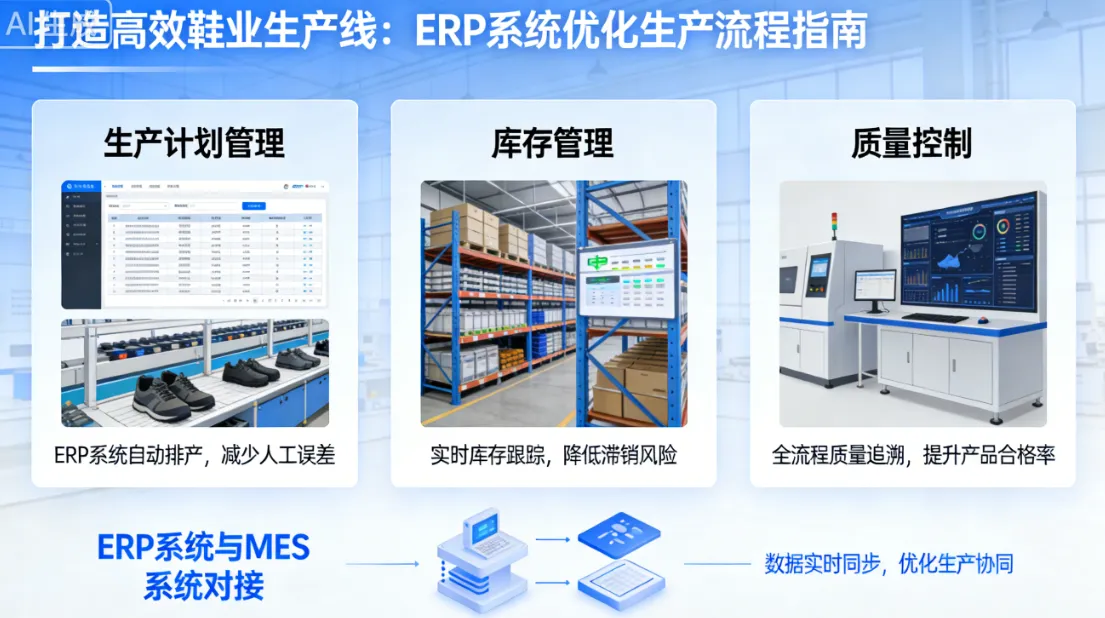
Building an efficient shoe production line: How to optimize the production process using an ERP system?
At the Fuhui Footwear cutting workshop in Qianfeng District, Guang'an, Sichuan, workers put the shoe upper flat into the machine, and one minute later, the precise printed pattern appeared before their eyes. In the past, one person could manually draw up to 1000 pairs of lines per day. Nowadays, one machine can hold up to seven pairs of lines, and the daily production has exceeded 7000 pairs. This enterprise has introduced 110 intelligent devices, which have undergone a complete transformation from cutting, sewing to packaging, resulting in a 30% increase in production efficiency and a decrease in the defect rate to less than 1%. When asked about his transformation experience, the administrative manager's answer went straight to the core: "Intelligence is not a multiple-choice question, but a survival question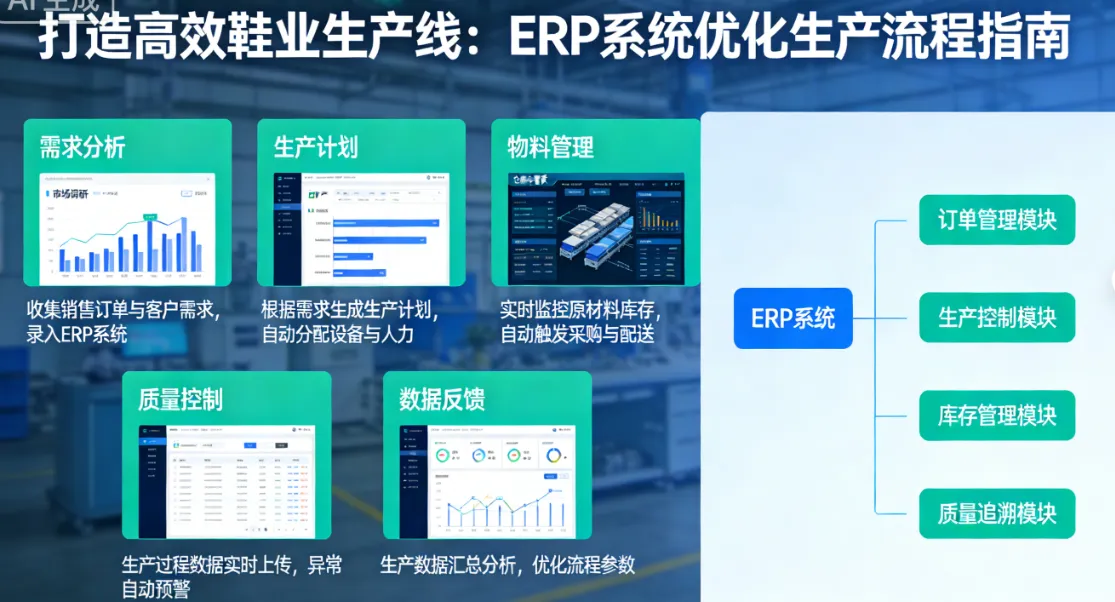
Behind this statement is an accelerating industrial reality: the competition in the footwear production line is no longer simply about comparing the level of equipment advancement or worker proficiency, but about competing to see who can achieve efficient collaboration among equipment, materials, orders, and personnel on the same digital plane. And the ERP system is precisely the operating system of this collaborative network.
The complexity of shoe production lines often exceeds the imagination of outsiders. A pair of sports shoes requires an average of hundreds of components, each corresponding to a different size and color scheme. The upper and sole come from different production lines, but must be closed at the same time. In the traditional mode, the planner holds an Excel spreadsheet to schedule production, the purchaser estimates material preparation based on experience, the workshop leader tracks the progress of the process, and information is delayed and transmitted between departments on an hourly or even daily basis. A sports shoe factory in Fujian once had a large backlog of semi-finished products due to the mismatch between the production progress of shoe uppers and soles, resulting in a 15% extension of the production cycle. This is not a matter of management attitude, but the inevitable result that manual work cannot handle such complexity.
The primary value of optimizing the production process with an ERP system is to completely break through this information bottleneck. Xinxie Cheng Footwear is an intelligent production base created for the "China Li Ning" brand, with 16 production lines and an annual output of 9 million pairs of high-end sports shoes. Here, the ERP system is connected in real-time with every automatic cutting machine, visual cutting machine, and pattern computer cart. Starting from order entry, material requirements are automatically calculated, procurement plans are automatically generated, production schedules are automatically allocated, and warehousing instructions are automatically issued. Each batch of hundreds of components produced is assigned a unique code, which is scanned and tracked throughout the entire process from storage to receipt and assembly. The efficiency improvement brought by this full process visualization is astonishing. The application data of Wanda Bao ERP in a shoe factory in Vietnam shows that the order delivery cycle has been shortened from 14 days to 8 days, and the equipment utilization rate has increased by 25%. A shoe factory in Zhejiang province utilized the digital twin scheduling simulation function to simulate the impact of different scheduling plans on costs and delivery times in a virtual factory, resulting in an 18% increase in quarterly production capacity.
The intelligence of production planning and scheduling is the technological high ground for ERP optimization of shoe production lines. Shoe production has strong seasonal fluctuations and order driven characteristics, with tight production capacity during peak seasons, idle equipment during off-season, and traditional manual production scheduling neglecting one aspect. The professional footwear ERP system is equipped with an advanced scheduling engine, which can comprehensively weight dozens of parameters such as order priority, equipment status, mold availability, material completion time, and worker skill level, and generate the globally optimal production plan within minutes. After a fast fashion shoe company applied this feature, the on-time delivery rate of orders increased from 78% to 95%. More importantly, this production scheduling is not a static lock - when equipment suddenly malfunctions, emergency insertion orders flood in, or supplier delivery delays occur, the system can instantly recalculate subsequent task nodes after confirming the abnormality on site and automatically push adjustment instructions to relevant positions. A certain generation factory in Fujian used a dynamic scheduling engine to compress the production line adjustment time for switching between different shoe types from 45 minutes to 15 minutes. This flexible response capability is the underlying support for shoe factories to cope with the market environment of small batches, multiple varieties, and short delivery times.
Material control is the most direct area where ERP systems can leverage cost reduction in the production process. The cost of raw materials such as fabrics, leather, rubber, and glue in the footwear industry accounts for more than 60% of the total cost. However, under the traditional management model, the waste of scraps in the cutting workshop, thread loss in the sewing process, and glue waste in the molding process were only discovered during the end of month inventory, but the losses had already occurred. After deploying an RFID real-time tracking system in a shoe company in Fujian, Wanda Bao ERP has achieved full process monitoring of raw material warehousing, requisition, and consumption. The system automatically compares standard BOM consumption with actual consumption, reducing stagnant material inventory by 30% and saving over 5 million yuan in procurement costs annually. New Xiecheng's approach goes further. Before cutting each batch of genuine leather materials, the ERP system will call AI visual recognition data to automatically optimize the texture direction and cutting arrangement, increasing the utilization rate of precious leather materials from 78% to 91%. This is not achieved through the skilled craftsmanship of workers, but rather the result of the system matching the physical properties of materials with the process requirements of orders in milliseconds.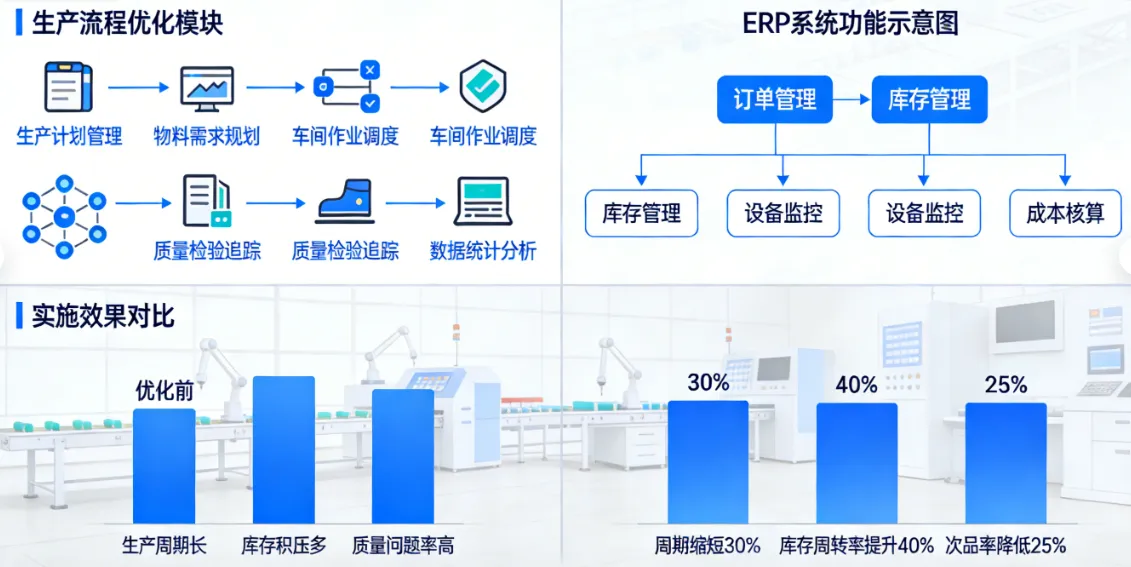
The optimization of production processes by ERP has never occurred in isolation, it must form a "brain and limb" synergy with intelligent devices. The automatic cutting machine introduced by Fuhui Footwear has an error controlled within 0.1 millimeters, but if the cutting plan is disconnected from the real-time production capacity of the cutting workshop, no matter how high the accuracy is, it cannot be converted into overall efficiency. The 22 AGV intelligent robots that shuttle around the clock in the Xinxie Cheng warehouse center can accurately deliver materials, but what supports them to not run randomly, empty or congested is the real-time calculation of the progress of each production work order and the material requirements of each workstation by the ERP system. The case of the snow boot industry in Shangni Village is more enlightening: it has evolved from the first generation of "Niutouchong" to the sixth generation of AI intelligent cutting machines. The machines have become increasingly advanced, but what truly compresses fabric loss from over 15% to 7-8% is the closed-loop linkage between intelligent devices and ERP systems - the system automatically optimizes layout density based on orders, and the machines execute cutting according to the optimal path. Equipment solves the question of 'can it be done', while ERP solves the question of 'what to do, when to do it, and how much to do it'.
The digital reconstruction of the quality traceability system is another hidden front for ERP optimization of production processes. The quality management of traditional shoe factories relies on finished product sampling and post accountability. Problems have already occurred, costs have sunk, and customer complaint processing cycles often exceed one week. The modern footwear ERP system establishes a unique electronic quality file for each pair of finished shoes, recording the entire chain information from raw material batches, operators of each process, each quality inspection parameter to factory inspection reports. Once there is a quality customer complaint, the warehouse scans the QR code on the returned shoe box, and the system can trace back to the specific fabric cylinder number, needle sewing machine, and vulcanization curve abnormality within ten minutes. After a certain sports brand shoe factory applied this system, the customer complaint processing cycle was shortened from seven days to one day, and the product defect rate decreased by more than 30%. More importantly, the system can identify the correlation between high-frequency defects and process capabilities through clustering analysis of historical quality data. If the rate of unqualified shoe sole peeling strength increases during a certain period of time, the system will automatically associate the glue batches used during the same period, operator training records, and vulcanization workshop temperature and humidity parameters to assist technicians in quickly identifying the root cause.
The refinement of cost accounting is the final step for ERP to convert the optimization results of production processes into financial value. The cost structure of shoe factories is highly complex, with volatile prices of rubber raw materials and significant differences in cutting losses due to different batches, shoe types, and process routes. The traditional extensive practice of sharing costs based on production output can result in a profit deviation of over 15%, making it difficult to distinguish between best-selling and low profit products. A professional footwear ERP system supports multi-dimensional cost collection, collecting actual material requisition, labor hours, and manufacturing costs based on production orders, product models, customer classifications, and even single pairs of shoes. A certain brand shoe company found through the system that the actual manufacturing cost of a certain series of casual shoes was significantly higher than expected. After analysis, it was identified that a certain manual process took too long. After optimizing the process, the unit cost decreased by 8%. A more forward-looking application is the real-time comparison between standard costs and actual costs, where the system automatically alerts when actual costs deviate from a preset threshold, exposing cost anomalies in the month of occurrence rather than at the end of the quarter.
It is worth noting that ERP optimization of production processes is not a one-time technical project, but a continuous iterative management change. When Jiaozuo Longfeng Fur introduced C3ERP software in the shoe-making sector, it thoroughly standardized and organized the internal material coding system, process naming rules, and approval authority nodes, unifying the data language that was originally separate from each department into a universally recognizable language for the entire company. At the same time as deploying the ERP system, Xinxie Cheng Footwear has established a lean production management system covering sixteen intelligent production lines, incorporating the operational efficiency of each equipment, the time loss of each mold change, and the pass through rate of each batch of products into the daily operation dashboard. The practices of these enterprises reveal a simple yet often overlooked truth: ERP systems are the materialized carrier of management logic, and if the management logic itself is chaotic, even the most powerful software cannot carry it.
When Fuhui Footwear 'shoe production exceeded 300000 pairs in the first quarter, an increase of 20% compared to before the transformation, when Xinxie Sheng Footwear saved over one million yuan in mold development costs, and the material utilization rate and production efficiency increased by about 10% synchronously, and when Xianyou County's shoe and clothing industry led the regional economy with a production value growth rate of 18.3%, these achievements were all supported by the same underlying capabilities: transforming the production process that relied on the experience of old masters, paper work orders, and verbal communication into a quantifiable, traceable, and optimizable data loop. ERP system is not a decoration that makes enterprises look smarter, but a decision engine that determines whether every order can be delivered on time, whether every meter of fabric can be fully utilized, and whether every minute of labor can create value.
The length of this production line is never the physical distance from the cutting workshop to the packaging workshop, but the information link from customer ordering to finished product shipment. The ERP system shortens this invisible but decisive path.