
Introduction to Footwear ERP System (Footwear ERP System)
In the footwear industry, an order often means dozens of raw materials, hundreds of processes, combinations of sizes and colors, and a long chain from research and development sampling to finished product delivery. Under the traditional management model, this information is scattered in Excel spreadsheets, paper work orders, and the experience of experienced craftsmen. During peak seasons, there is a surge in orders, and production plans are scheduled until late at night. However, inventory books and physical items never match, and it is only after the end of the financial month that profits are already eroded by hidden costs. This is exactly the proposition that the footwear ERP system needs to solve - it is not a simplified version of a general ERP, but a digital operating system tailored for this pair of shoes from the underlying data model to business processes.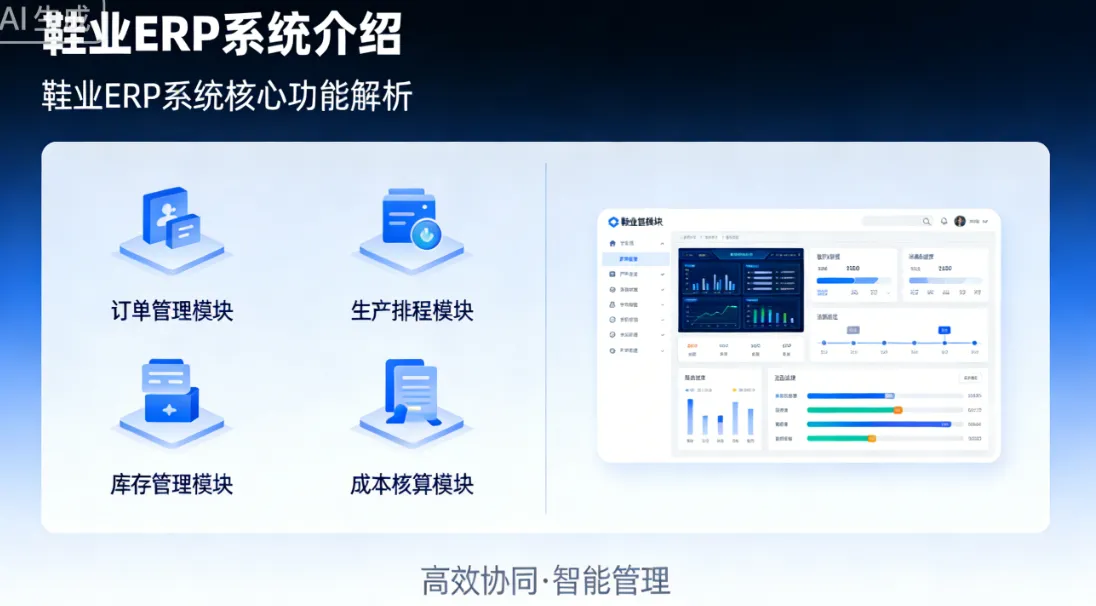
The particularity of the footwear ERP system is first reflected in its need to understand the "multidimensional language" of the footwear industry. The SKU of a pair of shoes is not simply a code, but a composite of style, color, size, material, craftsmanship group, and even shoe last model. General ERP can often only manage one-dimensional or two-dimensional attributes, while shoe ERP must have the ability to manage inventory and orders in three or even four dimensions of "color code". Wanda Bao's customized ERP system for the footwear and apparel industry precisely records key parameters such as color, size, and material of each product through multi-dimensional attribute management functions. This allows enterprises to automatically identify whether a pair of shoes is a size 37 beige sheepskin loafers or a size 41 black cowhide business shoes when entering an order, and maintain consistency in this identification ability throughout the entire procurement, production, warehousing, and sales chain. This is not a technical display, but the first threshold that shoe companies must cross from extensive management to refined operation.
Production management is the core battlefield of footwear ERP system, and also the watershed between it and general inventory software. The material list of the footwear industry is not static, and the same shoe may have different unit consumption due to different fabric cylinder numbers. The glue ratio needs to be adjusted due to different quality inspection standards of different brand customers, and the insole material needs to be changed due to seasonal changes. In the solution of Jiandao Cloud ERP for shoe enterprises, it supports flexible splitting and dynamic adjustment of material lists. Enterprises can add materials or change structures at any time according to order requirements. Wanda Bao ERP has built-in standard process route templates, which can systematically configure and precipitate the production processes, working hours standards, and quality inspection nodes of different styles of shoes. When an emergency order is received, the system can automatically call historical process data, combined with the current equipment load and material matching status, to generate an executable scheduling plan within a few minutes. This transition from experience based production scheduling to algorithm based production scheduling is a crucial step for shoe companies to transform the risk of mentor turnover into organizational assets.
The material and inventory management module is the main battlefield for eliminating hidden costs in footwear ERP systems. The types of shoe materials are diverse, ranging from genuine leather, microfiber, mesh to rubber outsole and EVA midsole. Different batches may have differences in cylinder, color, and thickness; Finished shoes must manage inventory levels for dozens of sizes simultaneously. Under traditional manual accounting, it is not uncommon to have inventory on paper but actual missing codes. As a group enterprise with an annual output of over 200000 pairs and products sold to more than ten African countries, Randy Footwear has achieved real-time inventory coordination between domestic factories and overseas markets through the YonSuite system of Yonyou. Every transaction, including business receipts and payments, inventory changes, and production material control, automatically generates financial accounting vouchers, freeing financial personnel from tedious reconciliation. Daphne achieved unified basic files and centralized financial accounting through UFIDA U8 Cloud, shortening the monthly settlement cycle by five days and reducing unreasonable expenses by 50%. The practices of these top enterprises reveal a simple rule: the value of shoe ERP in inventory management lies not in making the books more beautiful, but in making every pair of shoes appear in the right place at the right time.
Quality traceability capability is becoming a new competitive dimension for footwear ERP systems. When a pair of finished shoes have quality customer complaints such as glue breakage, sole breakage, color difference, etc., the traditional mode requires manual review of batch records, contacting multiple suppliers, and inquiring with workshop leaders, with a processing cycle of up to one week. The Wanda Bao ERP system records the inspection report of each batch of materials, the operator of each process, and the parameter values of each vulcanization curve through a comprehensive quality management module. Once a quality abnormality occurs, it can be traced back from the finished product to the raw material batch within ten minutes. Jiandao Cloud ERP supports batch numbers accurate to each pair of finished products, linking raw material batches, process nodes, and quality inspection records. This capability not only reduces recall costs and customer complaint processing cycles, but more importantly, shifts quality management from "post event accountability" to "in-process intervention" - when the system detects abnormal fluctuations in the peeling strength of a batch of shoe soles, it will automatically issue a warning to the technical supervisor, rather than waiting until the customer returns the product to discover it.
The refinement of financial and cost accounting is the last mile for footwear ERP systems to convert business value into profit insights. The cost structure of the footwear industry is highly complex, with natural leather prices fluctuating with the futures market, cutting losses varying with blade density, and significant differences in energy consumption for different shoe types on the molding production line. The traditional practice of sharing costs based on production output can result in a profit deviation of over 15%, making it difficult to distinguish between best-selling and low profit products. Changjie Tonghao Yecai's solution for shoe-making enterprises is to use product cost maintenance tools to allocate monthly material out of stock costs and manufacturing expenses to each batch of finished products. YonSuite, on the other hand, has achieved a one-to-one correspondence between business vouchers and accounting for Randy Footwear, automatically triggering bookkeeping, document preparation, and monthly settlement. When financial personnel no longer need to stay up late at the end of the month to reconcile accounts, but can access the gross profit margin of each order and product in real time, pricing decisions and customer trade-offs will have reliable data support.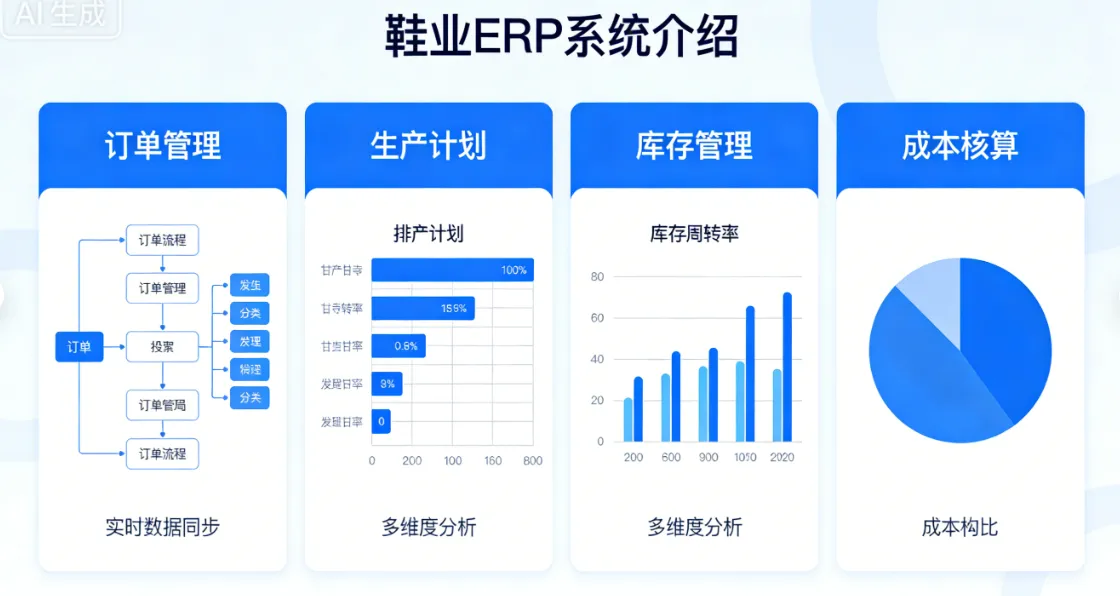
It is worth noting that the footwear ERP system is not a fixed software product, but a solution that continuously adapts to the growth cycle of the enterprise. When Wenzhou Yiting Princess Footwear chooses a pan micro digital intelligent operation platform, it values not only standardized process management, but also the system's ability to quickly respond to changes as the enterprise expands from a single brand to multiple brands and integrates from offline to online. After a sports shoe factory in Fujian launched Jiandao Cloud ERP, it completed the iterative upgrade of three modules: production scheduling, outsourcing, and piece rate wages within three months through zero code customization capability, while the secondary development cycle of traditional ERP takes at least six months. This flexibility is not just icing on the cake, but a survival necessity in the footwear market as it transitions from large-scale standardized production to small-scale, multi variety, and fast response orders.
The case of Daphne and Randy Footwear points to another important direction of evolution for footwear ERP systems: cloud based and global business capabilities. Daphne saved 500000 yuan in IT software and hardware costs and reduced the number of ERP maintenance personnel from four to one through the public cloud deployment of UFIDA U8 Cloud. Randy Footwear relies on YonSuite's cloud native architecture to build a global online multi organizational collaboration platform between domestic factories and sales networks in over ten African countries, achieving remote financial accounting and supply chain collaboration. For an increasing number of Chinese shoe manufacturers expanding into overseas markets, ERP systems are no longer just servers in internal computer rooms, but cloud hubs that can extend their business reach to any geographical boundary.
The selection and implementation of footwear ERP systems also require enterprises to complete a prerequisite task: master data governance. The inconsistent material coding rules, incomplete supplier file information, and individual process names that have been accumulated for many years will not be automatically cleared due to the launch of the new system. Successful practitioners often thoroughly standardize and clean the bill of materials, process routes, and customer files before importing the system. This job is tedious, time-consuming, and lacks merit, but it is the soil for whether the ERP system can take root in the shoe factory. The soil is fertile, and the seeds will naturally take root and sprout; The soil is barren, and even the most expensive seeds cannot escape withering.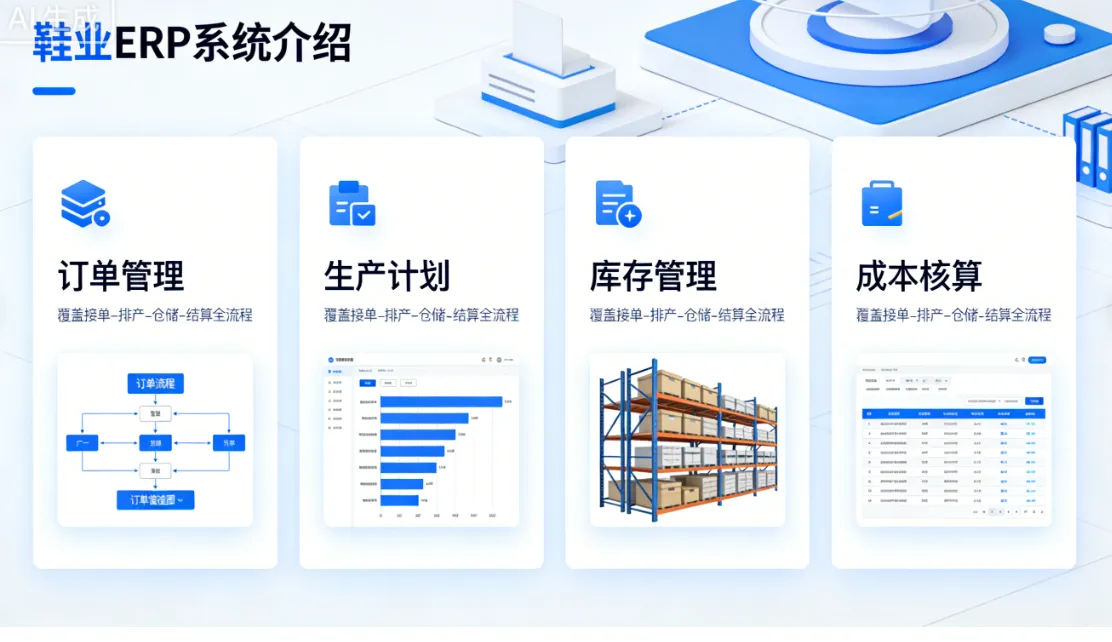
From the stacking of functional modules to the reconstruction of business processes, from internal enterprise control to global supply chain collaboration, the footwear ERP system is undergoing a profound evolution of connotation. It is no longer a tool used by the finance department to calculate costs, nor is it a ledger used by warehouses for bookkeeping, but a digital nervous system that runs through research and development, procurement, production, sales, and service. The standard for measuring whether this system is compatible is not the length of the function list, but whether the system can answer within five minutes when a company faces a temporary additional order of 3000 pairs: whether the materials are sufficient, whether the equipment can be arranged, whether the delivery time can be met, and whether the order will be profitable until the end. When these shoes go from the design drawings to the consumer's feet, the footwear ERP system is no longer an observer, but the invisible but decisive digital production line.