
Shuntong Footwear ERP Software - A Production Management System for Solving Financial Inventory Problems in Shoe Enterprises
At a women's shoe OEM factory in Huizhou, Guangdong, the most anxious moment for CFO Lin Min every month is the third day after the warehouse inventory. The difference between book inventory and physical inventory is never less than 8%. The purchasing department says to prepare materials according to system data, while the production department says to collect materials according to work orders. However, at the end of the month, 30000 pairs of genuine leather fabrics are missing. What gave her even more headache was cost accounting - for the same style of Le Fu shoes, the gross profit was 20% last month, but this month it has become 8%. Although the production line has never stopped, the profit is like sand that cannot be grasped. It was not until this company introduced the Shuntong Footwear ERP software that Lin Min first saw the hidden bleeding points of the past three years: the scraps in the cutting workshop were never accurately collected, the glue consumption in the molding production line exceeded 30% of the standard BOM, and there were seven types of dark leather materials piled up in the warehouse with an account age of over 18 months.
The birth of Shuntong Footwear ERP software is precisely in response to two propositions that have long troubled shoe companies but have not been properly solved by general software: why inventory can never match and who has eaten up profits. It is not a stitching solution that forcefully packages general financial software with inventory modules, but rather redefines inventory dimensions and cost collection paths on the underlying data architecture based on the business logic of the footwear industry.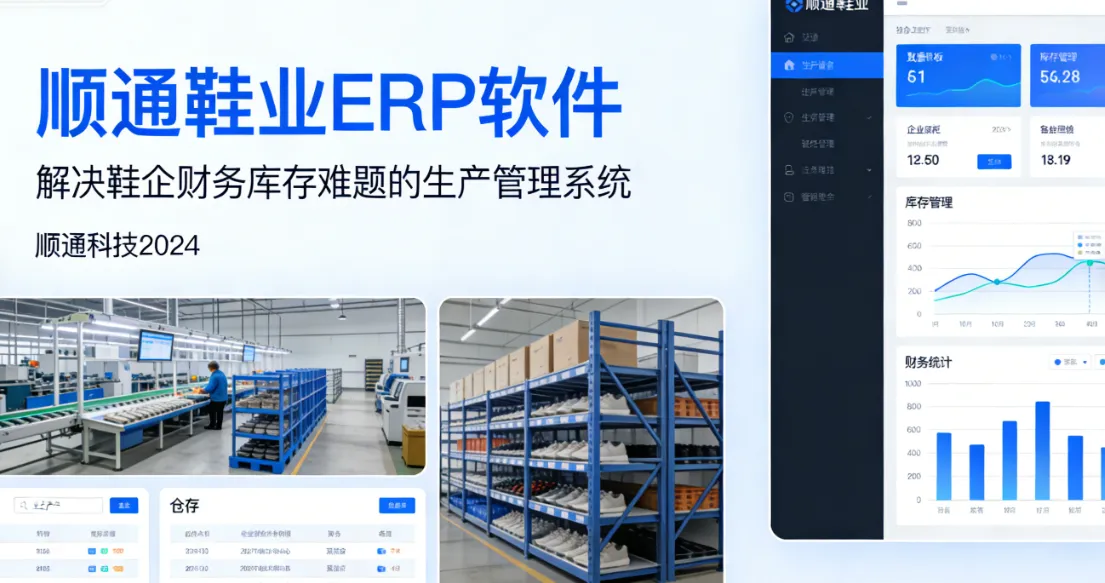
The root cause of inventory management disorder lies in the multidimensional attributes unique to the footwear industry. When a pair of finished shoes is defined as an inventory unit, it is accompanied by more than ten labels including style, color, size, material, season, supplier, etc. Traditional inventory software only recognizes one material code, resulting in black and white shoes of the same model being registered as two independent products, with no association between size 37 and 38 in the system. The core breakthrough of Shuntong ERP is the construction of a three-dimensional matrix model of "color code" in the material master data layer. When a company enters a batch of newly developed Martin boots, it only needs to define the basic style information once, and the system automatically derives all color and size combinations downwards, and maintains the integrity of this dimension structure in purchase orders, production work orders, and sales outbound orders. When the warehouse administrator scans the code to store 100 pairs of shoes, the system not only knows the total number of stores, but also accurately records 12 pairs of black size 37, 15 pairs of black size 38, and 10 pairs of brown size 39. At the end of the month inventory, the finance department no longer faces a vague total book count, but can directly retrieve the theoretical inventory and actual inventory differences for each size, and pinpoint the specific location of distortion.
A more profound inventory transformation occurs on the raw material side. Shoe material suppliers often have multiple batch attributes such as cylinder number, color number, and width when delivering. Genuine leather with the same color number may have slight color differences due to different slaughter seasons in different production areas. Mixing it with the same batch of finished products will lead to serious customer complaints. Shuntong ERP sinks batch management to the moment every roll of fabric and every bucket of glue is stored, and the system forcibly associates supplier batch numbers with internal traceability codes. When picking up materials in the cutting workshop, the scanning gun automatically verifies whether the cylinder number of the received fabric matches the requirements of the process sheet, and the risk of color difference is intercepted in the issuing process rather than the finished product inspection process. After a certain men's shoe brand in Wenzhou applied this function, the return rate caused by color difference decreased from 5.3% to 1.1%, and the wear and tear of fabric collar decreased by 15% simultaneously. Inventory is no longer a static asset number, but a dynamic resource that can be traced and intervened in.
The solution to financial difficulties relies on the deep adaptation of Shuntong ERP to the cost model of the footwear industry. The cost structure of shoe-making enterprises is naturally complex: the price of genuine leather fluctuates weekly with the international auction market, rubber raw materials are greatly affected by the crude oil market, cutting losses vary from person to person due to the density of the cutting blades, and the steam energy consumption of the molding production line is difficult to accurately segment by product. Traditional cost accounting uses the month end weighted average method, which divides all differences into total costs, resulting in confusion between best-selling and low profit items, and loss orders being masked by profitable orders. Shuntong ERP introduces a dual track parallel mechanism of multi version standard cost and actual cost. The system generates a benchmark BOM cost and process route standard working hours for each shoe based on historical data. During the production process, the actual material requisition quantity, actual working hours, and equipment energy consumption are collected in real time. After the order is completed, a cost difference analysis table is automatically generated. Financial personnel no longer need to wait for the end of month inventory, and can view the actual gross profit margin of each batch of products at the moment of completion and receipt.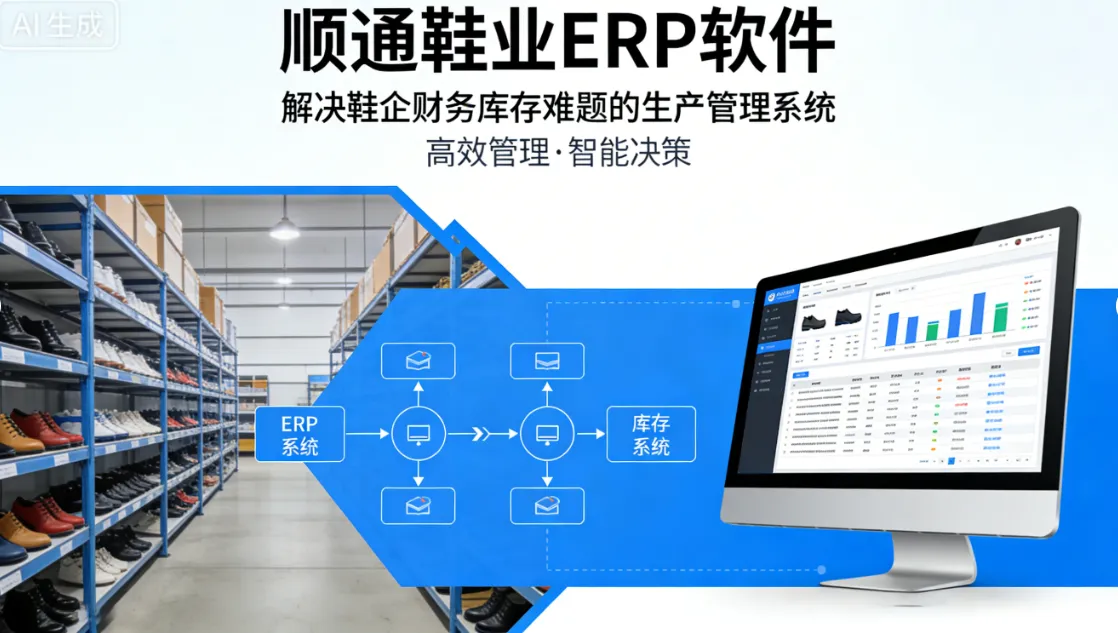
A sports shoe OEM factory in Jinjiang, Fujian, discovered for the first time after the launch of Shuntong ERP that the actual cost of a domestic brand of running shoes that they have been receiving orders for years is 9% higher than the quoted price. The differences are mainly concentrated in two aspects: this shoe type requires manual sewing of decorative threads, and the hourly wage of skilled workers is three times that of ordinary needle workers, while the system has never separately collected the working hours of this process before; When purchasing insole materials, we only focus on the unit price, but ignore the urgent air freight caused by the unstable delivery cycle of the supplier. The cost tracing function of Shuntong ERP associates each abnormal expenditure with specific orders, processes, and procurement batches, giving managers the data chips to negotiate with brand customers for the first time.
As a production management system, the value of Shuntong ERP is not only reflected in the post accounting of finance and inventory, but also in real-time intervention in the production execution process. The complexity of shoe production scheduling lies in the fact that multiple styles may flow simultaneously on the same production line, and there are significant differences in process time, equipment requirements, and worker skill levels among different styles. The advanced scheduling engine built into Shuntong ERP comprehensively weights parameters such as order delivery time, material completeness status, current equipment load, mold availability, and each team's expertise in process types to generate executable daily dispatch plans within five minutes. When a supplier's fabric delivery is delayed, the system automatically pushes the affected orders back and synchronously pushes the expected delivery date change warning to the sales end, instead of waiting for the production manager to discover the problem and then communicating step by step.
After applying the Shuntong ERP scheduling module in a women's shoe brand factory in Foshan, Guangdong, the average waiting time for materials on the production line was reduced by 40%, and the response time for emergency insertion orders was compressed from half a day to 40 minutes. What benefits workshop managers more is the electronic work order system. When each process is completed, workers scan the QR code of the work ticket, and the system updates the process level progress of the order in real time and automatically calculates piece rate wages. In the past, the team leader spent two hours every afternoon counting production and checking labor prices. Now, the real-time output and efficiency ranking of each production line can be viewed on the mobile phone at any time. The enthusiasm of workers is also changing - the system compares the standard working hours of each process with the actual working hours, and the excess completion is immediately converted into performance bonuses. The performance feedback cycle has been shortened from monthly settlement to daily visibility.
Shuntong ERP's control over quality costs also runs through the entire production process. The system establishes electronic quality records for each batch of finished shoes, linking the raw material inspection report, each process operator, key process parameter records, and finished product sampling results to a unique batch traceability code. A foreign trade shoe company in Jiangsu once faced huge claims due to a batch of snow boots being found to have excessive adhesive residue in the export destination country. In the traditional mode, it takes at least a week to retrieve production records from three months ago, but the traceability module of Shuntong ERP locks in the glue supplier used for the problematic batch, the temperature and humidity curve of the vulcanization workshop for the day, and the list of operators on duty within forty minutes. The enterprise quickly identified the root cause of the problem and accurately controlled the recall scope within three batches of products, avoiding catastrophic losses caused by the return of full container goods.
In the design concept of Shuntong ERP, finance and inventory have never been two isolated issues, but two sides of the same coin. Behind the discrepancy between inventory accounts and reality is often the lack of production material control, and the root cause of distorted cost accounting is usually the lack of process route standards. Shuntong ERP designs procurement inbound, production material requisition, process flow, finished product inbound, and sales outbound as closed-loop linked business events. Each material movement is synchronized to generate accounting vouchers, and business vouchers correspond one-to-one with financial vouchers. After the launch of the system, a certain export shoe enterprise in Huidong County has reduced its monthly billing cycle from seven days to two days. The finance department no longer needs all employees to work overtime to reconcile accounts, and has transformed into a management accounting team specifically responsible for cost analysis, pricing simulation, and customer profitability evaluation.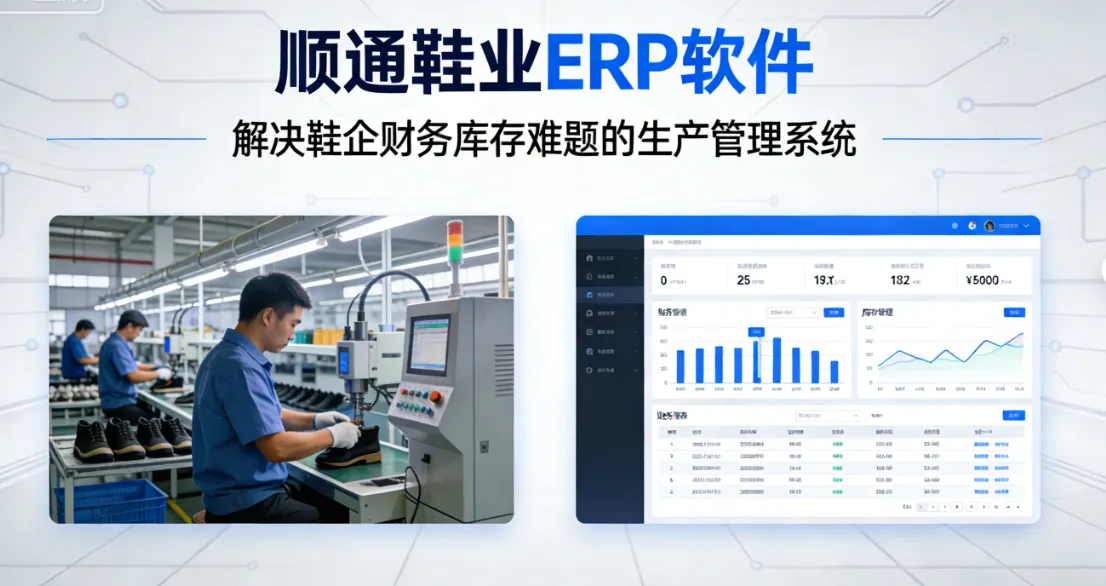
From a longer-term perspective, Shuntong ERP is redefining the functional boundaries of financial and inventory management for shoe companies. It is no longer a tool for month end surprise inventory, but allows real-time visualization of inventory health; No longer a profit calculator, but to expose cost anomalies at the moment they occur. After the women's shoe OEM factory in Huizhou went online with Shuntong ERP for twelve months, Lin Min's meeting topic changed from "Why the accounts don't match" to "How much can this new product be priced to cover the actual cost?" The warehouse area was reduced by one-third, and the space left by the backlog of materials was freed up for foreign trade orders with an 80% higher profit margin. Financial figures no longer make her anxious, but become her most solid source of confidence when talking to management.