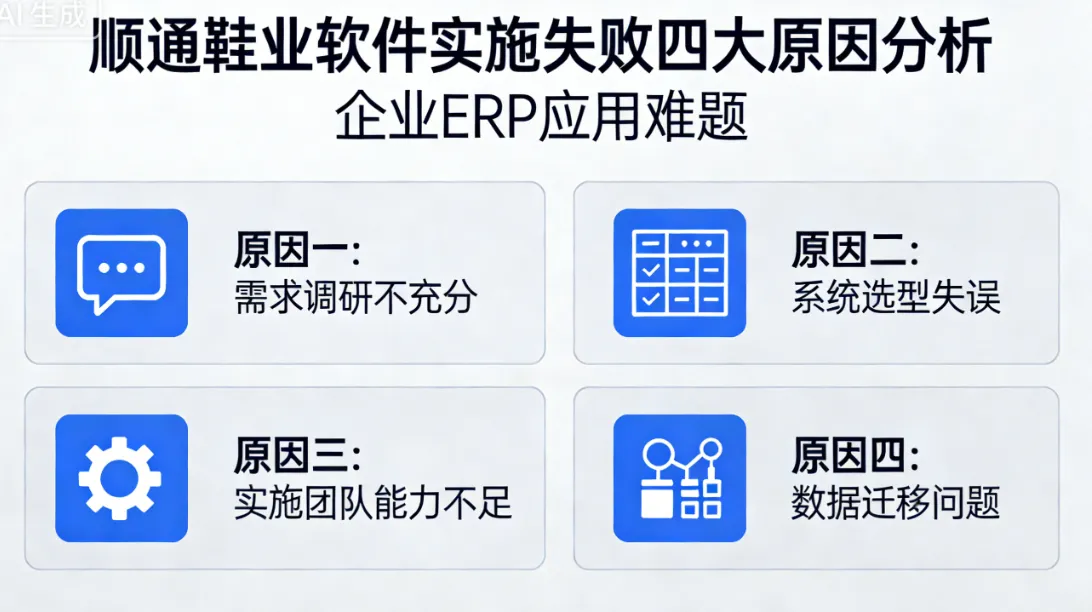
Analysis of Four Reasons for the Failure of Shuntong Footwear Software Implementation | Enterprise ERP Application Difficulties
Shuntong Footwear ERP software is not unknown in the industry. In the past five years, it has helped dozens of small and medium-sized shoe companies make a leap from manual ledger to digital management, and has also increased inventory turnover efficiency in some factories by more than 30%. However, on the back of these successful cases is another group of silent failures - they purchased software, paid implementation fees, and mobilized key personnel to cooperate, but had to put the system on hold and restart Excel spreadsheets six months later. These failures are not unique to Shuntong alone, but a typical epitome of ERP application in the entire footwear and manufacturing industry. Dissecting these failed cases is not to blame, but to see the real traps hidden behind the procurement contracts and functional lists.
The first reason is the cognitive dissonance caused by the interweaving of "assumption" and "being deceived" during the demand research stage. Many shoe company owners decide to adopt ERP because they have heard that their peers have used a certain system with good results, or they have been moved by sales rhetoric such as "intelligent scheduling" and "business finance integration". But when implementing the consultant's on-site research, the enterprise cannot say what the three most painful things they are currently facing are - the lack of accounting for fabric loss in the cutting workshop? Is it impossible to keep up with the progress of the needle car production line process? Or do we have to stay up all night for the cost accounting at the end of the month? More commonly, companies write their demand list as' I need a system to manage production, procurement, inventory, and finance ', which is equivalent to saying nothing. The consultant of Shuntong Software completed the process according to the standard questionnaire and went back to configure a fully functional demonstration environment. After seeing it, the enterprise nodded repeatedly, but no one realized that this system did not support the unique "style color code" three-dimensional inventory dimension of the footwear industry, and no one realized that the vulcanization curve parameters of the molding production line could not be found in the system for input. The seed of demand misalignment was planted at the moment of signing, and all subsequent configurations and developments were built on the wrong foundation.
The second reason is that the long-term arrears of data governance exploded in the moment the system was launched. There are many shoe companies that have been operating for more than ten years, and material coding has already evolved into an anarchist carnival. The same black sheepskin is called "Heiyang-01" by the purchasing department and "Leather Sheepskin Black" by the warehouse. The production department directly uses the supplier's part number, and the finance department generally accounts for it as "raw materials auxiliary materials". Shuntong ERP requires unified material coding, unified customer files, and unified process routes, which are the prerequisites for the operation of any professional ERP system. But many business owners see data cleaning as "the responsibility of the IT department" and send two clerks to work overtime for a week to hastily complete the task. In the first month of launch, purchase orders could not be automatically associated with work orders due to inconsistent material codes. When the warehouse issued materials, the inventory quantity displayed by the system did not match the actual goods. During financial cost accounting, it was found that the same shoe upper had a 20% difference in unit consumption in different work orders. The chaos caused by the lack of data governance is like a snowball, with new anomalies requiring manual firefighting every day. After three months, the system's trust level returns to zero, and key users begin to privately use Excel.
The third reason is that the resistance to organizational change is severely underestimated. The workshop directors of shoe factories are mostly from the backgrounds of cutting or sewing workers, and have gradually risen to management positions based on their skills and management reputation. They are familiar with the temperament of each device and the expertise of each team member in the process, but they have a natural barrier or even resistance to computer operation. The launch of Shuntong ERP means that after each process is completed, a QR code must be scanned to report the work, and each material requisition must be associated with a work order in the system. The efficiency of each team is quantified as a visual chart. For grassroots managers, this is not empowerment, but monitoring; Not to reduce burden, but to increase burden. What's even more tricky is the ambiguous attitude of middle-level managers. They expressed their full support in front of their boss, but secretly tacitly allowed or even condoned their subordinates to "work first and fill in orders later", citing that "urgent orders from customers cannot wait for the system to slow down the process". After the departure of the Shuntong implementation consultant, the deviation between the hourly data entered in the system and the actual production pace became increasingly large, resulting in distorted cost accounting and reports becoming mere decorations. The training only taught the operational steps, but did not establish a belief in data - employees do not know why to record, what will happen if they record incorrectly, and what benefits accurate data entry can bring to themselves. A system lacking interest driven mechanisms is destined to be a castle in the air.
The fourth reason is the uncontrolled cycle of implementation scope and customization depth. The consultants of Shuntong Software usually recommend companies to "start with standards, then focus on individuality, and take steps", but few shoe companies listen to them. The management hopes to solve all problems in one step, with CRM for sales, MES for production, precise cost accounting for finance, and a mobile cockpit for the boss. The scope of project implementation doubled within two weeks after the kickoff meeting, and the originally planned three-month launch cycle was compressed into two months. The consulting team was exhausted, and requirement research turned into filling out forms and signing. Customized development is another deep pit. The processes of shoe factories are diverse - vulcanized shoes require recording the temperature curve of the vulcanization tank, cold bonded shoes require managing the glue ratio and drying time, and special labor protection shoes need to be associated with test report numbers. Shuntong ERP standard products cannot cover these scenarios, and the enterprise insists on secondary development and requires completion within the total price package. The developed features are functional, but the interface interaction is rigid and poorly integrated with the mainstream process, requiring re adaptation every time the system is upgraded. Three years later, these customized modules became a technological debt that no one dared to touch, and the enterprise was caught in a dilemma of "not upgrading and lagging, upgrading and collapsing".
These four reasons do not exist in isolation, they are intertwined and mutually reinforcing. Misalignment of requirements leads to inherent deficiencies in system selection, lack of data governance makes operation difficult in the future, organizational resistance drags small problems into big ones, and out of control customization leaves no room for negotiation in all conflicts. The failure case of Shuntong Software in a women's shoe base in Huidong is extremely typical: the enterprise owner invested a lot of resources, even setting up a digital transformation office, but quietly withdrew the system after nine months of launch. At the review meeting, the CFO said 'the cost is still uncertain', the production manager said 'scheduling is not as flexible as manual labor', the warehouse keeper said 'spending two extra hours recording orders every day', and the implementation consultant wrote four words in the summary report: weak management foundation.
This statement is correct, but also useless. The foundation of management never falls from the sky, it gradually grows through system selection, data governance, and process optimization. The success or failure of Shuntong Footwear software is essentially not the success or failure of the software, but the projection of the enterprise's maturity in digital thinking. Those enterprises that ultimately emerge from the shadow of failure often do not switch to a more expensive software, but finally admit that ERP is not a pain reliever, but a physical examination device. It won't make the lesion disappear automatically, but it will illuminate the problems you dare not face one by one.