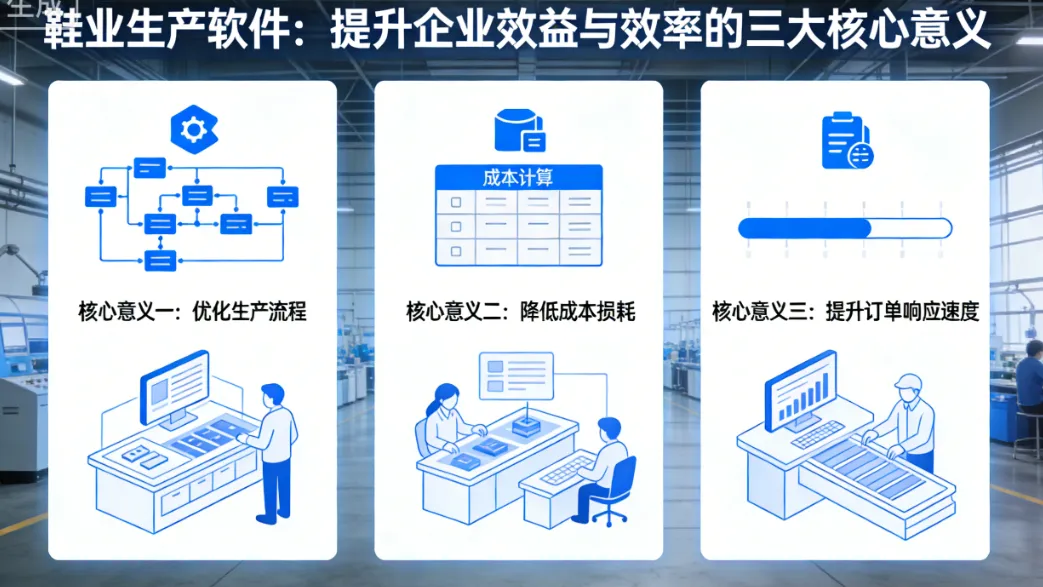
Shoe production software: three core meanings for improving enterprise efficiency and effectiveness
An old factory manager who has been working in the footwear industry for twenty years often knows better than anyone the cost structure of a pair of shoes: how much does the fabric cost per foot, how much does the glue cost per barrel, and how much does the needle worker pay for each process. But when asked why the overall operational efficiency of the enterprise has never improved and why profits always quietly evaporate at the end of the month, they are often more confused than anyone else. This confusion does not stem from a lack of professional competence, but from the structural gap between traditional management tools and the increasingly complex business environment of the footwear industry. The value of shoe production software is not just about bringing manual reports to the screen, but redefining the sources of efficiency and effectiveness from three fundamental levels.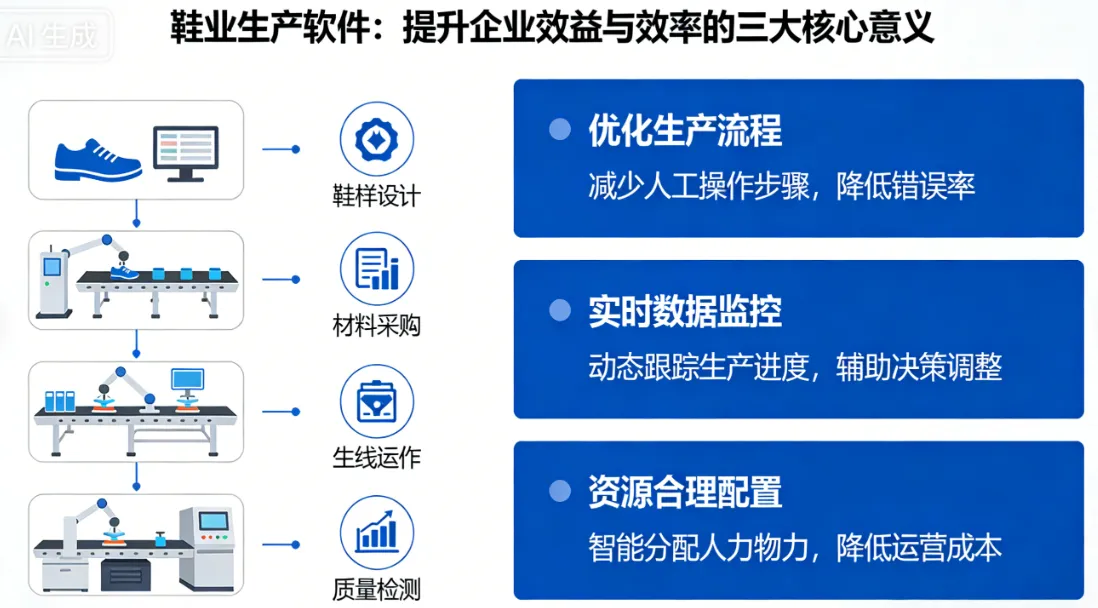
The first core significance is to shift corporate decision-making from "experience dependence" to "fact driven". The decision-making environment in the footwear industry is extremely complex - raw material prices fluctuate dramatically, order structures are fragmented, production line status changes dynamically, and customer delivery times are frequently adjusted. In the traditional model, managers rely on a mixture of reports and intuition to make judgments: the purchaser predicts the leather material usage for the next quarter based on years of experience, the production manager evaluates the remaining production capacity of the production line based on memory, and the sales director maintains quotes from core customers based on relationships. This dependence is not wrong, but its ceiling is extremely low. No matter how excellent a purchaser is, they can only track the price trends of thirty suppliers at the same time, and no matter how mature a factory is, they cannot rely on manual production scheduling to deal with dozens of urgent orders every day.
Shoe production software consolidates every data generated by a company's daily operations - purchase orders, inventory changes, work hour records, equipment status, quality inspections - into structured, retrievable, and computable assets. When the purchaser needs to decide whether to prepare materials in advance, the system no longer relies on his personal memory, but presents the sales volume of the same period in the past three years, the current inventory turnover days, and the coverage period of in transit orders. When the production plant manager needs to promise customer delivery time, the system no longer relies on him to inquire from each workshop, but provides real-time feedback on material completeness rate, equipment load rate, and production capacity surplus of each team. After a sports shoe OEM factory in Jinjiang, Fujian launched software, the order review meeting was compressed from twice a week to once a week, and the duration of each meeting was shortened from three hours to forty minutes. This is not because managers have become smarter, but because the facts on which decisions depend have become transparent, immediate, and without debate.
On a deeper level, fact driven decision-making has also reshaped the authorization boundaries of enterprises. In the traditional mode, bosses dare not delegate power because they cannot see frontline data; Middle managers dare not make decisions because reporting upwards is too costly. The shoe production software pushes key indicators such as inventory level, order progress, and cost deviation in a visual dashboard format - grassroots employees see their task lists and efficiency benchmarks, middle-level managers see department level anomaly warnings, and senior decision-makers see strategic level trends and risks. Decentralization no longer means losing control, as the system provides decision-makers at every level with factual evidence that matches their responsibilities. This is a more substantial organizational benefit beyond efficiency improvement.
The second core significance is to make implicit waste explicit and systematically eliminate it. The waste in the footwear industry is rarely manifested as grand scrapping events, but more as silent daily losses - insufficient blade density in the cutting workshop leads to the consumption of three inches more fabric per pair of shoes, thick glue brushing on the molding production line consumes two barrels more per month, the capital cost occupied by the accumulation of semi-finished products in the sewing process has never been calculated, and the electricity generated by equipment waiting for materials has never been collected. Traditional financial accounting packages these losses into the black box of 'manufacturing costs', where managers know there is waste but never know where it is, who created it, and how much resources are needed to eliminate it.
Shoe production software exposes these hidden wastes one by one through precise measurement of the entire production process. At the moment when the cutting worker presses the confirm button on the layout interface, the system automatically calculates the actual utilization rate of the batch of materials and compares it with the standard BOM. If the deviation exceeds the threshold, an alert is immediately pushed to the process supervisor. The glue bucket of the molding production line is equipped with an electronic scale, and the amount of glue applied each time is uploaded in real-time. The system summarizes the actual consumption according to the order and associates it with the specific operation team. A women's shoe OEM factory in Huizhou, Guangdong Province, found through such fine measurement that the glue cost of a certain Le Fu shoe was 32% higher than the standard. After investigation, it was found that the uneven atomization was caused by the aging of the spray gun diameter. After replacing the nozzle, the cost of a single shoe decreased by 0.17 yuan, saving more than 400000 yuan for the whole year. This profit was not squeezed out through layoffs and salary cuts, but rather the system dragged invisible losses into the sunlight, providing precise targets for improvement.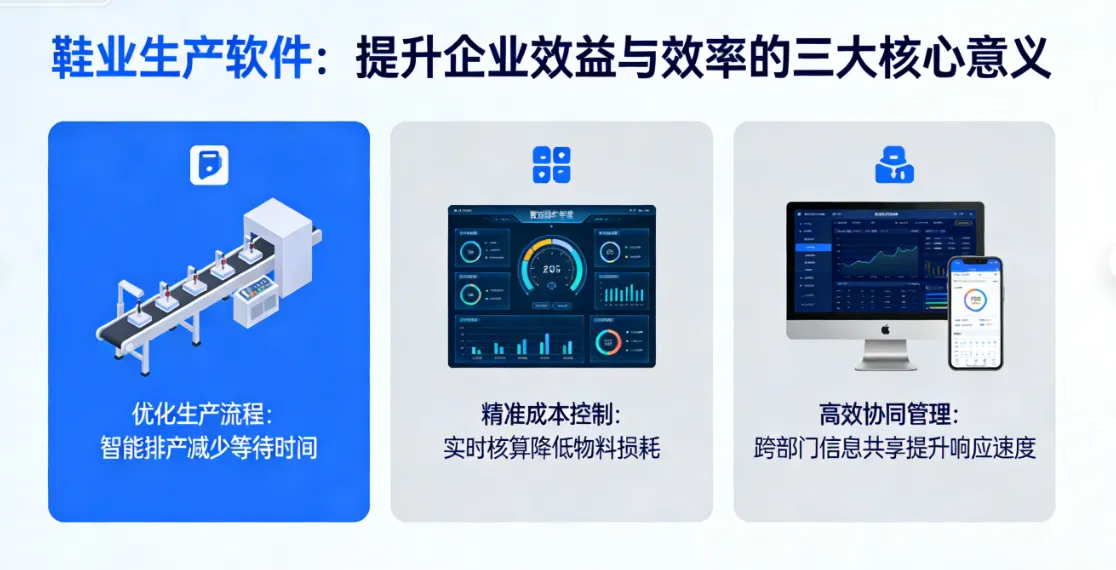
The elimination of implicit waste also has an easily overlooked dimension: time loss. The 20 minute wait for mold delivery during production line changeover, the 15 minute search for materials in the warehouse, and the three hour dispute between finance and sales during month end reconciliation have never been included in standard working hours, but they are truly consuming the effective production capacity of the enterprise. Shoe production software systematically compresses and reduces these discrete time losses through modules such as location navigation, automatic scheduling, and business finance integration. After a men's shoe brand in Wenzhou launched its software, the waiting time for work in progress in the cutting and sewing workshops decreased by 41%, which is equivalent to releasing an additional production line with an annual output of 80000 pairs without increasing equipment and personnel.
The third core significance is to make implicit knowledge explicit and transform it into organizational assets. The footwear industry is a typical skill dependent industry, and the vision, feel, and experience of experienced craftsmen are the most valuable assets and vulnerable weaknesses of enterprises. A skilled cutting worker can determine the optimal layout direction from the trend of the leather texture, a molding team leader can predict the peeling strength of the shoe sole from the fluctuation of the vulcanization curve, and a procurement manager can judge whether there may be a delay in delivery from the tone of the supplier's response. These abilities cannot be written into institutional documents or replicated in bulk through training. They are stored in individuals' minds and are lost with resignation or retirement.
Shoe production software cannot replace the experience of a master craftsman, but it provides a mechanism for precipitating experience into data. The system records the supplier, incoming batch, cutting loss rate, and finished product quality performance of each batch of leather materials. After six months of data accumulation, procurement decisions are no longer based on relationships, but on historical data to evaluate which supplier's leather has a lower shrinkage rate in a specific season. The system records the standard and actual working hours for each process, and through continuous comparison, process engineers can identify which processes have efficiency bottlenecks and optimize tooling or adjust labor price standards accordingly. After three years of using software, a sports shoe enterprise in Putian has established a process parameter database covering the main shoe types. Newly hired technicians can complete more than 80% of process problem diagnosis by calling historical data, significantly reducing their dependence on senior engineers.
The higher-order form of knowledge explicitization is the evolution of a system from a passive recorder to an active proposer. When a newly developed running shoe enters the sampling stage, the system automatically prompts based on historical data that another shoe with a similar structure has generated a batch of customer complaints due to insufficient stitching strength of the tongue anti deviation piece. It is recommended to add reinforced stitching in the process sheet. This is not the magic of artificial intelligence, but the embedding of past accumulated experience into business processes in the form of rules, so that historical lessons are no longer repeatedly forgotten. A shoe company in Suixian County, Henan Province, which has transformed from traditional OEM to its own brand, relied on this mechanism to increase the first-time trial production qualification rate of new shoe models from 67% to 89% within two years. Their R&D director said a thought-provoking sentence: In the past, we relied on capable people, and when capable people left, experience was also taken away; The capable people are still those capable people now, but their experience remains in the system.
The three core meanings of footwear production software correspond to the fundamental dimensions of enterprise competitiveness, namely decision quality, operational efficiency, and organizational capability. It does not promise to make a loss making factory profitable immediately, nor does it promise to let outdated management take off overnight. Its value lies in the fact that when business managers feel confused when looking at the profit and loss statement at the end of the month, the system can tell them where the problem lies; When enterprises want to replicate successful experiences and explore new markets, the system can provide transferable management templates; When companies need to quickly adjust to market fluctuations, the system can shorten the time delay from perception to response.
The shoes, which have gone through hundreds of hands from the cutting machine to the packaging line, have never changed their physical form. What changes is the speed of information flow around it, the density of facts that decision-making relies on, and the efficiency of recording, inheriting, and reusing experience. The significance of shoe production software ultimately boils down to three sentences: making the right decisions happen earlier, reducing ineffective consumption, and preventing valuable experience from being forgotten. Behind these three sentences is the inevitable path for the footwear industry to move from manual workshops to modern manufacturing, and from experience management to data governance.