
Shuntong Software ERP: Integrated Solution for Shoe Industry Production, Supply and Marketing
In the footwear industry, the three words' production, supply, and sales' have never been independent functions, but rather the three most tightly interlocked gears on the same chain. If the procurement is delayed for one day, production will have to stop and wait for materials; The production line made a mistake and the warehouse immediately accumulated thousands of pairs of finished products; The promised delivery time for sales orders ultimately depends on when the purchased fabric arrives at the port and when the sewing machine goes offline. However, the management software of the vast majority of shoe companies precisely separates these three functions into information islands that do not communicate with each other. The procurement department uses a set of inventory management, the production department has a piece rate payroll system, the sales department keeps an Excel order ledger, and the finance department manually reconciles the three sets of data at the end of the month. This kind of fragmentation is not a lack of technical ability, but a misunderstanding of "integration" - true production, supply, and marketing integration is not about stuffing three modules into the same software interface, but about allowing the four types of information - orders, materials, production capacity, and funds - to flow on the same digital track without distinction. Shuntong Software's ERP integrated solution for shoe production, supply, and marketing has re established the operational logic of shoe enterprises along this track.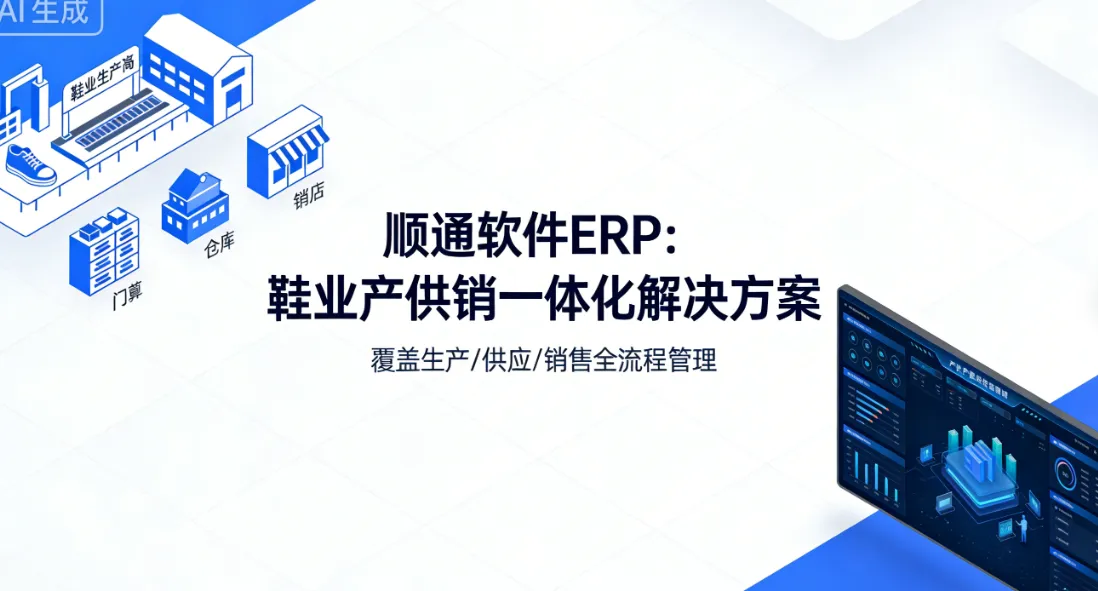
Shuntong has set the starting point for the integration of production, supply, and marketing at the most easily overlooked stage of receiving orders. In the traditional mode, salespeople only care about what customers want, how much they want, and when they want it when entering orders. As for whether the warehouse has fabrics, whether the production line has capacity, and whether the procurement team can replenish them in time, that is the responsibility of production management and procurement. The order review meeting is held twice a week, during which sales were criticized by procurement and production, and the delivery commitment was changed by three rounds before it could be sent to customers. The order taking model of Shuntong ERP has completely changed this game structure. At the same time as the salesperson enters the order requirements in the system, the system runs real-time material requirement verification and capacity load verification: Is the inner leather inventory required for this shoe sufficient? How many days is the procurement cycle for the insufficient part? What is the next week's load rate for the second line of molding? Can you squeeze out 36 hours? Within ten seconds, the system will provide a promised delivery time and automatically lock in the required materials and production capacity. After a snow boot export enterprise in Cixi applied this function, the order review meeting was completely cancelled, and the salesperson directly quoted the delivery time to the customer, reducing the overdue rate from 23% to 6%. This is not about salespeople becoming stronger, but about the system projecting the constraints of the supply and production sides in real time onto the demand side.
The core proposition of the supply side is never to issue purchase orders, but to ensure that each batch of purchased materials accurately matches the time and quantity windows of the production plan. The complexity of shoe material procurement far exceeds that of general manufacturing industry - genuine leather needs to be dyed in batches according to the order color, rubber outsole mold scheduling is limited by vulcanization machines, and auxiliary packaging materials often share inventory with multiple orders. The procurement collaboration module of Shuntong ERP designs material requirement planning and supplier lead time management as a closed-loop system. The system automatically calculates the net material demand for the next four weeks on a daily basis, generates purchase orders based on supplier quotas, and pushes them in real-time through the supplier portal. After the supplier confirms the delivery date, the system automatically marks the batch of materials as in transit inventory and includes them in the main production plan for complete verification. More importantly, there is an abnormal warning mechanism: when a supplier confirms a delivery date later than the order demand date, the system automatically pushes a delay warning to the purchaser and synchronously affects the calculation of the promised delivery date for the order. After applying this mechanism in a sports shoe factory in Jinjiang, Fujian, the number of production line shutdowns caused by material delays decreased by 70%, and the procurement staff transformed from firefighters chasing orders and urging goods to supplier performance analysts.
The role of the production end in the integrated architecture is no longer an isolated cost center, but a dynamic buffer that connects supply and demand. Shuntong ERP has upgraded the production schedule from fixed scheduling to rolling scheduling. Every morning, it automatically refreshes the process level dispatch tasks for the next 72 hours based on the latest order priority, material arrival progress, equipment maintenance plan, and personnel attendance status. The leader of the molding production line opened the system dashboard this morning and saw not a fixed weekly plan, but real-time adaptation of the batch of Oxford cloth that was just confirmed to arrive at the port last night, the brand side flip order that was temporarily inserted this morning, and the sudden temperature controller failure of the vulcanization No. 3 machine. After a men's shoe brand factory in Wenzhou launched a rolling schedule, the response time for emergency insertion orders was reduced from half a day to 40 minutes, and the average waiting time for product line replacement was reduced by 35%. This flexibility is not achieved by workers working overtime, but by the system adjusting the production pace and material pulse to the same frequency.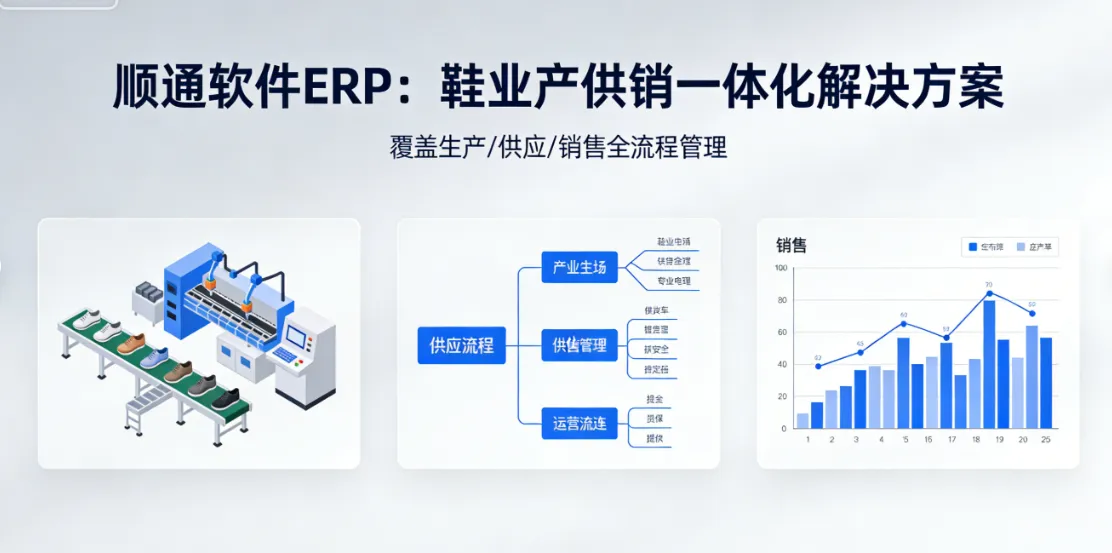
The closed-loop integration of production, supply, and marketing ultimately returns to the value realization stage of finished product inventory and sales performance. Shoe finished product inventory is a typical "three-dimensional maze" - the same style of black, white, and brown colors, each color splitting from size 36 to size 44 into nine sizes, with hot selling sizes out of stock and unsold sizes piling up at the same time. Under the traditional replenishment model, salespeople estimate the proportion of each size based on their experience. They cannot catch up with orders during peak seasons when they are high, and discounts cannot be fully applied during off-season clearance. The intelligent replenishment model of Shuntong ERP inputs historical sales data, current inventory levels, in transit orders, and seasonal coefficients into the algorithm engine, automatically generating replenishment suggestions for each store, channel, and size on a daily basis. A more advanced application is the linkage between order commitment and inventory reservation: when a customer places an order, the system automatically locks the available inventory for the corresponding size. If the inventory is insufficient, it triggers real-time production or purchase tracking, and automatically reserves a new batch of finished products for the order, avoiding the classic dilemma of "inventory on paper but missing codes on delivery". After a children's shoe e-commerce enterprise in Huizhou, Guangdong connected to this module, the out of stock loss decreased by 41%, and the turnover of unsold inventory increased by 1.8 times.
Financial accounting is the ultimate judge of the value of integrated production, supply, and marketing. In the traditional mode, purchase invoices, production work orders, and sales delivery orders are circulated separately in three systems. At the end of the month, the finance department manually matches three Excel sheets, and the differences cannot be explained clearly, resulting in mutual responsibility shifting. Shuntong ERP integrates the granularity of business and finance into every purchase receipt, every production material requisition, and every sales outbound order. The estimated payable is generated at the moment of scanning the warehouse code for storage, the actual cost is collected at the moment of completion of the production work order, and the accounts receivable and cost transfer are confirmed at the moment of sales outbound confirmation. After applying this architecture, a shoe company in Cixi has compressed its monthly billing cycle from seven days to two days. Financial personnel have transformed from data loggers to business analysts and are now able to answer the most fundamental questions from management: which shoes make real money, and which shoes only make a pile of inventory.
Shuntong Software's ERP integrated solution for shoe production, supply, and marketing has never claimed to be able to eliminate all breakpoints. It only acknowledges a simple fact: all the difficulties in the footwear industry are essentially caused by the distortion, delay, and loss of information transmitted between different functions, systems, and individuals. Purchasing doesn't know which explosive product sales will launch next week, production doesn't know that the batch of genuine leather in the warehouse has been stored for 18 months, and finance doesn't know that the vulcanizing machine on the molding production line has been idle for 400 hours. What Shuntong has done is simply to pave a digital highway without traffic lights for this information, starting with orders and ending with cash, flowing continuously between all stations with the same standards, speed, and format.
The European order that was cancelled by the customer at Cixi Women's Shoe Factory was later taken over by another factory that also uses Shuntong ERP. The salesperson did not bargain when reporting the delivery date, and the system displayed 42 days. The customer asked if it could be done within 38 days. The salesperson clicked the mouse again, and the system ran the materials and production capacity again. The cost of 38 days was a 0.4 dollar increase in shipping costs per pair. The customer accepted. No one went to the warehouse to search for materials, no one went to the workshop to collect orders, and no one went to the finance department to inquire about prices from beginning to end for this business. The three gears of production, supply, and sales bite quietly, as they should have.