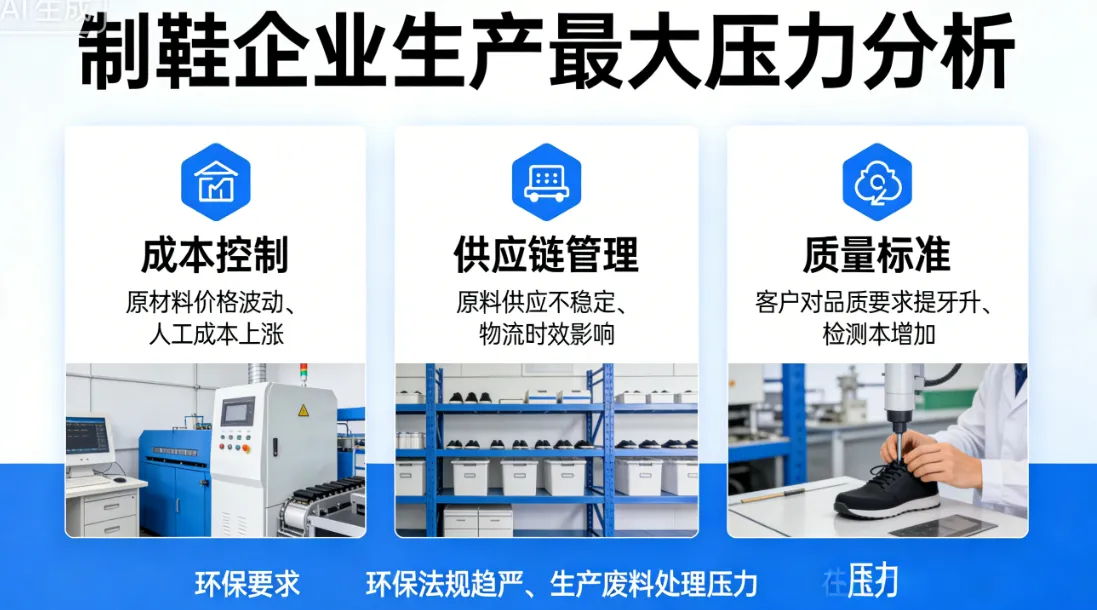
What is the biggest pressure for shoe manufacturing enterprises to produce?
In the footwear industry, anxiety is a daily air. At the beginning of the month, I was still worried about insufficient orders, but suddenly three urgent orders flooded in mid month. At the end of the month, I found that despite being busy for thirty days, my profit was as thin as a blade. But when asked what frontline managers - the factory directors, team leaders, and planners who shuttle through cutting, sewing, and molding workshops every day - fear the most, the answers are often surprisingly consistent: it's not that there are too few orders or the unit price is too low, but that even though all links are running, they don't know which node will fall off in the next second.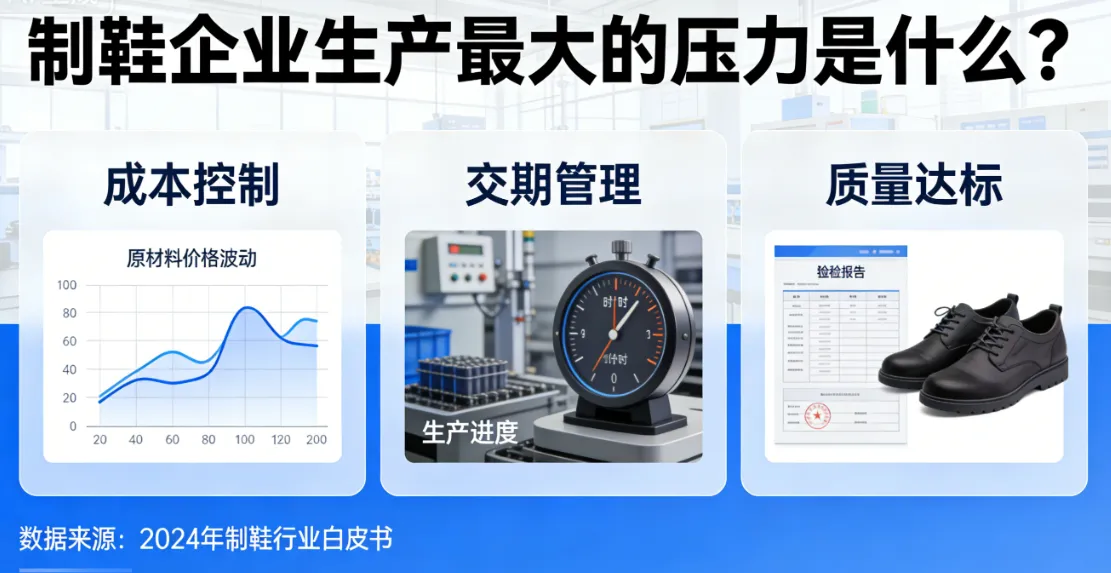
This kind of pressure cannot be quantified by a single indicator, but it is the real background of production management in shoe manufacturing enterprises. It is not delivery pressure, because delivery pressure is at least clear - which day to ship, how many days are left, how much is still missing, these are all measurable goals. It is not a cost pressure, and cost pressure is also measurable - material consumption, labor hours, manufacturing costs, each of which has an accounting caliber. The real greatest pressure comes from the incalculable abyss behind these computable goals: uncertainty.
Uncertainty first lurks in the material. The complexity of the shoe material supply chain far exceeds the imagination of outsiders. Natural leather is purchased according to size, but there may be visible color differences between different batches of the same leather material. The cutting workshop must strictly follow the cylinder size ratio, otherwise the finished shoes will present awkward shades in the hands of customers. The rubber outsole relies on vulcanization molds, and the complexity of mold scheduling and vulcanization machine binding is no less than a precise domino scheduling. What's even more tricky is the unpredictability of suppliers - the Oxford cloth that was promised to arrive at the port today may still be floating at sea, and the glue factory that promised to ship next week suddenly received an environmental production restriction notice. A production manager at a sports shoe factory in Jinjiang, Fujian, has over 70 suppliers' follow-up phone numbers stored in his phone directory. During peak hours, he makes 80 calls every day, but still cannot prevent the production line from shutting down and waiting for materials. He described the feeling: You never know who will be the next one to stand up.
The ultimate form of material uncertainty is that inventory accounts never match reality. The book shows sufficient information, but the physical item is missing codes and colors; The system confirms that it is in stock, but the warehouse keeper cannot find it after searching through the shelves. This is not a matter of management attitude, but rather the manual mode is simply unable to withstand the dimensional explosion of shoe warehouses - thousands of types of materials, dozens of size matrices, several cylinder number batches, and dynamically changing warehouse location adjustments. The end of month inventory has become a battlefield between finance and warehouse management, with unclear explanations for differences and shifting of responsibilities, ultimately resulting in customary provision of losses. That loss figure is a tool for balancing accounts, but it never answers the most fundamental question: where did those missing fabrics go.
The second battlefield of uncertainty is on the production line. The production scheduling of the footwear industry is a typical nonlinear problem. The same production line may flow three to five styles simultaneously, with significant differences in process time, equipment requirements, and worker skill levels for each style. Even more fatal is the hard constraint of the process sequence - the stitching of the shoe upper must be done before the sole is attached, otherwise the semi-finished products will be piled up at the entrance of the molding workshop waiting for rework; It takes forty minutes for the vulcanization tank to heat up, and temporarily inserting an urgent order means that the previous batch of products may have been over sulfurized. Traditional production scheduling relies on the personal experience of production managers, and the boundaries of experience are clear: a person can track no more than thirty orders simultaneously, and can accurately remember no more than twenty process constraints. When the daily number of work orders exceeds fifty, production scheduling turns from planning to gambling. The production manager of a certain men's shoe brand in Wenzhou admitted that the first thing I do every morning is to guess which link will be blocked today.
The uncertainty of the equipment is equally hidden. The aging of the temperature controller of the vulcanizing machine, oil leakage of the hydraulic valve of the cutting machine, and overload of the servo motor of the computerized needle car, these faults will not be notified in advance, but will occur on time during the most tense shipping week. What's even more tricky is the isolated island of equipment status information - the maintenance department knows the cause of the malfunction, but the workshop director doesn't know the expected repair time; The operator felt a strange noise from the machine and reported it, but it sank into the sea. A shoe factory in Putian, Fujian Province, was once delayed in delivering 20000 pairs of sports shoes due to a malfunction of a molding assembly line frequency converter that was not detected in a timely manner, resulting in a four hour shutdown of the entire production line. After tracing back, the abnormal symptoms of this device were recorded during the inspection half a month ago, but the paper documents were left unattended at the bottom of the filing cabinet.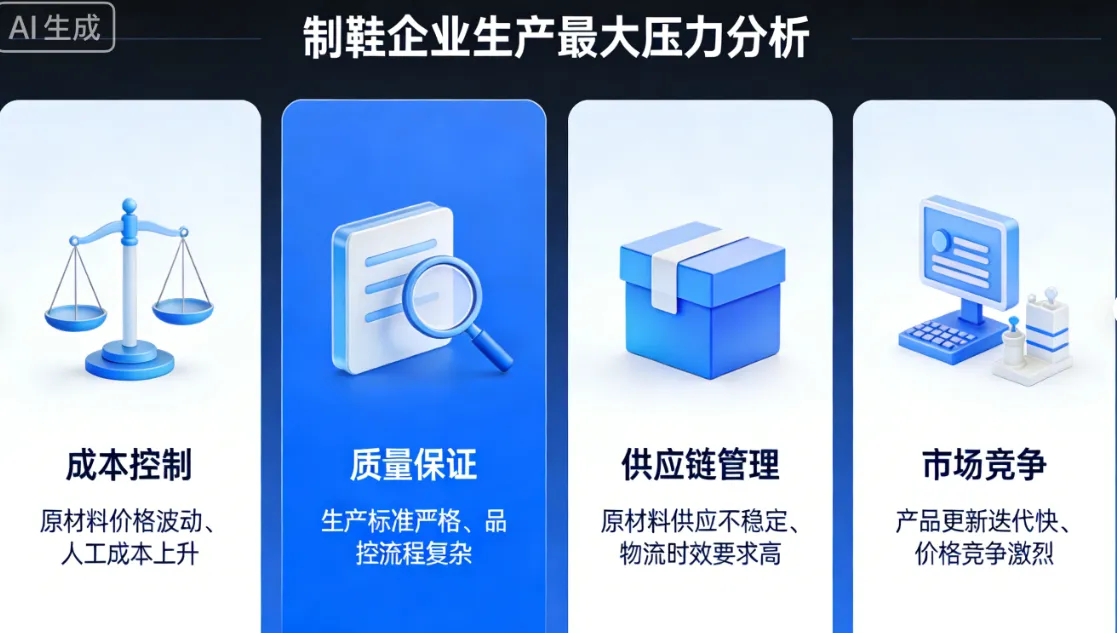
Quality risk is the third type of uncertainty and the most unpredictable source of stress. The quality defects in the footwear industry are rarely manifested as whole batch scrap, and are more scattered, occasional, and difficult to reproduce - a certain pair of shoe uppers have stitch skipping, a certain batch of shoe soles have low peeling strength, and a certain order has excessive residual glue odor. Traditional quality management relies on finished product inspection and customer feedback. Defects have already occurred and costs have sunk, but the reasons remain a mystery. A women's shoe OEM factory in Huizhou, Guangdong once faced a devastating blow of full container return due to a batch of exported snow boots being detected with excessive formaldehyde at the destination port. During the three days from receiving the notification to determining the scope of the recall, no one was able to answer the most crucial questions: how many pairs of problematic batches are there, which channels are being sent to, and whether there are any hidden inventory in the warehouse. The quality control manager searched through six months of inspection records and found that the supplier's batch number could not be associated with the production work order, resulting in an omni channel recall. The loss of that batch of goods was not determined by the quality issue itself, but by the amplification of information gaps.
The common essence of these uncertainties is that information is distorted, delayed, and lost during the transmission process. The purchaser was aware of the supplier's delayed shipment, but by the time the production manager received the updated delivery date, the schedule had already been executed for two hours. The workshop leader discovered an abnormal efficiency in a certain process, but when the process engineer received feedback, the defective product had already flowed into the production line. At the end of the financial month, cost overruns were calculated, but it is no longer possible to trace which order, process, or material was exceeded. The information lag of each node itself is not fatal, but the accumulated lag of thousands of nodes forms a fog that envelops the entire production system. Managers make decisions in this fog based on experience, intuition, and luck.
The biggest pressure on shoe-making enterprises' production is never a specific problem, but the uncertainty of how the problem will manifest, at what time, and at which stage it will explode. This pressure does not erode production capacity, costs, or even profits - it erodes managers' sense of control over the enterprise. When production managers no longer believe that their plans can be executed, when factory managers are no longer confident that monthly reports reflect the real situation, and when bosses find that the information they have is always three days behind reality, that is the deepest anxiety in the digital age of the footwear industry.
The black tire leather that had been stored at the bottom of the warehouse for 28 months, with a book value of 110000 yuan, is no longer suitable for mass production. It is never an isolated case of procurement decision-making errors, but a microcosm of the slow accumulation of uncertainty and eventual solidification into silent assets in the traditional production mode of the footwear industry. It exists on the top shelf of every factory, in the system ledger, and in the financial provision for losses. It is visible inventory, but also invisible pressure.
Resolving this pressure does not require more diligent pursuit of orders, stricter assessments, or more complex Excel formulas. What is needed is to transform the information hidden in everyone's brain, on every paper document, and in every phone conversation into data that is fluid, aligned, and traceable. When the purchase order and production schedule are verified in real-time in the same system, when equipment operating parameters are automatically associated with quality inspection records, and when cost differences can be traced item by item at the moment of order completion, that fog will begin to dissipate. This is not technological supremacy, but the most honest response to the production pressure in the footwear industry - we cannot eliminate all uncertainty, but we can expose uncertainty in advance, accurately pinpoint it, and respond quickly.
This is the true proposition of production management in shoe-making enterprises: not to fight against uncertainty, but to lay the track for certainty.