
Shuntong Footwear ERP Management Software - Solving Production Management Problems in Footwear Enterprises
At a medium-sized women's shoe OEM factory in Huizhou, Guangdong, the first thing Chen Jianxin, the production director, does when he arrives at the office every morning is not to read reports or attend meetings, but to go around the workshop. He needs to confirm with his own eyes whether the cutting machine has started on time, whether the shoe uppers for the urgent orders on the sewing line have been delivered to the molding workshop, and whether the batch of black sheepskin that arrived in the warehouse yesterday has been inspected. Fifteen years of work experience have taught him a skill - to judge where there are blockages, material shortages, and potential delays in delivery based on the accumulation of semi-finished products on the production line. But this skill is becoming ineffective. The orders are becoming increasingly fragmented, with more and more styles and colors available, and the frequency of product changes has increased from twice a week to three times a day. He takes forty minutes to walk one lap, and during these forty minutes, the production line may have changed to a new shoe design.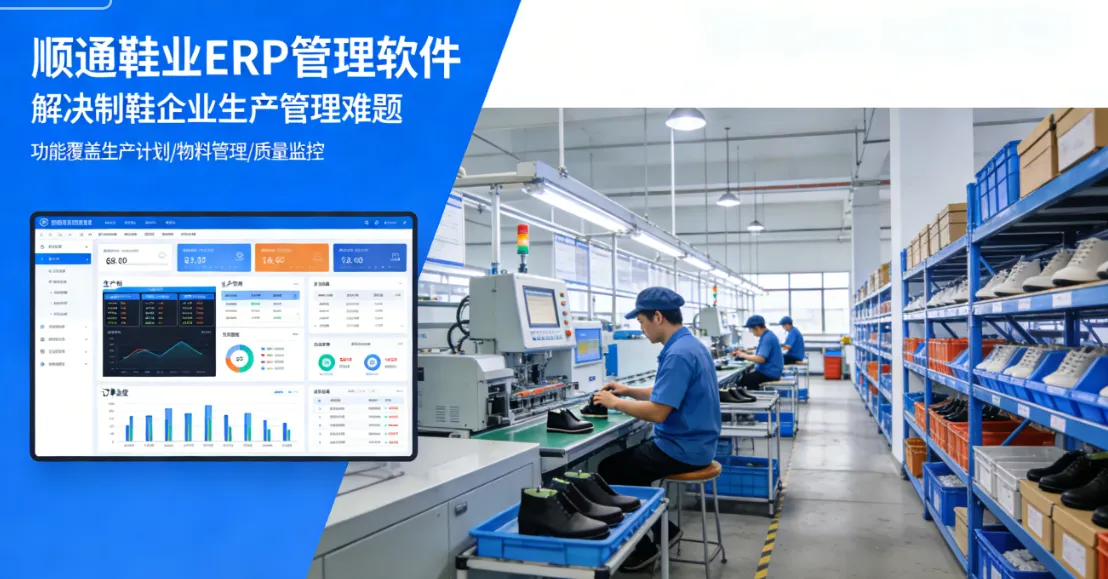
Chen Jianxin's predicament is the core proposition that Shuntong Footwear ERP management software aims to solve. The production management challenges of shoe-making enterprises have never been isolated, they are interwoven dominoes - the disconnect between materials and plans, the disconnect between plans and production capacity, the disconnect between production capacity and schedule, and the disconnect between schedule and cost. The problem-solving approach of Shuntong software is not to straighten each card, but to start from the first card and lay out the entire arrangement of tracks.
The most painful first card in production management is the uncertainty of materials. The entry point of Shuntong Footwear ERP is not to teach procurement personnel how to urge goods, but to make the material status visible, calculable, and predictable in real-time in the system. Scan the supplier batch number and cylinder number when each batch of genuine leather is stored, and the system automatically associates the purchase order and generates an internal traceability code; When picking up materials in the cutting workshop, scan the code to verify whether the cylinder number matches the process sheet. The risk of color difference is intercepted in the material issuing process rather than the finished product inspection process; The material complete set verification module runs automatically every morning, comparing the planned work orders for the next 72 hours with the current inventory, in transit procurement, and online semi-finished products one by one. The complete set of work orders is converted to a schedulable state, and the incomplete set of work orders is alerted to the purchaser. After a certain men's shoe brand in Wenzhou applied this module, the number of production line shutdowns caused by material delays decreased by 70%, and Chen Jianxin no longer had to ask every day whether the batch of sheepskin had arrived.
The second deepest card in production management is the complexity of scheduling. The production line of the footwear industry is not an assembly line, but a flexible unit with multiple varieties, small batches, and frequent product changes. The same molding production line may run vulcanized shoes in the morning and switch to cold bonded shoes in the afternoon, with completely different process durations, equipment molds, and personnel skill requirements for the two shoe types. Traditional scheduling relies on the personal experience of production managers, and the capacity limit of experience determines the management ceiling of the factory. The advanced scheduling engine built into Shuntong Footwear ERP comprehensively weights dozens of parameters such as order delivery time, material completeness status, equipment load, mold availability, and team expertise in process types to generate executable daily dispatch plans within five minutes. More importantly, it has the ability to dynamically rearrange - when a supplier notifies of a two-day delay in material delivery, the system automatically shifts the affected orders back and synchronously refreshes the start time and completion expectations of subsequent processes, pushing a deadline change warning to the sales end. After applying dynamic scheduling in a sports shoe factory in Jinjiang, Fujian, the response time for emergency insertion orders was compressed from half a day to 40 minutes, and the average waiting time for product line replacement was reduced by 35%.
The most hidden third card in production management is the black box of progress. The workshop director receives more than ten follow-up calls on his phone every day, each asking the same question: Where has my batch of goods arrived now. Chen Jianxin knows the answer, but his answer is always estimation - according to normal progress, it should be in the needle car if the auxiliary materials are not stuck. The electronic work order system of Shuntong Footwear ERP decomposes each production work order into process level tasks. After each worker completes a process, they scan the code to confirm, and the system updates the current process, cumulative working hours, and estimated remaining time of the order in real time. The manager's mobile phone can retrieve the production trajectory of any order at any time, just like querying express logistics, which is intuitive. The more important thing is not to be queried, but to trigger anomalies automatically - when the dwell time of a certain process exceeds 1.5 times the standard working hours, the system automatically pushes a timeout warning to the team leader, rather than accidentally discovering it while waiting for the factory manager to patrol the line.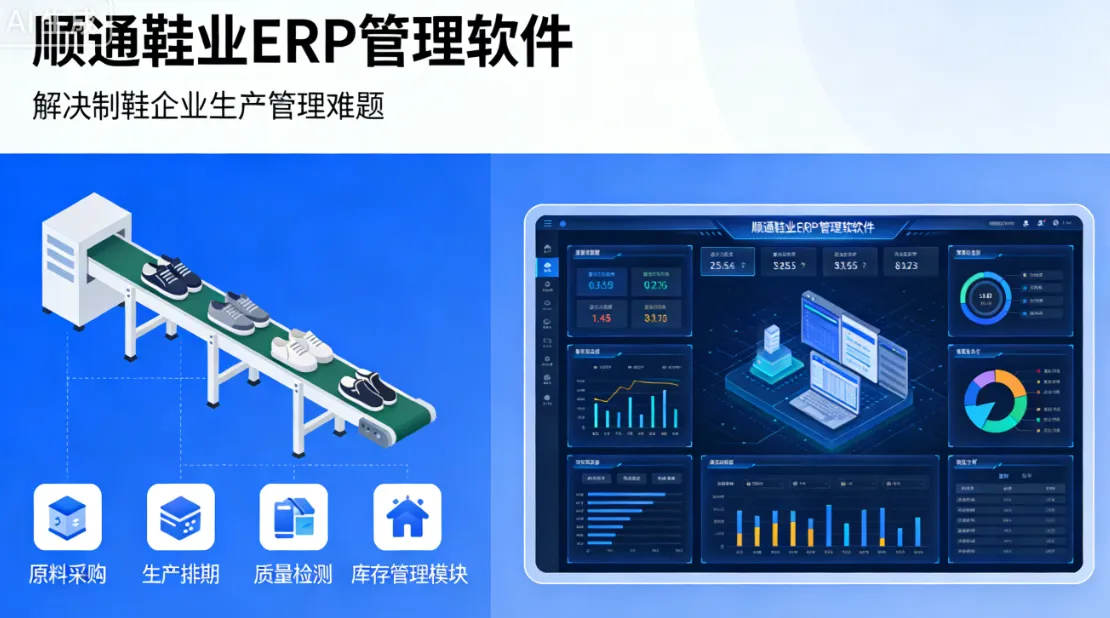
The fourth most expensive card in production management is post accountability for quality. Customer complaints in the footwear industry are often not about whole batches being scrapped, but rather about discrete, occasional, and difficult to reproduce defects. In the traditional mode, when a customer returns a pair of open rubber shoes, the quality control officer needs to manually review the material requisition records, process flow sheets, and inspection reports from six months ago, which takes several days. The cost of tracing is even higher than the cost of restocking. Shuntong Footwear ERP establishes a unique electronic quality file for each pair of finished shoes, linking the raw material batch, each process operator, each quality inspection parameter, vulcanization curve, and glue ratio to the finished product traceability code. When customers return goods, they scan the QR code of the shoe box, and the system completes the reverse traceability from finished products to raw material batches, from quality issues to responsible processes within fifteen minutes. A foreign trade shoe company in Jiangsu once had a batch of snow boots with excessive adhesive residue detected in the export destination country. The Shuntong traceability module locked the problem batch, which only involved three furnaces of vulcanized products, to avoid catastrophic losses caused by the return of the entire container of goods. The recall scope was precisely controlled at 240 pairs.
The silent fifth card of production management is the true collection of costs. The biggest headache for shoe companies' finances is not the inability to calculate the total cost, but the inability to determine how much gross profit each shoe, order, and customer contributes. The price of genuine leather fluctuates weekly in the international auction market, and cutting losses vary from person to person due to layout density. The steam energy consumption of the molding production line is difficult to accurately segment by product. Traditional cost accounting adopts a weighted average at the end of the month, which divides all differences into total costs, and confuses best-selling items with low profit items. Shuntong Footwear ERP introduces order level cost accounting, which automatically collects the actual material requisition cost, actual labor hours, equipment depreciation, and energy consumption allocation upon completion of each production work order, and compares the standard cost in real time. After a shoe company in Cixi launched its system, it was discovered for the first time that the actual cost of a classic sandal that it had been taking orders for years was 12% higher than the quoted price. The crux of the problem was that the manual bead decoration process had never been separately accounted for in terms of working hours, and the actual cost had been concealed by the average labor price of needle workers.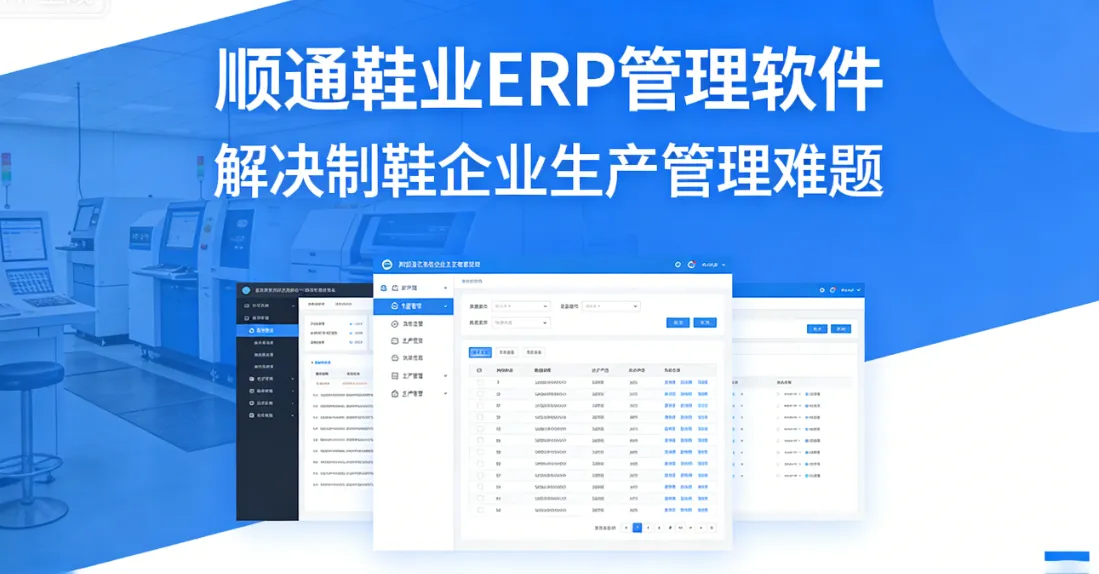
Shuntong Footwear ERP management software has never claimed to be able to eliminate all accidents in solving production management problems. Order insertion, equipment malfunctions, supplier delays, and personnel turnover continue to occur every day. The real change is that accidents are no longer sudden attacks in the information black box, but warnings issued by the system in advance; Accountability is no longer a mutual buck passing at the conference table, but a traceable, attributable, and modifiable management loop. Chen Jianxin still goes to the workshop every morning to take a tour, but he is no longer there to confirm if the production line is blocked, but to verify whether the system warning is consistent with his own visual observation. In the past six months, he has lost to the system more and more times, but he thinks this is a good thing - it means he no longer has to rely on a pair of eyes to stare at the entire production line.
Those eyes that have been circulating on the production line for eighteen years can finally be lifted up to look further away.