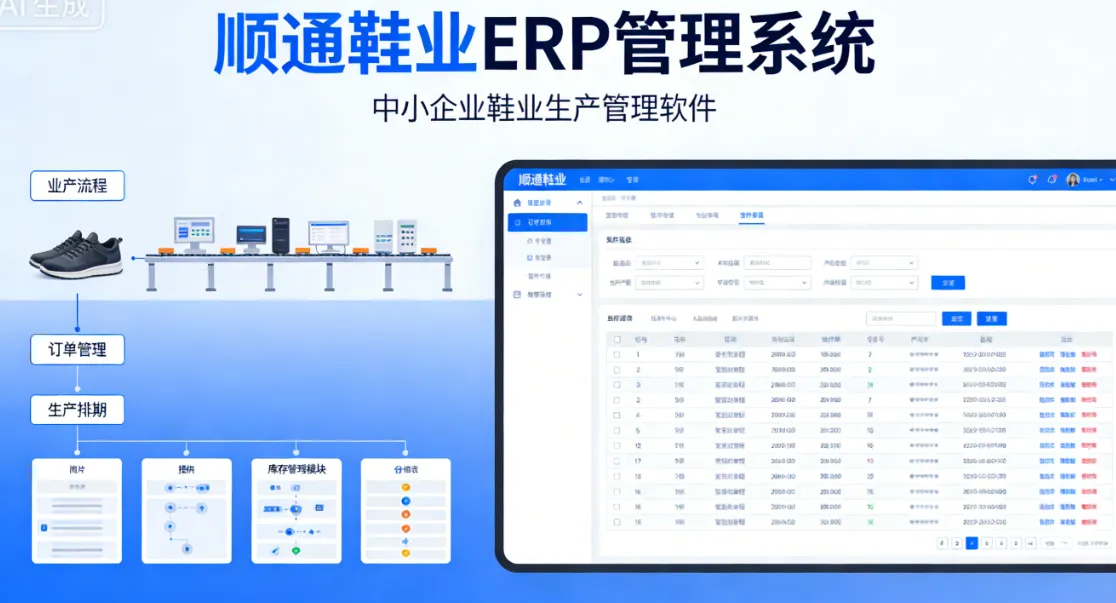
Shuntong Footwear ERP Management System - Small and Medium sized Enterprise Footwear Production Management Software
In Chenjiang Town, Huizhou, Guangdong, there are hundreds of small and medium-sized shoe processing factories with varying scales. Li Ming's factory is one of the most typical ones: five molding production lines, 130 workers, mainly engaged in women's shoe foreign trade OEM, with a monthly production capacity of 40000 pairs during peak season and only 20000 pairs during off-season. Over the past eight years, he has relied on a set of Excel templates and three skilled order clerks to maintain operations. Last autumn, the biggest client compressed the turnover cycle from 30 days to 18 days, and his Excel crashed - it wasn't a software crash, it was a human crash. The fabric has not been fully purchased yet, and the production line has been idle for half a day; After finally arranging the shipment, the customer said the color was incorrect; At the end of the month, despite being busy for the whole month, the profit is even thinner than the off-season. Li Ming's story is replayed every day in the shoe-making clusters of the Pearl River Delta, Wenzhou, and Chengdu. The Shuntong Footwear ERP management system was born in response to the small and medium-sized enterprises that were rejected by the digital solutions of large enterprises.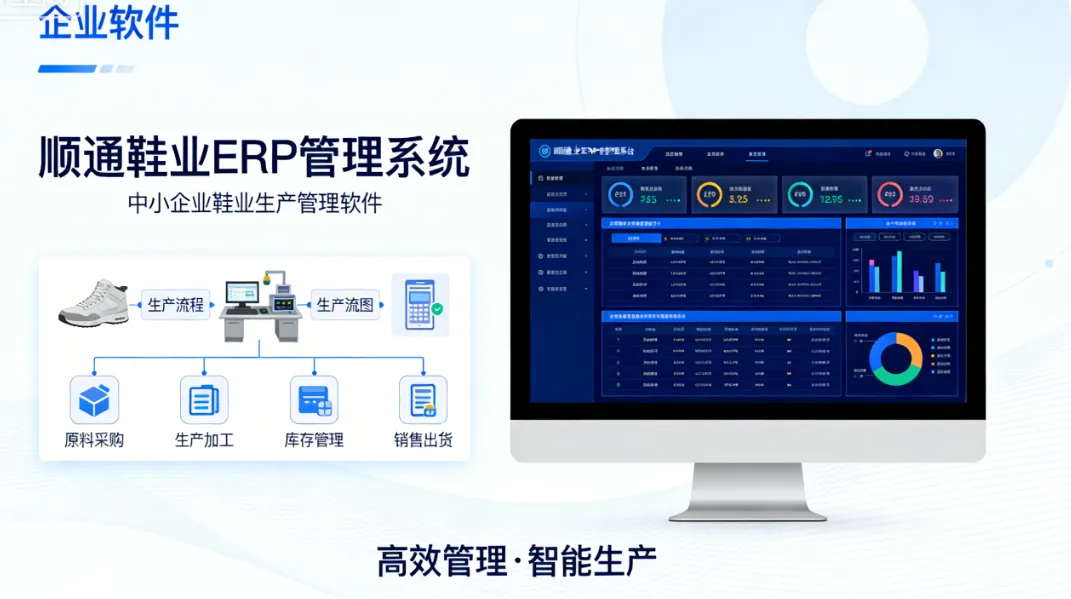
The first hurdle in the production management of small and medium-sized enterprises in the footwear industry is never insufficient functionality, but rather a high threshold for activation. For a shoe factory with an annual output value of 20-30 million yuan, software licensing fees of hundreds of thousands, implementation cycles of more than six months, and the need to hire IT specialists for operation and maintenance costs are psychological accounts that decision-makers cannot cross. The product logic of Shuntong Footwear ERP has diverged from that of general ERP from the beginning: it does not pursue comprehensive functional coverage, but rather grinds the four most core and painful scenarios of footwear production - order scheduling, material control, process reporting, and cost accounting - into lightweight, subscription based, standardized modules that can be launched within two weeks. When Li Ming's factory launched the Shuntong system, there was no shutdown training or dedicated IT. The implementation consultant stayed on site for four days with a set of templates pre-set with basic shoe industry data. The cutting workshop began scanning codes for material requisition, and the molding line leader reported work on their mobile phone. On the seventh day, the finance department saw the first actual cost report collected according to the order.
Order scheduling is the most chaotic battlefield for production management in small and medium-sized enterprises. Li Ming's method of scheduling production in the past was to hold a meeting with the production manager, purchaser, and workshop leader. Three Excel spreadsheets were projected onto a white wall, and everyone relied on their memory and intuition to determine which order could be inserted and which material was about to arrive. A 30 minute meeting can be scheduled for three days, but someone came to change the plan in the afternoon of the first day - the agreed fabric has not arrived at the port, and urgent orders from customers need to be advanced. The Shuntong system simplifies the scheduling engine into two core models: material complete set verification and capacity load verification. When the salesperson enters a new order, the system automatically captures the inventory of materials and in transit purchases for that shoe type, and reads the remaining working hours pool of the molding production line for the next seven days. Within ten seconds, it provides feedback on the earliest possible start date and expected completion date. Production managers no longer need to keep up with the progress of procurement inquiries. The system refreshes the material shortage list in the early morning every day and pushes it to the purchaser's mobile phone in order of urgency. A sports shoe OEM factory with an annual output value of 18 million yuan in Jinjiang has reduced its order overdue rate from 31% to 11% after applying a scheduling module. During a gathering of Li Ming's colleagues, someone began to ask: What system are you using.
Material control is the area where the gap between small and medium-sized enterprises and large-scale enterprises is most significant. Large factories can build automated warehouses, install RFID, and maintain a team of ten people for warehousing, while small factories only have warehouse keeper Lao Zhang and the stack of purchase orders in his hand. The complexity of shoe materials is magnified to the limit in small and medium-sized enterprises - genuine leather procurement is priced by feet, but actual consumption is greatly affected by layout density and defect distribution; The effective use period of glue after opening the barrel is only six months, and Lao Zhang cannot remember the date of storage of each barrel. It is common for new barrels to crush old barrels. The material module designed by Shuntong Footwear ERP for small and medium-sized enterprises is not about precise inventory, but about establishing a simple batch order. Each batch of fabrics, adhesives, and accessories is required to register the production date or storage date when they are received. The system allocates the issuing warehouse location based on the first in, first out principle. If the warehouse keeper skips the recommended batch when scanning the code for material requisition, a warning will pop up on the handheld terminal and an exception will be recorded. After a certain men's shoe factory in Wenzhou applied this function, the amount of expired and scrapped glue decreased from an average of 60000 yuan per year to 8000 yuan. Lao Zhang said he finally didn't have to rely on smelling to determine which bucket to use first.
Process reporting and piece rate wages are the most emotionally charged aspects of production management in small and medium-sized enterprises. In the traditional mode, after a worker completes a process, the team leader checks the paper work tickets. At the end of the month, the statistician enters thousands of work tickets into Excel, and the worker finds that the output is 200 pairs less. When searching for the work tickets, one-third of them have already been lost. The Shuntong system implants electronic work tickets into workers' mobile phones. Workers scan the QR code to start work and report their work upon completion. The system calculates the piece rate wages for the day in real-time, and workers can see how much money they earned today on their phones after work. More importantly, efficiency comparison - the system automatically compares the actual time spent on each process with the standard working hours, and the excess completed is immediately converted into performance bonuses. The lagging processes are automatically highlighted in red on the team leader's dashboard. The leader of a sewing machine at a children's shoe factory in Foshan said, 'I used to urge the workers to speed up, but the workers said I was already the fastest.'; Now the system shows that his efficiency is 18% lower than the average of the same process, and he proactively asked the team leader if the needle should be replaced. This mechanism does not rely on any management language, and efficiency improvement is a natural product of data comparison.
Cost accounting is the last hurdle for small and medium-sized enterprises to move from "doing messy accounts" to "doing clear business". Li Ming used to calculate costs by adding up the total materials, total labor, and total electricity bills at the end of the month, dividing by the total output, to obtain the average cost per pair of shoes. But this number is of no help to him in accepting orders - most of the inquiries from foreign trade customers are for new products, and there is no historical cost to refer to; The old customer requested a 5% discount when flipping through the order, and he doesn't know how much more he can offer. The Shuntong system provides a simplified order level cost collection model for small and medium-sized enterprises: when a production work order is completed, the system automatically captures the actual fabric roll number, glue bucket number, and worker reported work hours used for the work order, while sharing energy consumption costs based on equipment power and operating hours. At the moment when the work order is closed, the system generates a comparison table between the actual cost and standard cost of the batch of products, and automatically pushes an abnormal warning to the factory director if the difference exceeds 5%. Li Ming received the first warning in the fourth week after the system went online: the actual cost of a certain Le Fu shoe was 11% higher than the standard. Tracing back, it was found that the layout density of this batch in the cutting workshop was lower than the conventional value, and the loss of scraps increased abnormally. He adjusted the formatting standards on that day, and the cost fell back to the normal range in the second week. This loss was not discovered until the end of the month inventory, but was locked by the system in the week it occurred.
Shuntong Footwear ERP management system has never attempted to transform small and medium-sized enterprises into standardized large factories. It acknowledges the reality of small factories: workers have low levels of education and cannot operate complex interfaces; The boss has a fast decision-making pace and cannot wait for the report in three days; Cash flow is tight and cannot afford a one-time investment of hundreds of thousands. Therefore, its product form is cloud subscription, mobile first, and can be started in fifteen minutes. Its functional boundaries are also sufficiently restrained - without touching on high-order modules that require massive data support such as automatic scheduling and artificial intelligence prediction, it only solves the four most basic, urgent, and directly profitable problems of material stability, visible progress, accurate wage calculation, and cost estimation.
Li Ming's factory received a trial order from a Spanish customer last week for 3000 pairs of Martin boots, with a delivery time of 42 days. The salesperson completed the material verification and capacity load in the system, and informed the customer that it would take 35 days to ship. The customer asked in surprise: Do you not need to reserve a two-week procurement buffer period? The salesperson said no, the system shows that our fabric supplier has stock and can ship it tomorrow. This order has not gone through any review meeting, and there is not a single paper work order circulating. It takes six minutes from input to confirmation. Li Ming stood at the entrance of the molding workshop, with the daily output bulletin board displayed on his phone screen, with green, yellow, and red progress bars quietly arranged. He can't say if this counts as digital transformation, he just feels that after 20 years of making shoes, for the first time, there's no need to chase after problems every day.