
Shuntong Store ERP System - Shoe and Clothing Store Specific Management Software | Sales, Inventory, Scan Code, Piece Count Financial Management
The shoe leather city in Wenling, Zhejiang, is the busiest time for wholesale business at 3 pm in the afternoon. Wang Xuemei sat behind the cashier at her own stall, with three books spread out in front of her: one for purchasing, one for shipping, and one for the wages of six salespersons. How many pairs of shoes were sold yesterday? She had to ask the store manager first, and the manager asked the warehouse manager. The warehouse manager flipped through a stack of handwritten orders and gave a rough estimate. Calculating commission at the end of the month is even more troublesome - for the same dad shoes, black sells faster, white presses inventory, and the salesperson says white is difficult to promote, so the commission should be higher. Wang Xuemei thinks it makes sense, but she can't figure out exactly how much to give. She has been in the shoe store business for twelve years, and the most tiring thing is not moving goods, but calculating accounts.
Wang Xuemei's predicament is almost a common problem in the footwear and apparel retail industry. The business logic of shoe and clothing stores is completely different from that of convenience stores and hardware stores. A shoe comes in three colors: black, white, and brown. Each color splits into six sizes from size 35 to size 40, with eighteen inventory units corresponding to the same product code. Traditional inventory management software can control product items but cannot control sizes; Can control the total number, cannot control the distribution. The book shows sufficient inventory, but customers always lack the most commonly sold size 37 when trying it on. At the end of the month inventory, the boss was worried about the warehouse full of shoes with broken sizes. Every pair was recorded, but none of them could be sold. The starting point of Shuntong's store ERP system is precisely from this "style color code" three-dimensional maze that breaks through.
Shuntong Store ERP embeds multi-dimensional attributes unique to the footwear and apparel industry into the underlying data architecture. When creating product files, the system no longer uses the universal one item one size logic for inventory, but instead takes style as the root node and automatically derives color branches and size nodes downwards. Scan the supplier tag when purchasing and storing, and the system will automatically split the detailed inventory according to the preset size ratio; When opening a sales order, click on the product icon and the system will directly display the real-time inventory distribution of all color codes for that product. It is clear which code is out of stock and which code is abundant. A time-honored shoe store in Rui'an, Wenzhou, which has been open for 18 years, discovered for the first time after connecting to the Shuntong system that the most serious backlog in their store is not unsold items, but oversized shoes above size 39. The system retrieved sales data from the same period last year, and the boss immediately decided to reduce the proportion of oversized purchases, freeing up funds for two more volume based items. After three months, the overall turnover increased by 27%.
Scanning codes is the most direct way for Shuntong store ERP to integrate efficiency into daily operations. Traditional shoe store cashiers are often equipped with two devices - a barcode scanner to scan the barcode for checkout, and another computer to input the bill of lading. The warehouse keeper also needs to re-enter the inventory changes on the paper bill before leaving work. The Shuntong system integrates all five scenarios of procurement, sales, inventory, transfer, and return/exchange into the same scanning logic. When the goods arrive at the store, the staff scans the barcode on the supplier's accompanying documents, and the system automatically matches the purchase order and generates a warehouse draft. After checking the quantity, one click confirmation is required; When the customer pays the bill, the cashier scans the shoe box tag, and the system simultaneously completes four tasks: sales outbound, inventory update, commission calculation, and printing receipts; When transferring inventory, the outgoing store scans the packaging and the incoming store scans the receipt. The two inventory changes are mirrored and synchronized, and there is no need to manually enter the transfer order. After a chain shoe company in Hangzhou with seven branches applied this module, the daily checkout time for a single store was reduced from an average of 45 minutes to 12 minutes, and the number of warehouse keepers was reduced from three to one. The freed up manpower was transferred to online customer maintenance.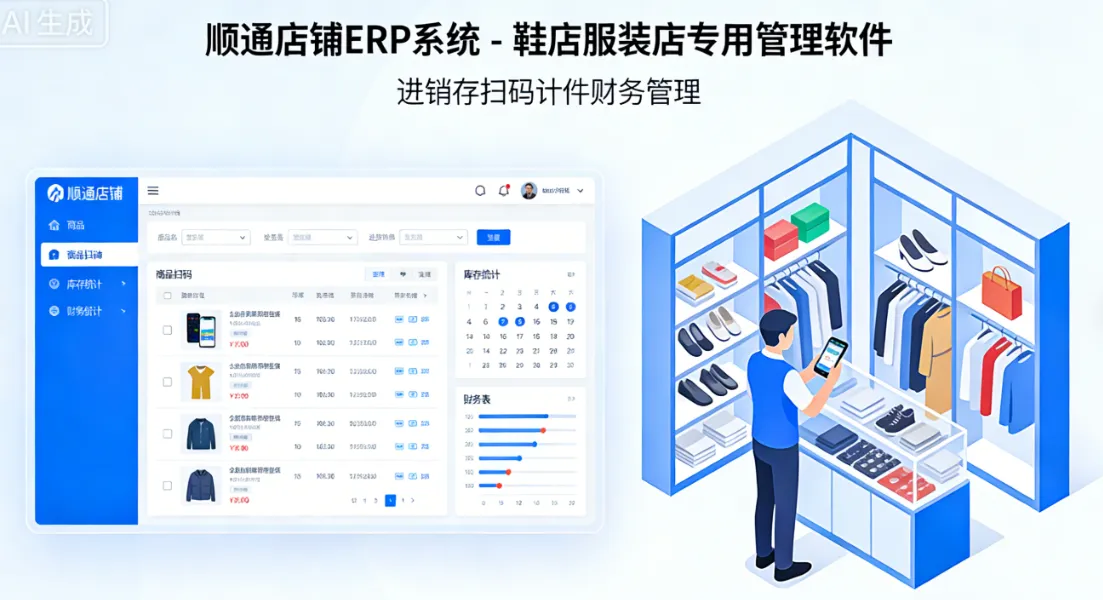
The automatic calculation of piece rate wages and sales commissions is the most significant watershed that distinguishes Shuntong store ERP from general retail systems. The salary structure of shoe and clothing stores is much more complex than that of standard retail - salespersons have both basic salary and total sales commission, as well as those who calculate based on even numbers; There are both individual performance independent accounting and team collaboration proportionally shared. What's even more tricky is the difference in commission coefficients for different product categories, including new and discounted models, regular and promotional prices, as well as high gross margin main promotion and low gross margin drainage models. Under the traditional manual statistical mode, store managers have to spend half a day a week verifying handwritten employee IDs and sales receipts, and accountants have to double check them at the end of the month. Miscalculations and omissions are not uncommon, and complaints from sales guides often occur.
Shuntong store ERP will embed the commission rule engine into the sales billing interface. The system supports configuring commission schemes based on multiple dimensions such as product classification, brand, season, and gross profit margin range. Complex piece rate scenarios with different categories, coefficients, and allocation ratios can exist simultaneously in the same order. When the cashier scans the barcode of the product, the system automatically identifies the commission group to which the product belongs and matches the effective rules based on the current activity schedule. The sales confirmation is synchronized with the commission amount and written into the salary ledger. The shopping guide mobile app allows users to check the estimated commission for the day at any time, eliminating the need for end of month reconciliation and disputes. A group of foreign trade tail order shoe stores gathered around Yiwu Small Commodity Market have a consistently higher turnover rate of employees compared to their peers, with one of the key issues being unclear commission calculation and inaccurate distribution. In the third month after the launch of the Shuntong system, an old store employee with eight years of experience told the boss: "This is the first time in ten years that no one has come to the accountant to change the numbers when paying salaries.
The embedding of the financial management module has upgraded the Shuntong store ERP from a tool for managing goods and accounting to a central hub for business decision-making. The financial pressure of shoe and clothing retailers often comes not from the procurement itself, but from the mismatch between procurement and sales - spring orders will squeeze 60% of the cash in the second half of the year, and in autumn when payment collection is slow, they have to force suppliers to settle accounts. Traditional financial software only focuses on the inflow and outflow of funds, regardless of the relationships between funds and goods, stores, and customers. The Shuntong system automatically associates accounts receivable and payable with purchase orders and sales orders. During supplier reconciliation, historical purchase orders and payment records are retrieved, and any discrepancies are immediately traced back to specific batches and arrival dates; The customer's credit sales limit is forcibly bound to the control of overdue accounts, and overdue customers cannot add sales orders in the system. A merchant in Luqiao, Taizhou, engaged in wholesale of sports shoes, applied the accounts receivable warning module, and the bad debt rate decreased from 3.7% to 0.9%. The finance department said that the missing 2.8% was not saved, but blocked by the system.
The Shuntong store ERP system did not attempt to become a large and comprehensive general retail platform from its inception. Its product logic always revolves around the daily scenarios of shoe and clothing retailers: the commission paper in front of the checkout counter, the broken shoes in the warehouse that never match, the long email sent by the supplier at the end of the month reconciliation, and the customer WeChat taken away by the store clerk after leaving. It's not about using grand digital narratives to impress the boss, but about using every scan to save one line of text, every commission to calculate one cent correctly, and every inventory to save one shift, so that those who have been guarding the counter in the shoe store for ten years gradually no longer need those three open ledgers.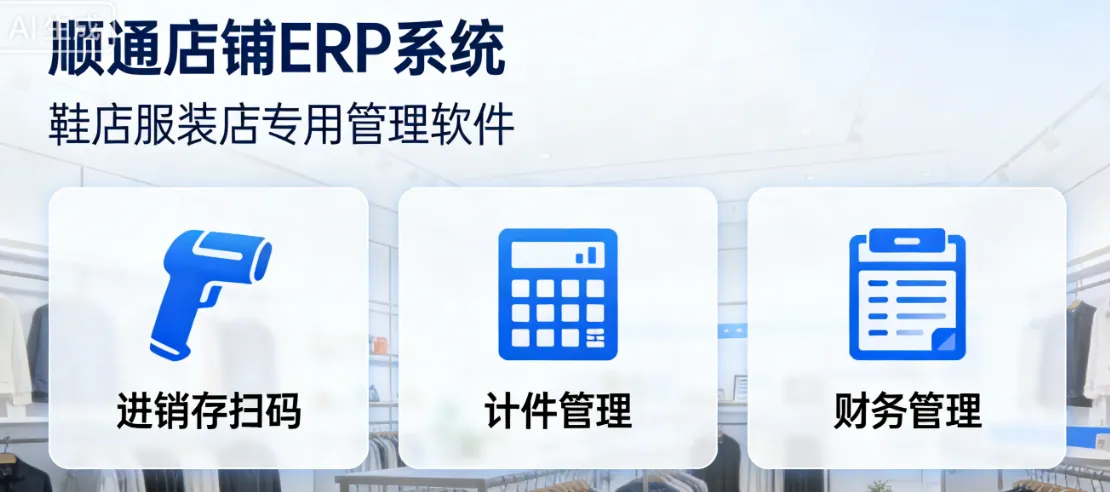
There is currently only one Shuntong system left at Wang Xuemei's checkout counter. When the salesperson hands over the shift, they no longer hand over the account book, but hand over their mobile phone - each person has an independent account, and before leaving work, they can take a look at today's commission estimate and have a clear idea. She took down the vacant stall next door that had been vacant for half a year last month. The store manager asked if she wanted to hire another warehouse manager, but she said she wasn't in a hurry and wanted to fully utilize the system first. The white dad shoes that had been giving her a headache for three months had a system prompt that the inventory turnover had exceeded 90 days. She bit on them and gave them a 40% discount, clearing them in 48 hours. At the moment when the arrival reminder popped up, she couldn't describe how she felt, as if she wasn't as anxious anymore.