
Shoe and clothing ERP software: a one-stop intelligent management solution for procurement, sales, and inventory management
At the Four Seasons Green Clothing Wholesale Market in Hangzhou, the hustle and bustle of 4am is the earliest pulse of the city. The stall owners held up their mobile phones to live stream and sell goods, with piles of new models sent overnight from Changshu and Guangzhou behind them. The warehouse keeper held a PDA and shuttled between the shelves, scanning every order and the inventory in the system jumping once. A few hundred meters away in an office building, the purchasing director of a brand is staring at the supplier delivery rate displayed on the screen, deciding on the order quota for the next quarter. This scenario is repeated every day, supported no longer by Excel spreadsheets and WeChat voice, but by a set of shoe and clothing ERP software that connects the entire process from procurement to sales, from warehouse to finance. It is not some mysterious cutting-edge technology, but rather a ticket for shoe and clothing companies to participate in market competition today.
The procurement management in the footwear and apparel industry is never simply about comparing prices from three different sources. The fabric has cylinder differences, the auxiliary materials have ratios, and outsourcing processing has process progress. Traditional purchasers carry sample books back and forth between the factory and the warehouse. Order confirmation relies on fax, progress tracking relies on phone, and reconciliation settlement relies on express delivery. This model can still be maintained in an era of stable orders and a single category, but in today's fast response cycle compressed to seven days and single orders splitting from 3000 to 300, information lag itself is the biggest cost black hole. The shoe and clothing ERP integrates the entire procurement chain into a unified digital track. Starting from material demand planning, the system automatically generates procurement suggestions based on sales forecasts, existing inventory, and in transit orders, and intelligently allocates quotas according to the supplier's historical delivery completion rate and quality inspection pass rate. After the purchase order is confirmed, it will be pushed to the supplier portal in real time. The supplier can confirm the delivery date online, print barcode labels, and scan the labels when the goods arrive at the warehouse to complete the receipt, shelving, and A/P estimation. After a leisure clothing enterprise in Zhongshan, Guangdong Province connected to the procurement collaboration module, the fabric procurement cycle was shortened from twelve days to six days. The number of production line shutdowns caused by material delays decreased by 70%, and the procurement officer transformed from a firefighter to a supplier performance analyst.
The complexity of the sales side is amplified to the extreme in the footwear and apparel industry. The speed of channel fission in traditional retail, e-commerce platforms, live streaming sales, community group buying, and private domain mini programs far exceeds the iterative ability of any general inventory software. For the same sweater, Tmall sells at the regular price, Tiktok conducts activities and clears the inventory in private. The pricing strategy, inventory strategy and settlement cycle of different channels vary greatly. The multi-channel sales management module of shoe and clothing ERP is not about helping enterprises open stores, but about merging the order flow, capital flow, and logistics of all channels on the same plane. The system is connected in real-time with mainstream e-commerce platforms and live streaming tools through API interfaces, automatically downloading orders, reviewing orders, matching warehouses, and returning logistics tracking numbers. More importantly, inventory synchronization - when a pair of shoes is sold at the store checkout, the available inventory in the e-commerce warehouse is immediately deducted. When the anchor shouts "last ten items" to the camera, the inventory data displayed by the system is exactly the same as when the consumer placed the order. Overselling, a stubborn problem that has plagued the e-commerce industry for 20 years, has been pushed to a corner by technology.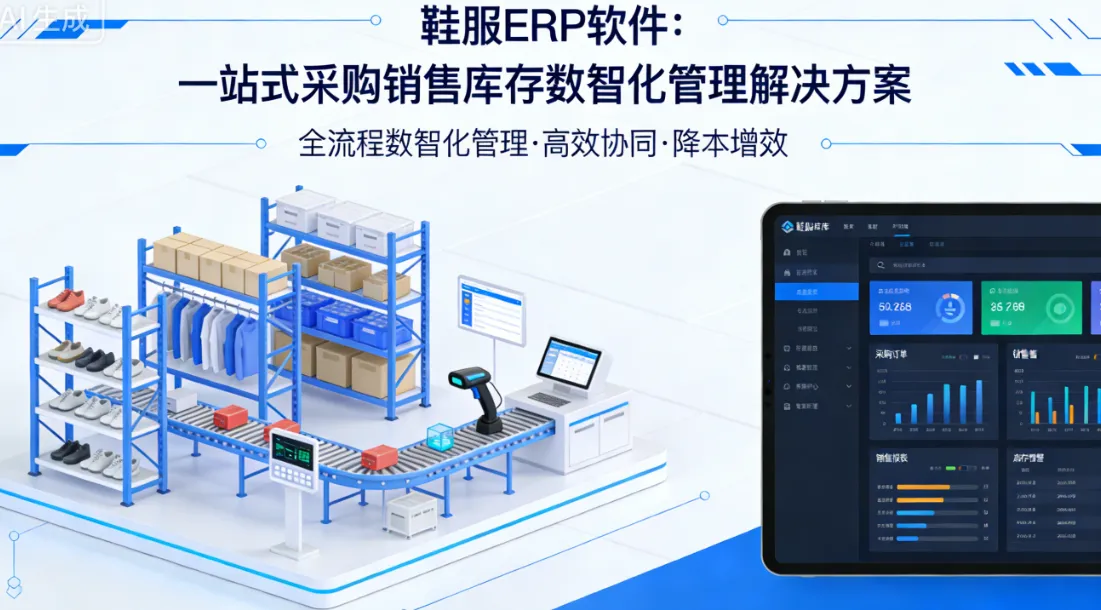
Inventory management is the most significant watershed that distinguishes shoe and clothing ERP from general software. A pair of shoes or a piece of clothing is never just a product code in the system, but a three-dimensional matrix of style, color, and size. Traditional inventory software can manage items but not size distribution; The book shows sufficient inventory, but customers always lack the most commonly sold size when trying it on. The shoe and clothing ERP embeds multidimensional attributes into every inventory change. When purchasing and receiving goods, the details are automatically split according to a preset ratio. When selling goods, the corresponding size is deducted in real time. Inventory differences are no longer counted and recorded, but traced and attributed based on specific sizes and batches. A women's clothing brand in Shanghai with 40 directly operated stores saw its real inventory structure for the first time after launching the inventory module - the size mismatch between unsold and best-selling items resulted in nearly 30% of funds being deposited in ineffective inventory. After adjusting the procurement ratio, inventory turnover increased by 35%, freeing up cash flow to support the development of two new series.
Another deep-water area of inventory management is batch and shelf life. Materials such as genuine leather, down, and glue have clear physical shelf lives, and storage beyond the specified time limit may cause discoloration, hardening, and failure. The batch traceability function of the shoe and clothing ERP forcibly associates the storage date, supplier batch number, and inspection report of each batch of raw materials. The system allocates the issuing warehouse location according to the first in, first out principle. If the warehouse keeper skips the recommended batch when scanning the code for material requisition, a warning will pop up on the handheld terminal and the outbound confirmation will be refused. After a down jacket company in Jiaxing, Zhejiang applied this feature, the scrap amount of inventory fabrics decreased from an average of 150000 yuan per year to 30000 yuan. The warehouse manager said that in the past, new employees had to scrap several batches of leather materials before they could remember them, but now the system remembers them more accurately than old employees.
The true essence of digitization is not to turn paper documents into electronic ones, but to reverse drive decision-making with accumulated data. The intelligent analysis engine of shoe and clothing ERP aggregates real-time indicators such as purchase price fluctuations, supplier delivery time achievement rate, inventory turnover days, channel gross profit margin, and single product lifecycle into a visual dashboard. The purchasing director no longer waits until the end of the month to look at reports. Every morning, he can open his phone and see which suppliers have delivered on time recently and which categories have procurement costs that deviate from the average; Product planning no longer relies on experience to guess popular products. The system generates new product ordering suggestions based on historical sales data, search popularity, and competitor pricing; The financial director can estimate the gross profit of the sales order at the moment of confirmation, rather than waiting until the end of the month to discover that the proportion of loss making orders is too high. A top stall in the Thirteen Rows commercial district of Guangzhou has increased its first-time sales rate from 58% to 76% with the help of ERP data analysis capabilities. The boss said that in the past, popular products relied on luck, but now popular products rely on algorithms.
The value of a one-stop solution is also reflected in its complete dismantling of the invisible barriers between procurement, sales, inventory, and finance. In the traditional mode, there is a disconnect between purchase receipts and financial accounts payable, sales delivery receipts and accounts receivable write offs lag behind, and discrepancies between inventory books and physical items need to be exposed through month end inventory checks. The shoe and clothing ERP integrates business and finance to the moment of generating each business document. The warehouse scans the code to receive the goods and automatically generates estimated accounts payable. The sales outbound confirmation automatically confirms accounts receivable and cost transfer. Financial personnel are freed from the repetitive labor of data entry and turn to higher value-added work such as cash flow forecasting, cost control, and profitability analysis. A shoe and clothing enterprise in Quanzhou, Fujian that integrates design, production, and sales, has compressed its monthly billing cycle from nine days to two days after launching the business finance integration module. The financial manager said that in the past, it used to reconcile accounts in the first ten days of each month, but now there is finally time to study which customers contributed real profits.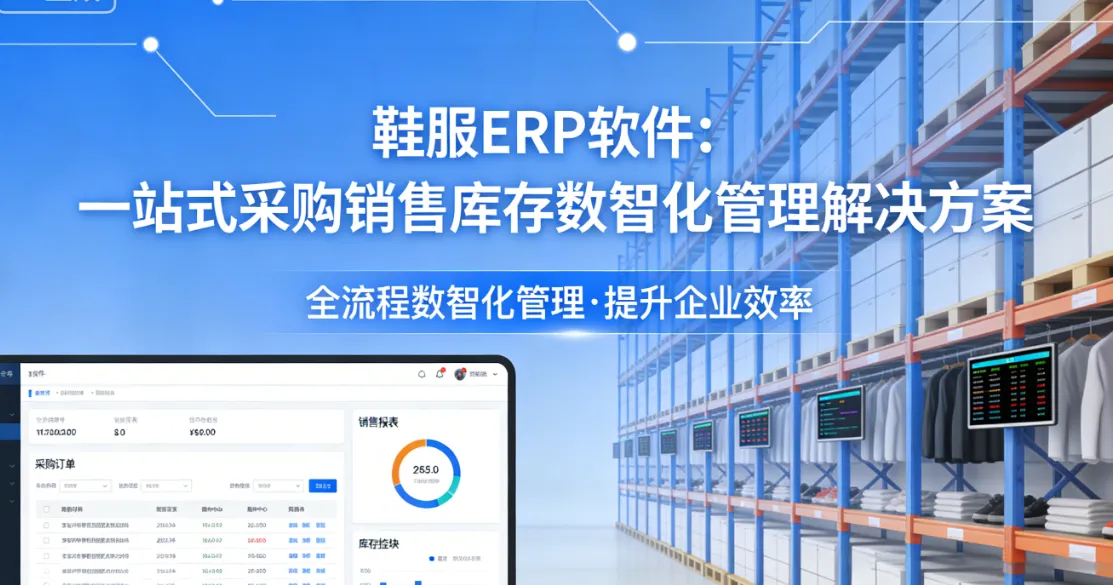
The shoe and clothing ERP software, as a one-stop intelligent management solution for procurement, sales, and inventory, has carried a distinct industry imprint since its inception. It is not managed for the sake of management, but to cope with the inherent complexity of this industry - changing channels, fragmented orders, three-dimensional inventory, and time sensitive materials. It doesn't promise to transform the enterprise overnight, but it allows those bosses who live stream at the stall at 4am to no longer have to hold two phones and reconcile accounts at the same time; Enable purchasers who are chasing suppliers to anticipate risks two weeks in advance; Let those warehouses that are always missing codes achieve matching between accounts and reality for the first time. This system may not have a fancy user interface or emotional brand story, but it is becoming one of the few determinacy that China's four million shoe and clothing merchants can grasp when facing market uncertainty.