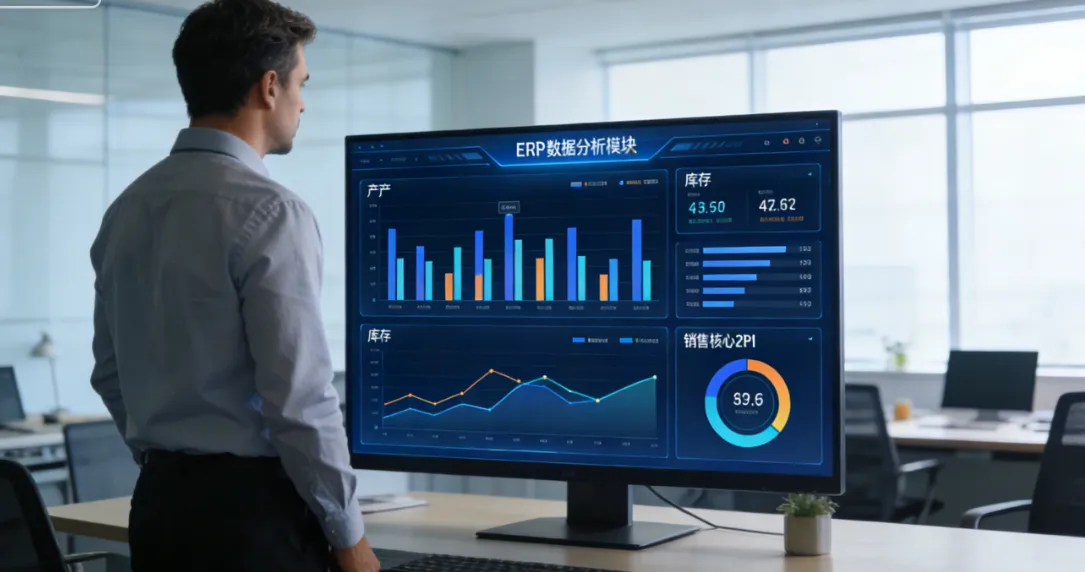
Analysis of core functional modules of footwear ERP: Accurately solving industry pain points and driving efficient upgrading of the industry
In 2026, China's footwear industry will remain at the core of global manufacturing, with a total output of 13 billion pairs by 2024, accounting for 54% of the global market share. At the same time, brand expansion is accelerating, consumer demand is upgrading towards personalization, and industry competition is shifting from scale competition to efficiency and quality competition. However, most shoe companies are still trapped in pain points: chaotic production scheduling, difficult inventory control for multiple SKUs, high material loss, vague cost accounting, and fragmented data throughout the entire chain. This is particularly evident for small and medium-sized enterprises, where traditional management models are no longer suitable for the industry trend of "small batch, fast delivery, and high quality". The shoe industry exclusive ERP system, with customized functional modules, accurately connects with the entire process of shoe manufacturing business scenarios, solves the core pain points of the industry, builds a digital collaborative base, and becomes the core engine driving the shoe industry to upgrade from extensive manufacturing to lean intelligent manufacturing. This article will break down the five core functional modules of footwear ERP and explain how they adapt to industry characteristics and empower enterprises to operate efficiently.
Production management module: Crack the complexity of processes and disorderly production scheduling, and build a solid foundation for efficient production. The production process of the footwear industry is extremely unique, requiring multiple processes such as cutting, sewing, molding, and quality inspection. Moreover, a shoe can have dozens of SKUs in multiple colors and sizes, and there are significant differences in the production routes of different styles. Traditional manual production scheduling is prone to problems such as poor process connection, weak emergency order response, and waste of production capacity. Most shoe companies that have not introduced ERP have a on-time delivery rate of less than 80% for orders. The production management module of the footwear ERP is customized for this scenario, with the core highlight being intelligent scheduling and full process tracking. The system can automatically generate production scheduling plans based on order priority, equipment capacity, and process dependencies, supporting rapid adjustment of emergency insertion orders and synchronously issuing them to various workshops and teams, completely eliminating the situation of "blind work".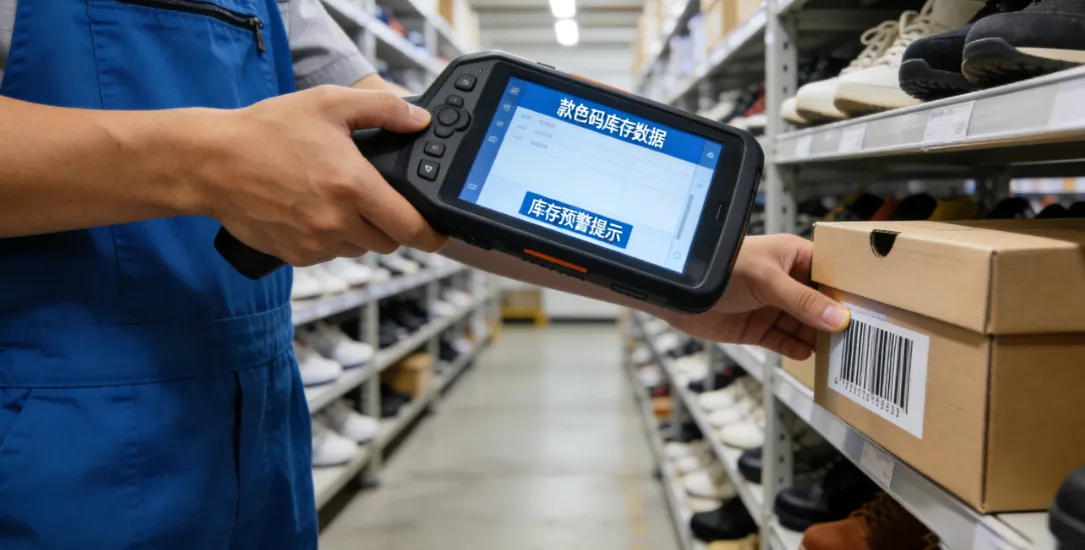
At the same time, this module supports real-time collection of process level data. Workers can scan codes on mobile devices to report work, and managers can view the completion quantity and yield rate of each process in real time, accurately controlling production nodes. Once a process lags behind in progress, the system automatically pushes warnings, making it easier to allocate resources in a timely manner. In response to the personalized needs of footwear production, the module can preset different styles of process standards and working hour quotas, standardize operating procedures, reduce human errors, and integrate automatic piece rate wage accounting function. Based on the reported labor data and preset unit prices, salary details are generated, reducing financial calculation burden and minimizing salary disputes. Based on this module, the production scheduling response time of a sports shoe factory in Zhongshan has been shortened from 4 hours to 30 minutes after its launch, and the on-time delivery rate of orders has increased from 75% to 95%, significantly improving production efficiency.
Inventory management module: Overcome the challenge of controlling multiple SKUs and optimize inventory turnover efficiency. The coexistence of inventory backlog and shortage is a common pain point in the footwear industry. The categories of raw materials such as leather, glue, and shoe soles are complex, and some materials are prone to deterioration. Managing multiple SKUs of finished shoes is difficult, and traditional manual inventory is inefficient and prone to errors. This not only leads to discrepancies between inventory accounts and reality, but also causes a large amount of capital accumulation. A leather shoe factory in Putian once had a high proportion of stagnant materials, accounting for 18%, due to extensive inventory management. The inventory management module of the footwear ERP system is centered around "multi-dimensional precise control" and supports the construction of inventory data structures based on "product code+shoe code+color+batch". Each batch of materials and finished products is assigned a unique identity code, and inventory operations are completed by scanning the code. The inventory efficiency is improved by more than 80%, and the inventory accuracy can reach 99.9% without the need for downtime inventory.
The module has a built-in inventory warning mechanism that can set safety stock thresholds based on production and sales needs. When raw material inventory falls below the threshold or finished product inventory exceeds the deadline, automatic reminders will be triggered to help enterprises optimize their inventory structure. For perishable materials, the module supports expiration monitoring and batch management, accurately tracing material flow and reducing losses; Simultaneously integrating production and sales modules to achieve real-time data synchronization, the production department can accurately query raw material inventory to avoid production stagnation caused by material shortages, and the sales department can view finished product inventory in real time to avoid overselling or shortages. With the help of this module, the proportion of stagnant materials in a leather shoe factory in Putian has decreased to 8%, the inventory turnover rate has increased by 35%, and about 2 million yuan of funds have been released, effectively activating the company's cash flow.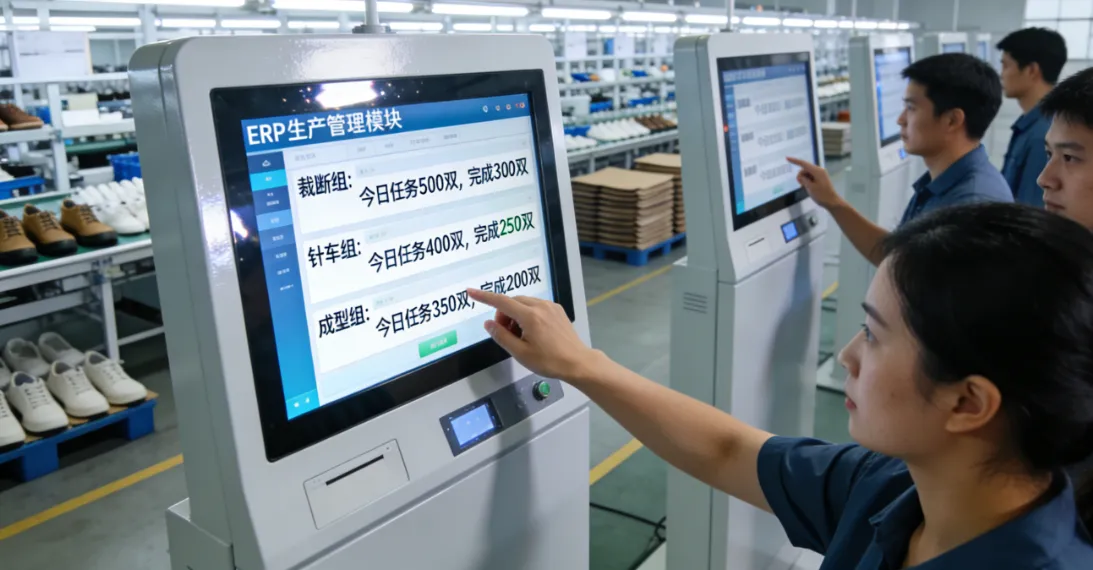
Procurement management module: Break down supply chain collaboration barriers and reduce procurement risks. The pain points in the procurement process of the footwear industry are concentrated in the dispersion of supplier management, the disconnection between procurement plans and production needs, and the difficulty in tracing material quality. Traditional experiential procurement can easily lead to delayed material arrival and the storage of unqualified materials, which in turn affects production progress. At the same time, the fluctuation of raw material prices intensifies, making it difficult to control procurement costs. The procurement management module of footwear ERP has built a full process control system of "supplier procurement plan arrival acceptance". Firstly, a complete supplier archive can be established to record supplier qualifications, cooperation history, on-time delivery rate, quality qualification rate and other information, support supplier hierarchical management, assist enterprises in screening high-quality partners, and optimize procurement channels.
Based on the production plan and inventory gap, the module can automatically generate a purchase suggestion form. The procurement specialist can adjust the purchase order according to the trend of raw material prices and track the delivery progress of the order in real time to avoid material delays. In the process of receiving and inspecting goods, the system supports scanning codes to compare purchase orders with delivery notes. Unqualified materials can be directly returned and synchronized with the financial module to adjust accounts payable. At the same time, material quality information is recorded to achieve full process traceability. In addition, the module can calculate procurement costs by material category and supplier dimension, and compare historical prices to assist in optimizing procurement strategies. Through this module, a leather shoe factory in Putian has reduced the loss rate of genuine leather materials from 12% to 7%, saving approximately 800000 yuan in material costs annually.
Cost accounting module: Achieve refined cost control and precise control of profit margins. The cost structure of the footwear industry is complex, with raw material losses, labor costs, equipment depreciation, logistics expenses, etc. accurately allocated to each SKU. The traditional accounting model relies on manual labor, with an error rate of over 8%, which makes it difficult to clearly grasp the profitability of individual products and leads to blind pricing. The cost accounting module of the footwear ERP system realizes automatic cost collection and accurate allocation throughout the entire process. The system can capture real-time cost data of procurement, production, inventory and other links, accurately allocate direct materials, direct labor, and manufacturing expenses by batch or single product, and generate detailed cost detail reports, allowing managers to clearly understand the profitability of each shoe.
In response to the frequent fluctuations in raw material prices in the footwear industry, the module can synchronize raw material price data in real time, dynamically update cost accounting results, assist enterprises in formulating scientific pricing strategies, and avoid pricing that is too high affecting sales or too low causing losses. At the same time, the module can decompose the cost proportion of each link, identify pain points in cost control, such as high raw material loss and insufficient equipment utilization, and provide data support for optimizing the cost structure of enterprises. After a well-known sports shoe brand went online, the cost accounting error was reduced to 2.5% through this module, and the accuracy of single shoe pricing was improved by 90%, effectively increasing profit margins.
Data analysis and decision support module: Breaking down data silos and empowering scientific decision-making. Most shoe companies have fragmented data from various departments, with production, inventory, sales, and other data scattered across different systems or tables. Managers find it difficult to gain a comprehensive understanding of the company's operating conditions and rely heavily on experience to make decisions, which can lead to missing market opportunities or falling into inventory difficulties. The data analysis and decision support module of the footwear ERP integrates full chain data, automatically generates multi-dimensional reports, covering core KPI indicators such as capacity utilization rate, inventory turnover rate, single product profit, and supplier fulfillment rate, without the need for manual organization. Managers can quickly grasp the operational dynamics of the enterprise through a visual dashboard.
The module has a built-in demand forecasting function, which combines historical sales data, seasonal trends, and market dynamics to accurately predict market demand for various styles and SKUs, assisting enterprises in optimizing production plans and inventory layouts, and reducing blind production. For shoe companies with overseas layout, the module can integrate cross-border sales, logistics, compliance and other data, generate multi currency and multi tax system analysis reports, and support global operational decisions. Leading brands such as ANTA and Li Ning use this module to achieve multi brand matrix collaborative management, accurately connect with market demand, and build industry competitiveness.
In addition to the core modules mentioned above, footwear ERP can also expand value-added modules such as R&D management, cross-border compliance, and green data tracking according to enterprise needs, adapting to the development needs of shoe enterprises of different sizes - small and medium-sized enterprises can choose lightweight versions, focusing on core functions to achieve cost reduction and efficiency improvement; Large corporations can expand their functions such as group management and full channel collaboration to support large-scale development. In 2026, the digital transformation of the footwear industry will enter a deep water zone, and the core value of ERP systems is no longer limited to process digitization, but also lies in solving industry core pain points and restructuring operational efficiency through modular collaboration. Only by relying on a dedicated ERP system and connecting the entire production, inventory, procurement, and decision-making processes can shoe companies stand firm in the competition of inventory and drive the industry to upgrade towards efficiency, lean, and intelligence.