
Footwear ERP: Cracking the pain points of full chain management for footwear enterprises and accelerating digital transformation
In 2026, China's footwear industry will continue to deepen its dual track of global manufacturing and brand upgrading. It not only has the industrial advantage of stable annual output occupying half of the world, but also faces multiple challenges such as accelerated consumption iteration, rising cost pressure, and intensified omnichannel competition. Currently, most shoe companies are still plagued by the chaos of full chain management, from raw material procurement to finished product delivery, from production control to market decision-making, with pain points overlapping layer by layer, becoming a bottleneck that restricts digital transformation and high-quality development. General management tools are difficult to adapt to the industry characteristics of "style color code" three-dimensional control, complex processes, and multi SKU operation in the footwear industry. However, the shoe industry's exclusive ERP system, with its full chain adaptation capability, accurately solves management problems, builds a digital collaborative base, and promotes shoe enterprises to leap from extensive manufacturing to lean intelligent manufacturing, becoming the core engine for accelerating digital transformation.
The procurement process, as the starting point of the footwear supply chain, focuses on three major pain points: loose supplier control, inefficient material adaptation, and difficult cost control. The production of footwear requires multiple categories of raw materials such as leather, shoe soles, adhesives, and accessories, and different styles have significant differences in material specifications and requirements. The traditional manual procurement model lacks systematic planning and is prone to problems such as missing, buying incorrectly, or overbought materials - either leading to production downtime and waiting for materials, delaying order delivery; Either it causes a backlog of raw materials, resulting in stagnant inventory, with some small and medium-sized shoe enterprises having stagnant materials accounting for as much as 18%. At the same time, supplier management lacks a unified file and assessment system, making it difficult to control delivery punctuality and material qualification rates. Some shoe companies need to rework due to substandard material quality, which increases production costs. In addition, raw material prices fluctuate frequently due to global trade and market supply and demand, making it difficult for manual procurement to accurately track price trends and achieve optimal cost control, further squeezing profit margins.
The complexity and lack of coordination in the production process are the core obstacles to the efficiency improvement of shoe enterprises. Shoe production covers multiple processes such as cutting, sewing, molding, quality inspection, and packaging. A shoe can have dozens of SKUs in multiple sizes and colors, and the process routes for different styles vary significantly. Traditional manual production scheduling cannot balance order priority, equipment capacity, and material delivery progress, and is prone to process discontinuity, equipment idle, and capacity waste. Most shoe companies that have not introduced ERP have a on-time delivery rate of less than 80% for orders, and they have a weak response when urgently inserting orders, either rushing to meet quality standards or delaying delivery and missing orders. In addition, material consumption during the production process cannot be tracked in real time, and workers rely on manual recording for reporting, which is prone to omissions and errors. This not only leads to a high rate of raw material loss (industry average of 8% -12%), but also increases the burden of financial accounting, frequent salary disputes, and affects team stability.
The extensive storage and inventory control directly leads to the accumulation of funds and waste of resources for shoe companies. Shoe raw materials need to be stored in batches and specifications, and some materials (such as leather and glue) are prone to spoilage and aging. Finished shoes need to be classified and managed according to style, size, and color, and the multi SKU nature makes warehouse management more difficult. The traditional manual ledger management mode has no standardized process for inbound and outbound inventory, and relies solely on manual counting for inventory. This not only reduces efficiency, but also increases the risk of issues such as incorrect or missed shipments, and discrepancies between accounts and reality. Managers are unable to accurately grasp the real inventory situation, or the core sizes of best-selling products are out of stock, missing market opportunities; Either the unsold goods accumulate for a long time, occupying a large amount of funds and storage space. Most small and medium-sized shoe enterprises have inventory turnover cycles of up to 3-6 months, and a large amount of cash flow is deposited, which restricts the circulation of enterprise funds and the expansion of production.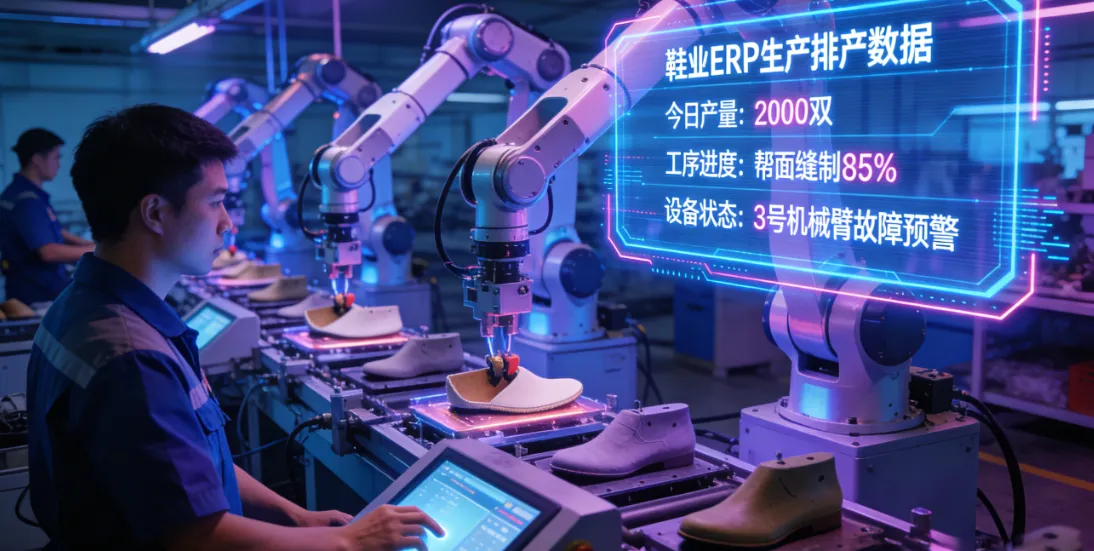
The digital shortcomings in the sales and decision-making processes make it difficult for shoe companies to adapt to the rapidly changing market. Currently, multi-channel layouts such as online e-commerce, live streaming sales, offline stores, and cross-border exports have become standard for shoe companies. However, under traditional management models, inventory and sales data from various channels cannot be synchronized in real time, which can lead to embarrassing situations such as online stockouts and offline backlogs. Additionally, member data is scattered, making it difficult to achieve precise marketing. More importantly, the entire data chain is fragmented, and data from procurement, production, warehousing, sales, and other links cannot be summarized and analyzed. Managers still rely on experience to make decisions and cannot accurately predict popular styles, colors, and sizes in the market. "Production based on intuition" can easily lead to a disconnect between production and the market, either missing opportunities or falling into the dilemma of inventory backlog. In addition, cross-border shoe companies face challenges such as compliance declaration and multi currency accounting, which traditional management tools cannot adapt to, further hindering the pace of brand expansion overseas.
The core value of the shoe industry's exclusive ERP system lies in breaking down the barriers of full chain management, achieving digital collaboration in procurement, production, warehousing, sales, and decision-making, accurately solving the core pain points of each link, and laying a solid foundation for the digital transformation of shoe enterprises. At the procurement management level, the ERP system can establish a comprehensive supplier archive, recording supplier qualifications, on-time delivery rates, quality qualification rates, and other information, achieving hierarchical management and scientific assessment, and helping to screen high-quality partners; At the same time, combined with production planning and inventory gaps, automatic purchase suggestion forms are generated, material price trends are tracked synchronously, procurement decisions are optimized, blind procurement is avoided, and a material quality traceability mechanism is set up to ensure that materials are suitable for production needs and reduce rework costs.
In response to the pain points in the production process, the ERP system is equipped with a shoe specific intelligent scheduling module, which can automatically generate the optimal scheduling plan based on order priority, equipment capacity, and process dependencies. It supports rapid adjustment of emergency insertion orders and synchronously distributes them to various workshops and teams to ensure smooth process connection. Workers can scan codes on their mobile devices to report work progress and material consumption in real-time. Managers can accurately control production nodes through the backend. In case of process delays or material shortages, the system automatically pushes alerts for timely resource allocation. At the same time, the system integrates piece rate salary automatic accounting function, generates salary details based on reported work data, eliminates manual errors, reduces salary disputes, accurately tracks raw material losses, sets loss thresholds, and helps reduce the loss rate to below 5%, improving production efficiency and cost control level.
At the level of warehousing and inventory management, the ERP system supports multi-dimensional inventory control based on "style+size+color+batch", assigning unique identification codes to each batch of materials and finished products. Through scanning the codes, inventory operations are completed, and inventory efficiency is improved by more than 80%. The inventory accuracy can reach 99.9%, and there is no need to stop inventory. The system has a built-in intelligent inventory warning mechanism that can set safety stock thresholds based on production and sales needs. When best-selling items are out of stock or unsold items accumulate, reminders will be automatically triggered to help optimize inventory structure, accelerate inventory turnover, and release accumulated funds. For perishable materials, the system supports expiration date monitoring, precise traceability of material flow, and reduces losses.
At the sales and decision-making level, the ERP system realizes the integration of all channel data, connects online and offline inventory and sales data, implements "one inventory" management, supports nearby shipment and cross channel transfer, and improves performance efficiency and customer experience; At the same time, integrating member data and sales data, generating multi-dimensional analysis reports, and helping to carry out precision marketing. More importantly, the system aggregates data from the entire chain and accurately predicts market demand through data analysis models, providing scientific support for product design and production planning, shifting decision-making from experience driven to data-driven, and helping shoe companies quickly adapt to market changes. For cross-border shoe companies, ERP systems can integrate customs supervision and multi currency accounting functions, adapt to cross-border compliance needs, and help brands go global.
In 2026, digital transformation has become a necessary path for shoe companies to break through competitive bottlenecks and achieve high-quality development, and the digital collaboration of full chain management is the core prerequisite for successful transformation. The shoe industry ERP system is not a simple tool upgrade, but a reshaping of the operation mode of shoe enterprises. It achieves multiple goals of cost reduction, efficiency improvement, quality improvement, and empowerment by accurately solving the pain points of full chain management. It not only meets the lightweight transformation needs of small and medium-sized shoe enterprises, but also supports the group and global layout of large shoe enterprises. With the deep integration of AI, big data technology, and ERP systems, their empowerment capabilities will continue to upgrade, helping more shoe companies break free from extensive management, accelerate digital transformation, and seize the opportunity in global shoe industry competition.