
Breaking through the supply chain dilemma in the footwear industry: ERP full process management opens up a new paradigm for cost reduction and efficiency improvement
The supply chain is the core competitiveness of the footwear industry, running through the entire chain from raw material procurement, production and processing, warehousing and logistics to terminal delivery. Its efficiency and stability directly determine the profitability and market competitiveness of the enterprise. In 2026, although China's footwear industry remains at the core of global manufacturing, the industry is deeply mired in supply chain difficulties - inefficient inventory turnover, lengthy delivery cycles, loose material control, insufficient full chain collaboration, coupled with external pressures such as accelerated consumption iteration and stricter cross-border trade compliance. Many shoe companies are trapped in a vicious cycle of "high cost, low efficiency, and high risk". According to industry research data, the average inventory turnover days in the footwear industry are 182 days, with unsold products accounting for over 35%. The average lead time from design finalization to store shelving is 127 days, and the on-time delivery rate of orders for small and medium-sized shoe enterprises is less than 80%. In this context, ERP full process management relies on end-to-end digital collaboration capabilities to break down barriers in various links of the supply chain, becoming the core engine for shoe companies to solve difficulties and open up a new paradigm of cost reduction and efficiency improvement.
The dilemma of the footwear supply chain is not a single link problem, but a concentrated manifestation of the disconnection of the entire chain process, data fragmentation, and extensive control. It is deeply bound to the industry characteristics of three-dimensional control of footwear "style color code", complex processes, and multi SKU operation. Pain points run through the entire process of procurement, production, warehousing and logistics, sales collaboration, and cross-border compliance, forming an unbreakable closed loop.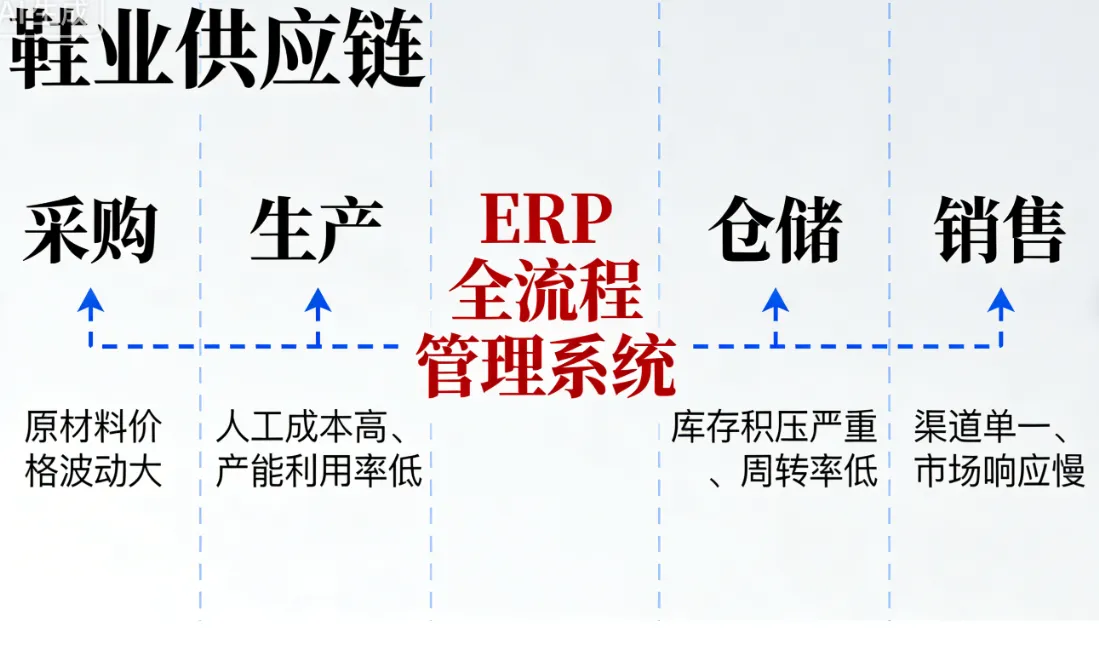
The collaborative imbalance on the procurement side is the starting point of the supply chain dilemma. The production of footwear requires the integration of multiple categories of raw materials such as leather, shoe soles, and accessories. Suppliers are scattered and have uneven qualifications. The traditional procurement model relies on manual experience and lacks systematic supplier management and material adaptation control, which can easily lead to material errors, omissions, or overbooking - either resulting in production downtime or raw material backlog. The proportion of stagnant materials in some small and medium-sized shoe enterprises is as high as 18%. At the same time, raw material prices fluctuate frequently due to global trade and market supply and demand, and manual procurement cannot accurately track price trends, making it difficult to achieve optimal cost control; More importantly, procurement data is disconnected from production and inventory data, and procurement plans cannot accurately match production needs, further exacerbating supply chain inefficiencies. Some shoe companies incur rework costs exceeding 10% due to material adaptation errors. For cross-border shoe companies, they also face additional challenges such as compliance with raw material imports and multi currency procurement accounting, making it difficult for traditional management models to adapt.
The lack of flexibility in the production end and the disconnection between processes further exacerbate the supply chain dilemma. Shoe production covers multiple processes such as cutting, sewing, molding, and quality inspection. A shoe can have dozens of SKUs in multiple sizes and colors, and the process routes for different styles vary significantly. However, most shoe companies still adopt the traditional push supply chain model of "prediction ordering production distribution", and their flexible production capacity is weak. Traditional manual production scheduling cannot balance order priority, equipment capacity, and material delivery schedule, and is prone to the phenomenon of process connection gaps, equipment idleness, and capacity waste. When urgent orders are inserted, there is a lack of response, resulting in a generally long delivery cycle for orders. The industry average cycle from receiving orders to shipping exceeds 25 days, and even for small and medium-sized enterprises, it can be as long as 30 days or more. In addition, material consumption during the production process cannot be tracked in real time, and workers rely on manual recording to report work, which is prone to omissions and errors, resulting in a high rate of raw material loss, with an industry average of 8% -12%, further pushing up production costs.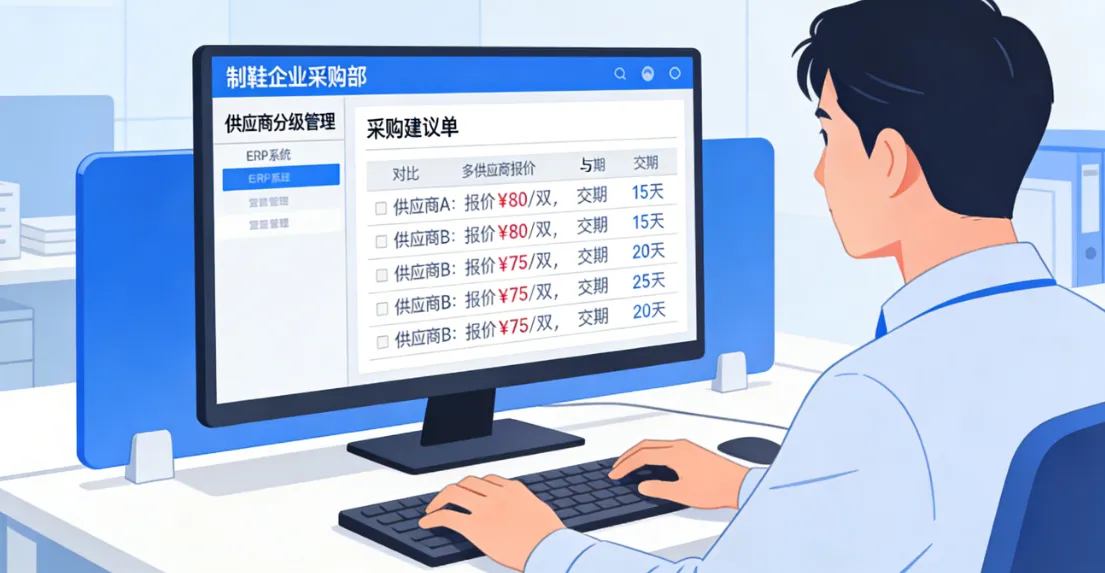
The weak link between warehouse logistics and sales collaboration has become a stumbling block to the efficient operation of the supply chain. The characteristic of multiple SKUs in the footwear industry doubles the difficulty of warehouse management. Raw materials need to be stored in batches and expiration dates, and finished shoes need to be classified and controlled according to style, size, and color. The traditional manual ledger management mode is prone to problems such as wrong or missing shipments, and discrepancies between accounts and reality. The inventory accuracy rate is less than 90%, and inventory counting requires downtime and low efficiency. At the same time, there is a lack of intelligent warning mechanisms for inventory control, and the shortage of best-selling items and the backlog of unsold items have become the norm. The average inventory turnover days in the entire industry reach 182 days, and for small and medium-sized chain brands, it is as high as 210 days or more. A large amount of cash flow is accumulated, which restricts the circulation of enterprise funds and the expansion of reproduction. The logistics process suffers from insufficient collaboration and unclear trajectories, which are disconnected from warehousing and sales data. It is prone to errors and omissions in shipping, and the transportation progress cannot be tracked in real time, resulting in frequent loss of items and delays; The lack of data between online and offline channels on the sales end creates an "information island" that cannot achieve "one inventory" management, leading to embarrassing situations such as online stockouts and offline backlogs, resulting in low performance efficiency and customer experience.
The compliance and coordination challenges of cross-border supply chains have become additional barriers for shoe companies to go global. With the acceleration of brand going global, more and more shoe companies are entering cross-border trade. However, traditional management models cannot adapt to the needs of multi currency accounting, customs compliance declaration, and international logistics tracking, which can easily lead to exchange rate conversion errors and delayed HS code updates, resulting in customs clearance obstacles. Some companies have been forced to lower prices to protect orders due to compliance issues, adding additional operational risks and costs.
The key to solving the above dilemma lies in breaking down the data barriers of the entire supply chain, achieving digital collaboration and refined control of each link in the supply chain. The full process management capability of the shoe industry's exclusive ERP is the key to opening up a new paradigm of cost reduction and efficiency improvement. Unlike the "one size fits all" model of general ERP, shoe specific ERP deeply adapts to industry characteristics, with data as the core, connecting the entire chain of procurement, production, warehousing, logistics, sales, decision-making, and compliance, building a "collaborative, refined, and intelligent" supply chain management system, achieving end-to-end full process control, and accurately solving the core pain points of each link.
ERP full process management empowers the dual optimization of supply chain efficiency and cost through the closed-loop of "procurement production warehousing logistics sales compliance". In the procurement process, the ERP system establishes a comprehensive supplier archive to record supplier qualifications, on-time delivery rates, quality qualification rates, and other information, achieving hierarchical management and scientific assessment, and helping enterprises screen high-quality partners; At the same time, combined with production plans and inventory gaps, automatic purchase suggestion forms are generated, and multiple supplier quotations and delivery dates are compared synchronously. Raw material price warnings are set to cope with price fluctuations and risks, achieving precise procurement and cost reduction and risk control. For cross-border procurement, the system supports multi currency accounting and customs compliance docking, automatically synchronizing the latest HS codes and customs declaration rules to avoid customs clearance risks.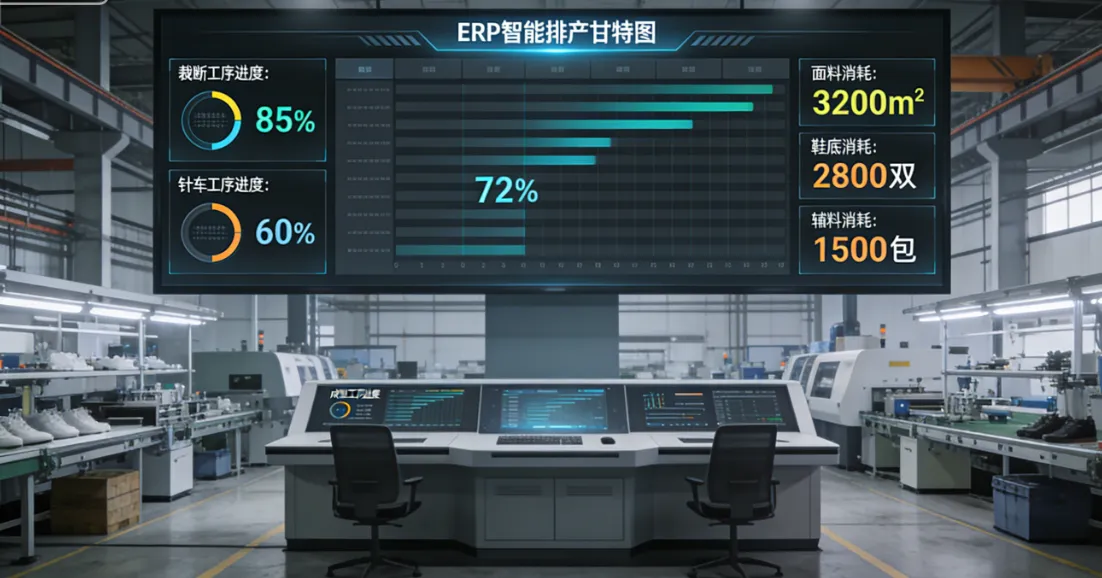
In the production process, the ERP system is equipped with a shoe specific intelligent scheduling module, which adapts to the needs of small batch, multiple orders, and fast response production. It can automatically generate the optimal scheduling plan based on order priority, equipment capacity, and material arrival progress, and support rapid adjustment of emergency insertion orders to achieve seamless process connection. Workers can scan codes on their mobile devices to report work progress and material consumption in real-time. Managers can accurately control production nodes through visual dashboards. In case of process delays or material shortages, the system automatically pushes warnings and allocates resources in a timely manner; At the same time, the system can track material consumption, set loss thresholds, and help enterprises reduce raw material loss rates to below 5%, balancing efficiency and quality. The practical case of Southeast Footwear confirms this value. After introducing ERP, the delivery cycle of orders within 8 months was shortened from 25 days to 17 days, and production efficiency was greatly improved.
In the warehousing and logistics process, the ERP system solves the problem of multi SKU control and supports multi-dimensional inventory control based on "style+size+color+batch". Through RFID or barcode technology, scanning codes for inbound, outbound, and inventory can be achieved, increasing inventory accuracy to 99.9% and inventory efficiency by more than 80% without the need for downtime inventory. The system has a built-in intelligent inventory warning mechanism that combines sales data and market trends to set safety stock thresholds. When best-selling items are out of stock or unsold items accumulate, automatic reminders are triggered to help enterprises optimize inventory structure and accelerate inventory turnover. Southeast Footwear has achieved a reduction in inventory capital usage from 1 million to 200000 through ERP, releasing a large amount of working capital. The logistics module is integrated with mainstream logistics platforms and international logistics channels to automatically generate and scan delivery notes for verification, avoiding errors and omissions. At the same time, the transportation trajectory is synchronized in real time, and both managers and customers can check the progress of goods, respond to logistics anomalies in a timely manner, and improve performance efficiency and customer experience.
In the sales and decision-making process, the ERP system realizes the integration of omnichannel data, connects inventory and sales data from multiple channels such as online e-commerce, offline stores, and cross-border exports, implements "one inventory" management, supports nearby shipments and cross channel transfers, and solves the structural mismatch problem of "having goods but no market, having market but no goods". At the same time, the system builds a global data platform, integrates data from all links, automatically generates multi-dimensional analysis reports, covering core indicators such as inventory turnover, order delivery, single product profitability, and supplier performance, helping managers accurately predict market demand, optimize production plans and procurement decisions, bid farewell to empiricism, and achieve data-driven refined operations. For cross-border shoe companies, the system supports multi currency accounting, cross-border compliance data tracking, adapts to global operational needs, and reduces overseas risks.
More noteworthy is that the shoe industry's exclusive ERP can adapt to the development needs of shoe enterprises of different sizes. Small and medium-sized enterprises can choose a lightweight version, focus on core process collaboration, without the need for large hardware investments. Annual subscriptions and on-demand selection of functional modules can lower the threshold for digital transformation; Large enterprises can expand their functions such as group control, omni channel collaboration, and green compliance management to support large-scale and global development, in line with the trend of industrial green upgrading and brand upgrading.
Currently, the competition in the footwear industry has escalated into a competition for supply chain efficiency. The stability and efficiency of the supply chain directly determine the survival and development of enterprises. ERP full process management is not a simple tool upgrade, but a reconstruction of the supply chain model for shoe companies. It breaks through data silos, optimizes process collaboration, achieves refined control, solves the industry's full chain supply chain dilemma, and opens up a new paradigm of "cost reduction, efficiency improvement, quality improvement, and risk control". For a large number of shoe companies, relying on ERP full process management can not only solve the pain points of current inventory chaos, delivery lag, and high costs, but also build core competitiveness, adapt to industry transformation trends, stand firm in stock competition, achieve high-quality development, and promote China's footwear industry to leap from a "manufacturing power" to a "manufacturing powerhouse".