
Analysis of Six Pain Points in Warehouse Management for Small and Medium sized Shoe Factories and the 2025 Shoe Industry ERP Solution
Warehousing is the core hub of the supply chain for small and medium-sized shoe factories, connecting the entire chain of raw material procurement, production and processing, and finished product delivery. Its management efficiency directly determines the cost control level and order delivery capability of the enterprise. However, currently, most small and medium-sized shoe factories are limited by factors such as funding, technology, and talent, and warehouse management still remains at the stage of manual ledger and extensive control. Pain points are concentrated and overlapping, becoming a key weakness that restricts enterprises from reducing costs, increasing efficiency, and breaking through development bottlenecks. In 2025, the digital transformation of the footwear industry will enter a deep cultivation period. With the advantages of lightweight deployment, industry-specific adaptation, and low-cost implementation, the exclusive ERP system will become the core tool for small and medium-sized shoe factories to solve their warehousing difficulties. It will accurately match the operational characteristics of "style color code" multi SKU control and small batch multi order, and help small and medium-sized shoe factories achieve the transformation of warehouse management from "passive response" to "active control".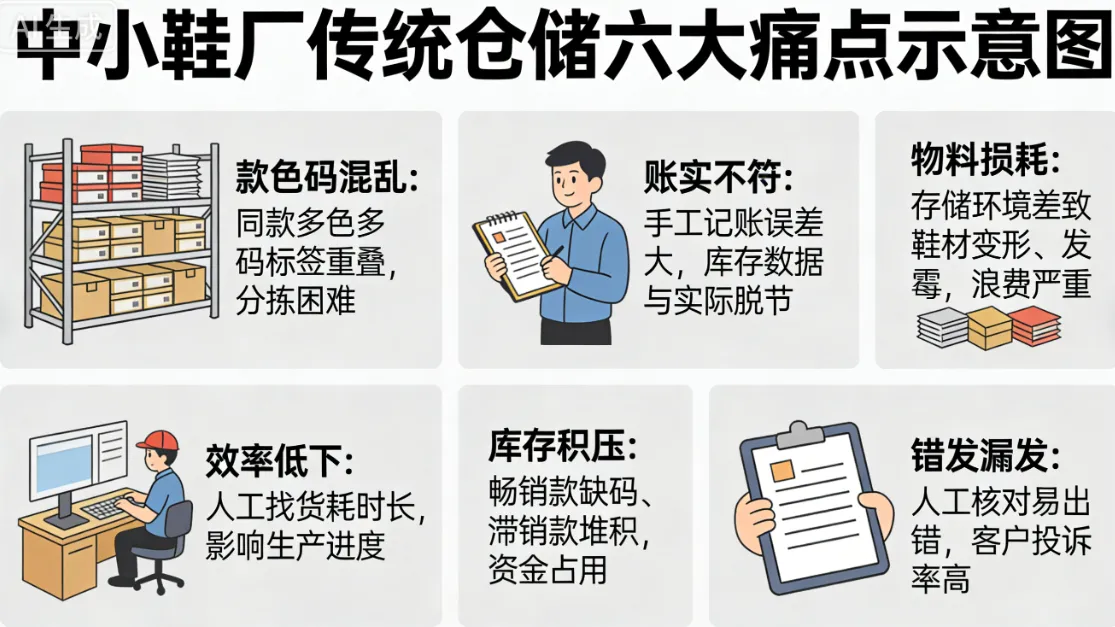
Pain point one: Chaotic control of multiple SKUs and difficulty in distinguishing product color codes. Small and medium-sized shoe factories mainly produce in small batches and multiple styles. A shoe can have dozens of SKUs in multiple sizes and colors, and some sports shoes need to be further subdivided according to last shape and material. In addition, raw materials (leather, sole, accessories) are mixed with finished shoes, which doubles the difficulty of control. Traditional manual management lacks a standardized coding system and relies heavily on the memory or simple labeling of warehouse personnel, which can lead to problems such as size confusion, color mismatch, and style mixing. This results in repeated checks during inbound and outbound operations, greatly reducing operational efficiency and easily causing chain problems such as incorrect use of materials and wrong delivery of finished products in subsequent production. According to industry research, small and medium-sized shoe factories that have not introduced digital tools have a SKU control error rate of up to 12%, which directly affects the quality of order delivery and customer reputation.
Pain point two: prominent discrepancies between accounts and reality, and distorted inventory data. Small and medium-sized shoe factories generally rely on Excel ledgers or manual recording of warehouse data, with manual entry for inbound, outbound, material requisition, and inventory. This not only reduces efficiency, but also increases the risk of omissions, errors, and delays, resulting in a disconnect between book inventory and actual inventory. The inventory accuracy rate of most small and medium-sized shoe factories is less than 85%, and the inventory needs to be stopped for a long time, which not only affects the production progress, but also makes it difficult to accurately grasp the real inventory situation - either the best-selling core sizes are out of stock but not replenished in a timely manner, missing market opportunities; Either the long-term accumulation of unsold payments will occupy a large amount of funds and storage space, exacerbating cash flow pressure. According to industry data, inventory waste and business opportunity loss caused by discrepancies between accounts and reality in small and medium-sized shoe factories account for an average annual loss of 5% -8% of revenue.
Pain point three: Uncontrolled material loss and hidden cost increase. The raw materials used in the footwear industry, such as genuine leather and high-end functional fabrics, are of high value, and some auxiliary materials, such as glue and stitching, are prone to deterioration and aging. Therefore, they need to be stored according to batch and expiration dates, and losses should be accurately controlled. However, small and medium-sized shoe factories lack a sound material traceability mechanism, and there is no standardized process for material requisition. Workers randomly requisition materials according to their needs, and scraps and remaining auxiliary materials are not collected in a timely manner, resulting in a high raw material loss rate, with an industry average of 8% -12%, and some small and medium-sized shoe factories even exceeding 15%. At the same time, there is a lack of protective control in the storage process of finished shoes, which can easily lead to deformation, moisture, wear and tear, further increasing the cost of loss and squeezing the already limited profit space.
Pain point four: Lack of inventory warning and severe supply-demand imbalance. The warehouse management of small and medium-sized shoe factories is mostly "passive response", lacking intelligent warning mechanisms, and unable to dynamically adjust inventory based on production plans and sales data. For raw materials, it is impossible to predict the risk of shortage, which can easily lead to production downtime and delayed order delivery; For finished shoes, it is difficult to identify unsold categories in a timely manner, resulting in inventory backlog. Some small and medium-sized shoe factories have stagnant materials accounting for up to 18%, and the inventory turnover cycle is as long as 3-6 months. A large amount of cash flow is accumulated, which restricts the expansion of production by enterprises. In addition, some small and medium-sized shoe factories are involved in multi-channel sales, resulting in fragmented online and offline inventory data, which is more prone to the embarrassing situation of "online shortage and offline backlog".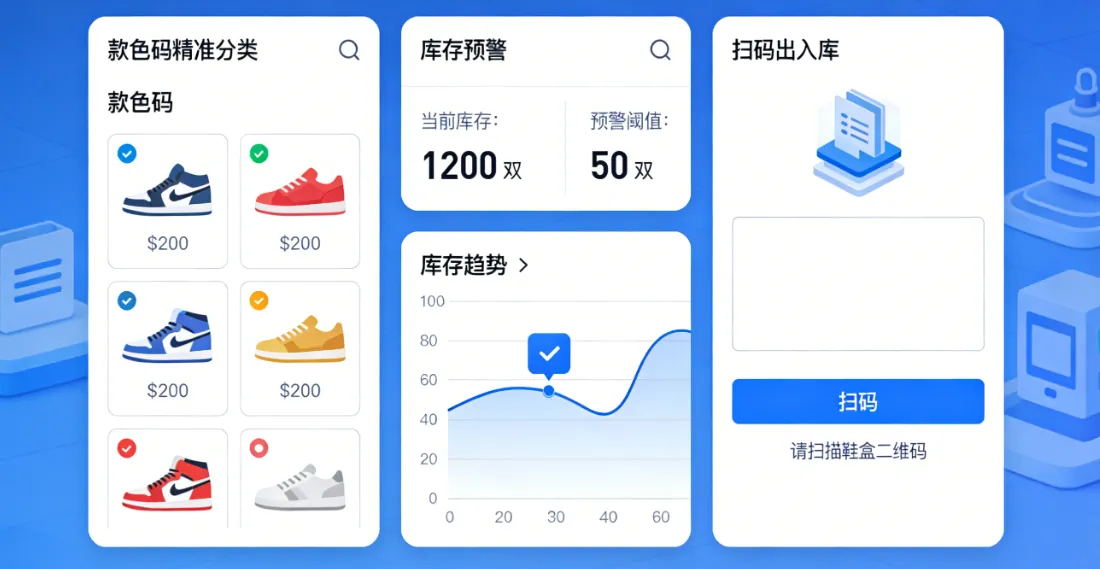
Pain point five: The inbound and outbound processes are not standardized, and errors and omissions occur frequently. The storage operations of small and medium-sized shoe factories lack standardized processes. When entering the warehouse, material specifications and batches are not strictly checked, and precise picking and review processes are not carried out when leaving the warehouse. They rely solely on the experience of warehouse personnel to operate, which can easily lead to problems such as incorrect, missed, and excessive shipments. Especially in the face of multiple parallel orders and urgent insertion of orders, the workflow is chaotic, which not only increases rework and replenishment costs, but also leads to delayed order delivery and damages customer cooperation stickiness. According to statistics, the customer complaint rate caused by non-standard inbound and outbound operations in small and medium-sized shoe factories accounts for over 30% of the total complaint rate, resulting in some companies missing out on long-term cooperative orders.
Pain point six: Insufficient coordination between warehousing and the entire chain, resulting in information silos. The warehouse management of small and medium-sized shoe factories is often independent of the procurement, production, and sales processes, and data cannot be synchronized in real time, forming an "information island". The procurement department is unable to accurately obtain raw material inventory data, which can lead to blind procurement and material backlog; The production department is unable to timely grasp the progress of raw material delivery and inventory levels, making it difficult to optimize production plans; The sales department is unable to check the inventory of finished products in real time, cannot accurately promise delivery cycles when accepting orders, and the after-sales return and warehousing are not synchronized in a timely manner, further exacerbating inventory chaos. This lack of collaboration leads to low efficiency throughout the entire supply chain, making it unable to meet the development needs of small and medium-sized shoe factories for "fast reverse production".
In response to the six major pain points mentioned above, the footwear ERP system will launch a lightweight and industry-specific warehouse management solution in 2025, abandoning the redundant functions of traditional heavy-duty ERP and focusing on the core needs of small and medium-sized shoe factories for "low cost, fast landing, and easy operation". It does not require large hardware investment or professional IT teams, and achieves precise control of the entire warehousing process through digital means, solving management problems one by one.
In response to the pain points of chaotic control of multiple SKUs, ERP has established a shoe industry exclusive coding system that supports the generation of unique SKU codes based on "style+color+size+batch+material", achieving accurate differentiation between raw materials and finished shoes. Warehouse personnel can quickly locate materials and finished products by scanning the code, eliminating the problem of confusion between style and color codes. At the same time, the system supports multi-dimensional classification and archiving, which can be subdivided and controlled according to last shape, material, expiration date, etc., adapting to the operational characteristics of small and medium-sized shoe factories with multiple styles and small batches, greatly improving the efficiency of warehousing operations, and reducing the SKU control error rate to less than 1%.
In response to the pain point of discrepancies between accounts and reality, ERP realizes real-time synchronization of warehouse data, equipped with barcode/RFID scanning function, and performs scanning operations throughout the entire process of inbound, outbound, material requisition, and inventory. The data is automatically entered into the system to eliminate manual recording errors. The system supports one click inventory and cycle inventory, without the need for downtime. The inventory efficiency is improved by over 80%, and the inventory accuracy can be increased to 99.9%. Managers can view real inventory data in real time through their mobile phones, completely eliminating the limitations of manual ledgers and accurately grasping inventory dynamics.
In response to the pain point of material loss control, ERP has established a full process material traceability system, accurately recording the procurement source, requisition situation, and consumption progress of each batch of raw materials, setting loss thresholds, and automatically pushing warnings when the loss exceeds the threshold to remind managers to control it in a timely manner. At the same time, the system supports the registration of auxiliary materials and scraps recycling, optimizes material utilization efficiency, and helps small and medium-sized shoe factories reduce raw material loss rates to below 5%, effectively reducing hidden costs. For materials that are prone to deterioration and aging, the system supports graded warning of expiration dates, providing early reminders for handling and reducing material waste caused by expiration.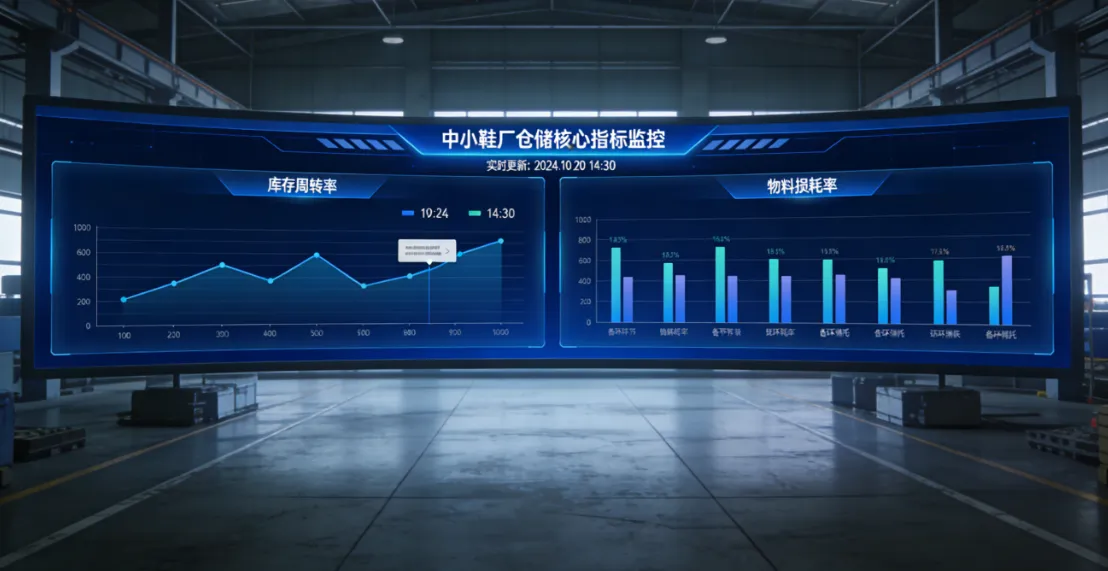
In response to the pain point of missing inventory warnings, ERP has a built-in intelligent inventory warning module that can set safety stock thresholds for raw materials and finished shoes based on production plans, sales data, and historical consumption patterns. When inventory falls below the threshold, a replenishment reminder will be automatically triggered; When the inventory of finished products exceeds the unsold period, automatic clearance suggestions will be pushed, and promotional plans will be provided based on sales data to help accelerate the return of funds. At the same time, the system supports omnichannel inventory synchronization, connects online and offline inventory data, realizes "one inventory" management, avoids supply-demand imbalance, shortens inventory turnover cycle to 1-2 months, and releases accumulated cash flow.
In response to the pain points of non-standard inbound and outbound processes, ERP has solidified standardized operating procedures. When entering the warehouse, it is necessary to scan the code to check the material specifications, batches, and quantities. Only after confirming that there are no errors can the warehouse be completed; When leaving the warehouse, the system automatically generates a picking list and guides the picking according to the optimal path. After the picking is completed, it needs to undergo a second scan of the code for review to prevent issues such as incorrect, missed, or excessive delivery. At the same time, the system records every inbound and outbound record, which can be traced at any time, facilitating subsequent reconciliation and problem investigation, effectively reducing customer complaint rates, and enhancing cooperation stickiness.
To address the pain point of insufficient full chain collaboration, ERP breaks down the data barriers between warehousing and procurement, production, and sales processes, and achieves real-time synchronization of data throughout the entire process. The procurement department can accurately develop procurement plans based on raw material inventory data to avoid blind procurement; The production department can query the inventory and delivery progress of raw materials in real time, optimize production scheduling, and avoid downtime and waiting for materials; The sales department can query finished product inventory in real-time, accurately promise delivery cycles, synchronize after-sales returns and inventory in real-time, and optimize inventory structure. At the same time, the system generates multidimensional warehouse analysis reports, covering core indicators such as inventory turnover rate, material loss rate, SKU turnover rate, etc., providing scientific support for management decision-making and promoting the improvement of overall supply chain efficiency.
In 2025, competition among small and medium-sized shoe factories has entered a stage of refined management, and the efficiency and cost of warehouse management directly determine the survival and development of enterprises. The footwear ERP warehouse management solution can not only solve the six major pain points of warehousing for small and medium-sized shoe factories one by one, but also help enterprises achieve cost reduction and efficiency improvement, optimize supply chain collaboration, and complete digital upgrades without large investment. For the majority of small and medium-sized shoe factories, using ERP systems to achieve warehouse management transformation can not only solve current problems such as inventory chaos, high losses, and insufficient collaboration, but also strengthen the core competitiveness of the supply chain, stand firm in fierce industry competition, and achieve long-term development.