
Analysis of the Current Status and Future Trends of the Global Footwear Industry: New Opportunities Driven by Production Recovery, Technological Innovation, and Consumer Change
As an important branch of the global traditional manufacturing industry, the footwear industry combines labor-intensive attributes and consumer oriented characteristics. After experiencing the impact of the epidemic, supply chain restructuring, and consumer demand iteration, it is gradually entering a new stage of production recovery and quality upgrading. At present, the global footwear industry is showing a development trend of "regional pattern differentiation, accelerated technological penetration, and diversified demand upgrading". The deep integration of technological innovation and consumer change is opening up new growth space for the industry and promoting its transformation from "scale driven" to "value driven".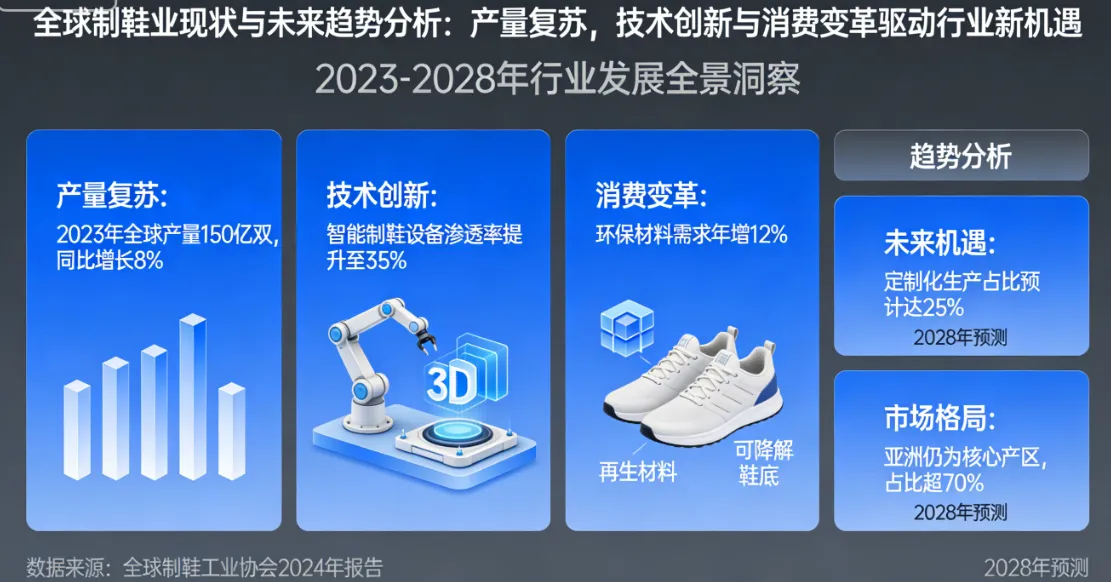
1、 The current situation of the global footwear industry: steady recovery of production, continuous restructuring of the pattern
The recovery of production has become the most prominent feature of the global footwear industry. Affected by supply chain disruptions and shrinking terminal demand during the pandemic, global footwear production experienced a significant decline from 2020 to 2021. However, with the normalization of global pandemic prevention and control, gradual recovery of logistics systems, and recovery of consumer markets, footwear production has entered a recovery channel from 2022 onwards. Data shows that the global footwear market has grown to $1.5 trillion in 2023 and is expected to exceed $450 billion by 2025. Core production countries such as China, Vietnam, and Indonesia continue to rebound in production, with China, as the world's largest footwear producer and exporter, expected to achieve a shoe export value of $87.3 billion by 2025, still occupying a core position in the global supply chain.
The regional pattern presents the characteristics of "capacity gradient transfer and consumption stratification upgrading". On the production side, due to rising labor costs and stricter environmental policies, global shoe production capacity continues to shift to Southeast Asia and South Asia. Countries such as Vietnam, Bangladesh, and India are gradually expanding their global production capacity by leveraging their cost advantages. Vietnam is expected to surpass Indonesia to become the world's second largest shoe exporting country by 2025, while China is accelerating its transformation towards high-end manufacturing and brand operation, consolidating its core competitiveness by relying on its complete industrial chain advantages. On the consumer side, the Asia Pacific region has become the world's largest consumer market, accounting for 45% of global shoe sales by 2024 and expected to increase to 52% by 2030. Emerging markets such as China and India have seen a surge in demand driven by consumption upgrades; The growth rate of the European and American markets has slowed down, but high-end footwear products maintain an annual growth rate of over 8%, forming a distinct consumer stratification pattern.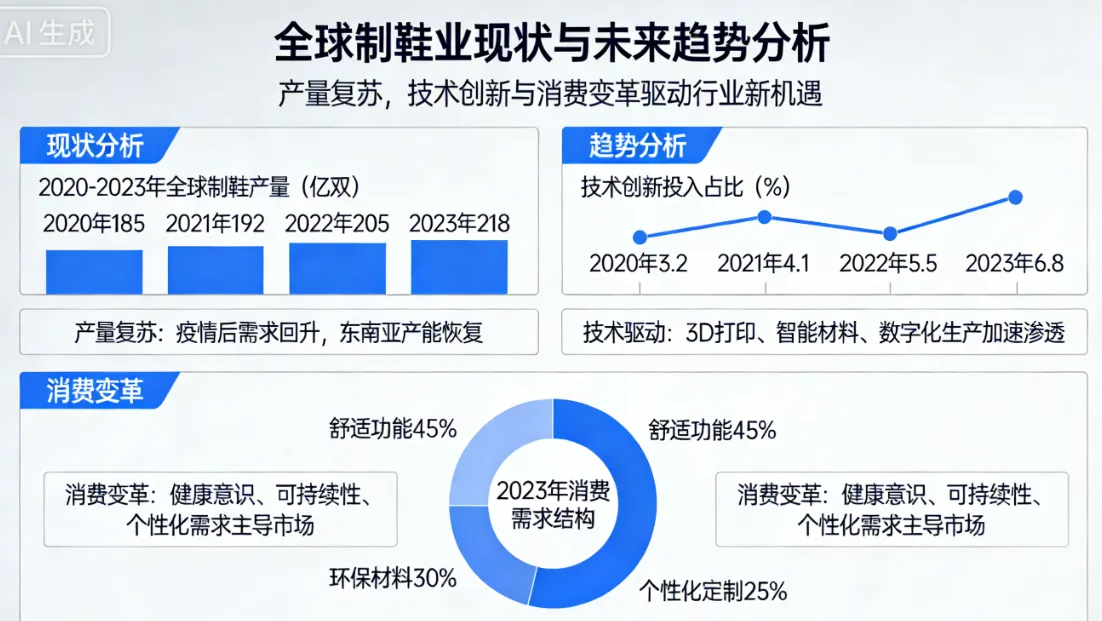
The industry competition presents a trend of "head concentration and small and medium-sized breakthroughs". International brands such as Nike and Adidas continue to dominate the high-end market with their technological research and brand influence. By 2023, Nike's global sales will reach $40 billion, while Adidas will reach $38 billion; Domestic brands such as Anta and Li Ning have gradually emerged as important forces in the global market through international layout and product innovation. Anta has achieved global expansion through the acquisition of Filo, and Li Ning has improved its brand value with the help of China-Chic trend. At the same time, small and medium-sized shoe enterprises focus on segmented fields, respond to market competition through differentiated positioning and flexible production, and form a diversified competitive pattern.
2、 Core driving force: Technological innovation reconstructs production mode, consumption change reshapes demand pattern
(1) Technological innovation empowers industries to improve quality and efficiency
Intelligent manufacturing has become the core direction for upgrading the production end, gradually replacing traditional manual production modes. The penetration rate of technologies such as automated cutting, 3D printing of shoe molds, and AI visual quality inspection has significantly increased among leading enterprises. Intelligent production lines can improve cutting efficiency by 30%, digital design can compress the new product development cycle from 18 months to 9 months, and 3D printing technology can achieve rapid prototyping in 72 hours, greatly reducing production costs and research and development cycles. For example, Adidas has launched 3D printed running shoes that meet personalized foot shape needs through precise modeling, while enhancing product comfort and durability; Domestic shoe companies are also accelerating the layout of smart factories, relying on digital twin technology to achieve visualization and traceability of the entire production process, and promoting the transformation of the industry towards high-end manufacturing.
The research and application of new materials have become important breakthroughs in product innovation, especially focusing on green environmental protection and functional upgrades. The commercialization of green materials such as bio based polyurethane, recycled PET, and biodegradable EVA is accelerating. It is expected that the substitution rate of bio based environmentally friendly materials will reach 40% by 2030, promoting a 20% -30% reduction in the carbon footprint of products throughout their lifecycle. Brands such as Allbirds and NewBalance have launched environmentally friendly shoes to attract consumers through sustainable production methods. The application of functional materials promotes the professional upgrading of products. The aerogel composite insole improves the shock absorption performance by 40%. The intelligent wearing shoes and boots are equipped with pressure monitoring, gait correction and other functions, becoming a new hotspot in the field of sports and health. The growth rate of intelligent wearing integrated footwear products is expected to reach 45% in 2025.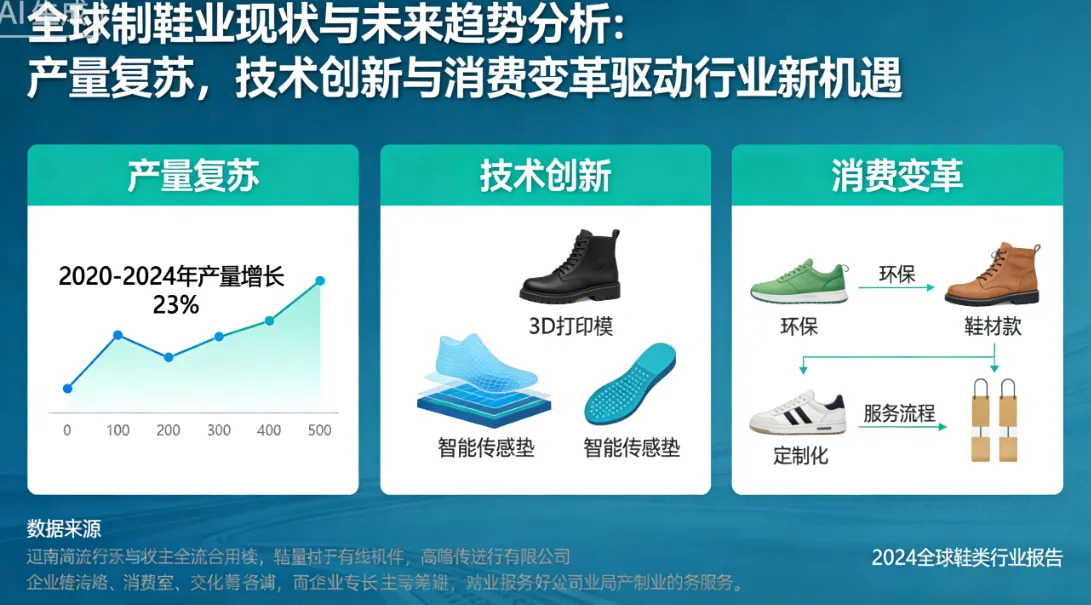
(2) Consumer change leads to diversified upgrading of demand
The iteration of consumer groups drives personalized and diversified development of demand. Generation Z and the new middle class have become the core consumer groups, no longer satisfied with basic clothing needs, but more focused on product design, functionality, and brand values. The demand for customized services has surged, and it is expected that the proportion of customized services will soar from the current 3% to 15% by 2030. The combination of 3D foot scanning and flexible production technology has reduced the cost of single piece flow by 62%, attracting top enterprises to increase research and development investment. At the same time, consumer scenarios continue to be segmented, and the demand for shoes in sports and leisure, business leisure, outdoor exploration and other segmented scenarios continues to grow. Among them, the sports shoe category has the fastest growth, accounting for 42.3% of the global footwear market share by 2025 and expected to exceed 50% by 2030.
The concept of green consumption has deeply penetrated people's hearts, promoting the transformation of the industry towards sustainable development. Global consumers' attention to environmental certification and low-carbon production continues to rise, and shoes made with environmentally friendly materials and recyclable designs are more favored. It is expected that green footwear products will account for more than 30% of the global market share by 2030. In addition, the digital transformation of consumer channels is accelerating, with e-commerce platforms and social media becoming core sales and marketing platforms. Cross border e-commerce has increased the proportion of shoe exports to 35%, and technologies such as AR virtual try on have improved consumer experience, making online channels an important support for industry growth. Nike has successfully increased its global market share through the "Nike+" platform and social media marketing.
3、 Industry Challenges and Future Trends: Breaking through the impasse and embracing new opportunities for high-quality development
The current global footwear industry still faces multiple challenges: fluctuations in raw material prices (such as a 10% -15% increase in the cost of synthetic rubber and other materials), rising labor costs, intensified international trade frictions, and increasingly strict compliance requirements such as the EU Carbon Border Adjustment Mechanism (CBAM) and the Corporate Sustainability Due Diligence Directive (CSDDD), which bring significant pressure to small and medium-sized shoe enterprises; At the same time, issues such as homogeneous competition and insufficient brand influence constrain the industry from upgrading to the high-end market.
In the future, the global footwear industry will present four major development trends. One is that greening has become the core track of the industry. Enterprises will continue to increase investment in research and development of environmentally friendly materials and low-carbon process transformation, build a circular economy model of "production consumption recycling", and respond to the global trend of environmental protection regulation and green consumption demand. The second is the deep integration of intelligence and digitization. Intelligent production, digital marketing, and personalized customization will become the core competitiveness of enterprises. The industry automation rate is expected to increase to over 50% by 2030, and digital capabilities will become the key to the survival and development of enterprises. The third is the transformation of the global supply chain towards diversification and localization. Enterprises will adopt the "China+1" or "friendly shore outsourcing" strategy to diversify supply chain risks, while deeply cultivating the local market, achieving an organic combination of global layout and localized operation. The fourth is the continuous expansion of segmented markets, with explosive growth in areas such as sports technology, elderly walking, and light luxury leisure. Enterprises with differentiated advantages and core technologies will seize market opportunities, promote industry profit levels, and expect the industry profit margin to increase from 5.8% to 8.3% by 2030.
In summary, the global footwear industry is currently in a critical period of transformation, characterized by a recovery in production and an upgrade in quality. Technological innovation and consumer change are the core driving forces behind the industry's development. In the face of opportunities and challenges, shoe companies need to leverage their own advantages, focus on product innovation, technological upgrades, and brand building, and adapt to the trend of green, intelligent, and personalized development in order to break through the global market competition and seize new opportunities for high-quality industry development.