
Comparison of differences between footwear ERP and traditional factories
In the wave of digital transformation in the footwear industry, the management mode of traditional factories has gradually become difficult to adapt to the high-quality development needs of the industry. The popularization and application of footwear ERP systems are promoting the leapfrog transformation of footwear factories from "extensive management" to "refined operation". As a typical labor-intensive, multi category, and fast turnover industry, the footwear industry covers multiple links such as shoe upper processing, sole production, and finished product assembly. The materials are complex (shoe upper, sole, heel, accessories, etc.), there are numerous SKUs, the production cycle is short, and market demand is variable. These characteristics make the management pain points of traditional factories increasingly prominent. As a digital management tool tailored specifically for the footwear industry, the footwear ERP system has essential differences from traditional factory management models, process control, cost control, and many other aspects. These differences are not only reflected in management methods, but also determine the operational efficiency, cost control capabilities, and core competitiveness of the factory. This article will comprehensively compare the differences between shoe ERP and traditional factories from multiple core dimensions, and interpret the reshaping value of digital tools on shoe factories.
The difference in management mode is the core difference between shoe ERP and traditional factories, which directly determines the management efficiency and decision-making scientificity of the factory. Traditional shoe factories rely on "manual management" as their core, relying on the experience of management personnel to carry out daily operations, which belongs to a typical "experience driven" model. In traditional factories, every step from production planning, material procurement, inventory management to order delivery requires manual statistics, manual recording, and verbal communication. The management process is loose and lacks a standardized and regulated control system. For example, the formulation of production plans relies solely on the judgment of management personnel based on historical order experience, which can easily lead to a disconnect between plans and actual production capacity; Material procurement relies on manual inventory statistics, which can easily lead to problems of excessive or insufficient procurement; There is a lack of effective information linkage between departments, with production, procurement, inventory, sales and other links fighting independently, forming information silos, resulting in low management efficiency and a lack of precise data support for decision-making, often leading to the phenomenon of "brainstorming" decisions.
The footwear ERP system adopts a "digital and intelligent management" mode, with "data-driven" as the core, integrating all operational links of the factory into a unified digital control platform, achieving standardized, normalized, and visualized control throughout the entire process. The ERP system relies on big data and information technology to integrate multi-dimensional data such as personnel, finance, materials, production, supply, and sales in factories, breaking down information barriers between departments and achieving real-time data sharing and collaborative linkage. For example, the formulation of production plans no longer relies on manual experience. The system can integrate multidimensional data such as sales orders, inventory levels, and production capacity, automatically generate scientific and reasonable production plans, and clarify production tasks, time nodes, and responsible persons for each link; Management personnel can view real-time operational data of each link through the system, accurately grasp production progress, inventory status, material consumption, and other situations, and make decisions based on data, avoiding the subjectivity and blindness of empirical decision-making. This shift from "experience driven" to "data-driven" has made the management of shoe factories more precise, efficient, and standardized.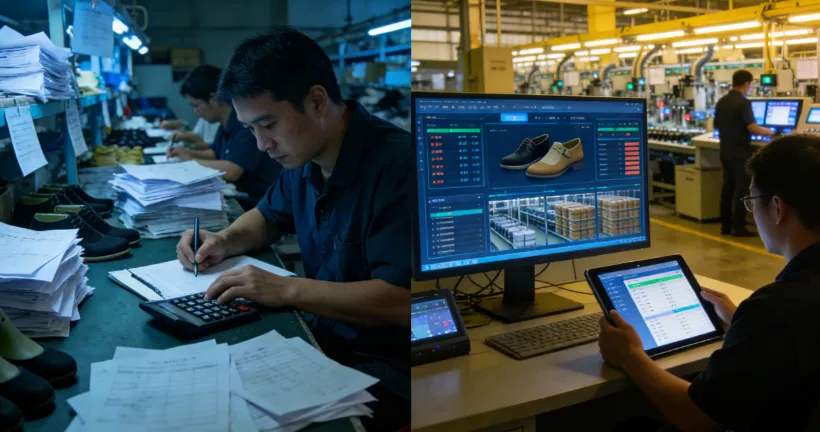
The difference in production process control directly affects the factory's production efficiency, product qualification rate, and order delivery capability, and is also one of the most intuitive differences between the two. The production process of traditional shoe factories is mainly based on "manual scheduling", which is cumbersome, poorly connected, and lacks effective control measures. It is prone to problems such as production disconnection, chaotic processes, and low efficiency. In the traditional production mode, the connection between various processes such as shoe upper processing, shoe sole production, and finished product assembly relies on manual transmission of documents and verbal communication, which can easily lead to document loss, information transmission errors, and other situations, resulting in the inability to connect the next process in a timely manner after the completion of the previous process, leading to downtime for materials or process accumulation; At the same time, data statistics in the production process rely on manual recording, which is time-consuming, labor-intensive, and has significant errors. Production progress, process losses, product quality, and other data cannot be grasped in real time. Once quality problems or production abnormalities occur, it is difficult to quickly trace the root cause and can only be passively rectified, seriously affecting production efficiency and product qualification rate.
The footwear ERP system realizes the "full chain digital control" of the production process, incorporating every process and detail of the production process into the scope of system control, achieving smooth process connection, transparent production progress, and traceable abnormalities. The system can break down the production plan into specific process tasks, specifying the production time, personnel, required materials, and equipment for each process. Workers can view the process tasks and operating standards in real time through the system. After completing a process, they can submit completion information through the system and automatically synchronize to the next process, achieving seamless connection between processes and avoiding downtime, waiting for materials, or process accumulation; At the same time, the system collects various data in real-time during the production process, including production progress, process losses, product quality, equipment operation status, etc., and updates them in real-time to the system backend. Management personnel can visually view the entire production process through the system and accurately grasp the production situation of each process. Once production abnormalities or quality problems occur, the system can automatically issue warnings and quickly trace the root cause of the problem (such as material quality, operating procedures, production personnel, etc.), guiding management personnel to rectify in a timely manner, effectively improving production efficiency and product qualification rate. In addition, the system also supports the standardization of production processes, standardizing the operating standards and procedures of each process, ensuring the unity and standardization of the production process, and reducing human operational errors.
The difference between material and inventory management is the core manifestation of cost control between the two, which directly affects the capital occupation and operating costs of the factory. The materials of footwear products are complex and there are numerous SKUs. Traditional footwear factories mainly rely on "manual accounting" for material and inventory management, resulting in chaotic inventory data, discrepancies between accounts and reality, and easy problems such as material backlog, shortage, or loss. A large amount of funds are idle in inventory, which increases the operating costs of the factory. In the traditional inventory management model, the entry, exit, and storage of materials rely on manual recording, which can lead to accounting errors, material loss, and other situations, resulting in discrepancies between inventory data and actual materials. Management personnel cannot accurately grasp inventory levels and can only blindly purchase materials, which can lead to excessive procurement and material backlog, occupying a large amount of working capital and storage space, and increasing costs such as warehouse rent, manual management, and material loss; Or there may be material shortages leading to production shutdowns, affecting production progress, increasing production costs and opportunity costs. In addition, in traditional inventory management, the search and scheduling of materials rely on manual labor, which is time-consuming and labor-intensive, further reducing management efficiency.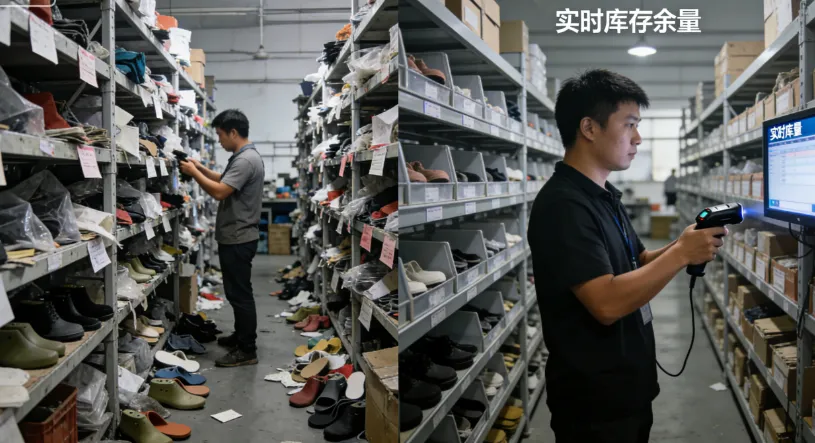
The footwear ERP system has achieved "refined and intelligent control" of materials and inventory, completely solving the pain points of traditional inventory management and effectively reducing inventory costs and capital occupation. The system has built a full process material and inventory management module to achieve full lifecycle control of materials from procurement, warehousing, storage, requisition, consumption to scrapping. When materials are received, relevant information (specifications, quantity, batch, supplier, etc.) is entered by scanning the code, and the system automatically generates a receipt document, updates inventory data in real time, and ensures that the accounts match the actual inventory; When storing materials, the system classifies and manages them based on their characteristics and specifications, sets inventory warning thresholds, and automatically triggers replenishment reminders when material inventory is below the warning value. When material inventory is above the warning value, management personnel are reminded to adjust the procurement plan in a timely manner to avoid material backlog; In the material requisition process, the production department needs to submit a requisition application through the system, specifying the purpose and quantity of the materials to be requisitioned. The system automatically checks the inventory balance and can only be requisitioned after approval. The requisition data is synchronized in real time to the inventory module to ensure that material consumption can be traced and controlled, avoiding material waste and misuse. At the same time, the system can automatically calculate material loss, analyze the causes of loss, and help factories optimize material usage plans to reduce material loss; Through accurate inventory data support, optimize procurement plans, achieve "production based on sales, procurement based on production", balance supply and demand, reduce capital occupation costs, and activate idle funds.
The difference between order management and delivery capabilities directly affects the market competitiveness and customer satisfaction of the factory. The order management of traditional shoe factories is mainly based on "manual recording and tracking", with chaotic order information and untimely tracking, which can easily lead to problems such as order delays and delivery errors, affecting customer satisfaction and factory reputation. In the traditional order management mode, the processes of receiving, entering, tracking, and delivering orders rely on manual operations, which can easily lead to errors in order information input, untimely tracking, and other situations. Management personnel cannot grasp the production progress, material preparation, delivery status, etc. of orders in real time. When there are abnormalities in orders, they cannot detect and handle them in a timely manner, resulting in delayed delivery of orders; At the same time, traditional factories lack effective overall planning for order delivery, which can lead to multiple orders being produced simultaneously, resulting in production capacity conflicts, further exacerbating order delays, affecting customer satisfaction, and even causing customer churn.
The footwear ERP system has achieved "full process visualization and intelligent tracking" of order management, greatly improving order delivery capabilities and customer satisfaction. The system can achieve rapid entry, automatic disassembly, and real-time tracking of orders. Management personnel can view detailed information of each order (customer requirements, product specifications, delivery time, etc.) in real time through the system, as well as the production progress, material preparation, quality inspection, delivery status, etc. of the order, achieving visual control of the entire order process; At the same time, the system can automatically optimize the order production plan based on order demand and production capacity, allocate production capacity reasonably, avoid capacity conflicts caused by multiple orders being produced simultaneously, and ensure timely production and delivery of orders. When there is an abnormality in the order (such as material shortage, production delay, etc.), the system automatically issues a warning to remind management personnel to handle it in a timely manner, minimizing the risk of order delay. In addition, the system can automatically generate order delivery reports, collect data such as order delivery rate and delay rate, help management personnel analyze weak links in order management, optimize order management processes, and further improve order delivery capabilities and customer satisfaction.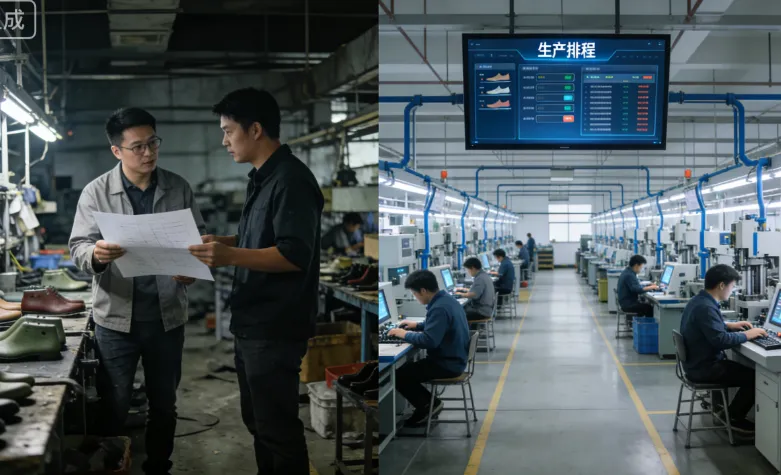
In addition to the core differences mentioned above, there are also significant differences between shoe ERP and traditional factories in cost control, personnel management, data statistics, and other aspects. In terms of cost control, traditional factories rely on manual accounting for cost statistics, which is time-consuming, labor-intensive, and has significant errors. It is difficult to accurately grasp the cost consumption of each link, and cost optimization lacks specificity; The footwear ERP system can automatically collect cost data from various links such as production, procurement, and inventory, conduct real-time cost accounting and analysis, generate multidimensional cost reports, help management personnel accurately grasp cost consumption pain points, formulate targeted cost optimization plans, and effectively reduce operating costs. In terms of personnel management, traditional factories mainly rely on manual registration and verbal arrangements, with unclear job responsibilities and non-standard performance evaluations, which can lead to problems such as work shirking and low efficiency; The footwear ERP system can achieve clear division of personnel job responsibilities, precise allocation of work tasks, and digital control of performance evaluation. It automatically collects data on employees' work progress, work quality, etc., providing accurate basis for performance evaluation, stimulating employees' work enthusiasm, and improving work efficiency.
In summary, the difference between shoe ERP and traditional factories is essentially the difference between "digital management" and "manual management", "refined operation" and "extensive management". The management mode of traditional shoe factories is no longer suitable for the digital and refined development needs of the industry. With the increasingly fierce competition in the shoe industry, their management pain points will be further highlighted and gradually eliminated by the market. The footwear ERP system, through digital and intelligent management methods, completely solves the management pain points of traditional factories from multiple dimensions such as management mode, production process, material inventory, and order management, greatly improving the operational efficiency, cost control ability, and order delivery ability of factories, and promoting the high-quality development of footwear factories.
For footwear enterprises, introducing a footwear ERP system is not a simple tool upgrade, but a comprehensive change in management mode. In the process of introducing ERP systems, enterprises need to combine their own production scale, product types, and management needs, reasonably layout system functions, promote deep integration between the system and business, strengthen employee training, enhance employees' digital operation capabilities, and ensure that the value of the ERP system is fully realized. In the future, with the continuous iteration of digital technology, the footwear ERP system will be further optimized and upgraded, incorporating emerging technologies such as AI and digital twins. The difference from traditional factories will further expand, becoming the core support for footwear enterprises to achieve differentiated competition and sustainable development, and promoting the transformation of the entire footwear industry towards digitization, intelligence, and refinement.