
Analysis of Core Functions of ERP System in Shoe and Clothing Industry: Intelligent Control of Production, Inventory and Quality
The footwear and apparel industry has the characteristics of fast fashion iteration, multi SKU control, strong seasonal periodicity, and high demand for flexible production. Production chaos, inventory backlog, and uneven quality are the core pain points that have long constrained the development of enterprises. With the deepening of digital transformation, ERP system has become a key lever for shoe and clothing enterprises to solve management difficulties. Among them, the three core control functions of production, inventory and quality are the core support for reconstructing enterprise operation efficiency and building a solid brand foundation. Unlike the homogeneous design of general ERP, the shoe and clothing specific ERP is based on industry scenarios, deeply integrating and coordinating the three major functions to achieve intelligent control of the entire chain from raw material input to finished product output, helping enterprises to break away from extensive operations and move towards a new stage of refined management.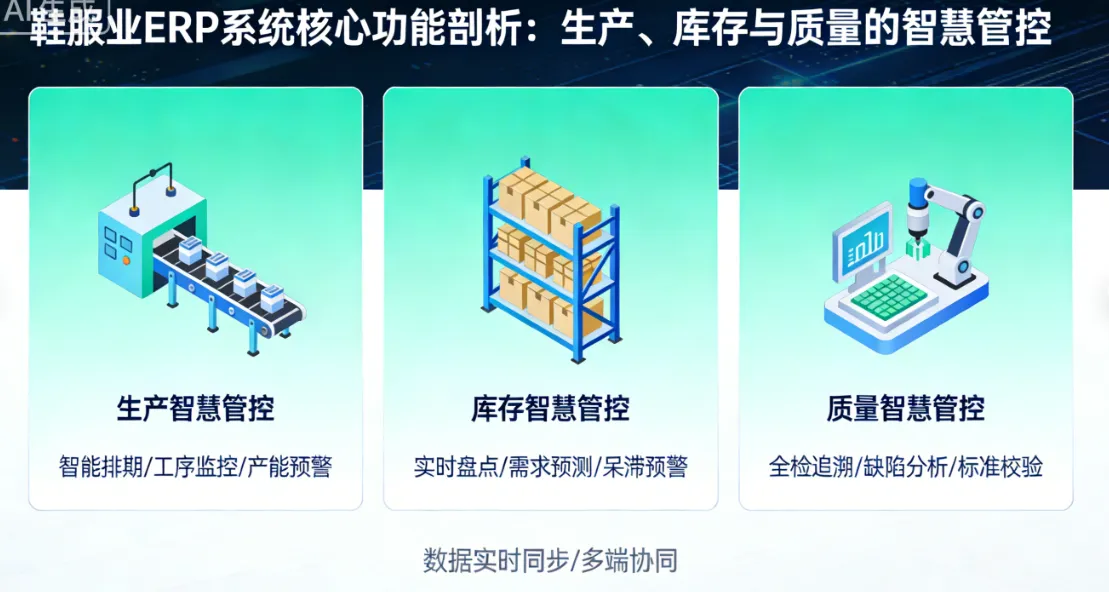
Intelligent Production Control: Adapt to Flexible Production, Break Efficiency Bottlenecks
The production of shoes and clothing often involves multi process collaboration, small batch and multi batch orders. Traditional manual scheduling is difficult to balance order priority, equipment load and material matching, and is prone to problems such as work stoppages, long production cycles, and poor process connections. It is particularly difficult to adapt to the core requirements of the fast fashion industry's "small order quick response". The production control function of ERP in the footwear and apparel industry, with "intelligent collaboration and flexible adaptation" as its core, connects the entire production process and achieves closed-loop management from order placement to finished product warehousing.
Intelligent scheduling is the core highlight of production control. ERP systems can automatically generate optimal production plans by combining multi-dimensional data such as order requirements, process complexity, equipment capacity, and personnel configuration, clarifying task allocation, time nodes, and responsible persons for each process, completely replacing the tedious and inefficient traditional manual scheduling. In response to the production characteristics of multiple styles, sizes, and colors in the footwear and apparel industry, the system can achieve parallel production of multiple orders, flexibly adjust production priorities, and quickly re adapt scheduling when orders change or are inserted, reducing production interruptions and losses. At the same time, the system supports scanning codes in the workshop to report work progress. Frontline employees can provide real-time feedback on process progress, and management personnel can monitor production dynamics in real-time through the background, accurately locate bottleneck links, and timely allocate manpower and equipment resources, shortening the production cycle by 25% -30% and greatly improving order delivery efficiency.
In addition, the production control function also realizes deep linkage with the procurement and inventory modules, automatically synchronizes material demand data, checks the completeness of materials, warns of material shortage risks in advance, and avoids downtime and waiting for materials; Simultaneously recording data such as material consumption and labor hour statistics during the production process, providing accurate support for cost accounting, helping enterprises optimize production processes, reduce operating costs, and adapt to the dual needs of flexible production and large-scale production.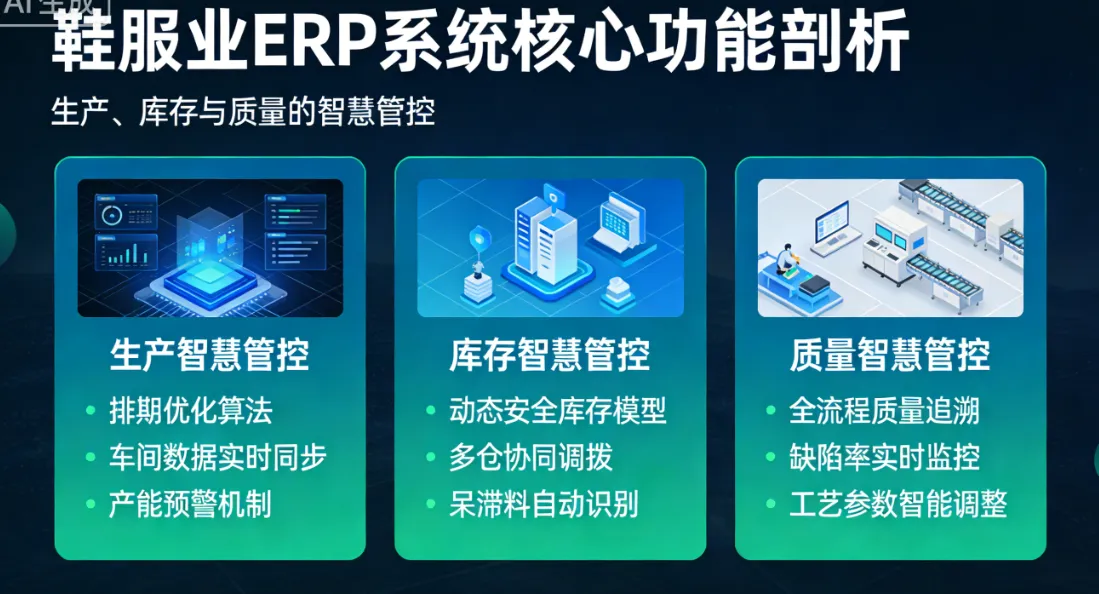
Intelligent inventory management: precise control of the entire domain, activating cash flow
Inventory management is a "pain point and disaster area" for footwear and apparel enterprises. It is difficult to control SKUs with multiple sizes, colors, and styles. Traditional manual recording is prone to errors and omissions, resulting in discrepancies between the book and actual inventory. Either best-selling items are out of stock and miss the market, or unsold items accumulate and occupy funds. Some footwear and apparel enterprises' stagnant inventory even occupies more than 10% of their revenue. The inventory control function of ERP in the footwear and apparel industry, with "global visibility and precise scheduling" as its core, solves the problem of inventory chaos and achieves efficient capital utilization.
Multi dimensional inventory control is the core advantage. The ERP system supports "style color size" three-dimensional coding management, accurately records the detailed specifications of each product, and synchronizes real-time data from the entire process of warehousing, outbound, transfer, and inventory to ensure accurate and traceable inventory dynamics. The system can set a safety stock threshold, which will automatically trigger a replenishment warning when inventory falls below the threshold. Combined with sales data and seasonal cycles, intelligent replenishment suggestions will be provided to avoid stock shortages and supply interruptions; At the same time, intelligent tagging of stagnant inventory is carried out, combined with sales trends to push clearance plans, helping enterprises quickly digest inventory and reduce capital occupation.
The collaboration of global inventory highlights its value. The ERP system connects inventory data from all channels, including general warehouses, sub warehouses, offline stores, and online e-commerce, achieving "global inventory management". Management personnel can control the inventory balance of each channel in real time, flexibly allocate inventory, and avoid the problem of cross channel shortage and backlog. For example, when a certain size is out of stock in offline stores, it can be quickly transferred from nearby warehouses or the main warehouse to improve customer satisfaction; At the same time, it supports synchronous inventory counting, replacing manual reconciliation with QR code counting, shortening monthly inventory time from a few days to a few hours, improving inventory accuracy to over 99%, and significantly reducing labor costs and data errors.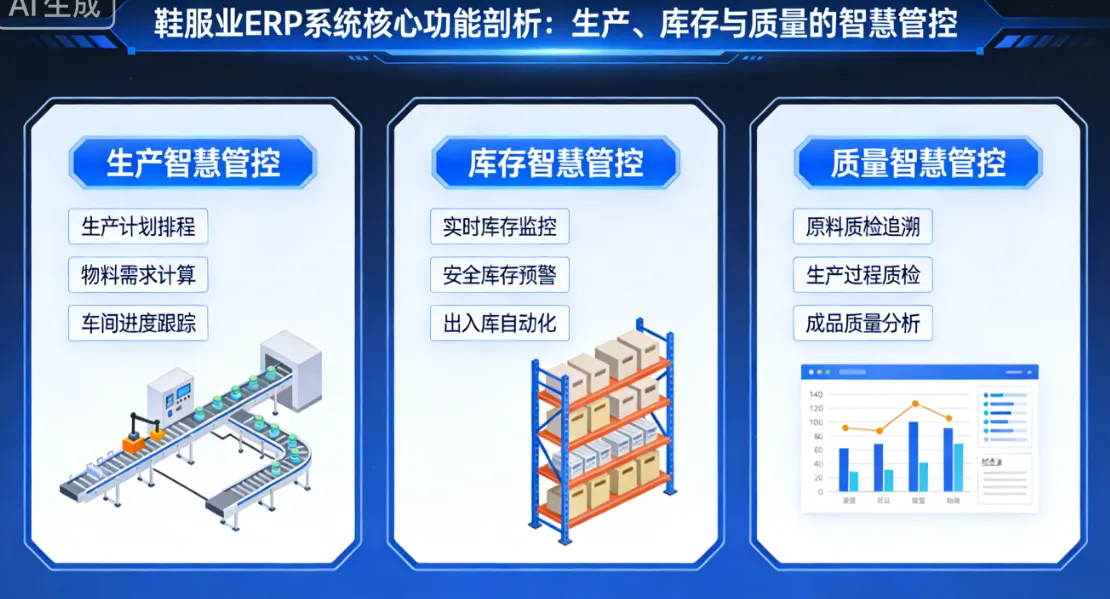
Quality intelligent control: full chain traceability, building a solid brand foundation
The quality of the footwear and apparel industry directly determines brand reputation. Traditional quality control relies heavily on manual quality inspection, which leads to problems such as inconsistent standards, difficult traceability of hidden dangers, and high rework rates. Especially with consumers' increasing demand for quality and stricter environmental compliance, full chain quality control has become the core competitiveness of enterprises. The quality control function of ERP in the footwear and apparel industry is centered on "standardized control and full process traceability", achieving quality control at every stage from raw material entry to finished product exit.
Full chain quality traceability is the core highlight, and the ERP system can record the entire process quality inspection data of raw material procurement, production and processing, finished product testing, and outbound delivery, establishing a complete quality traceability system. When raw materials enter the factory, strict quality inspection is carried out on fabrics, accessories, etc. Unqualified materials are prohibited from being stored. At the same time, the quality inspection results and supplier information are recorded to provide support for supplier rating; During the production process, standardized quality inspection nodes are set up for each process such as shoe upper sewing, cutting, and forming, and real-time quality inspection data is collected. Once quality hazards occur, automatic warnings are issued, forcing the production process to rectify and reduce rework rates; Before the finished products are released from the warehouse, a comprehensive quality inspection is conducted. Only qualified products can be released from the warehouse, while unqualified products are classified and processed to avoid inferior products from entering the market.
In addition, the ERP system can integrate quality data, generate multi-dimensional quality inspection reports, and visually present information such as the pass rate and types of quality hazards in each link, helping enterprises analyze the root causes of quality problems, optimize production processes and quality inspection standards, and gradually improve product yield. For products that have quality complaints, the ERP system can quickly trace back to the production batch, raw material suppliers, and quality inspectors, accurately locate the problem, quickly provide solutions, reduce brand reputation losses, and build a solid foundation for brand quality.
Conclusion: Intelligent control of production, inventory, and quality is the core value of ERP systems in the footwear and apparel industry. The three do not exist independently, but work together to form a closed loop - production control links inventory data to avoid downtime and waiting for materials, inventory control relies on optimized scheduling of production and quality data, and quality control runs through the entire production and inventory process, jointly promoting efficiency improvement, cost reduction, and quality upgrading of footwear and apparel enterprises. In the current era of accelerated fast fashion iteration and intensified market competition, shoe and clothing enterprises can only rely on the three core control functions of ERP systems, solve traditional management pain points, and achieve refined control throughout the entire chain in order to stand firm in the wave of digital transformation, build differentiated competitive advantages, and promote high-quality brand development.