
ERP system achieves efficiency improvement, information integration, and process optimization
In the context of the deep integration of the digital economy and the real economy, enterprise operation and management are facing the challenge of transitioning from extensive to refined, and from decentralized to integrated. In the traditional enterprise management model, there are strict data barriers between departments, fragmented and redundant business processes, and a high proportion of manual operations, which not only slow down the pace of operations, but also lead to decision-making lag, high costs, and difficult risk control, becoming the core bottleneck restricting the development of enterprises. ERP (Enterprise Resource Planning) system, as the core carrier of digital management in enterprisesInformation integration breaks down data silos, optimizes processes, reconstructs business loops, improves efficiency, and unleashes operational potentialAs a core value, reshaping enterprise management models in all aspects has become an essential tool for modern enterprises to reduce costs, increase efficiency, operate in compliance, and achieve high-quality development.

Information integration is the fundamental capability of ERP systems and a key lever for solving the problem of "data silos" in enterprises. Traditional enterprises commonly use fragmented management tools, with independent operation and maintenance systems for departments such as finance, procurement, production, sales, warehousing, and human resources. Data standards are not unified, updates are not synchronized, and circulation is not smooth: financial personnel need to manually summarize documents from various departments to account for accounting, sales data cannot be synchronized in real time to the production end, inventory changes cannot be timely fed back to the procurement department, cross departmental data verification is time-consuming and labor-intensive, and the error rate is high. The ERP system integrates all business modules into an integrated management system by building a unified enterprise data center. Standardized master data codes, business fields, and flow rules are developed to achieve "one-time entry, global sharing, and real-time synchronization". From the perspective of internal integration, the system has established a business finance data link, and sales orders automatically trigger production scheduling, procurement requests, and inventory deductions. Business data generates financial vouchers in real-time, achieving seamless integration of business finance; From the perspective of external integration, by opening API interfaces to connect with supplier management systems, logistics platforms, e-commerce malls, and customer management systems, upstream and downstream data exchange can be achieved, and supplier supply progress, logistics trajectory, and customer order status can be visualized in real time. After deploying ERP in a certain equipment manufacturing enterprise, the internal data flow efficiency increased by 70%, and the cross departmental data verification time was compressed from an average of 3 hours per day to 15 minutes. The data error rate was reduced to below 0.5%, completely eliminating the management pain points caused by data barriers.
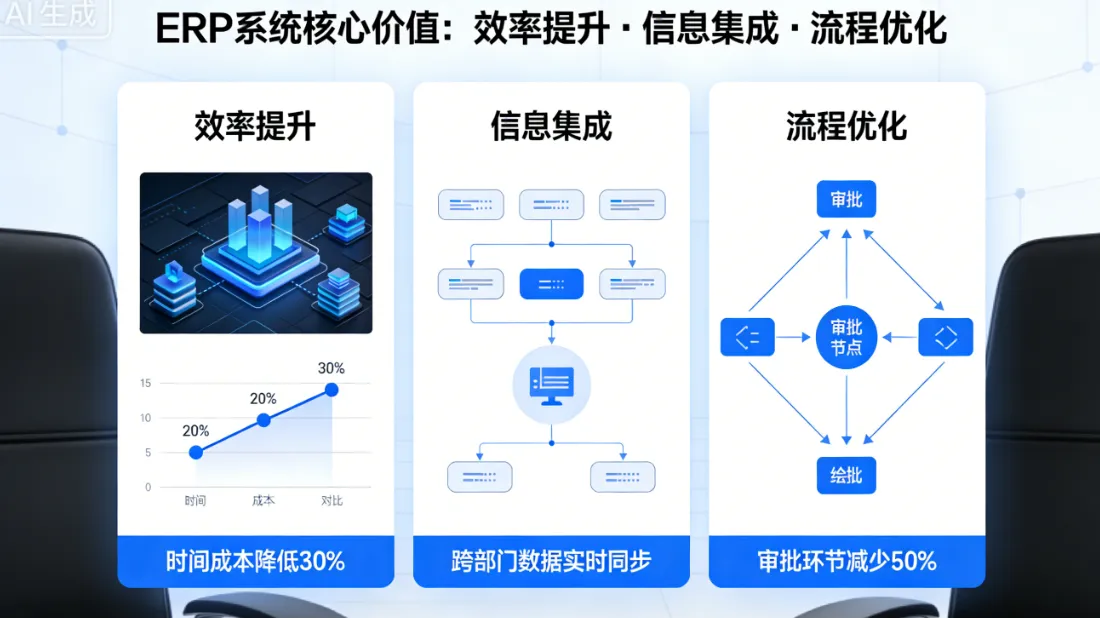
Process optimization is the core value of ERP systems, which reconstructs the entire business process through standardization, automation, and visualization, eliminates redundant links, and strengthens compliance control. Traditional enterprise business processes rely on manual transmission and offline approval, which suffer from problems such as non-standard processes, opaque nodes, and lack of efficiency guarantee: procurement approval requires layers of offline signatures, reimbursement processes take several weeks, production work order transmission is prone to omission, and violations are difficult to monitor in real time. The ERP system is based on industry best practices and has built-in standardized business process templates, covering all scenarios such as procurement management, production management, sales performance, financial accounting, and human resources. Enterprises can customize approval processes, business nodes, and permission rules according to their own needs to achieve standardized process implementation. At the same time, the system replaces repetitive manual operations with automation, and RPA technology automatically completes tasks such as invoice verification, reconciliation, inventory counting, salary accounting, and report generation. Intelligent rules trigger reminders for inventory warnings, overdue approvals, abnormal transactions, etc., forming a closed-loop management of "initiation execution approval monitoring review". In addition, the entire process can be traced and visualized, and managers can monitor the progress of the process in real time to accurately locate bottlenecks and pain points. A certain commercial enterprise optimized its procurement and reimbursement process through ERP, reducing the procurement approval cycle from 10 days to 3 days, shortening the employee reimbursement time from 15 days to 3 days, and increasing the compliance rate of the process to 100%, completely solving the problem of tedious and inefficient offline processes.
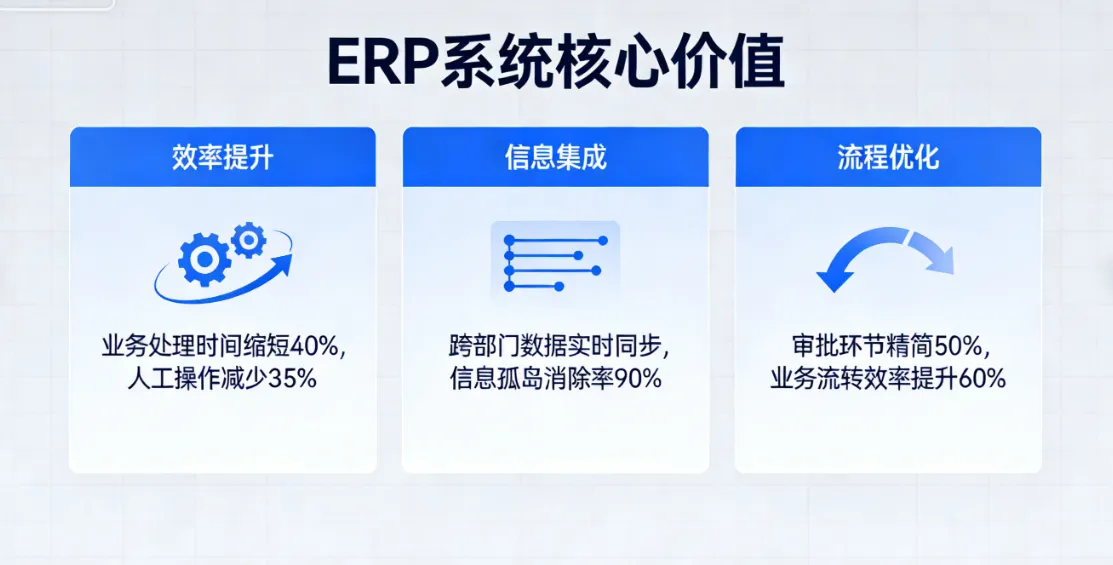
Efficiency improvement is the ultimate result of ERP system integration and optimization, covering three dimensions: operational efficiency, decision-making efficiency, and human resource efficiency, achieving cost reduction and efficiency improvement throughout the entire process. In terms of operational efficiency, ERP optimizes production scheduling and inventory configuration through precise MRP calculations, reducing the risk of raw material shortages and inventory backlog, and improving equipment utilization and order delivery efficiency; The entire process of sales fulfillment is automated, from order placement, inventory locking, logistics delivery to payment verification, and the entire process is accelerated. The average order processing cycle is shortened by 40% -60%. At the level of decision-making efficiency, the system has a built-in BI analysis module that automatically generates multi-dimensional visual reports such as sales, costs, profits, inventory, and cash flow. It supports data penetration queries and multi-dimensional drilling, allowing managers to obtain real-time operational insights without relying on technical departments. This compresses the decision-making cycle from weekly to real-time, achieving a transition from "experience decision-making" to "data decision-making". In terms of human efficiency, automation functions replace over 80% of repetitive manual operations, freeing up manpower in finance, procurement, warehousing, and other positions, allowing employees to focus on core business and value creation. After applying ERP, a small and medium-sized manufacturing enterprise reduced backend management labor costs by 30% and increased per capita output by 25%. Overall, enterprises deploying ERP have seen an average improvement of over 30% in overall operational efficiency, a reduction of 15% -25% in comprehensive costs such as warehousing, manpower, and management, and a significant enhancement in core competitiveness.
With the deep integration of cloud native, artificial intelligence, and big data technologies, the new generation of cloud ERP further amplifies the value of information integration, process optimization, and efficiency improvement. The cloud deployment mode eliminates the cost of hardware procurement and operation for enterprises, compresses the implementation cycle from months to weeks, supports elastic expansion and remote access, and adapts to the lightweight deployment needs of small and medium-sized enterprises and the large-scale expansion needs of large groups; AI algorithms empower demand forecasting, intelligent production scheduling, and risk warning, making process optimization more forward-looking and information integration more timely; The low code configuration platform supports enterprises to quickly customize business modules, adapt to personalized management needs of different industries and development stages, and achieve "on-demand empowerment and continuous iteration".
In summary, ERP systems build a solid data foundation through information integration, optimize and restructure management logic, and enhance efficiency to unleash the potential of enterprises. The three support and work together to form a core competency loop for digital management in enterprises. In the increasingly fierce market competition and continuous upgrading of management requirements, deploying and deeply applying ERP systems is not only a practical choice to solve the pain points of traditional management, but also a strategic support for building a refined management system and achieving sustainable development. Only by using ERP as a tool to integrate data, optimize processes, and improve efficiency can enterprises maintain agile response in complex business environments, achieve stable operations, and achieve long-term growth.