
How ERP software promotes digital transformation and efficient management of enterprises through cloud computing, big data, and intelligence
In the current era of deep penetration of the digital economy, the digital transformation of enterprises has evolved from local tool optimization to full chain management reconstruction, becoming a core strategy for responding to market fluctuations and building core competitiveness. Traditional locally deployed ERP software has inherent shortcomings such as high hardware investment, long implementation cycles, difficult data interoperability, and slow iterative upgrades. It can only achieve basic process solidification and cannot meet the new needs of enterprise agile collaboration, global data analysis, and intelligent forward-looking decision-making. whenCloud computing, big data, and intelligenceThe deep integration of three cutting-edge technologies with ERP not only reconstructs the deployment architecture, data capabilities, and application logic of ERP, but also upgrades it from a single process management tool to the core center of enterprise digital transformation, driving comprehensive management mode innovation, operational efficiency leap, and value creation upgrade.
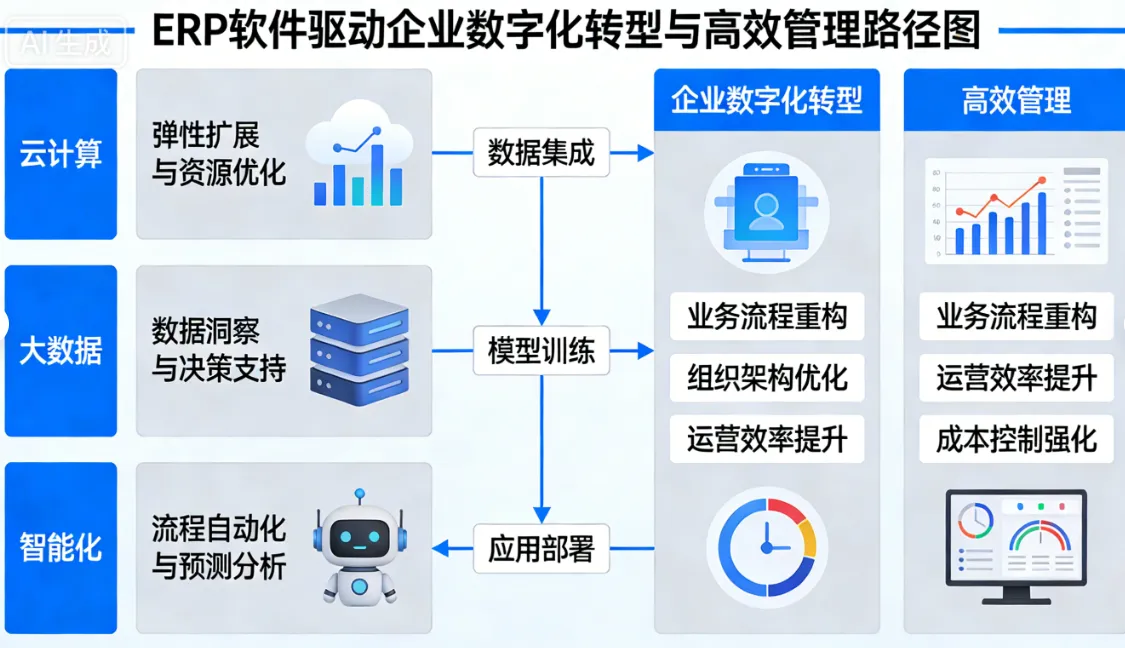
Cloud computing builds a lightweight and flexible deployment foundation for ERP software, breaking the physical limitations of traditional ERP from the bottom and reducing the entry threshold for enterprise digital transformation. Traditional local ERP requires enterprises to build their own data centers, purchase servers, and establish dedicated operation and maintenance teams. The initial capital investment can reach millions, and the implementation cycle can take up to six months to a year. Moreover, the system computing power is fixed, making it difficult to cope with the traffic impact of business peaks such as e-commerce promotion and production peak season. Upgrading in the later stage also requires additional investment in customized development costs, which makes many small and medium-sized enterprises hesitant. Cloud native ERP relies on flexible deployment models of public cloud, private cloud, and hybrid cloud to migrate software services to the cloud, adoptingSubscription based payment systemMode, enterprises can purchase according to the number of users and business modules as needed, reducing initial investment by more than 60% and shortening the implementation cycle to 1-3 months, enabling rapid implementation of digital management. At the same time, cloud architecture has elastic scalability, which can dynamically allocate computing power resources according to business fluctuations, avoiding system lag or resource idle; Breaking geographical and terminal limitations, employees can remotely access the system through PCs, mobile phones, and tablets, achieving real-time reporting of field operations, synchronized collaboration across regional branches, and remote management control by management. In addition, cloud ERP is uniformly responsible for system upgrades, data backups, security protection, real-time iteration of compliance rules and new functions by vendors. Its security capabilities such as data encryption and remote disaster recovery far exceed local deployment, effectively avoiding risks such as data loss and system failures, and providing stable and reliable underlying support for enterprise digital transformation.
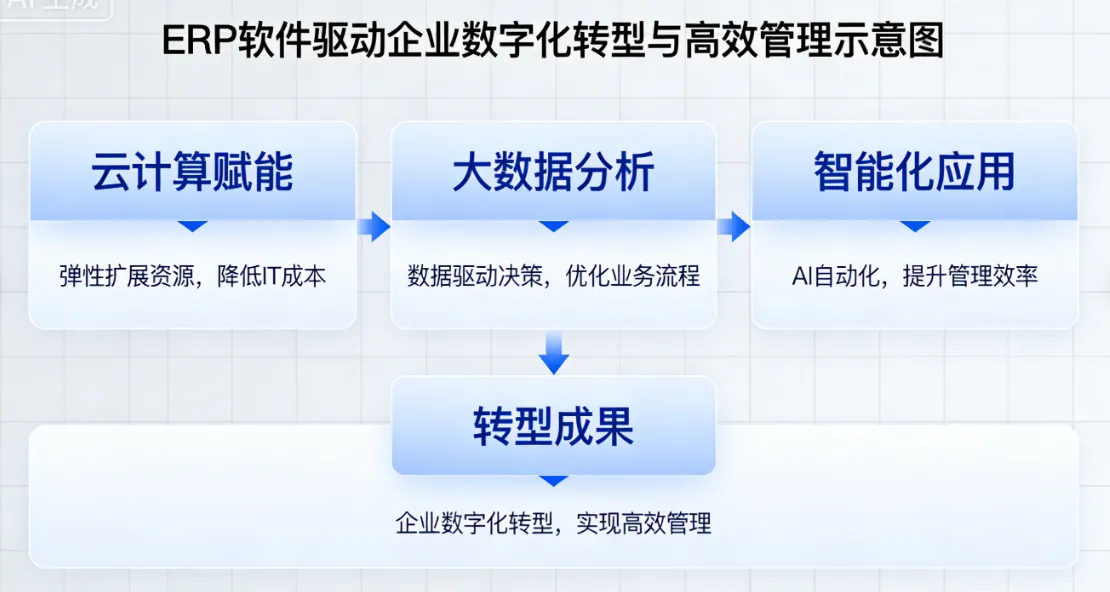
Big data technology activates the global data value of ERP, promoting the transformation of enterprises from "process recording" to "data insight", and transforming decision-making from experience driven to data-driven. Traditional ERP can only record internal business process data, and the data is scattered in various modules to form a "small data island", which cannot integrate internal and external multidimensional data to form a complete operational view. ERP that integrates big data capabilities can connect internal data such as finance, production, procurement, sales, inventory, and manpower, while also integrating external data such as e-commerce platforms, logistics systems, supply chain upstream and downstream, and market public opinion to build a comprehensive data platform for enterprises. By unifying data standards, cleaning redundant information, and managing data quality, we ensure the accuracy and consistency of data; By relying on distributed computing technology, efficient storage and rapid analysis of massive data can be achieved, generating multi-dimensional visual reports such as sales trends, cost composition, inventory turnover, customer profiles, supplier performance, etc., supporting data penetration queries and multi-dimensional drilling. In practical applications, manufacturing enterprises can optimize production plans and raw material procurement by analyzing historical orders, market demand, and seasonal fluctuations through big data, reducing inventory backlog rates by 20% -30%; Commercial enterprises can operate in a layered manner through customer behavior data, accurately locate high-value customers, and improve repurchase rates and average customer prices; Group enterprises can integrate data from all branches, monitor overall business conditions in real-time, shorten decision-making cycles from weekly to real-time, and fully unleash the value of data as a core production factor.
Intelligent technology injects autonomous decision-making and automatic execution capabilities into ERP, achieving automation of operational processes, proactive risk control, and forward-looking management decisions, greatly improving the efficiency of enterprise management. With artificial intelligence RPA、 Intelligent technology with machine learning as its core, deeply embedded in the entire business process of ERP, replaces repetitive manual operations, and compensates for the subjective limitations of manual decision-making. At the level of process automation, RPA technology automatically completes high-frequency repetitive tasks such as invoice verification, reconciliation and write off, salary accounting, report generation, and inventory counting, reducing manual input by more than 70% and lowering human error rates; At the level of intelligent decision-making, AI algorithms use deep learning of historical data to achieve market demand forecasting, supply chain risk warning, intelligent production scheduling, and logistics route optimization. For example, manufacturing companies can increase equipment utilization by 15% -25% through intelligent scheduling, while fast-moving consumer goods companies can reduce out of stock rates by 30% through demand forecasting; At the level of intelligent risk control, the system has a built-in risk control model that monitors risks such as abnormal transactions, fund misappropriation, tax violations, and overdue performance in real time. It actively pushes warning information and links processes to block them, achieving risk prevention and control in advance. Some of the new generation intelligent ERP systems are also equipped with natural language interaction technology. Employees can query reports and issue business instructions through voice commands, reducing the threshold for system use and enabling intelligent management to cover grassroots business scenarios.
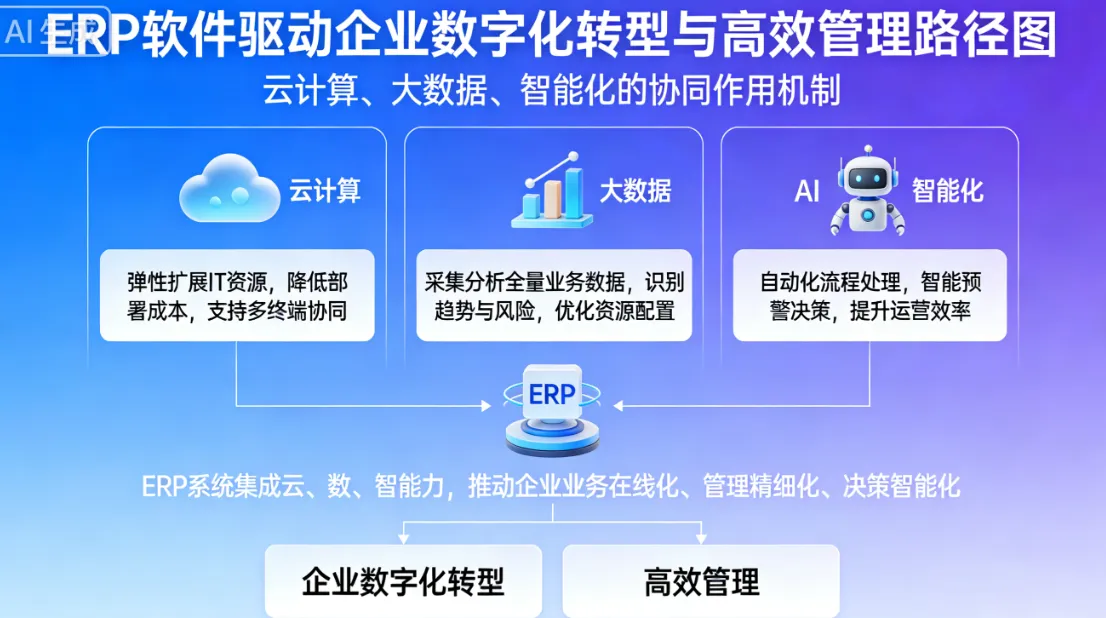
Cloud computing, big data, and intelligence do not act independently on ERP. The deep integration of the three forms a collaborative system of "computing power support data fuel intelligent brain", jointly driving the full chain digital transformation of enterprises. Cloud computing provides elastic computing power and a bottom-up environment for global collaboration, making it possible for massive analysis of big data and intelligent model training; Big data provides high-quality data raw materials for intelligent applications, ensuring the accuracy of algorithm models; Intelligence relies on cloud computing power and big data resources to upgrade from passive execution to active optimization. At the same time, through the open API interface, cloud intelligence big data ERP seamlessly connects IoT devices, industrial Internet, upstream and downstream ecosystems, builds a digital ecosystem from internal resource management to industrial chain collaboration, and cooperates with the low code configuration platform, so that enterprises can customize business modules as needed to meet the personalized needs of different industries such as manufacturing, commerce, and services. According to industry research data, after deploying the new generation ERP that integrates three major technologies, the overall operational efficiency of enterprises has increased by an average of over 30%, management costs have been reduced by 15% -25%, and market response speed and risk resistance have been significantly enhanced.
In the wave of digital transformation, the technological iteration of ERP software has always resonated with the upgrading of enterprise management. The cloud computing reconstruction deployment model, big data activation of data value, and intelligent upgrade of management efficiency work together to make ERP the core engine for enterprises to break through data barriers, optimize business processes, and achieve efficient management. For enterprises, adapting to technological trends and combining their own scale and industry characteristics to choose a suitable cloud intelligence big data ERP is not a simple system replacement, but a comprehensive innovation in management mode, operational logic, and value creation. Only by relying on the integration of technology and ERP to build a solid digital foundation can enterprises maintain agile response in complex business environments and achieve high-quality and sustainable long-term development