
Tongxin Yan S-ERP Helps Medical Device Enterprises Achieve APS Intelligent Scheduling
In the highly regulated and quality critical medical device industry, production management faces a unique and precise balance: it must meet bothMulti variety, small batch, high customizationComplex requirements that must be followedRigorous regulations (such as GMP, QSR) and full process traceabilityThe rigidity requirement. Traditional production scheduling relies on the experience of planners, who often neglect multiple constraints such as material completeness, equipment capacity, process sequence, and urgent order insertion, resulting in delivery delays, high inventory, and uneven resource utilization. Deep integration of Tongxin Yan S-ERP systemAdvanced Planning and Scheduling (APS)The module provides a data-driven and globally optimized intelligent scheduling solution for medical device enterprises, becoming the key to solving the core pain points of this industry and moving towards lean intelligent manufacturing.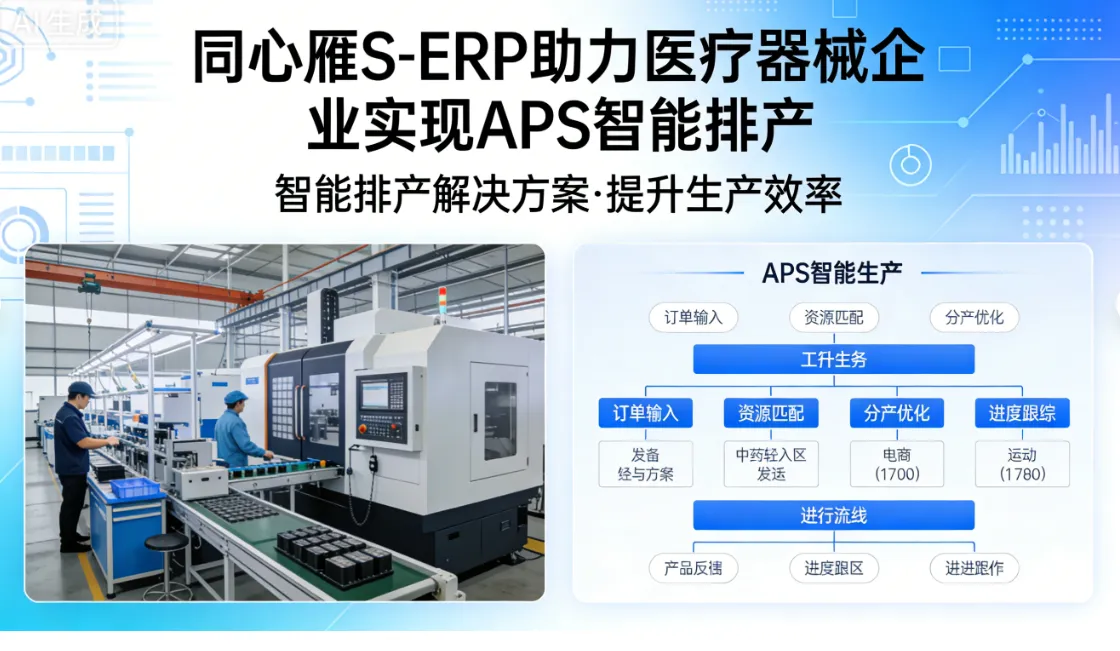
Industry Pain: The Special Complexity of Medical Device Production Scheduling
The production scheduling of medical devices is far from a simple process sequence, it is situated in a network woven by multiple rigid rules:
-
The absolute priority of regulations and quality traceabilityAny production plan must ensure compliance with the product registration process specifications, and any deviations must be rigorously evaluated and recorded. The entire process data, from raw material batch numbers, production environment, equipment parameters to operators, must be traceable, which requires the scheduling logic to deeply bind the qualification status of materials, equipment, and personnel.
-
Complex materials and production capacity constraintsCore raw materials (such as polymer materials and precision components) may have long procurement cycles and a single supplier. At the same time, the production capacity of key resources such as clean workshops, sterilization equipment, and specialized testing instruments is limited, and the preparation time for switching is long. The plan must accurately coordinate the completion date of materials and the availability window of key equipment.
-
The normalcy of demand fluctuations and emergency order placementClinical emergency orders, preparation of clinical trial samples, and design changes caused by market feedback all require the production system to have extremely high agility and responsiveness, and be able to quickly evaluate the ripple effects of insertion orders on the entire plan.
Traditional ERP/MRP (Material Requirements Planning) is based on the assumption of unlimited production capacity and fixed lead times, and is no longer able to cope with the dynamic and multi constrained reality scenarios mentioned above. This often leads to "planning not keeping up with changes" and a disconnect between workshop execution and planning.
The way to crack: the core intelligence of the Tongxin Yan S-ERP APS module
The core value of the APS module of Tongxin Yan S-ERP lies in the use of operations research algorithms and real-time data to simulate and calculate under multiple constraint conditions in secondsOptimal or feasible production planIts empowerment of medical device enterprises is reflected in three aspects:
Firstly, global visibility and synchronous planning.
The system breaks down the data barriers between sales, planning, procurement, production, and warehousing, and builds a unified view of demand and supply networks. When entering a new customer order or clinical trial sample requirement, the APS engine will simultaneously consider:
-
Material constraintsCheck the inventory and in transit status of required raw materials and components. If there is a shortage, automatically trigger procurement suggestions and schedule production based on the supplier's confirmed delivery date.
-
Ability constraintsAccurately match the available time and capabilities of key equipment (such as injection molding machines, sterilization cabinets), production lines, clean rooms, and qualified operators.
-
process constraintsStrictly adhere to the product process route, necessary intermediate product inspection and release time, mandatory equipment cleaning and verification cycle.
Through synchronous planning, the system can promise a reliable delivery date during the order confirmation stage and form a detailed job plan with minimal resource conflicts and the highest efficiency.
Secondly, dynamic optimization and intelligent decision support.
Faced with normalized insertion and changes, the APS system has demonstrated significant advantages. The planner only needs to drag the emergency order into the production schedule board, and the system can instantly re simulate the schedule, visually display the delivery impact of the new order on all existing orders (which orders may be delayed), and provide multiple optimization solutions for decision-making. For example, the system may suggest moving some processes of a batch of non urgent orders to idle capacity on weekends, or fine-tuning the process sequence to release critical equipment resources. This frees planners from tedious calculations and coordination, allowing them to focus on exception management and strategic decision-making based on system simulation results.
Thirdly, compliance embedding and full chain traceability.
The APS of Tongxin Yan S-ERP internalizes the compliance requirements of medical devices as the basic rules for production scheduling. The system will automatically avoid the time period when the equipment exceeds the calibration validity period, reserve sufficient time window for necessary cleaning and sterilization, and ensure that the relevant production batches can be fully associated with specific material batches, equipment numbers, environmental monitoring records, and operators. This production instruction generated by APS, precise to the minute level, seamlessly integrates with the subsequent MES (Manufacturing Execution System), forming a complete digital loop from planning to execution, from execution to traceability, providing a solid and error free data chain for responding to regulatory audits.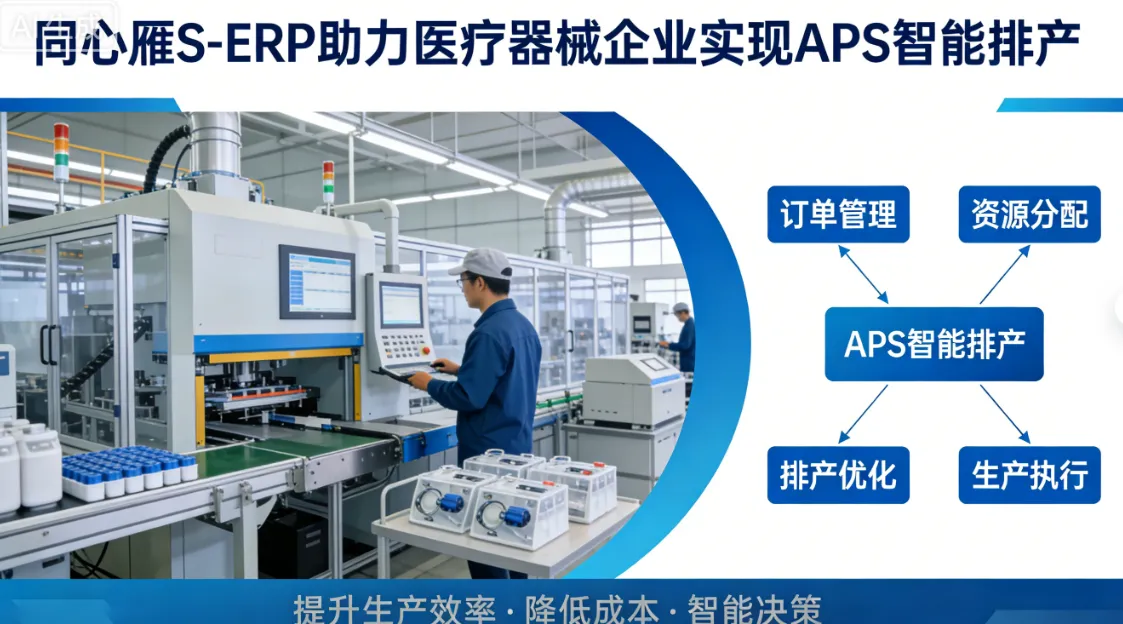
Implementation Path: From Data Governance to Continuous Optimization
Successfully deployed APS intelligent scheduling, it is recommended to follow a clear path:
-
Foundation consolidation and data governanceFirstly, relying on Tongxin Yan S-ERP to achieve standardized and precise management of core materials, BOM (Bill of Materials), process routes, resource capabilities, and other master data. This is the 'high-quality fuel' on which the APS algorithm operates.
-
Scene focus and step-by-step promotion: Priority selectionTypical and high-value product series或The workshop with the most prominent bottleneck in production capacityConduct a pilot program. For example, starting from the precision assembly line of implantable devices or the final assembly testing line of active equipment, quickly verifying value and building team confidence.
-
Human machine collaboration and cultural adaptationAPS is a powerful decision support tool, rather than a complete replacement for manual labor. It is necessary to cultivate the ability of planners to understand system logic, interpret simulation results, and make final judgments. The focus of change management is to transform the planning team from a "manual dispatcher" to a "resource optimization analyst".
-
Closed loop feedback and continuous learningReal time comparison between APS plan and actual execution data feedback from workshop MES. Deviation data will continuously feedback and optimize the scheduling parameters of APS (such as standard working hours and switching time), making the model more realistic and achieving self evolution of scheduling accuracy.
Expected Value: From Efficiency Enhancement to Strategic Empowerment
Deploying APS intelligent scheduling with Tongxin Yan S-ERP will not only improve scheduling efficiency, but also provide strategic empowerment for overall operational quality for medical device companies
-
Leap in delivery reliabilityThe on-time delivery rate of orders has significantly improved, enhancing customer trust and market competitiveness.
-
Maximizing resource utilizationImprove the utilization rate of key equipment and release more production capacity with the same investment.
-
Inventory cost optimizationAccurate material integration drives "just in time" production, reducing inventory backlog of work in progress and raw materials.
-
Compliance risk reductionRule based planning and complete digital traceability significantly reduce compliance risks caused by planning omissions.
-
Scientific management decision-makingProvide decision-making basis based on simulated data for capacity planning, new investment evaluation, and order taking strategies.
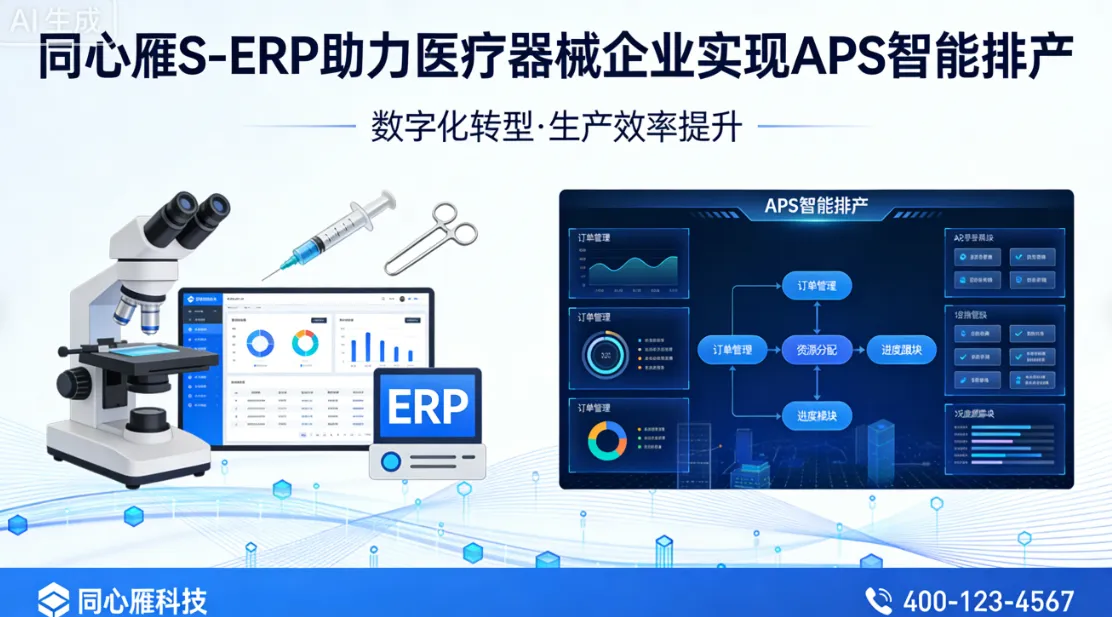
Conclusion
For medical device companies pursuing excellent operations, intelligent production scheduling is no longer a multiple-choice question, but a necessary question related to survival and development. Tongxin Yan S-ERP takes APS intelligent scheduling as its core, transforming the production planning of enterprises from an "art" that relies on personal experience to a "precision science" based on global data and intelligent algorithms. It helps enterprises navigate complexity and uncertainty within a strict compliance framework, ultimately achieving a perfect unity of quality, efficiency, and resilience, and building a smarter and more reliable production foundation for safeguarding life and health.