
Intelligent Customer Service System: Data Driven Engine and Business Value Loop in Digital Transformation
In the grand narrative of digital transformation, intelligent customer service systems have quietly evolved from the service end of cost centers to the core hub of enterprise customer interaction and the source of value creation. It is no longer just an automated tool for answering questions, but has evolved into aReal time perception of customer pulse, driving business decisions, and ultimately achieving value closed loop intelligent engineThe core of this transformation lies in the fact that intelligent customer service systems transform every customer interaction into quantifiable and actionable business insights through continuous data flow and intelligent analysis, thereby deeply reshaping the products, services, and operational models of enterprises.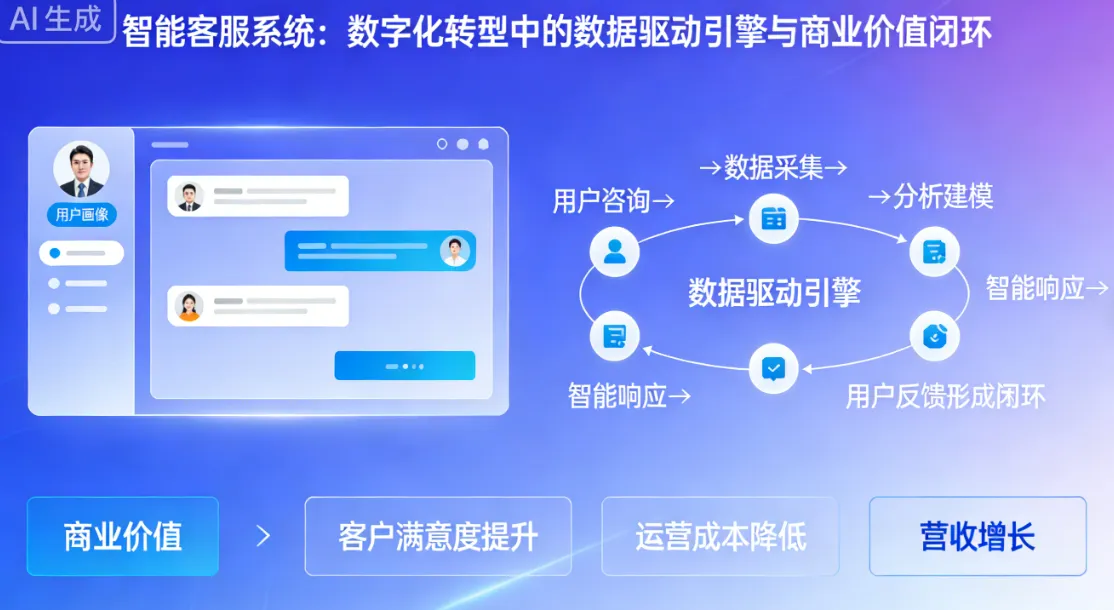
Role transition: from response tool to data-driven hub
The traditional customer service model is one-way, passive, and transactional, with the core goal of "solving problems and ending conversations". And modern intelligent customer service systems build aA dynamic, two-way, and continuous learning and empowerment platformIts underlying layer is a comprehensive technology stack that integrates natural language processing, machine learning, knowledge graphs, and big data analysis, which enables the system to have the ability to understand, reason, and predict.
The characteristics of its data-driven engine are reflected in three levels:
Firstly, it isUnified entry point for omnichannel customer interaction dataThe system seamlessly integrates interactive data from all touchpoints such as web chat, social media, voice calls, email, and mobile applications, building a 360 degree customer view. Every consultation, every complaint, every search, and even the tone and emotions in conversations are transformed into structured data assets.
Secondly, it isPerceptron for real-time business situationWhen a large number of users suddenly gather to inquire about the installation of a certain product, the system can identify and alert potential product defects or unclear explanations in real time; When competitors launch new products that spark market discussions, the system can capture the surge in customer comparative inquiries and provide real-time intelligence to the marketing department.
Finally, it isAutomation hub for business processesIt can not only answer questions, but also deeply connect with backend order systems, inventory systems, CRM, and work order systems through APIs, directly completing business operations such as self-service order modification, logistics query, invoicing, or appointment services, transforming the service process itself into a direct business flow.
Value closed loop: from service touchpoints to empowering the entire value chain
The business value created by intelligent customer service systems goes far beyond reducing labor costs and improving response speed. Its true power lies in the circular flow of data, forming a system that runs through the front, middle, and back ends of the enterpriseValue creation closed loop。
The starting point of closed-loop: experience optimization and instant value realization.
At the forefront, the system provides 7x24 hour real-time response by accurately understanding customer intentions, significantly improving customer satisfaction and loyalty. More importantly, its embedded intelligent recommendation and proactive service capabilities can create opportunities for cross selling and upward selling in service scenarios. For example, after resolving customer inquiries about printer malfunctions, the system can timely recommend extended warranty services or cost-effective consumables packages, directly transforming service interaction into sales opportunities and achieving "service as marketing".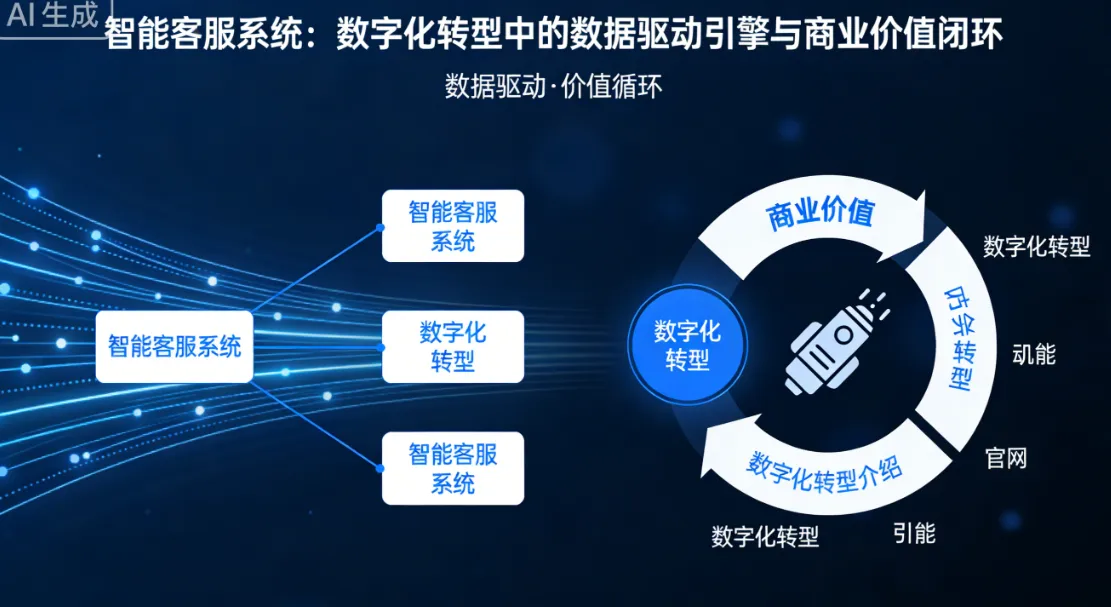
The core of closed loop: data insight drives the iteration of middle platform business.
This is the core manifestation of intelligent customer service as the "engine". The massive interactive data that has been accumulated, after desensitization and analysis, has become valuable fuel for driving decision-making in key departments of the enterprise
-
Product Development DepartmentObtained first-hand user feedback gold mine. By analyzing high-frequency consultations, fault complaints, and functional inquiries, it is possible to accurately locate product pain points, identify unmet needs, and guide the functional definition and optimization iteration of the next generation of products, achieving true "user driven innovation".
-
Marketing DepartmentObtained the most authentic customer feedback. Emotion analysis can quantify brand reputation; Dialogue topic clustering can reveal unnoticed market trends or customer groups; Monitoring the consultation volume of promotional activities can provide real-time evaluation of activity popularity and customer confusion points, helping to dynamically adjust marketing strategies.
-
Operations and Quality DepartmentObtained a precise map of process optimization. The supply chain, logistics, or billing issues exposed in customer service conversations can be systematically classified and analyzed to identify specific internal process bottlenecks, promoting continuous improvement of operational efficiency and risk prevention in advance.
The End of Closed Loop: Organizational Intelligence and Predictive Services.
When data flow and business flow continue to connect, intelligent customer service systems help enterprises move towards higher levels of "predictive services" and "organizational intelligence". A model trained on historical interaction data can predict which customers may face problems (such as subscription expiration or equipment failure), and actively initiate care or preventive maintenance, transforming passive response into active protection. Ultimately, the entire organization will be able to use customer data as a common language and action guide, forming an organism that is extremely sensitive to external market changes and can respond quickly and collaboratively.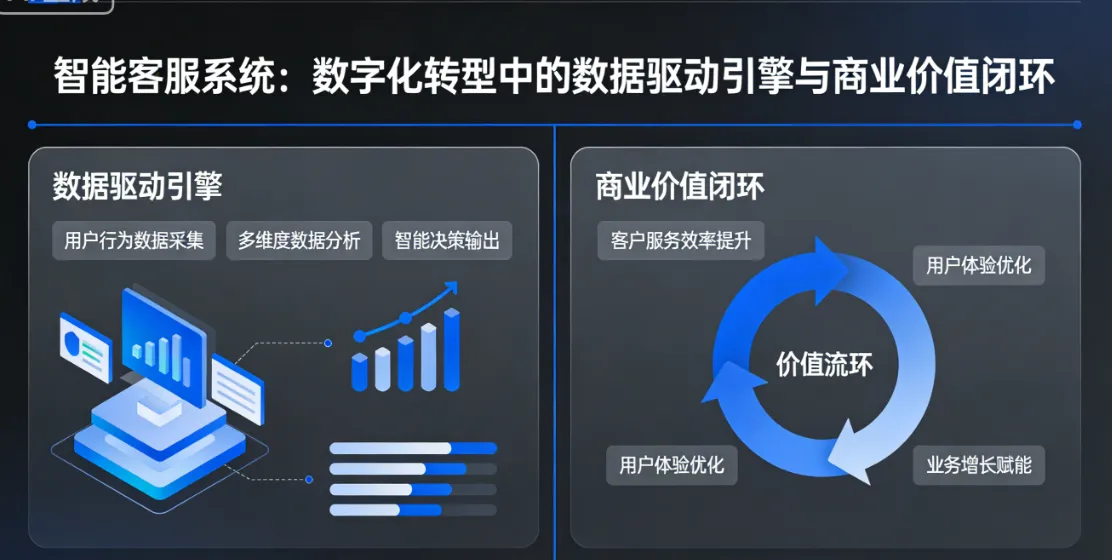
Future Evolution: From Efficiency Tools to Strategic Assets
Looking ahead, the evolution of intelligent customer service systems will focus on deeper intelligence and more seamless integration.Affective ComputingThe in-depth application of this technology will enable the system to not only understand literal meanings, but also comprehend emotions, providing warm and empathetic interactions. andEnterprise Knowledge Graph和business systemThe deep integration of customer service robots will make them the most knowledgeable and versatile "employees" within the enterprise, capable of handling extremely complex cross departmental and multi-step business consultations.
More importantly, as the most important aspect of a businessExternal data interfaceOne, the strategic position of intelligent customer service systems will be further enhanced. It will become the core feedback loop for enterprises to obtain market dynamics, verify business assumptions, and optimize customer journeys, and the value of its data assets will increase day by day.
In summary, intelligent customer service systems have completely surpassed the scope of traditional customer service. As a data-driven engine that connects the past and the future in digital transformation, it captures, analyzes, and transforms every customer interaction, not only improving service experience and sales conversion in a closed-loop manner, but also continuously delivering data energy to the core processes of product, marketing, and operation, driving the overall evolution of the enterprise towards a smarter and more customer-centric direction. In today's world where data has become the core production factor, investing in and building an advanced intelligent customer service system is essentially investing in the core perception and decision-making capabilities of enterprises for the future.