
Analysis of the reasons for the sharp rise in the ERP concept sector | The acceleration of digital transformation has given rise to investment opportunities and risks
In recent times, the ERP (Enterprise Resource Planning) concept sector has emerged as a rising force in the capital market, with representative companies such as UFIDA Network, Kingdee International, and Dingjie Software showing impressive stock prices, attracting widespread market attention. This round of market trend is not simply a rotation of sectors, behind it isMacro policies, industry trends, technological evolution, and intrinsic needs of enterprisesThe result of the resonance of multiple intertwined forces marks the market's reassessment of the value of core tools for enterprise digital transformation. However, under the wave of enthusiasm, opportunities and risks coexist, and a clear understanding of their driving logic and potential challenges is crucial for understanding the future direction.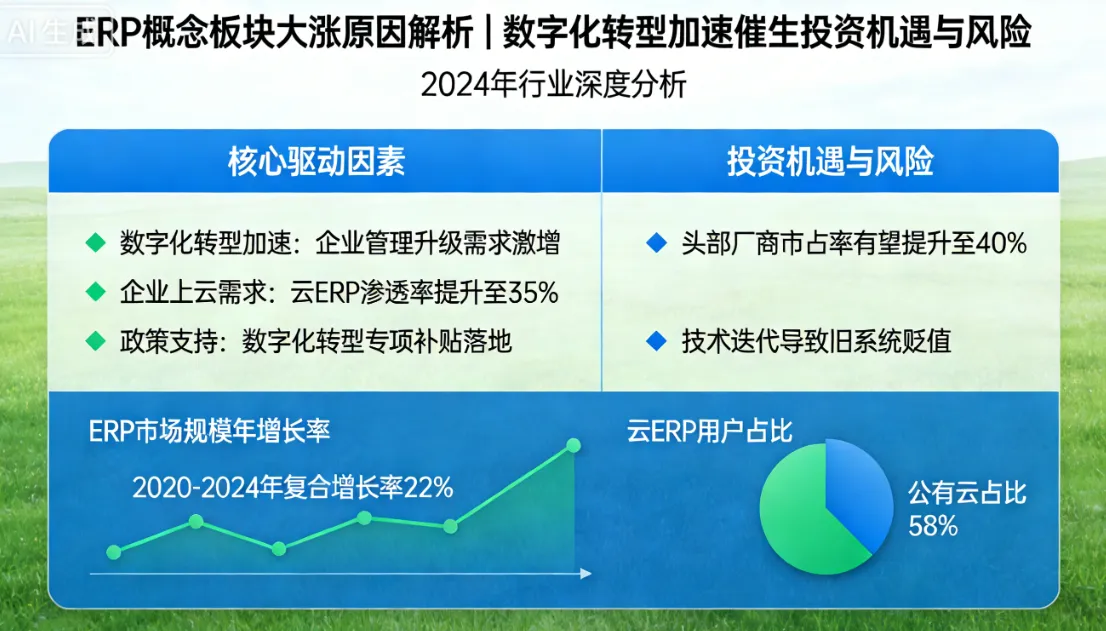
Core driver: Triple logical support for sector value reassessment
The driving force behind the rise of this sector is three-dimensional and in-depth, mainly due to the joint efforts of policies, demand, and technology.
The primary and most clear driving force comes from a continuously strengthening policy environmentThe construction of "Digital China" as a top-level strategy is being implemented through a series of specific industrial policies. The digital transformation action plan for various industries, especially the manufacturing industry, clearly lists industrial software such as ERP as a key support. More importantly, the deepening promotion of "safe and controllable" and "information and innovation" policies has given rise to a rigid demand for replacing similar foreign software in finance, energy, telecommunications, and large state-owned enterprises. This has opened up a high-end market that was previously difficult for top domestic manufacturers such as UFIDA and Inspur to enter, bringing about a certain incremental space and expectations for reshaping the market landscape. Policies are no longer just indicators, but also tangible guarantees for orders.
Secondly, the endogenous demand for digital transformation in enterprises has entered a period of explosion and deepeningAfter market education, especially stress tests in the past few years, companies' understanding of digitalization has shifted from "optional topics" to "mandatory questions". ERP, as the core system for integrating enterprise resources and connecting data, has rapidly penetrated from large groups to small and medium-sized enterprises. The market demand is no longer just about purchasing a set of software, but seeking solutions that can accompany business growth and provide full value chain management. The shift in demand from "going to the system" to "creating value with the system" has increased the value of the project and customer stickiness, allowing the market to see more sustainable growth potential. At the same time, the popularity of cloud subscription models has greatly improved the revenue visibility and stability of ERP vendors, and their business models are more favored by the capital market.
Thirdly, technological innovation injects new growth narratives into traditional ERP systemsCurrently, artificial intelligence, especially big model technology, is undergoing unprecedented deep integration with ERP. This is not only a combination of functions, but also a qualitative change in ability. AI can achieve intelligent process automation, natural language interactive decision analysis, accurate demand forecasting, and supply chain optimization, upgrading ERP from a process recording system to an intelligent decision-making system. This technological integration greatly expands the value boundary and imagination space of the product, making the market willing to give it a higher growth valuation. Technological evolution is breaking the inherent ceiling of the ERP industry.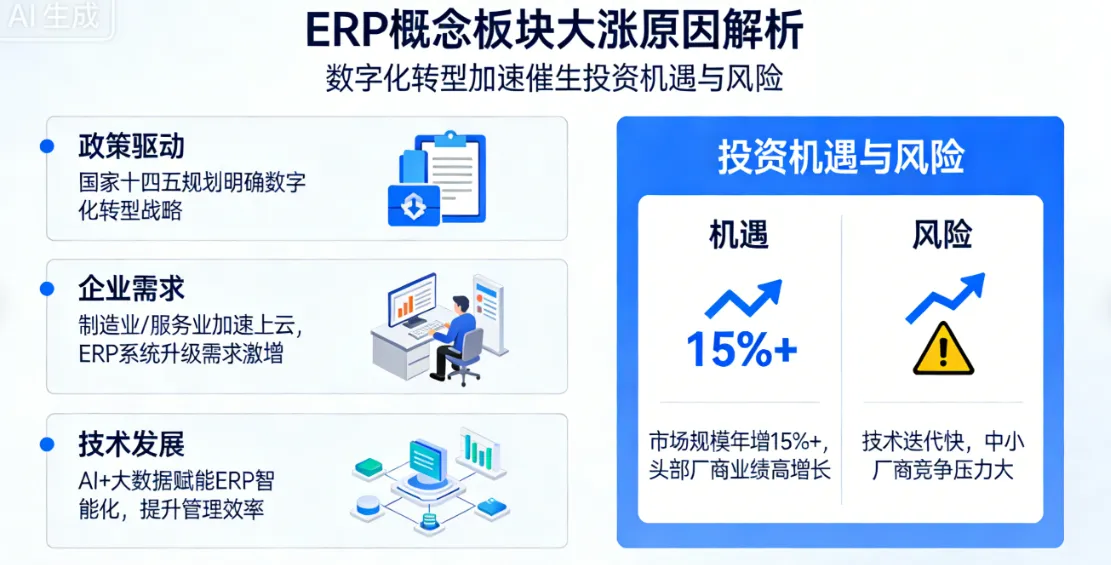
Investment Opportunities: Focusing on the Two Main Lines of Localization and Intelligence
Under this trend, investment opportunities mainly focus on two clear main lines.
firstlyDepth and breadth of localization substitutionThe process of substitution is advancing from the initial party and government organs to core industries such as finance, energy, and advanced manufacturing, with huge market space. Top manufacturers with profound industry accumulation, complete product system, and strong service capabilities will be the biggest beneficiaries. The opportunity lies not only in gaining new market share, but also in establishing long-term service relationships through replacement, in order to obtain sustained benefits in subsequent upgrades, operations, and ecological expansion.
SecondThe product value transition and business model innovation brought by "AI+ERP"Manufacturers who can take the lead in transforming AI capabilities into mature and feasible scenarios (such as intelligent financial analysis, AI assisted research and development, and supply chain risk warning) will achieve product differentiation and increase customer willingness to pay. The application of AI is expected to give rise to new service and fee models, opening up the second curve of growth. For investors, paying attention to manufacturers' AI research and development investment, landing cases, and ecological construction capabilities is the key to capturing future winners.
Potential risk: Cold thinking under the heat wave
While embracing opportunities, the challenges and risks faced by the sector cannot be ignored.
Valuation risk is the first to bear the bruntDriven by strong optimistic expectations, the valuations of some companies are already in historically high ranges. If the subsequent quarterly financial reports cannot continue to verify high growth, especially the growth rate of cloud business and the landing of large orders are not as expected, there may be pressure for valuation correction. The patience of the market depends on the pace of performance realization.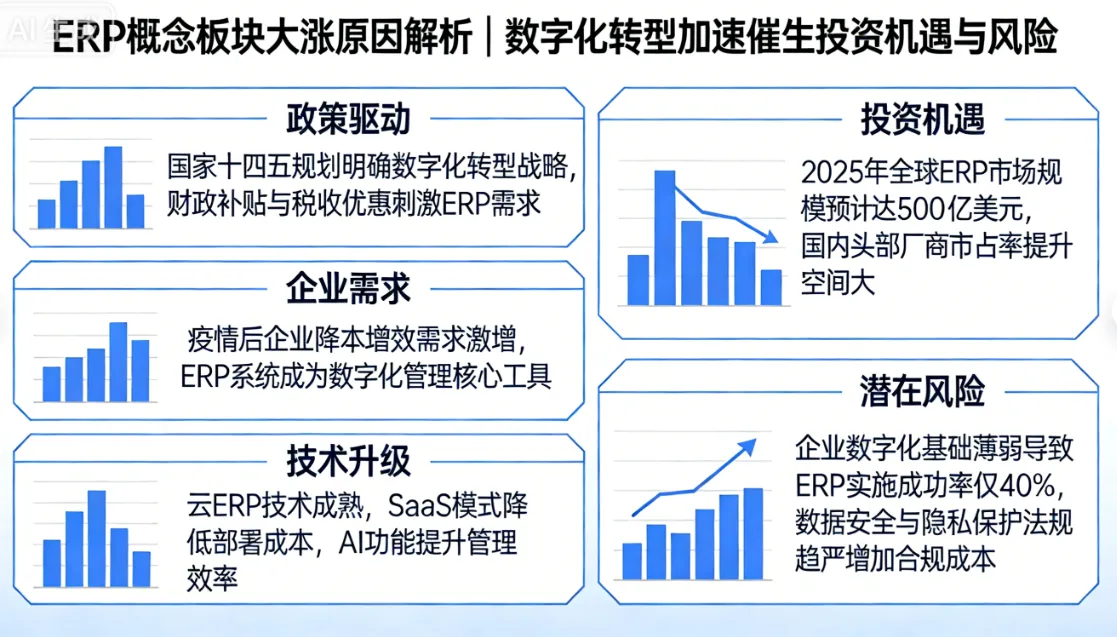
Industry competition is rapidly intensifyingThe feast of domestic substitution has attracted many participants. In addition to traditional ERP giants, emerging cloud native vendors, industry vertical solution providers, and even platform based technology companies are all entering the market. Intense competition may lead to price pressure and erode the overall profit margin of the industry. In the end, only companies with genuine products, technology, and ecological moats can win.
The uncertainty of technology implementation and customer acceptanceIt is also one of the risks. Although the story of "AI+ERP" sounds good, its implementation in the core processes of enterprises still takes time, and its effectiveness needs to be verified. Customers may have longer than expected procurement decision-making cycles for new technologies, and there is uncertainty in measuring the initial input-output ratio, which may affect the short-term revenue growth of related product lines.
Finally, the impact of the macroeconomic environment cannot be ignoredERP, as a significant capital expenditure or long-term operating cost for enterprises, has a close relationship between its procurement decisions and the overall business confidence and cash flow status of the enterprise. If the macroeconomic recovery falls short of expectations, companies may delay or reduce their IT investments, thereby affecting the demand fundamentals of the entire sector.
Future outlook: Steady and far-reaching development, true chapter to be seen in differentiation
Looking ahead, the long-term growth logic of the ERP sector remains solid, but the general upward trend may be difficult to sustain,Differentiation will become the main themeThe focus of the market will quickly shift from generalized "concepts" to the specific fundamentals of each company, including order acquisition capabilities in key industries, the proportion and growth rate of cloud business revenue, the productization progress and customer feedback of AI functions, and the health of operating cash flow.
In summary, the rise of the ERP concept sector in this round is a reasonable wave reflected by the trend of the times, national will, and technological progress in the capital market. It marks the rediscovery of the strategic value of enterprise digital core tools. For market participants, maintaining a clear perspective amidst optimism and carefully selecting the true value creators in the trend is the key to crossing the cycle and sharing the long-term growth dividends of this fundamental and critical field in the process of China's digital economy takeoff.