
How to deal with seasonal demand fluctuations in footwear ERP system | Production planning, inventory and human resource optimization solutions
In the footwear industry, seasonal fluctuations are not simply sales curve ups and downs, but a full chain stress test that runs through design, procurement, production, warehousing, and marketing. The demand pulse brought by holiday sales, seasonal updates, and promotional activities is in sharp contrast to the normal sales on weekdays. The traditional "empirical estimation+static safety stock" model is unable to cope with severe market fluctuations, which can easily lead to a dual dilemma of out of stock during peak season and inventory backlog during off-season. The core value of modern ERP systems lies in the use ofData driven, dynamic simulation, and resource collaborationTransforming a rigid supply chain into a flexible organism that can breathe and stretch, systematically addressing seasonal challenges.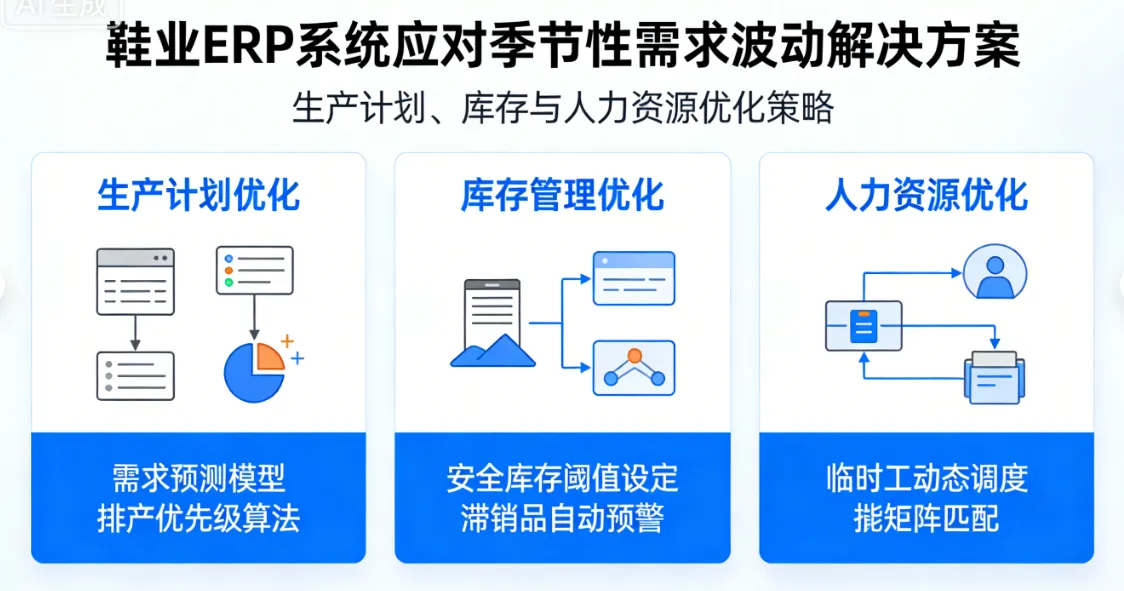
Production Plan Optimization: A Capacity Sand Table from Static Scheduling to Dynamic Simulation
The primary step in dealing with seasonality is production planning. Traditional planning is like an unchangeable 'architectural blueprint', while intelligent ERP provides a 'digital sand table' that can be repeatedly deduced.
Its core lies in buildingDemand driven rolling master production planThe system integrates historical sales data from the same period, current orders received, market trend intelligence, and marketing activity forecasts, and generates rolling demand forecasts for the next few months, weeks, or even days through algorithmic models. More importantly, the advanced planning and scheduling module in ERP can synchronize this prediction with the actual production capacity constraints of the enterprise, including maximum working hours on the production line, availability of critical molds, capacity quotas for outsourced factories, and raw material supply cycles.
When the sales department proposes a large-scale holiday promotion plan, planners no longer need to manually calculate the impact on existing production orders. They only need to input the expected sales volume and date of the promotion in the system, and the APS module can instantly simulate multiple production scheduling plans: whether to activate outsourced production capacity, arrange weekend overtime, or slightly adjust the delivery time of other non urgent orders? The impact of each plan on total cost, delivery commitment, and capacity utilization is clear at a glance. This transforms production planning from a passive order executor to an active capacity gamer, accurately laying out before peak demand and achieving "peak shaving and valley filling" of production capacity.
Inventory management optimization: achieving precise water storage and release in dynamic balance
Inventory is a 'reservoir' to cope with seasonal fluctuations, and the goal of ERP is to keep its water level in the optimal range, ensuring supply during peak demand and avoiding sunk costs during the dry season.
This depends onMulti level and dynamic inventory strategyThe ERP system can automatically classify and set different inventory models based on the importance of materials, procurement lead time, and demand volatility (such as shoe upper leather and core shoe soles being high-value key materials). For seasonal specific materials and finished products, the system strictly enforcesTime grid managementEstablish target inventory before the listing window, automatically initiate clearance alerts at the end of the season, and link with the promotion module to generate clearance recommendations.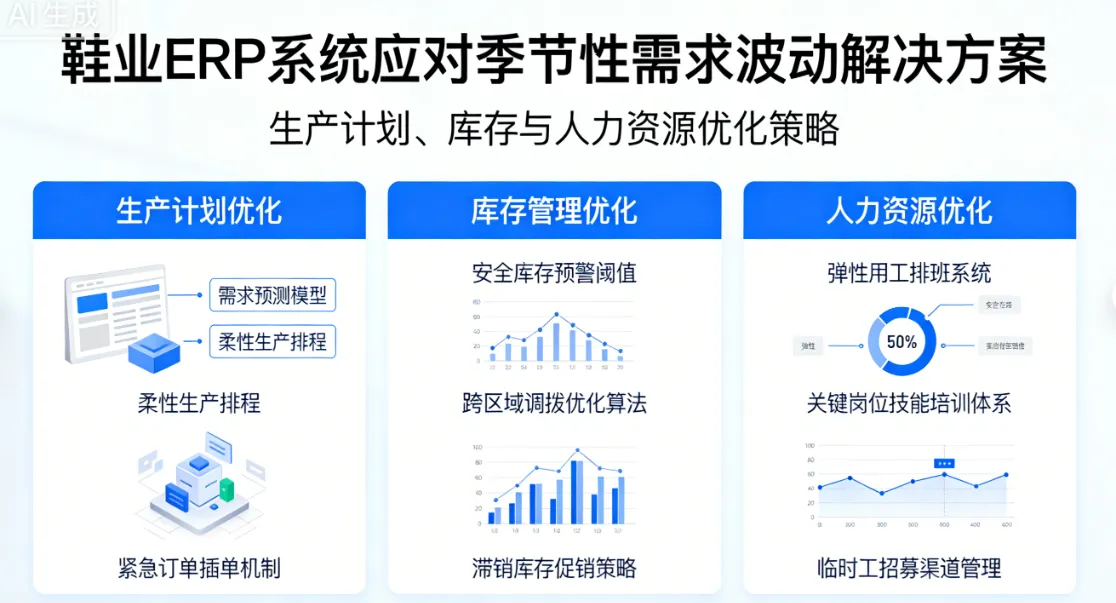
The more crucial innovation lies inDynamic visualization and integrated allocation of omnichannel inventoryThe inventory of shoe companies is often dispersed in headquarters warehouses, regional sub warehouses, offline stores, and online e-commerce warehouses. The global inventory view built by the ERP system makes all inventory points a "cloud inventory pool" that can be uniformly scheduled. When online channels suddenly run out of stock during promotional flash sales, the system can automatically initiate a "store direct delivery" fulfillment instruction from the nearest available store; When the peak season in a certain region arrives earlier, the system can automatically trigger replenishment and allocation from the central warehouse to the sub warehouses in that region based on preset rules. This dynamic balancing ability greatly improves the turnover efficiency and customer service level of limited inventory resources.
Human Resource Optimization: Building Agile and Resilient Organizational Cells
Seasonal fluctuations have the most direct impact on human resources, with a shortage of manpower during peak periods and idle manpower during off-season being the norm. ERP systems help achieve "flexible scaling" of human resources through refined management and cross departmental collaboration.
At the direct labor level, the production management and human resources modules of ERP work together to generate detailed production schedules for each workshop and process in the coming weeksHuman resource demand forecastThis allows the human resources department to plan ahead, flexibly arrange temporary worker recruitment, student worker supplementation, or coordinate with labor companies to dispatch workers, rather than hastily responding after the incident. At the same time, the system supports certification management for multi skilled employees, which can quickly identify and schedule competent employees for other positions when bottleneck processes occur, enhancing the flexibility of human resource allocation.
For indirect human resources such as procurement, planning, and customer service, ERP usesProcess automation and workflow collaborationTo enhance human efficiency. Before the peak season arrives, the system can automatically perform repetitive tasks such as confirming supplier capacity and delivery time, and batch issuing purchase orders; During peak after-sales periods, the integrated customer service ticket system can intelligently allocate tasks and directly link inventory and order information, reducing query time. This essentially liberates fixed employees from tedious tasks, allowing their energy to focus on handling exceptions and creating higher value collaborative work, using "system efficiency" to compensate for the shortcomings of "peak manpower".
Collaborative Closed Loop: Continuous Learning and Evolution Driven by Data
Real optimization is not a one-time project, ERP systems are established through the establishment of“Sales Production Inventory Human Resources”The data feedback loop enables enterprises to continuously learn and evolve their ability to cope with seasonality. After the end of each sales season, the system can automatically compare predictions with actual sales, planned production with actual output, expected manpower with actual working hours, and accurately quantify deviations in each link. These deviation data are used to continuously optimize the parameters of the prediction model, adjust the safety stock factor, improve production scheduling rules, and make the seasonal response strategy of the enterprise more and more accurate like an experienced captain in each voyage.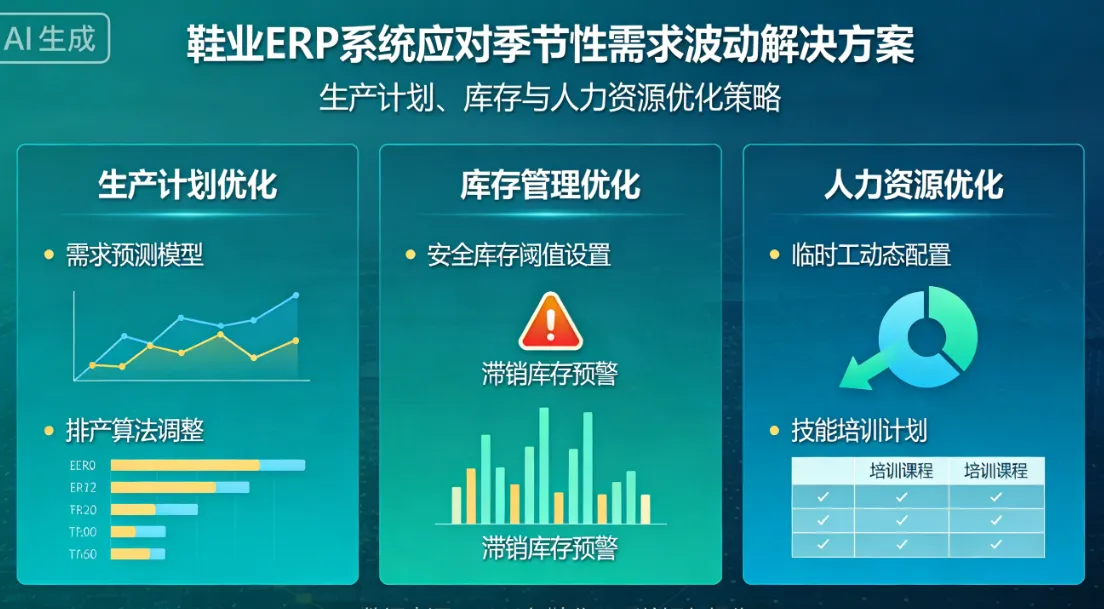
Therefore, a deeply applied footwear ERP system has surpassed the scope of traditional management software. It is the response of enterprises to seasonal fluctuationsIntelligent Command CenterBy making production plans replicable, inventory flowing, and manpower flexible, we can transform the drastic fluctuations in the external market into an internal, orderly, efficient, and controllable process of resource scheduling and value creation. Ultimately, in the ever-changing market rhythm, we can take steady and flexible steps.