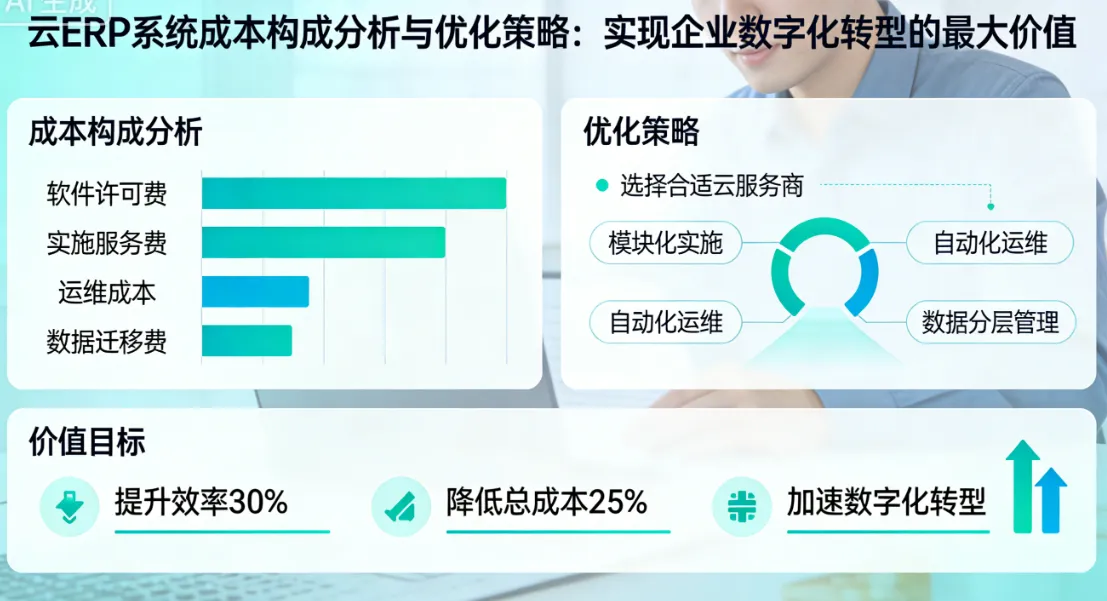
Cost composition analysis and optimization strategy of cloud ERP system: realizing the maximum value of enterprise digital transformation
Under the wave of digital transformation in enterprises, cloud ERP systems have become the preferred choice for many enterprises due to their agility, scalability, and reduced initial investment. However, embracing the cloud does not mean the end of cost issues, but rather a transformation in its form and management logic. Treating cloud ERP as a simple 'operating expense' is one-sided, as its total cost of ownership runs through the entire lifecycle of selection, implementation, operation, and iteration. Only by systematically analyzing its true cost composition and implementing forward-looking value optimization strategies can enterprises truly manage this investment and unleash its maximum efficiency in driving transformation.
Cost Panorama Perspective: Beyond Subscription Fees for Full Lifecycle Investment
The cost of cloud ERP is not just a simple monthly or annual subscription bill. It is a network woven together by visible and invisible, one-time and ongoing expenditures. Understanding the whole picture is the first step in optimization.
Explicit direct costThe most core calculation is based on the number of users, functional modules, and usage (such as data storage and API calls)Cloud service subscription feeThis is a predictable recurring expenditure. However, larger variables are often hidden inImplementation and deployment costsIn the middle. This includes blueprint design, system configuration, data migration, process adaptation, and professional service fees charged by suppliers or partners. The complexity of the project, the difficulty of data cleaning, customized requirements, and the depth of change management will all cause fluctuations of several times or even tens of times in this initial investment. In addition,Training and knowledge transfer costsIt is also crucial as it determines whether the system can be effectively used, typically involving key user training, textbook development, and online support.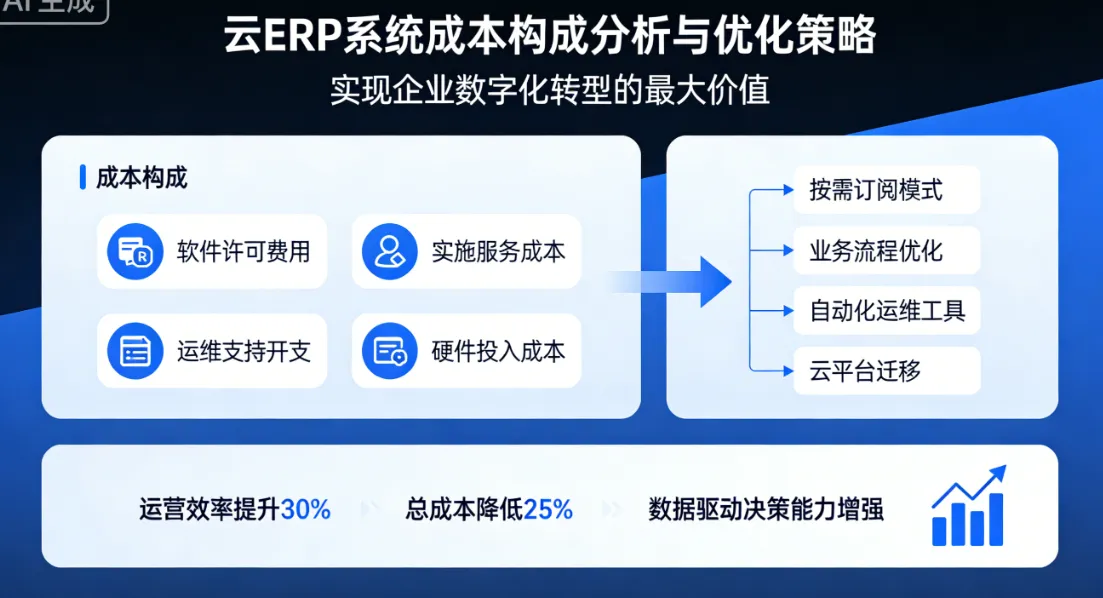
Implicit and long-term operating costsIt is more likely to be underestimated.Integration and expansion costsContinuous investment in developing customized APIs and maintaining interface stability involves connecting with existing CRM, SCM, MES, or self built systems.Internal operation and management costsAlthough significantly reduced compared to local deployment, enterprises still need to have administrators responsible for user permissions, process fine-tuning, and basic support, which consumes internal IT or business resources. The biggest hidden cost may beOpportunity cost and inefficiency costIf the system fails to support core business development due to improper planning, or if operational efficiency is hindered by rigid processes, the losses will be much higher than the software subscription fees themselves.
Optimizing core strategy: from cost control to value investment
The goal of optimizing the cost of cloud ERP should not be simply to cut budgets, but to pursue the maximum business value that can be generated from each unit of input. This requires a complete strategy from strategic planning to ongoing operations.
Strategy for Planning and Selection StageIt is the key to determining the cost baseline. Enterprises mustAdhere to the principle of "business driven, on-demand subscription"Avoid prepaying for "luxury features" that may not be needed in the future. Collaborate with suppliers to design a clear roadmap, adopt a phased and modular launch strategy, focus on core business flows first, quickly validate value, and then gradually expand. When negotiating contracts, emphasis should be placed on long-term price protection, clear expansion unit prices, and data migration plans to lock in long-term costs and maintain flexibility.
Strategy for Implementation and Deployment PhaseFocus on controlling the largest variable. Enterprises shouldStandard Best Practices for Maximizing the Utilization of Cloud ERPAdapt the system as much as possible rather than mass customization development. Each customization should be evaluated for its long-term maintenance costs and impact on upgrades. Meanwhile,Invest in thorough data governanceCompleting data cleaning and standardization before going live can increase initial investment, but significantly reduce the cost of subsequent data correction, integration failures, and decision deviations. Establishing an internal core team and deeply participating in project implementation is the key to enhancing autonomy and reducing long-term external dependence.
Strategy for Operations and Expansion PhaseFocus on sustained cost health. establishCloud resource usage monitoring mechanismRegularly audit user activity, storage growth, and API consumption, close idle accounts, and archive historical data. Actively adopting automated tools and AI assisted functions (such as automatic reconciliation and intelligent prediction) released by suppliers to improve operational efficiency, freeing internal teams from repetitive labor and shifting towards process optimization work that can create higher value. most important of all,Establish a continuous review mechanism of 'business value cost'Regularly evaluate the contribution of the system to key business indicators such as order processing efficiency, financial monthly closing speed, inventory turnover rate, to ensure that IT investment is closely linked to business results.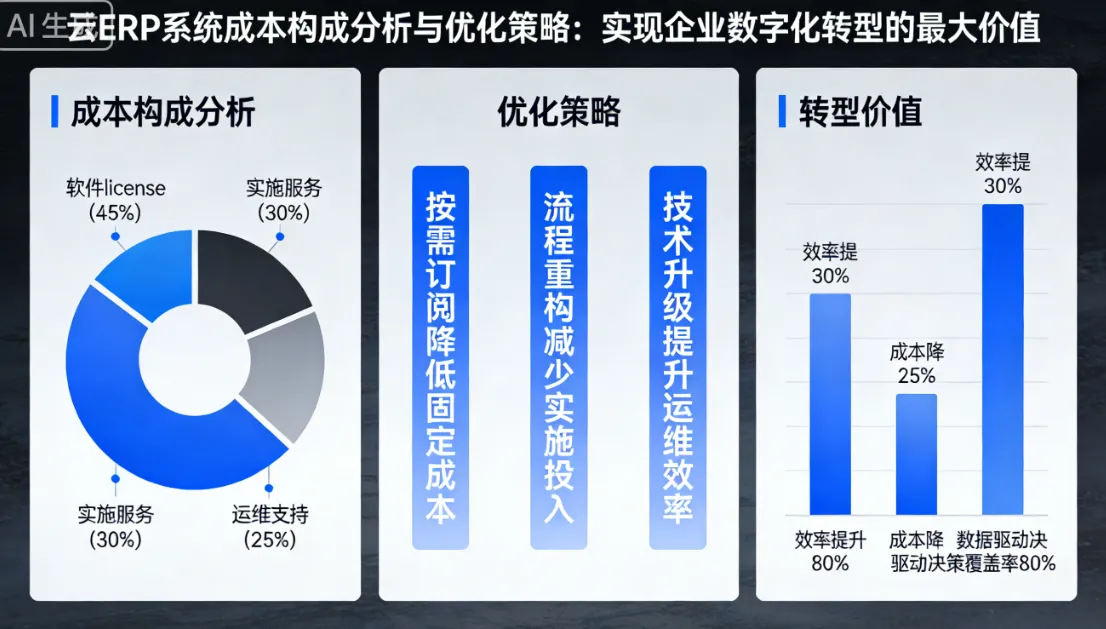
Realizing maximum value: integration of cost optimization and digital transformation
Essentially, the refined management of cloud ERP costs is a reflection of the maturity of enterprise digital transformation. It requires finance, IT, and business departments to break down barriers and engage in a unified 'value language' for dialogue. The result of successful cost optimization should not be a reduction in IT expenses on financial statements, but rather an improvement in overall operational efficiency, an acceleration in decision-making speed, and a reduction in innovation trial and error costs.
Enterprises should recognize that the most expensive cost is never a reasonable fee paid for advanced productivity tools, but rather the internal friction and opportunity loss caused by adopting inappropriate systems, poor process design, or inefficient resource utilization. Therefore, the highest level of cost optimization for cloud ERP is to integrate its management into the continuous digital governance of enterprises, so that technology investment always serves clear strategic goals, thereby transforming cloud ERP from a "cost project" to a "value engine" that drives enterprise growth and innovation. In this process, shrewd cost analysis and forward-looking value investment will become the core management capabilities for enterprises to navigate the journey of digital transformation and win future competitive advantages.