
DeepSeek's latest research and development achievements help upgrade the intelligence of the ERP industry
In the deep waters of digital transformation in today's enterprises, the evolution of ERP systems has moved from process automation to a new stage centered on "data-driven" and "intelligent decision-making". The latest achievements of advanced large-scale models such as DeepSeek are injecting core power into this intelligent upgrade. Its value lies not only in adding intelligent functions to existing systems, but also in redefining how ERP processes information, understands business, and responds from the bottom, driving its evolution from a "system" that records and executes business rules to an "intelligent business partner" that can perceive, analyze, predict, and even autonomously optimize.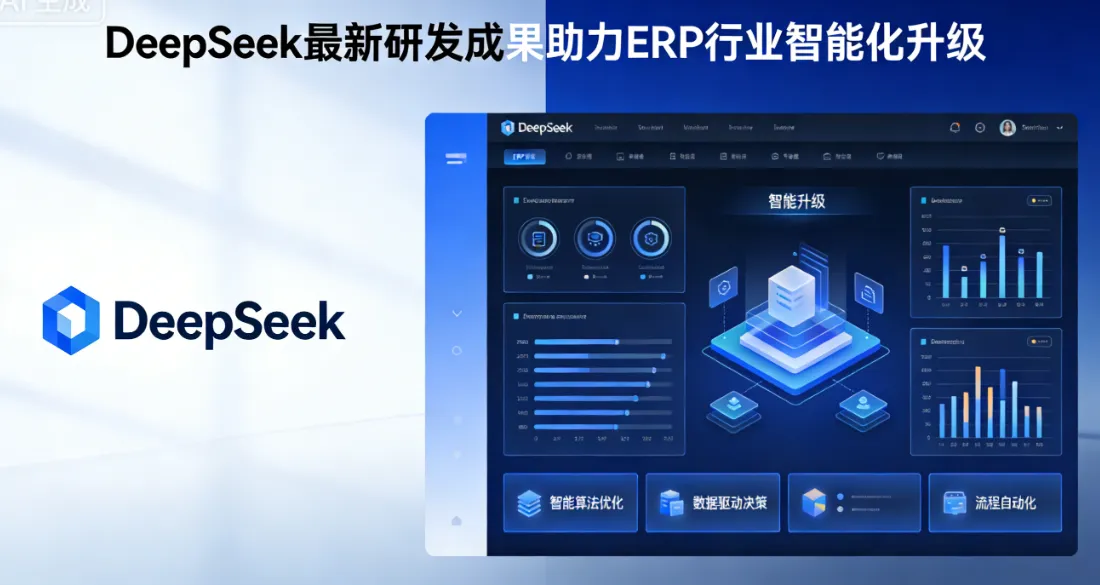
Technical cornerstone: deep integration of understanding, reasoning, and generative abilities
The breakthrough of big models such as DeepSeek lies in their powerful capabilitiesSemantic understanding, logical reasoning, and content generationAbility. This solves a fundamental bottleneck that traditional ERP systems have long faced: the system can only handle highly structured, pre-defined data and rules, but is powerless to handle unstructured information (such as customer service conversations, engineering drawings, market reports, email correspondence) and complex, ambiguous business contexts that flood enterprise operations.
The new generation of technology has enabled ERP to acquire the ability to "understand" and "think". The system can understand complex business queries raised by users in natural language (such as "analyzing the main reasons for the decline in gross profit margin in the East China region in the previous quarter and comparing competitor trends"), rather than relying on pre embedded reports. It can read and parse contract texts, technical documents, and extract key terms or parameters from them. More importantly, it can perform multi-step logical reasoning based on existing business data and new input information, generating causal analysis conclusions, risk assessments, or multiple alternative solutions, rather than just presenting data.
Core transformation: driving paradigm shift in three key areas
The injection of this underlying capability is driving paradigm shifts in ERP systems in three key areas.
Firstly, there is a fundamental change in the interaction mode.Traditional ERP interaction relies on complex menu navigation and form filling, resulting in high learning costs. Intelligent ERP will provide a "conversational" interactive interface. Managers or business personnel can directly use natural language to ask questions, issue instructions, or seek insights. For example, simply stating 'Prepare inventory for the upcoming promotional season and consider the risk of recent supply chain delays', the system can understand the intention, automatically simulate demand, check inventory, evaluate supplier risks, and generate an execution plan that includes replenishment suggestions and alternative solutions. This greatly reduces the threshold for system usage, truly empowering frontline business personnel with data and analysis capabilities.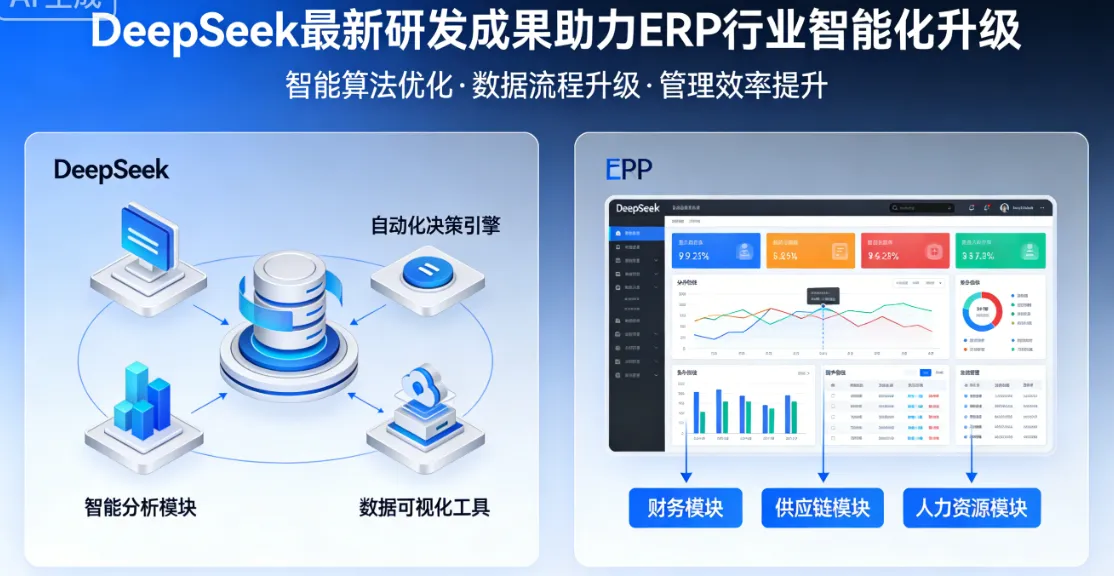
Secondly, it is the intelligent generation and dynamic optimization of business processes.Traditional business processes are rigidly fixed in the system. Based on large models, ERP can achieve intelligent construction and adaptive adjustment of processes. Business experts can use natural language to describe or sketch a new approval or production work order process, and the system can understand and automatically generate executable workflow models. When the process is running, the system can monitor execution data in real time, predict bottlenecks (such as possible timeout in certain stages of approval), and actively recommend or execute optimization paths (such as automatically reminding approvers or upgrading processing according to rules). This means that the business process has shifted from a "preset script" to a "dynamic music score" that can be adjusted in real time.
Thirdly, and most potentially, it is the automation closed-loop driven by AI intelligent agents.The excellent planning and reasoning abilities of large models enable them to play the role of "virtual business experts". When combined with automated execution technologies such as RPA robots, AI agents capable of autonomously completing complex, long chain tasks can be constructed. For example, a procurement reconciliation agent can automatically log in to the supplier portal, download reconciliation statements, match purchase orders with inventory records in ERP, identify differences, generate objection reports, and initiate communication processes. This achieves a complete closed-loop from "analyzing problems" to "executing solutions", freeing employees from repetitive and rule-based daily operations and allowing them to focus on more creative and strategic work.
Landing Path: From Empowering Scenarios to Reshaping the Ecology
To achieve this intelligent upgrade, a clear and pragmatic path is needed. Currently, technology implementation is starting from specific "empowering scenarios", such as intelligent financial statement note writing, automatic material list generation based on product descriptions and drawings, or 7x24 hour intelligent customer service and internal knowledge Q&A. These scenarios can quickly validate value and build confidence.
The deeper integration lies in designing the architecture of the new generation ERP with the ability of large models as the "intelligent core". The future system may adopt a model of "cloud native middleware+AI capability layer+scenario based application". The AI capability layer provides unified understanding, reasoning, and generation services, supporting the intelligence of all upper level application modules. At the same time, the boundaries of ERP will be further opened up, becoming an "intelligent business platform". Based on this platform, enterprises can use low code tools and AI assistants to quickly build and adjust intelligent micro applications that meet their unique needs.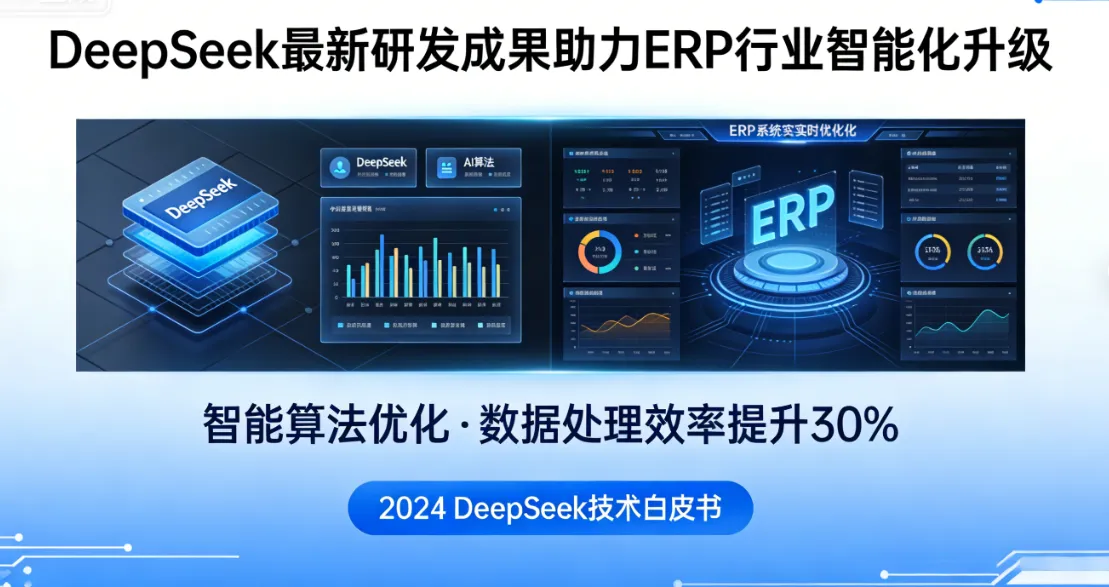
Forward looking outlook: redefining enterprise intelligent operation
In the long run, the continuous evolution of technologies such as DeepSeek will lead to deeper integration with ERP systems, ultimately giving rise to the embryonic form of "self-management". The system can not only answer "what happened" and "why it happened", but also continuously provide suggestions on "how to optimize" and autonomously perform fine-tuning after obtaining authorization. The operation of enterprises will gradually shift from a "human driven system" to a new model of "collaborative driving between humans and intelligent systems". Data and intelligence will seamlessly flow and circulate in various links such as finance, supply chain, production, and human resources, enabling enterprises to perceive market changes, assess risks, and adjust strategies at an unprecedented speed.
Therefore, the latest research and development achievements such as DeepSeek provide much more than just functional enhancements to the ERP industry. It is an upgrade that touches on the essence of the system, transforming ERP from a recorder of enterprise resource planning to an active planner and executor of value creation by endowing machines with deep business understanding and decision-making assistance capabilities. For enterprises, actively embracing this trend means being able to build a more agile, intelligent, and resilient digital core, thereby gaining decisive advantages in complex and ever-changing business environments.