
Integrated management of the entire process: driving digital transformation and efficiency upgrading of enterprises
In the deep waters of digital transformation, enterprises generally face a fundamental challenge: despite deploying numerous advanced digital systems, the expected efficiency revolution and value leap have not arrived as expected. Departmental walls still exist, data silos abound, processes are fragmented between systems, and customer experience is compromised during handover. The core of the problem often lies not in the technology itself, but in the fragmentation of management models.Integrated management of the entire processIt is the strategic core and critical path to solve this dilemma. It is not simply a system interconnection, but a management revolution centered on customers and value streams, which systematically reconstructs enterprise strategy, organization, processes, data, and technology. Its ultimate goal is to build a highly collaborative, agile, adaptive, and data-driven modern enterprise operation system.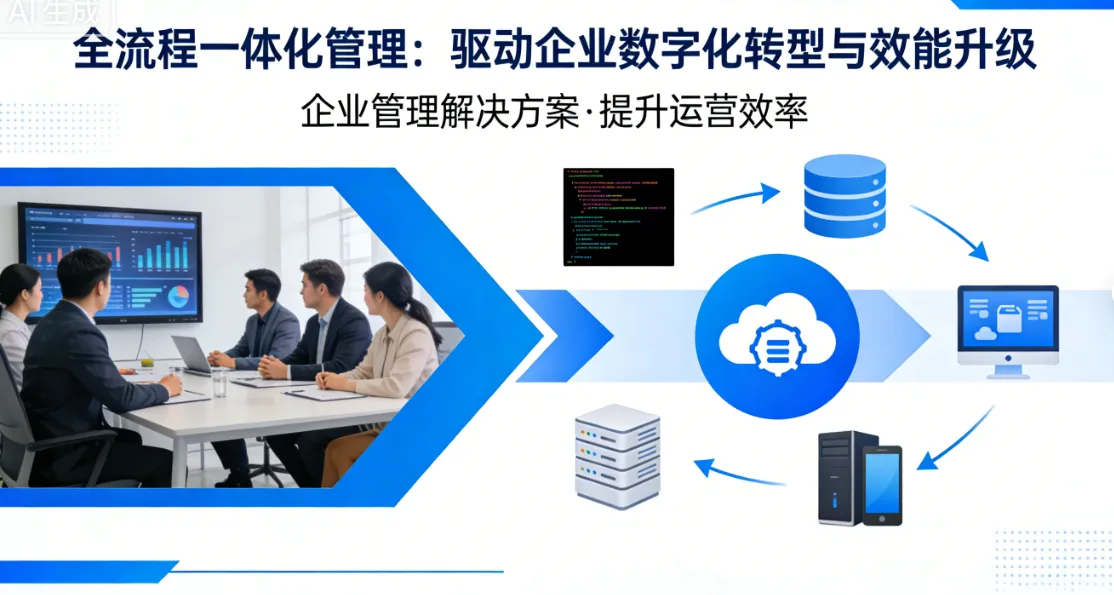
Essence and Connotation: Systematic Refactoring Beyond Integration
The essence of integrated management throughout the entire process is to break through traditional functional silos and process fragmentation, and to achieve end-to-end integration, optimization, and reconstruction around core value streams such as "from leads to payment", "from concept to listing", and "from order to delivery". It requires companies to shift their perspective from 'what departments have done' to 'what value they have created for customers' and redesign all activities accordingly.
Its core connotation is reflected in three key "integrations":Firstly, the deep integration of processes and dataThis means that every node in the process, including its triggering conditions, judgment rules, execution actions, and output results, must be data-driven, standardized, and able to be automatically circulated by the system. The creation of a sales order will automatically trigger credit checks, inventory reservations, production recommendations, and logistics forecasting. All relevant data will be generated naturally and seamlessly transmitted in the process, without the need for manual duplicate entry or cross system queries.Secondly, there is a deep integration of business and technologyTechnology is no longer a passive tool that supports business, but is embedded in the design of business processes, becoming the infrastructure that drives the intelligent operation of processes. Business experts can directly participate in process modeling and optimization with the help of low code platforms and other technologies.Ultimately, it is the deep integration of organization and collaborationThe integrated process requires matching organizational capabilities, which may require the formation of cross functional process governance teams or the establishment of roles focused on end-to-end value (such as "product lifecycle managers"), and the establishment of corresponding assessment and incentive mechanisms to promote horizontal collaboration from the root.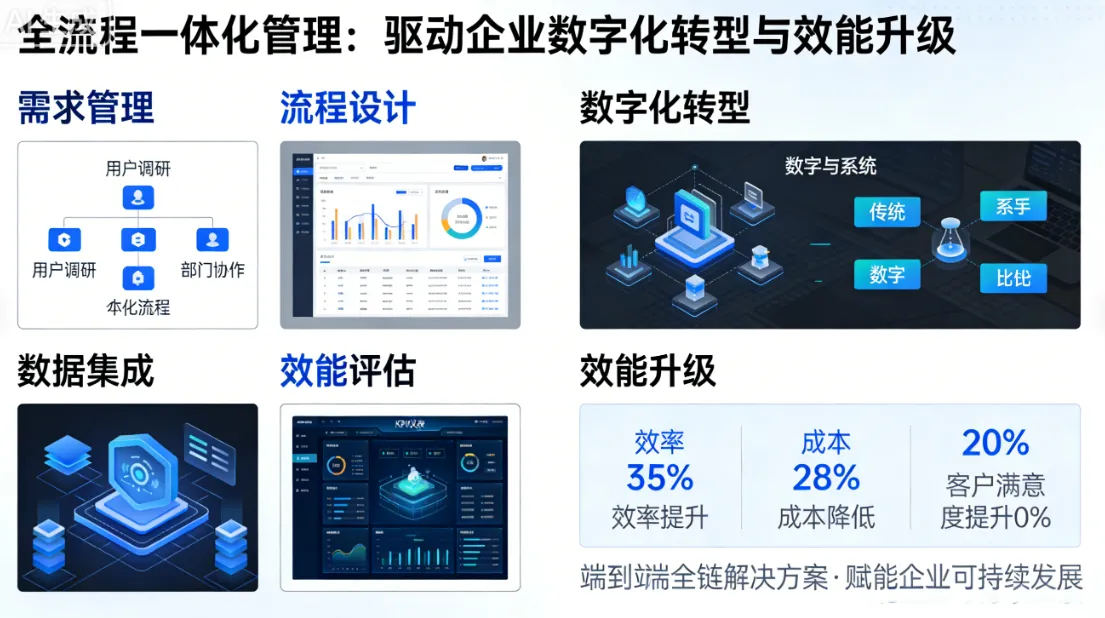
Transformation Path: From Value Stream Anchors to Digital Twin Closed Loop
Implementing integrated management throughout the entire process is a gradual journey that typically requires going through clear stages of development.
The starting point of transformation lies inIdentify and anchor core value streamsEnterprises do not need or have the ability to achieve the integration of all processes at once. Priority should be given to selecting core processes that have the greatest impact on customer satisfaction, operating costs, or competitive advantage (such as "from order to delivery" for manufacturing companies and "from concept to market" for research and development companies) as breakthrough points. A detailed mapping of the current status of this value stream, visualizing all links, participants, systems, and waste such as waiting and rework, is a crucial step in achieving consensus and identifying pain points.
Then, enterDesign and reconstruction phase based on digital platformBased on the analysis of the current situation, and guided by the principles of optimal customer experience and operational efficiency, we will redesign future processes using mature business process management methodologies and digital platform tools. The key to this stage is to integrate the new process logic throughConsolidate and empower a unified digital platform (such as modern ERP and BPM platforms)The platform serves as a 'digital operations hub', ensuring unified execution of process standards, global consistent sharing of data, and centralized intelligent processing of rules. For example, when the integrated process runs on a cloud native intelligent ERP platform, order changes can not only be synchronized in real-time to the production plan, but also evaluated for their impact on costs and delivery times through built-in AI models, and automatically alerted to relevant personnel.
Finally, move towardsAdvanced stage of continuous optimization and intelligent autonomyIntegrated management is not the end of the line. Based on the real-time data accumulated by the platform, enterprises can establish a "digital twin" of their processes and continuously monitor key performance indicators such as cycle time, circulation efficiency, and cost composition. Through data analysis, bottlenecks can be accurately identified and the effectiveness of optimization solutions can be simulated. Furthermore, artificial intelligence technology will enable processes to havePredictive and adaptive capabilitiesThe system can predict the risk of process interruption (such as a possible timeout in an approval process) and provide early warning, and even automatically adjust the process path and resource allocation based on real-time situations (such as urgent order insertion), achieving the evolution from "process driven" to "intelligent driven".
Ultimate value: Building dynamic core capabilities that are difficult to replicate
The efficiency upgrade brought about by the integrated management of the entire process is comprehensive and far-reaching. The most direct manifestation isA qualitative change in operational efficiencyThe end-to-end process time has been significantly shortened, cross departmental collaboration costs have been significantly reduced, and data accuracy and decision-making speed have been synchronously improved. The deeper value lies inFundamental improvement in customer experienceDue to seamless collaboration within the enterprise, it will ultimately translate into smooth, reliable, and personalized services perceived by customers.
However, its most strategic value lies in building aDifficult to imitate dynamic core competenciesWhen enterprises integrate their strategies, processes, data, technology, and organization into a highly collaborative organic whole through integrated management, they gain unprecedented agility and resilience. It can respond faster to market changes, allocate resources more efficiently, and respond more robustly to uncertainty. This' integration 'itself has become a stronger competitive barrier than any single technology or product.
Therefore, integrated management of the entire process is far more than just an IT engineering or process improvement project. It is essential for enterprises to survive and develop in the digital ageA fundamental evolution of operational modelsIt requires the leadership to have a firm strategic determination, drive change with a global perspective, and inject integrated thinking into the corporate culture. The result of this transformation will be a truly customer-centric, data-driven, and intelligent modern enterprise, winning sustained growth and upgrading in an increasingly complex business environment.