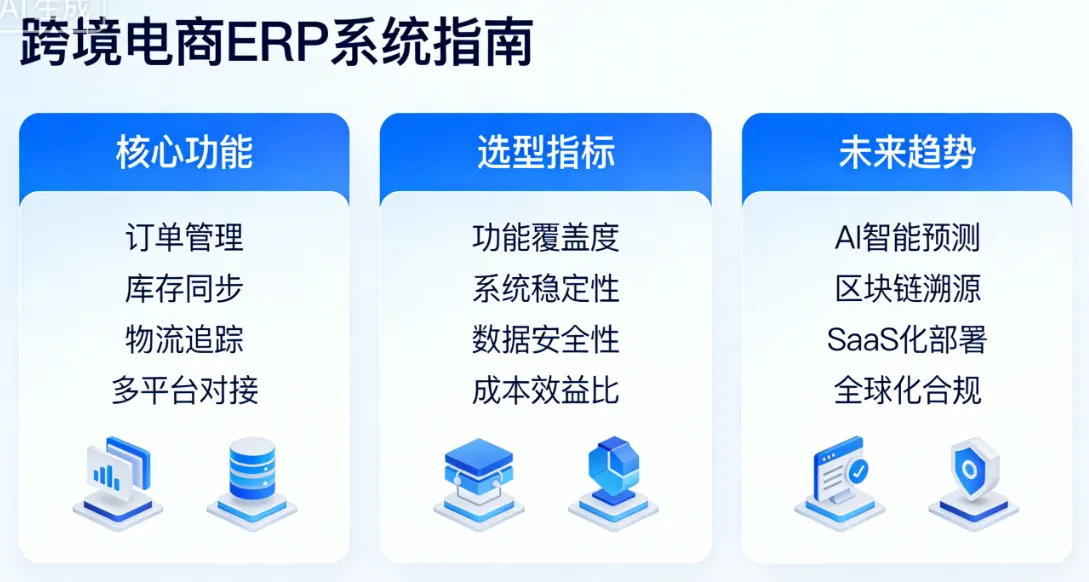
Cross border E-commerce ERP System Guide: Core Functions, Selection Indicators, and Future Trends
In today's increasingly integrated and competitive global e-commerce market, the operational complexity of cross-border e-commerce enterprises is growing exponentially. Multi platform store management, cross-border warehousing and logistics, multi currency financial settlement, and constantly changing compliance requirements together constitute an operational maze full of opportunities and challenges. In this context, an enterprise resource planning system designed specifically for cross-border e-commerce is no longer an optional efficiency tool, but rather one that maintains the survival of enterprises and drives scale growthCore digital center and decision-making brainIt is like a precise command tower, helping enterprises navigate accurately in this borderless commercial ocean and bid farewell to the chaotic management of manual workshops.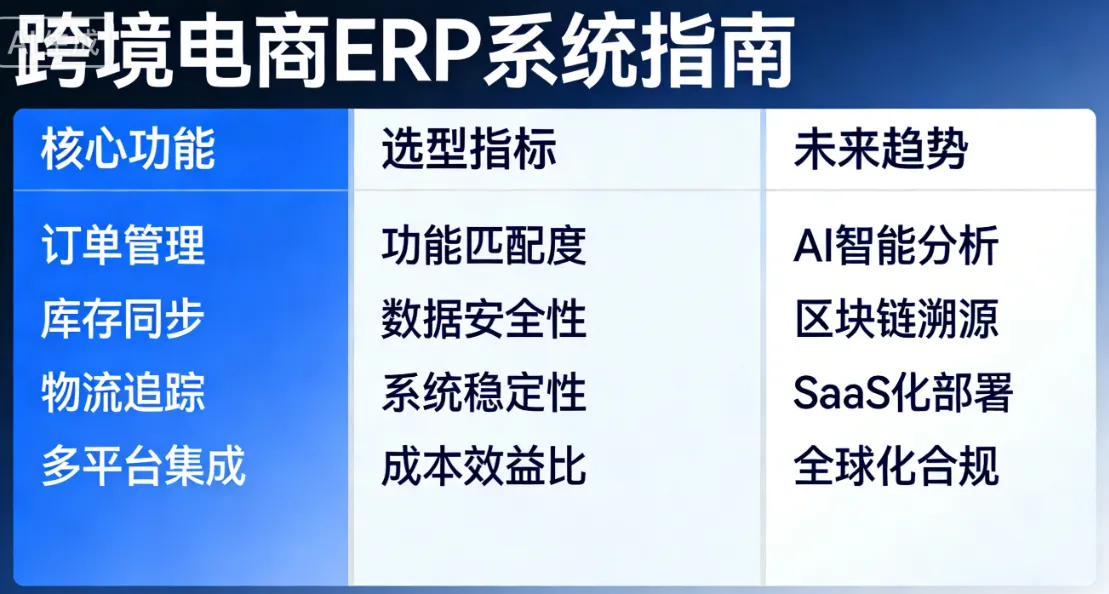
The core value of cross-border e-commerce ERP is first reflected in its construction of aCross platform, unified order and inventory management centerFor operators, managing Amazon eBay、Shopify、 Multiple stores such as AliExpress are the norm. Under traditional methods, each platform is like an information island, where processing orders, responding to inquiries, and synchronizing inventory all require manual switching between different backends, which is inefficient and prone to errors. Professional ERP systems can seamlessly aggregate these platforms through API interfaces. All orders are collected in real-time on one interface, supporting batch review, intelligent dispatching, and one click shipping. More importantly, it can achieveTrue global inventory visualization and intelligent linkageThe system automatically matches the optimal shipping warehouse for each order based on the inventory level, logistics cost, and timeliness of each warehouse, and synchronously updates the inventory quantity to all sales platforms in real time to prevent overselling at the root and maximize inventory turnover efficiency.
However, the aggregation of orders is only the beginning, complex and ever-changingCross border supply chain and logistics managementThat's the real test. A mature cross-border e-commerce ERP must have strong supply chain collaboration capabilities. It should be able to integrate multiple logistics service providers such as first mile transportation, overseas warehouses, and last mile delivery, providing full chain visualization management from purchase order generation, in transit tracking, warehousing and shelving to outbound distribution. The system can intelligently recommend logistics channels based on preset rules and automatically handle tedious tasks such as printing waybills and generating customs declaration information. In terms of financial management, the core challenge lies in handling multi currency transactions and accounting for tax inclusive costs and profits. An excellent system can automatically capture exchange rates, accurately convert them according to trading or settlement dates, and clearly calculate the cost of each order's goods, first leg shipping fees, platform commissions, marketing expenses, and taxes, ultimately obtaining the true net profit, allowing operators to have a clear understanding of the ins and outs of every penny.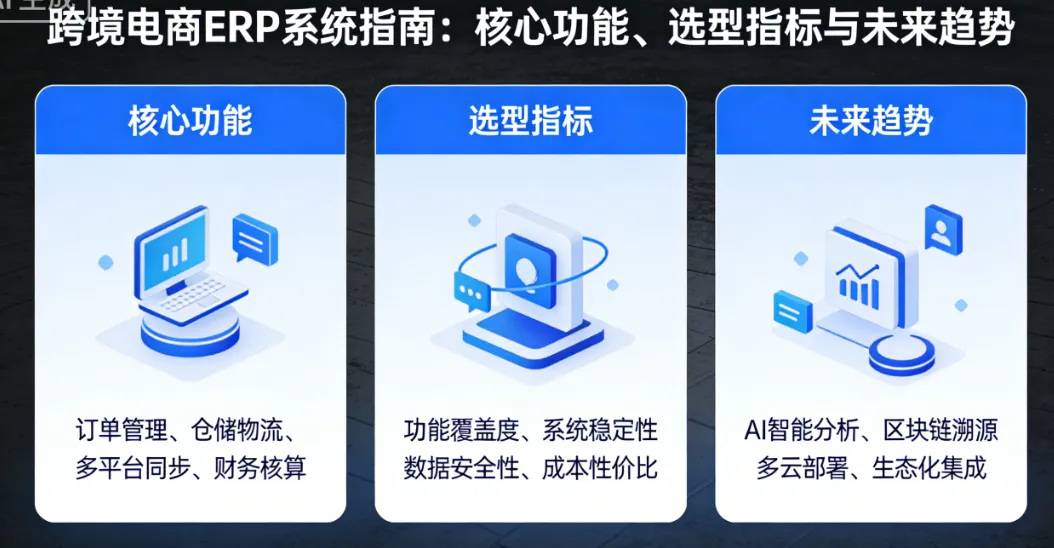
Faced with a dazzling array of products, business decision-makers must clearly grasp the key indicators for selection. The primary indicator isDeep adaptability to the target marketDoes the system support specific rules for your main sales platform and region? For example, automated VAT declaration support is crucial in the European market, while the US market may focus more on deep integration and inventory forecasting with Amazon FBA warehouses. Secondly, it isProgressiveness technology and open architectureA system based on cloud native and microservice architecture means higher stability, more agile iteration capabilities, and easier integration with third-party tools such as independent website building tools and marketing automation software, which determines the future digital expansion space of enterprises. Finally,Data driven Business IntelligenceAbility should be a key consideration. Can the system transform massive operational data into intuitive dashboards and actionable insights? For example, providing multi-dimensional sales and profit analysis by country, category, channel, etc., or predicting future replenishment needs based on historical data, these BI capabilities are key to upgrading ERP from a "recording system" to a "decision-making system".
Looking ahead to the future, the development trend of cross-border e-commerce ERP is moving towardsIntelligence and ecologicalizationThe direction is accelerating its evolution. Artificial intelligence technology will be applied at a deeper level to intelligent customer service, dynamic pricing, advertising optimization, and supply chain risk prediction, transforming the system from execution assistance to business partners. At the same time, ERP, as the core hub, will be more deeply integrated into the open ecosystem composed of professional service providers such as logistics, payment, marketing, and finance. At that time, enterprises can efficiently schedule global resources through one ERP portal, achieving true "one click global sales". Therefore, choosing and making good use of a powerful cross-border e-commerce ERP is not only about optimizing internal processes, but also about building a data-driven, intelligent engine, and difficult to imitate global operational system in fierce international competition. This is not only a sign of a company's maturity, but also a necessary path for it to move from being a "Chinese seller" to a "global brand".