
ERP system: the key role in breaking down communication barriers and improving enterprise collaboration efficiency
In the complex operation of modern enterprises, a long-standing and costly core pain point is the ubiquitous "communication barrier". This not only refers to the physical barriers between departments, but also to the "organizational wall" caused by information silos, process gaps, and cognitive differences at a deeper level. The sales department knows nothing about the production progress, the procurement department is not clear about the actual inventory in the warehouse, and the finance department needs to spend a lot of effort verifying data from all parties to complete the settlement. This fragmented state leads to slow decision-making, delayed response, and internal resource consumption, seriously restricting the overall efficiency of the enterprise. The introduction and deepening application of enterprise resource planning system fundamentally solves this dilemma by constructingUnified digital language, process platform, and data fact sourceReshaping the enterprise from a fragmented 'tribal alliance' to a highly collaborative 'organic whole', thereby unleashing astonishing collaboration efficiency and innovation potential.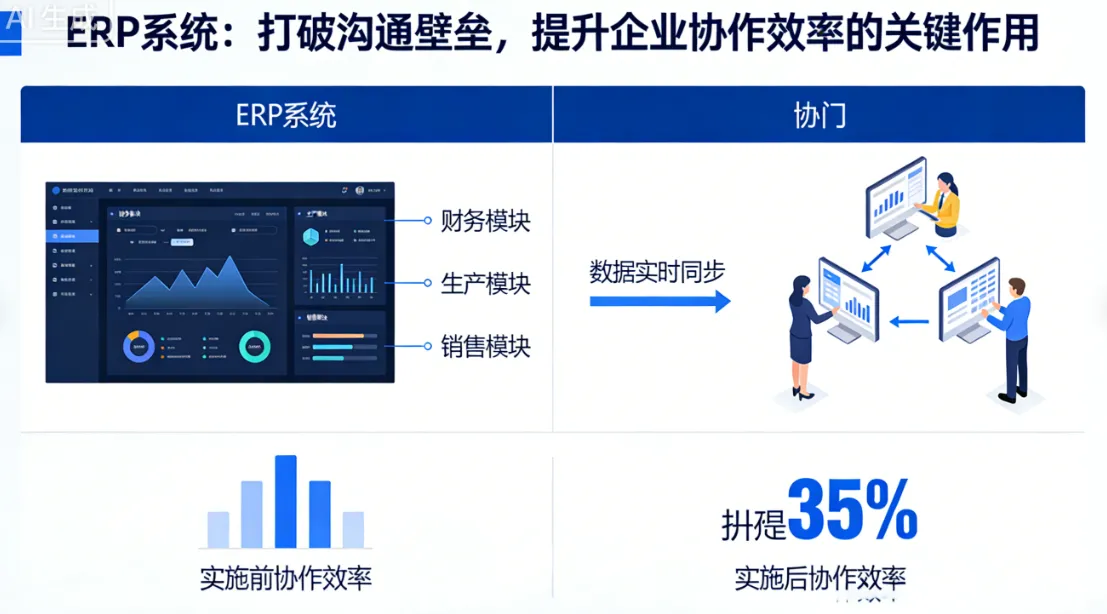
Its primary role is to build the only credible "source of data truth" within the enterprise, replacing discrete subjective statements with a unified factual basis.In an environment lacking ERP, departments often use independent spreadsheets, desktop databases, and even paper documents to manage their own business. Sales have sales ledgers, warehouses have inventory cards, and finance has independent account sets. When cross departmental collaboration is required (such as answering 'Can a major customer order be delivered one week ahead of schedule?'), it often leads to endless discussions, email exchanges, and meetings based on different data versions. The ERP system forcibly manages all core master data and transaction data such as customers, products, suppliers, orders, inventory, etc. through a highly integrated central database. Once any business action (such as a sales shipment) occurs in the systemReal time, automatic, and uniqueUpdate all relevant data views. From then on, when discussing the same order, the sales, planning, production, warehouse, and finance departments are faced with completely consistent current quantity, status, and cost information in the system. This dialogue based on common facts fundamentally eliminates suspicion and friction caused by information asymmetry and version confusion, allowing cross departmental communication to focus on problem-solving and value creation itself, rather than repeated confirmation of basic facts.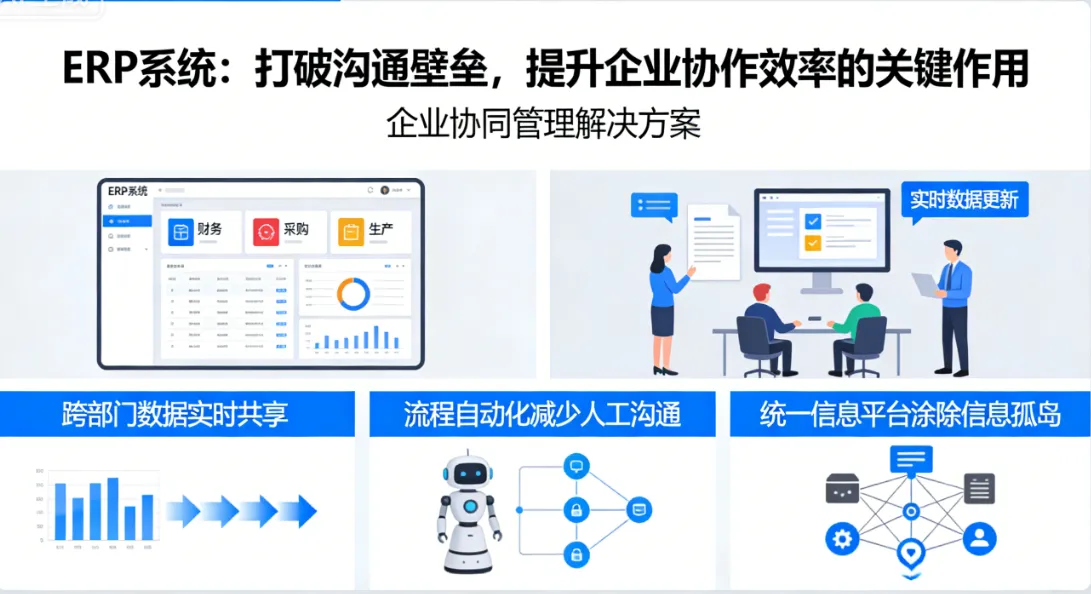
At a deeper level, ERP systems solidify and optimize end-to-end business processes, transforming the "handover" between departments into "automatic flow" within the system, and building seamless collaborative workflows.The traditional collaboration model is a relay race style: after the sales sign the order, the contract is "thrown" to the production plan, and after the plan is scheduled, the material requirements are "thrown" to the procurement department. After the procurement department places the order, they "notify" the warehouse to prepare the materials. There is a risk of waiting, misunderstanding, and manual transmission errors at every handover point. ERP systems weave these discrete links into a coherent, digital business process network. For example, the conversion from "sales order" to "production work order" and then to "purchase request" is automatically or semi automatically triggered by the system based on preset rules. When the production department completes the work report in the system, inventory is automatically deducted, financial costs are updated in real-time, and sales and management can immediately see the progress on the dashboard. This design naturally embeds the work of each department into a larger and clearer value stream graph. Everyone understands how their work takes over upstream and affects downstream, and their output is no longer an offline file delivered to a colleague, but a contribution to shared business processes. This greatly enhances the transparency and sense of responsibility of the organization's processes, transforming implicit collaboration into explicit and controllable systemic behavior.
Ultimately, the ERP system empowers management and teams to collaborate proactively and make scientific decisions based on overall goals by providing a globally visible management view and analysis tools.When data and processes are integrated, ERP can generate customized panoramic views for different roles, such as management cockpit, sales funnel analysis, production efficiency dashboard, supply chain health monitoring, etc. These views reveal the correlations that were previously obscured by departmental walls: how does the investment in market activities affect the gross profit margin of specific products? How does a supplier's delay affect the delivery of multiple projects? This global perspective encourages departments to go beyond the limitations of their own KPIs, understand their leverage role in the overall situation, and proactively engage in cross functional coordination. For example, before launching a large-scale promotion, the sales department can collaborate with the production and supply chain departments to develop a supply plan based on real-time capacity and inventory simulation in ERP, rather than blaming each other after a shortage. The finance department can also make more accurate budget forecasts and cash flow planning based on integrated business data, providing forward-looking guidance for the business department.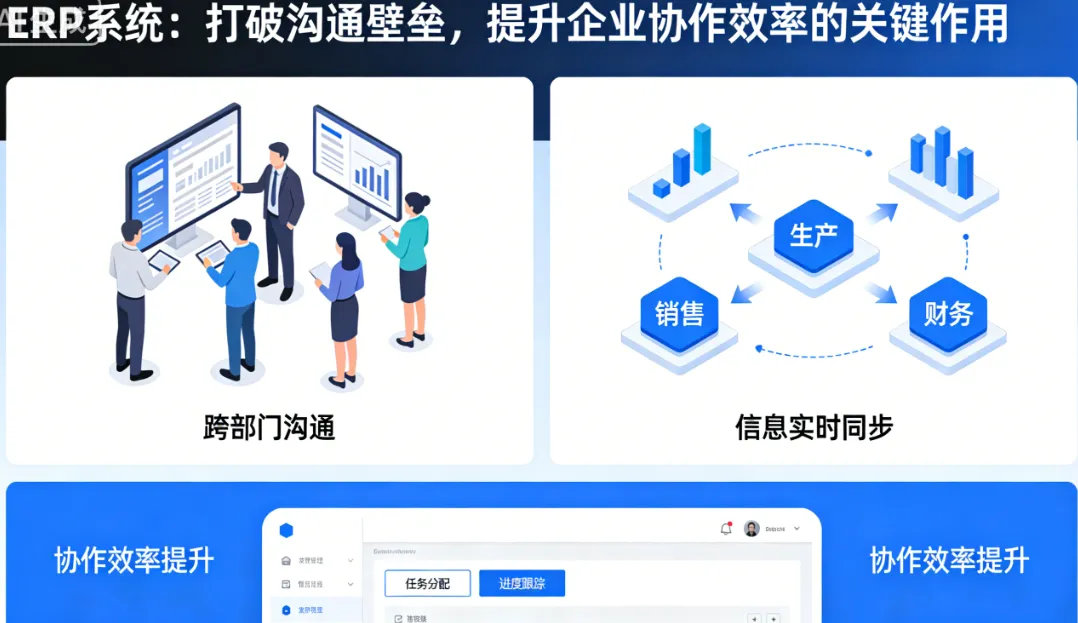
Therefore, as the key to breaking down communication barriers, the role of ERP systems goes far beyond providing convenient communication tools. It is throughThe mandatory nature of technical architecture, the directional nature of process design, and the constructive nature of data cultureSystematically reconstruct the underlying logic of enterprise collaboration. It upgrades enterprises from relying on personal communication skills and relationships for "rule of man" collaboration to relying on transparent rules and shared data for "rule of law" collaboration. The efficiency improvement brought about by this transformation is structural and sustainable: it reduces internal friction, accelerates response, and lays a solid organizational and digital foundation for the agility and innovation required by enterprises to cope with complex market environments. In the increasingly competitive business environment, having such a highly collaborative "digital nervous system" has become the key to building core competitiveness for enterprises.