
Analysis of Six Reasons for Unstable ERP Software
In the wave of digital transformation, enterprise resource planning systems have become the "digital central nervous system" of enterprise operations. However, many enterprises frequently encounter problems such as unstable system operation, slow response, data anomalies, and even service interruptions during ERP implementation and application, which seriously affect business continuity and management efficiency. Behind these unstable phenomena is often not a single technical failure, but a systemic risk formed by the interweaving of multiple factors. Thoroughly analyzing the root causes is of great significance for ensuring the stable operation and full potential of ERP systems.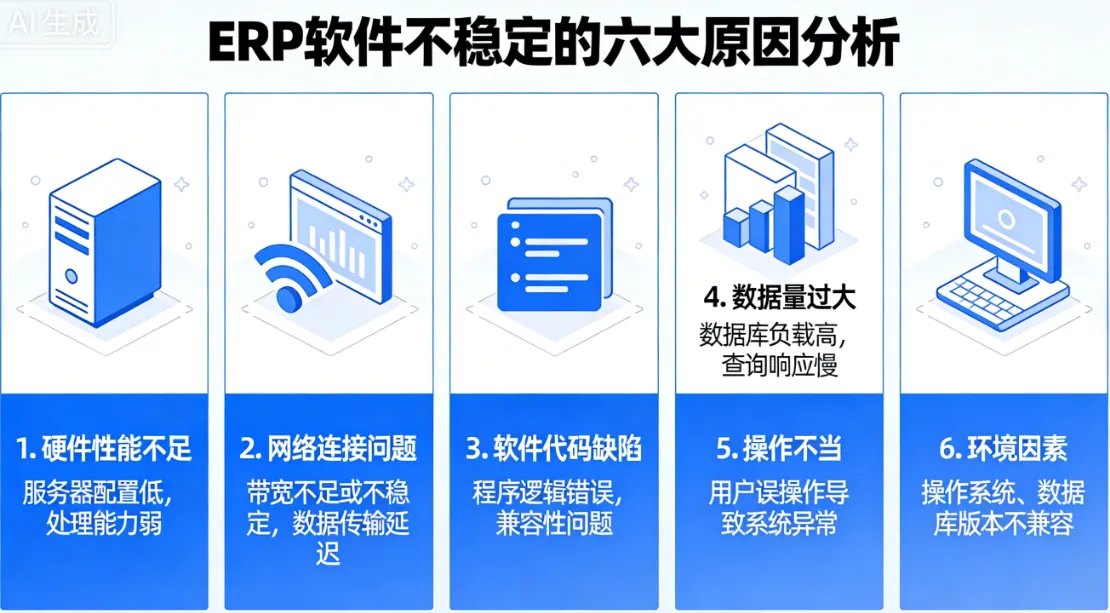
The historical burden of architecture design and technical debt
The instability of many ERP systems is rooted in inherent deficiencies in their architecture design or the resulting technical debt. Early deployed ERP systems often adopt a monolithic architecture. As enterprise business grows and functionality expands, the system becomes increasingly bloated and the coupling between modules becomes too high. A single modification may trigger multiple unforeseeable chain reactions, creating a vulnerability of 'one action affects the whole body'. In addition, in the long-term use of the system, enterprises tend to perform local patches and overlay development on the existing code to avoid the risk of large-scale refactoring, resulting in increasingly complex and chaotic internal logic and heavy technical debt. This kind of debt accumulates continuously, ultimately causing the maintenance cost of the system to skyrocket while stability continues to decline. Any small adjustment could become the last straw that breaks the system.
Hidden challenges of data quality and integration complexity
The stability of ERP systems is highly dependent on data quality and the reliability of system integration. Many enterprises have inadequate data governance systems, leading to long-term issues such as inconsistent master data, incomplete business data, and redundant historical data. When the system processes these low-quality data, it can cause business processes to lag, and in severe cases, trigger system logic errors or even crashes. Meanwhile, modern enterprise IT environments typically include various systems such as ERP, CRM, SCM, MES, etc., and the interface integration complexity between these systems is extremely high. Different systems adopt different data standards, communication protocols, and security mechanisms, and integration points often become high-risk areas for failures. Frequent issues such as interface call timeouts, mismatched data formats, and unsynchronized transactions directly undermine the overall stability of the ERP system.
The risk of loss of control in custom development and version management
Customized development of ERP systems has become a common practice for enterprises to meet specific business needs. However, the lack of standardized custom development processes is often the main human factor causing system instability. Excessive customization leads to significant modifications to the core code, disrupting the inherent balance of the original system; Temporary urgent development requirements often bypass the complete testing process and deploy unverified code directly to the production environment. At the same time, the chaos of version management has exacerbated this problem: patch updates and version upgrades lack systematic planning, version compatibility of different modules has not been fully verified, conflicts arise between hot fixes and official versions, ultimately leading to the system being in an unpredictable state.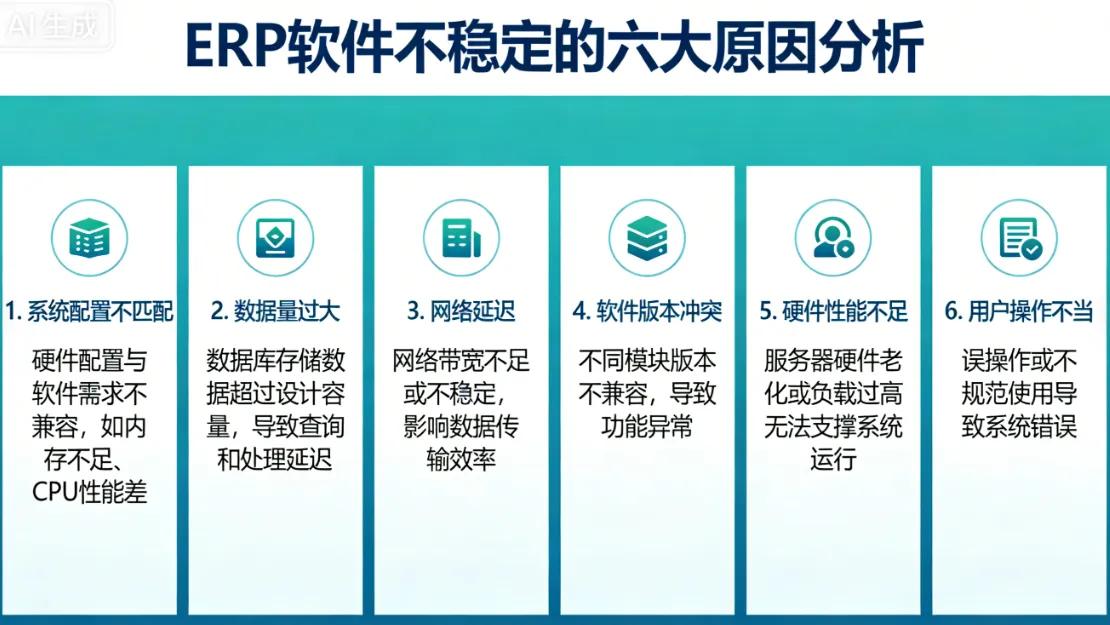
Mismatch between hardware infrastructure and performance planning
The stable operation of ERP system relies on the reliable support of underlying hardware infrastructure. Many enterprises underestimate the demand for system resources for business growth, and problems such as insufficient server configuration, storage performance bottlenecks, and network bandwidth limitations gradually become exposed after the system goes live. Especially during peak business periods, the number of concurrent users surges, data processing volume skyrockets, and infrastructure resources are rapidly depleted, leading to a sharp increase in system response time and even service interruptions. The unreasonable allocation of resources, inadequate disaster recovery and backup mechanisms, and aging hardware equipment in virtualized environments further amplify the risks at the infrastructure level. When hardware failures occur, the lack of effective fault transfer and recovery mechanisms poses a severe challenge to system stability.
Lack of mechanism for operation and maintenance management, monitoring and early warning
The stability of the system depends not only on the quality of construction, but also on continuous operation and maintenance management. Many enterprises lack professional ERP operation and maintenance teams, or simply understand operation and maintenance work as "restarting services" and "installing patches". In fact, proactive operation and maintenance require the establishment of a comprehensive monitoring and early warning system, which can track key data such as system performance indicators, business transaction success rates, and resource utilization rates in real-time. Lack of effective monitoring methods, system hidden dangers cannot be detected early; Without a sound warning mechanism, small problems gradually accumulate into major malfunctions; The lack of emergency plans leads to confusion in the handling process when a malfunction occurs. In addition, incomplete operation and maintenance documents and ineffective knowledge transmission have led to insufficient understanding of the internal logic of the system by operation and maintenance personnel, making it difficult to conduct in-depth problem diagnosis and repair.
Dynamic imbalance between business processes and system load
The instability of ERP systems sometimes stems from the business level rather than the technical level. The frequent adjustment and optimization of enterprise business processes may disrupt the original balance of the system. The new business rules conflict with the original system logic, and abnormal business scenarios have not been fully considered, resulting in system exceptions when processing specific business. At the same time, seasonal fluctuations in business volume, sudden traffic from promotional activities, and rapid launch of new business modules may all lead to system loads exceeding design capacity. If the system lacks elastic scalability and cannot dynamically adjust resources according to load changes, stability will be directly impacted. In addition, changes in user behavior, such as the increase in complex queries and the use of non-standard operations, may also exert unexpected pressure on the system.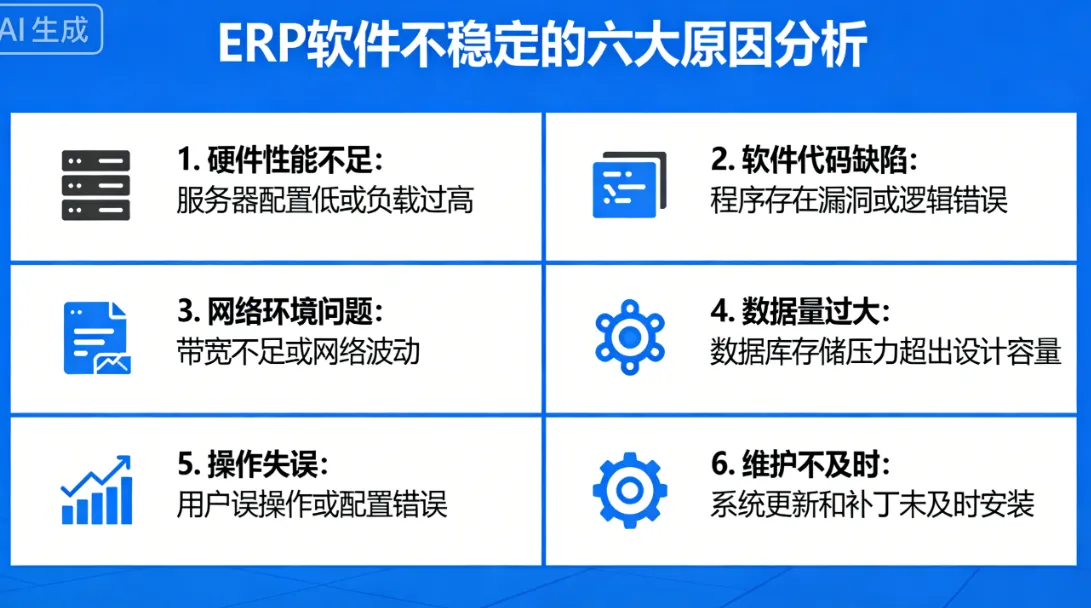
Comprehensive governance path for system stability construction
Faced with the multidimensional challenges of ERP system stability, enterprises need to adopt comprehensive governance strategies. At the technical architecture level, we should consider gradually evolving towards microservice architecture to reduce system coupling; In terms of data governance, establish a data quality management system throughout the entire lifecycle; Strictly implement development standards and testing processes in customized development management; When planning infrastructure, adopt elastic and scalable cloud architecture or hybrid architecture; In the construction of the operation and maintenance system, building a complete capability from monitoring, early warning to emergency response; Establish an analysis and evaluation mechanism for the impact of business changes on business system collaboration.
The stability of ERP systems is not a single technical issue, but a system engineering that deeply integrates technology, management, and business. Only by fundamentally understanding the inherent correlation and formation mechanism of these unstable factors can enterprises build a truly stable, reliable, and continuously evolving digital operation platform, transforming ERP systems from the "source of problems" of enterprises to the "solid foundation" of digital transformation. In an increasingly uncertain business environment, a stable ERP system is not only a guarantee of operational efficiency for enterprises, but also a core competitive advantage for enterprises to cope with changes and seize opportunities.