
How to determine if an ERP system is suitable for a company? -Shuntong ERP
Key Decisions in Digital Transformation
In today's rapidly changing business environment, enterprise resource planning systems have become an important tool for companies to improve operational efficiency and achieve refined management. However, facing the dazzling array of ERP solutions in the market, enterprises often find themselves in a dilemma of choice: what kind of ERP system is truly suitable for themselves? Improper choices not only result in significant financial waste, but may also disrupt existing business processes and even lead to the failure of digital transformation. Based on the practical experience of serving hundreds of enterprises in digital transformation, Shuntong ERP provides a systematic and multidimensional evaluation framework for enterprises, helping decision-makers scientifically judge the applicability of ERP systems.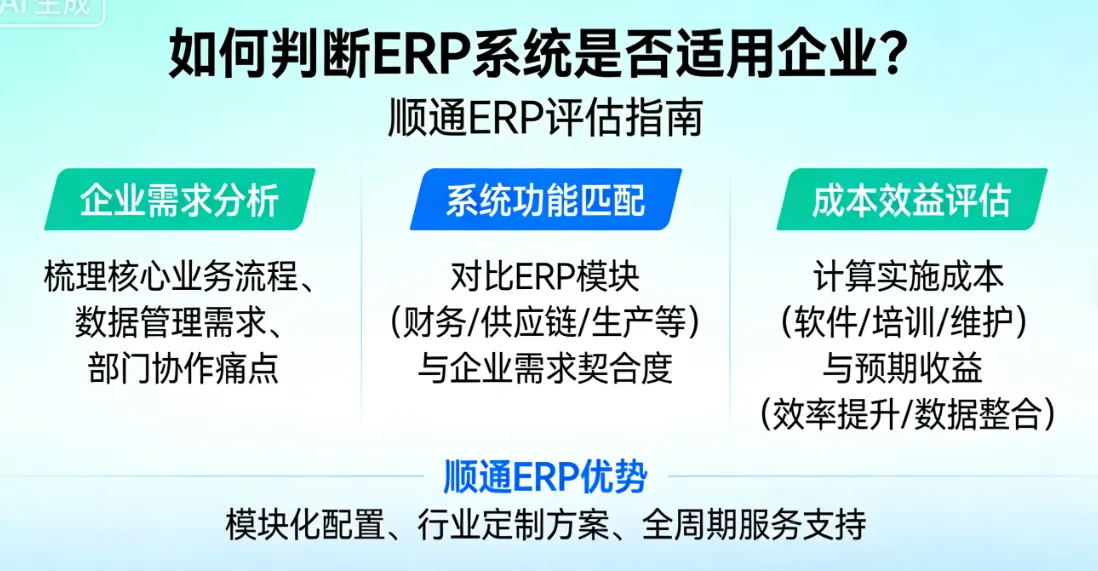
Strategic fit assessment: Can the system support the strategic development of the enterprise
The primary criterion for determining whether ERP is applicable isStrategic fitAn excellent ERP system should be able to support the current and future strategic development direction of the enterprise, rather than just meeting immediate needs. Enterprises need to examine whether the system has sufficient flexibility and scalability, and whether it can adapt to business model innovation and organizational structure adjustments. For example, for enterprises planning to expand overseas markets, ERP systems must support multiple languages, currencies, and cross-border tax compliance; For technology companies committed to product innovation, the system should have strong project management and R&D collaboration capabilities.
A deeper level of strategic alignment is reflected in the compatibility between the management philosophy embedded in the ERP system and the corporate culture. Does the system encourage centralized control or distributed decision-making? Is it emphasizing process standardization or flexible adaptation? These internal logics need to be coordinated with the development stage and management philosophy of the enterprise. A rapidly growing startup may require a flexible and agile system, while a mature large group may place greater emphasis on standardization and compliance control. Shuntong ERP has found that when the management logic of the system conflicts with the corporate culture while serving customers, the implementation process often faces numerous obstacles, and the final effect will be greatly reduced.
Business Process Matching: Can Core Pain Points be Resolved
The core value of an ERP system lies in optimizing and supporting business processes, thereforeBusiness process matching degreeIt is a key dimension for determining applicability. Enterprises should not simply list a list of functions for comparison, but focus on their core and most challenging business pain points, and evaluate whether the system can provide effective solutions.
The specific evaluation should be carried out from three levels. First of allCoverage of core business scenariosFor manufacturing enterprises, this may be an end-to-end process from sales orders to production planning, material procurement, workshop execution, and cost accounting; For retail enterprises, it may be a full channel integration from procurement, warehousing, distribution to store management and membership operations. Enterprises need to select key business processes for in-depth demonstration testing, observing how the system handles abnormal situations and complex scenarios, rather than just displaying standard processes.
Next isAdaptability to industry characteristicsDifferent industries have unique business rules and compliance requirements. Pharmaceutical companies require strict batch traceability and quality control, engineering companies require complex project cost accounting, and the fashion industry requires efficient inventory turnover and rapid response capabilities. General ERP systems often have weak functionality in these specialized fields, while industry solutions are specifically embedded with best practices. Industry experts from Shuntong ERP suggest that companies should focus on the depth and breadth of successful cases of the system in their own industry, which is often more valuable as a reference than a list of features.
FinallyThe guiding role of process optimizationAn excellent ERP system should not only automate existing processes, but also guide enterprises to improve in a more efficient and lean direction. Enterprises need to evaluate whether the system provides industry-leading process templates and business practices, and whether it can help identify and eliminate waste in the process. A certain mechanical equipment manufacturer found during evaluation that although the existing process can be implemented in the system, the best practice process of "design to order to mass production" provided by the system can shorten its order processing cycle by 30%, which has become a key basis for decision-making.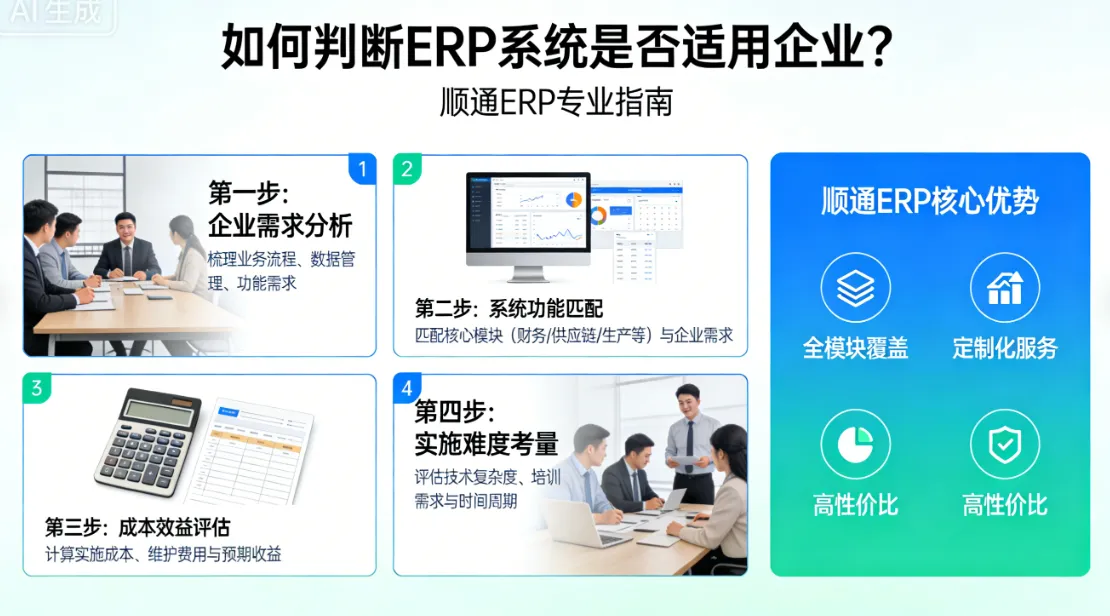
Technical architecture suitability: Can the system grow together with the enterprise
The technical architecture determines the vitality and expansion potential of ERP systems,Technical architecture suitabilityAssessment is crucial. First of allMatching deployment modesThe cloud SaaS model provides the advantages of rapid deployment, low initial investment, and automatic upgrades, making it suitable for enterprises with fast business changes and limited IT resources; The local deployment mode provides a higher degree of customized autonomy and data control, suitable for large enterprises with strict compliance requirements or highly customized needs. The hybrid cloud architecture provides a balanced choice.
Next isIntegration and scalability capabilitiesIn the modern enterprise digital ecosystem, ERP systems need to be integrated with various systems such as CRM, MES, PLM, e-commerce platforms, and IoT devices. The openness of the system, the maturity of APIs, and the convenience of data exchange directly affect the cost and complexity of future digital construction. Enterprises should pay special attention to integration cases between their systems and the core systems they have invested in or plan to invest in.
Once againUser Experience and Mobile SupportThe usability of the system directly affects user adoption and effectiveness. Intuitive interface design, convenient operation logic, and a comprehensive help system can significantly reduce training costs and operational errors. In today's world where mobile office has become the norm, the level of system support for mobile devices directly affects the flexibility of business operations.
Total cost of ownership and return on investment: Is value creation clear and sustainable
Economic feasibility is the foundation of decision-making, and enterprises need to comprehensively evaluate the ERP systemTotal cost of ownership and long-term investment returnThe total cost of ownership should not only include software licensing and implementation fees, but also hardware investment, customized development, system integration, data migration, training support, and maintenance and upgrade costs for the next 5-7 years. For cloud systems, it is necessary to carefully evaluate the growth pattern of subscription fees and changes in service scope.
More importantly, it is important to clarify the systemValue creation path and expected returnEnterprises need to set specific and measurable business goals, such as increasing inventory turnover percentage, shortening order processing cycle days, reducing financial settlement time, saving labor costs, etc., and evaluate the feasibility of the system achieving these goals. Shuntong ERP suggests that enterprises establish a return on investment analysis model, combining soft benefits (such as improving decision quality and customer satisfaction) with hard benefits (such as cost savings and efficiency improvements) for comprehensive calculation.
In the long run, the systemSupplier Strength and PartnershipIt also directly affects the investment value. The financial stability of suppliers, the proportion of R&D investment, industry experience accumulation, the maturity of implementation methodology, and local support capabilities are all related to whether the system can continue to receive updates and effective support. Enterprises should gain a deeper understanding of their suppliers' actual service capabilities through customer reference visits, on-site case studies, and other methods.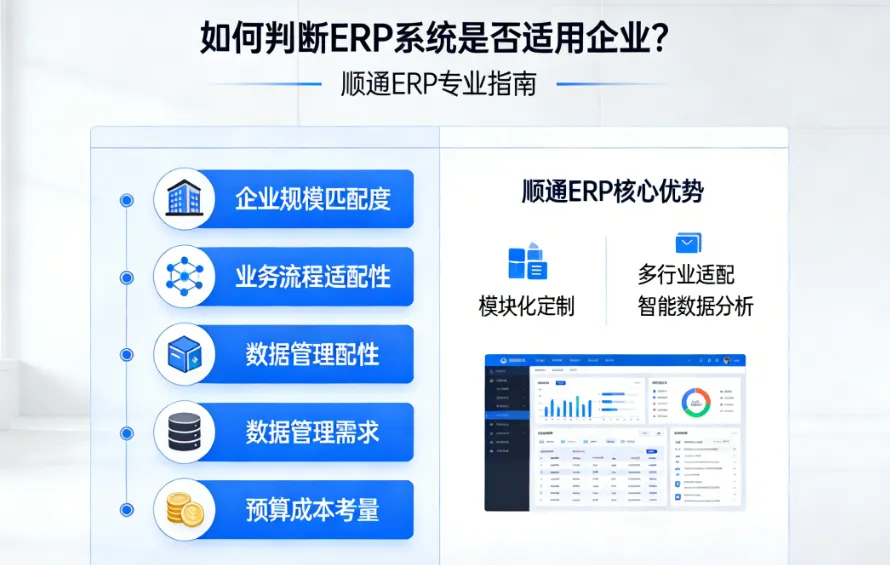
Organizational readiness: Is the enterprise ready to embrace change
Even the best system requires organizations to have the ability to adopt and use it,Organizational readinessOften the most overlooked but crucial evaluation dimension. Enterprises need to honestly evaluate their level of readiness for change: do senior managers have a clear vision and firm commitment to digital transformation? Do middle managers understand the necessity of change and are willing to adjust their management style? Do grassroots employees possess the necessary digital literacy and willingness to learn?
The standardization level of business processes and the basic condition of data quality also directly affect the difficulty and effectiveness of implementation. If a company has not yet established basic process specifications and data standards, directly implementing ERP may magnify existing problems rather than solve them. The experience of Shuntong ERP shows that investing resources in streamlining business processes and improving data quality before implementation can significantly increase project success rates and investment returns.
Finally, companies need to evaluate whether they possessThe cultural gene of continuous optimization and innovationThe launch of ERP system is not the end point, but a new starting point. Only when organizations establish a data-driven continuous improvement mechanism, encourage users to propose optimization suggestions, and actively embrace the new ways of working brought by the system, can the value of ERP systems continue to deepen and expand over time.
Comprehensive evaluation and wise decision-making
Judging whether an ERP system is suitable for an enterprise is a comprehensive decision-making process involving multiple dimensions such as strategy, business, technology, economy, and organization. Shuntong ERP suggests that enterprises establish an evaluation team composed of senior managers, business backbones, and IT experts, using a systematic evaluation framework to comprehensively evaluate the applicability of the system through various methods such as requirement analysis, solution demonstration, case study, and pilot verification.
In the final decision-making process, enterprises should avoid falling into the misconception of "more functions are better" or "lower prices are better", and instead return to the essence of value: whether this system can help us solve core business problems, support our strategic development, and bring sustainable investment returns. Only when the system is highly matched with the development stage, business characteristics, resource status, and organizational culture of the enterprise, can ERP truly become a powerful engine for digital transformation of the enterprise, rather than an expensive technological decoration.
Through scientific evaluation and wise selection, enterprises can find the most suitable ERP partners, open a new chapter in digital operations, and build lasting competitive advantages in a market environment full of challenges and opportunities.