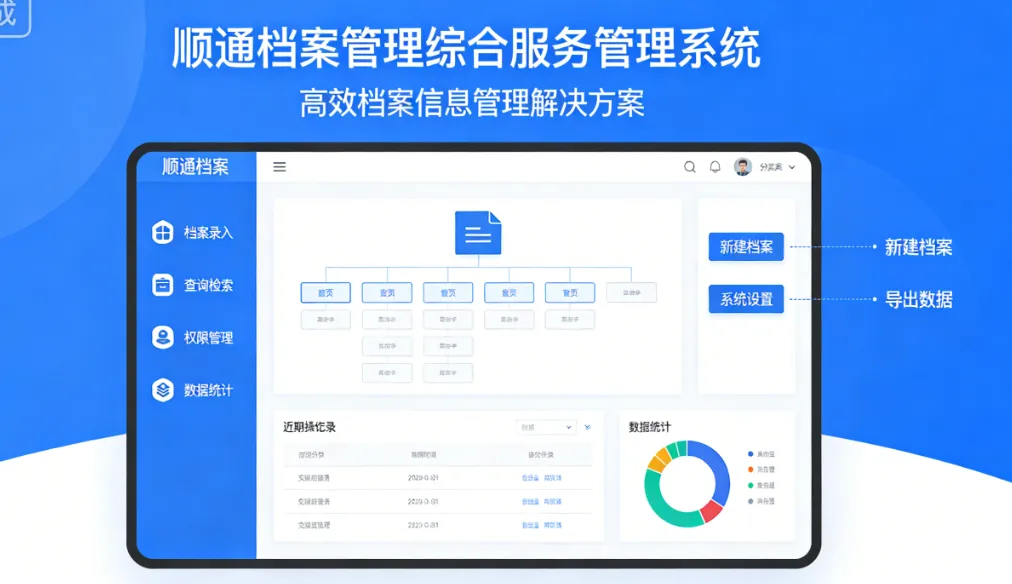
Shuntong Archive Management Comprehensive Service Management System - Efficient Archive Information Management Solution
The digital transformation dilemma and practical needs of archive management
In the era of information explosion, archives serve as the core carrier of organizational memory and important credentials for business operations. Their management effectiveness directly affects the operational efficiency and risk control capabilities of organizations. However, many government agencies, enterprises, and institutions are still deeply mired in traditional archive management: paper archives pile up like mountains, occupying a large amount of physical space; Retrieval relies on manual memory and directory browsing, taking tens of minutes or even hours to find an archive; Borrowing and circulation rely on paper registration, and the phenomenon of unclear whereabouts and overdue returns of archives is frequent; The appraisal and destruction of archives lack systematic basis, with incomplete retention and incomplete sales; Electronic documents and paper archives are managed separately, and the two forms of the same archive operate independently. These problems not only cause huge waste of manpower and material resources, but also conceal serious risks of archive damage, loss, and leakage. The Shuntong Archives Management Comprehensive Service Management System is designed to solve this series of problems. It is based on the theory of archives lifecycle management and integrates cutting-edge technologies such as the Internet of Things, big data, and cloud computing to provide efficient information management solutions covering the entire process of archives collection, organization, storage, utilization, identification, and destruction for various organizations.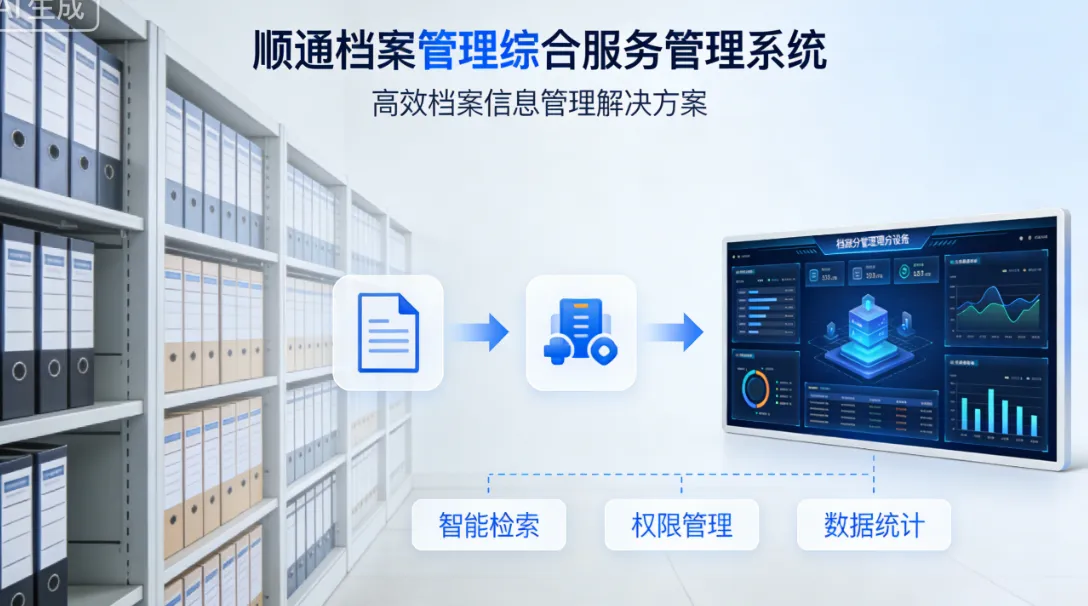
Unified management of all types of archives: breaking down media barriers and building a digital archive resource center
The primary value of Shuntong Archive Management System lies in achieving unified storage and centralized control of various archive resources. The system has completely broken down the management barriers between different media types such as paper archives, electronic documents, physical archives, and audio-visual archives, and standardized the management of all archive resources on the same digital platform.
For existing paper archives, the system establishes a unique digital identity identifier for each volume and file using barcode, QR code, or RFID tag technology. When organizing and shelving archives, administrators can easily input archive information and bind physical locations through scanning devices, forming a three-dimensional virtual warehouse map that is accurate to rows, columns, levels, and positions. For electronic files, the system supports seamless integration with OA systems, ERP systems, and business approval systems to achieve online real-time archiving of electronic files. After completing the issuance process in the business system, an official document can be automatically classified into the archive system according to preset rules, and metadata information can be generated synchronously without manual intervention. For audio and video files such as photos, recordings, and videos, the system provides online preview and streaming playback functions, which can be viewed without downloading. For physical archives such as trophies, banners, and samples, the system also assigns unique identifiers and digitally manages their storage location, storage conditions, appearance images, and other information.
The value of this unified management of all types is not only reflected in the technical aspect, but also profoundly changes the role positioning of the archives department. The archive room has transformed from a passive "warehouse administrator" who receives and preserves carriers to an active "knowledge service provider" who integrates, develops, and utilizes information resources. After the application of the Shuntong system in a certain municipal archives, the archives resources scattered in more than 30 departments and covering seven types of media were fully integrated, and a unified digital archive resource center was established. The utilization rate of the collection archives increased threefold, and the satisfaction rate of archive services jumped from 62% to 91%.
Intelligent archive storage: from manual inspection to proactive warning
Archive preservation is the foundation of archive work and also the most easily overlooked high-risk area. The Shuntong Archive Management System has upgraded archive preservation from traditional manual regular inspections to all-weather and all-round active intelligent protection through deep embedding of intelligent technology.
The system is linked in real-time with IoT devices such as temperature and humidity sensors, smoke detectors, access control systems, and video surveillance to establish a digital twin model of the archive warehouse environment. When the temperature in the warehouse exceeds the standard, the humidity is too high, the lighting is too strong, or there is a fire hazard, the system immediately issues a graded warning to the management personnel through multiple channels such as SMS, APP push notifications, and large screen pop ups, and provides disposal suggestions. Implementing full process intelligent control of archive inbound and outbound management: Authorized personnel can open the warehouse door through facial recognition or identity card, and the system automatically records the personnel, time, and operation content entering and exiting; When borrowing archives, the administrator scans the barcode of the archives with a handheld terminal, and the system automatically completes the registration of the archives being taken down and associates it with the borrowing application form; When returning the file, the system guides the administrator to return the file to its original location and ensures the accuracy of listing through location verification.
The traditional "tedious task" of warehouse inventory in archival work has been completely transformed. In the traditional mode, inventorying 100000 rolls of archives requires several staff members to spend several months, during which frequent adjustments to shelves and relocation of archives are also required. The Shuntong system supports two modes: batch scanning inventory and RFID RF induction inventory. When the staff walks along the channel with their handheld devices, the system can automatically identify the archive information on the shelf and generate real-time inventory surplus and deficit reports. After the application of RFID inventory function in a certain university archives, the annual inventory workload has been reduced from three months to two days, and the inventory accuracy has been improved from 85% to 99.9%. The long-standing problem of "discrepancies between accounts and reality" that has plagued the archives department has been fundamentally solved.
Precision file utilization: from waiting for customers to provide proactive services
The value of archives lies in their utilization. The Shuntong Archive Management System has completely changed the passive situation of traditional archive services, which rely on waiting for people to come, searching through books, and manually recording, by building a multi-level, multi-channel, and multi scenario archive utilization service system.
The system provides archive retrieval capabilities comparable to search engines, supporting various retrieval methods such as full-text search, combined condition search, fuzzy matching, and association recommendation. Users only need to input keywords, and the system can quickly locate the target file in the massive archives, and display its electronic original text, archive summary, associated archives and other information. For classified archives and internal control archives, the system implements strict permission grading control, and users at different levels can only retrieve and view archive information within their authorized scope. Permission control can be refined to the entire file, category, case file, document, and even specific fields within the file, ensuring the security of archive information while maximizing the satisfaction of utilization needs.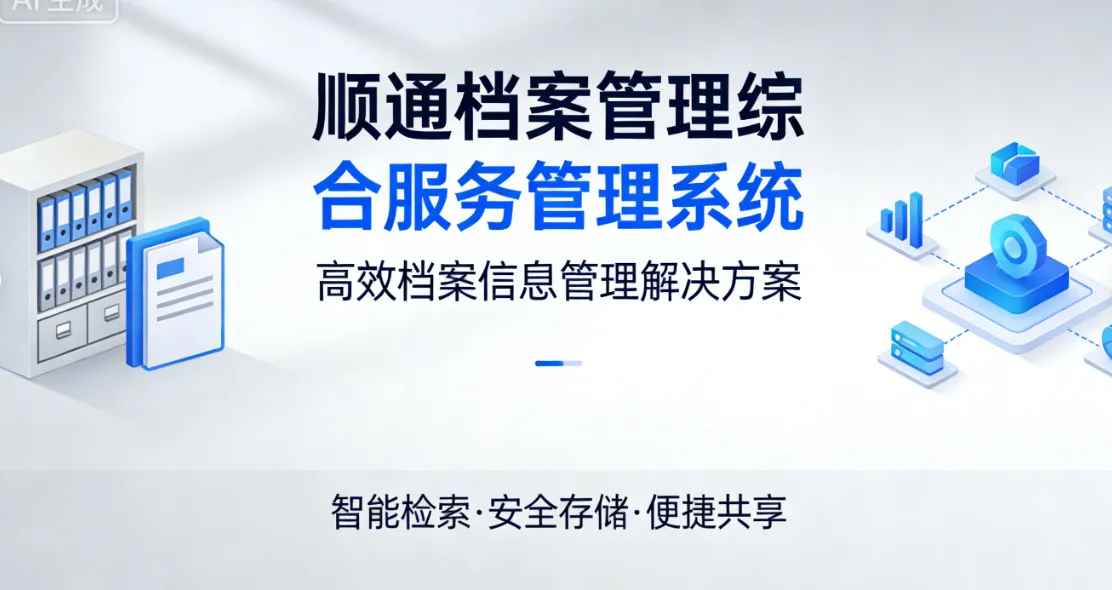
The archive borrowing process has been fully centralized and closed-loop managed. Employees can submit borrowing applications online through the system portal, selecting the borrowing period, purpose of use, and required carrier form; Online approval by department heads; The archive administrator shall handle the outbound of archives based on the approval results; The system automatically records lending information and sends reminders to borrowers; The system automatically urges the return when the deadline is approaching; Automatically push alerts to administrators and borrowers' superiors for overdue returns. The entire process is paperless, traceable, and traceable. After applying the borrowing management module in the archives center of a certain group company, the borrowing approval cycle was shortened from an average of three days to two hours, and the overdue return rate of archives decreased from 35% to below 5%.
The deeper value of archive utilization can be released through the development of editing and research functions. The system supports organizing archive resources by topic, time, department, and other dimensions, quickly generating research results such as milestones, organizational history, product development history, and engineering project summaries. Archive information is no longer a pile of old paper dormant in the warehouse, but transformed into a living knowledge asset that supports leadership decision-making, assists business development, and inherits organizational culture.
Standardized archive disposal: from casual to compliant
The identification and destruction of archives is an important link in the lifecycle of archives, and also a weak area in the management of archives in many organizations. The Shuntong Archive Management System is based on regulations and standards such as the National Archives Administration's "Regulations on the Scope of Archival Materials Filing and the Retention Period of Document Archives" and "Regulations on Enterprise Archive Management". It has built-in retention period tables and identification and disposal processes for various types of archives to ensure the compliance, scientificity, and traceability of archive disposal work.
The system supports regular automatic scanning of archive storage status and highlights archives that have exceeded their storage period and meet the destruction criteria. After the appraisal work is initiated, the system organizes the appraisal team members to review the value of the archives online, volume by volume and item by item, and record the appraisal opinions and reasons. The system generates a destruction inventory for archives that have been approved for destruction, detailing the basic information, destruction method, destruction time, monitoring personnel, etc. of the destroyed archives, and retaining visual materials of the destruction process. The entire set of appraisal and destruction archives will be stored as business records in the system for a long time and can be checked at any time.
For permanent archives that need to be transferred to the archives, the system supports automatic packaging according to the data format specified in the "Electronic Archives Transfer and Reception Measures", generates standardized transfer information packages, and completes the transfer work through offline media or online transmission methods. This function improves the efficiency of transferring archives from grassroots archives to archives by more than 70%, while ensuring the integrity and standardization of the transferred data.
A New Paradigm of Archive Management for the Future
The Shuntong Archive Management Comprehensive Service System represents not only a technological upgrade of archive management tools, but also a fundamental change in archive work philosophy. It shifts archival work from the traditional model of closed, passive, and preservation centered approach to a modern model of open, proactive, and utilization centered approach; Transforming archivists from back-end positions of burying themselves in organizing and not caring about worldly affairs to front-end forces that support decision-making and serve development; Reshaping the archives department from a cost center and consumption department to a knowledge center and value creation department.
With the deepening of digital government and digital enterprise construction, the digital transformation of archival work is no longer an optional but a necessary option. The Shuntong system provides various organizations with an archive management infrastructure that adapts to the digital age through the construction of four core capabilities: unified management of all types of archives, intelligent archive storage, precise archive utilization, and standardized archive disposal. When the entire lifecycle of every archive, from birth to destruction, is orderly and clearly traceable in the system, when every archive utilization can be accurately accessed and authorized within three seconds, and when the organizational memory and business wisdom hidden in the archive are fully activated and transformed into decision-making insights, archive management has completed a historic leap from "tools" to "capabilities", and from "costs" to "values". This is not only the mission of Shuntong Archive Management System, but also the rightful duty of archive work in the digital age.