
Shuntong Milk Delivery Management System - Efficient Milk Delivery Management Software Solution
Special delivery challenges in the livelihood industry
The milk delivery industry may seem ordinary, but it actually contains unique operational complexities. Unlike regular product delivery, milk has significant fresh attributes: short shelf life, temperature sensitivity during storage, and extremely high delivery time requirements. Every morning, thousands of bottles of fresh milk need to travel through the city's fabric in just a few hours, accurately reaching the milk boxes in front of thousands of households. This process not only tests physical strength, but also the level of refinement in management. The traditional management model that relies on paper documents, telephone communication, and manual memory is no longer sustainable under the pressure of increasing order volume, diversified customer demands, and expanding delivery range. The Shuntong Milk Delivery Management System is a digital solution tailored for this livelihood industry. It focuses on core scenarios such as order intensive processing, intelligent path planning, milk box asset tracking, and automatic account settlement, providing full chain operational management support for dairy enterprises, milk station distributors, and community delivery centers.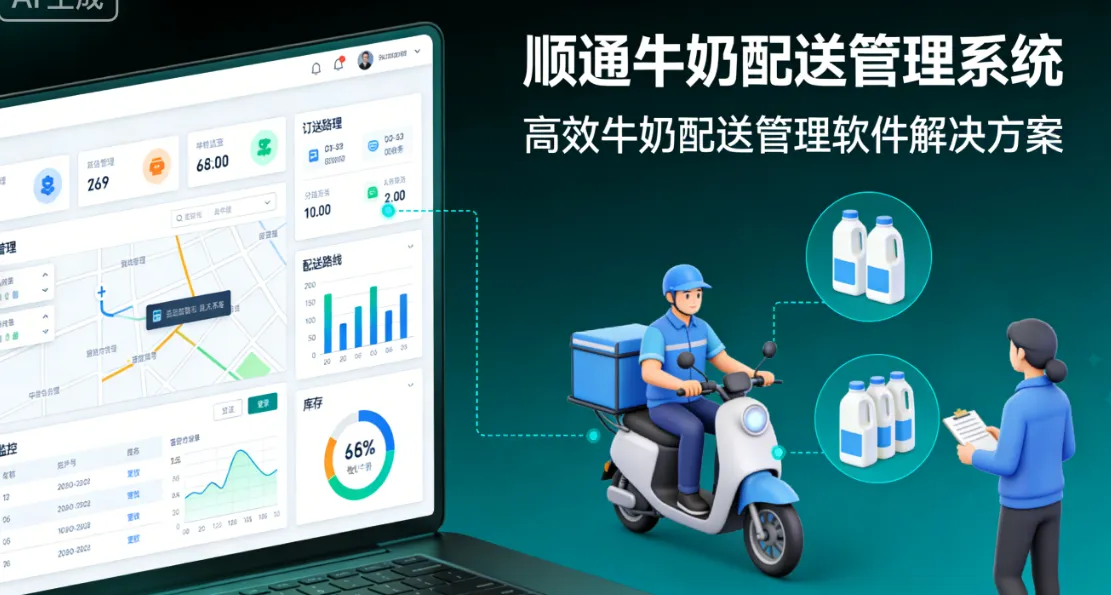
Order intensive processing: from scattered disorder to centralized collaboration
The order structure for milk delivery is highly fragmented. Customers have both long-term milk ordering households and temporary individual customers; There are both standard packages with daily delivery and special requests for weekend suspensions and address changes during winter and summer vacations. In the traditional mode, these order information are scattered in the delivery personnel's laptops, customer WeChat groups, and phone records, which is time-consuming and laborious to summarize and count, and errors and omissions often occur. The Shuntong system establishes a unified order processing center to consolidate all milk ordering demands from various channels onto the same platform.
Customers can place orders through the WeChat mini program, select product specifications, delivery cycle, start and end dates, and storage location. The system automatically verifies the validity of the address and pre occupies production capacity. Milk station customer service personnel can also enter phone orders on behalf of customers, and all orders will be processed in a unified pool for intensive processing. The system supports complex milk ordering rules configuration: Original flavor is given on Mondays, Wednesdays, Fridays, and Saturdays, high calcium is given on Tuesdays and Saturdays, and suspended on weekends; Temporary change of school address to home address during summer vacation; During the business trip, daily delivery will be adjusted to next day delivery. These personalized requirements can be configured through visual rules in the system, without the need for manual special labeling. The efficiency of order processing has increased by more than three times, and delivery errors caused by distorted information transmission have been reduced by 90%. After a dairy enterprise in a certain city connected to the system, the processing time for daily 20000 milk orders was compressed from four hours to forty minutes, and the customer service staff was reduced from twelve to five, resulting in a significant improvement in customer satisfaction.
Intelligent cable distribution: surpassing experience with algorithms
The path planning for milk delivery is a typical multi constraint optimization problem: thousands of delivery points are scattered in various corners of the city, each with precise time window requirements - fresh milk must be delivered before 6:30 in the morning, yogurt can be delayed appropriately but needs to be refrigerated; Some old residential areas do not have elevators and require additional time for climbing stairs; The congested periods and locations during the morning rush hour need to be dynamically avoided. In the traditional mode, these decisions rely entirely on the personal experience of delivery personnel, new employees are slow to get started, and the lines are almost paralyzed when old employees take leave.
The intelligent wiring module of Shuntong system upgrades delivery scheduling from empirical to algorithm driven. The built-in path optimization engine of the system takes the shortest total mileage, minimum total time consumption, and vehicle load balancing as the objective functions, comprehensively considering multi-dimensional constraints such as order quantity, delivery address, time window, vehicle capacity, and historical road conditions, and automatically generates the optimal daily delivery route. For temporary additions or cancellations, the system supports dynamic rearrangement to minimize the impact of changes. The delivery person receives the daily task list through the mobile phone and executes the delivery according to the system's planned order. After completing each order, the system automatically records the actual delivery time and location trajectory by scanning the code for confirmation. After the application of intelligent wiring in a fresh milk distribution center, the daily delivery mileage decreased by 18%, the daily number of delivery households per bicycle increased from 120 to 160, the training period for new employees was shortened from three weeks to three days, and the delay in delivery caused by unfamiliar routes was reduced by 75%.
Full cycle tracking of milk box assets: big ledger behind small boxes
The milk box is a crucial asset in the milk delivery system that is easily overlooked. The procurement cost of a high-quality insulated milk box is tens of yuan, and the number of milk boxes in a medium-sized city can reach hundreds of thousands, with a total asset value of several million yuan. However, the turnover management of milk cartons has been in a crude state for a long time: sending without recording, receiving without verification, and no one knows about damage or loss. Many dairy companies incur losses of up to hundreds of thousands of yuan annually in just one item, the milk box.
The Shuntong system assigns a unique QR code digital identity to each milk box, with clear and traceable status throughout the entire lifecycle from procurement and storage, initial release to daily circulation, damage and scrapping. When the delivery person places milk boxes to new customers, they complete the binding registration between the customer and the milk box by scanning the system code; When customers unsubscribe, the delivery person scans the code to retrieve the milk box, and the system automatically unbinds and updates the available inventory status. The system real-time calculates the number of milk boxes in transit, detained, vacant, and awaiting repair at each milk station and line, and automatically alerts for milk boxes that have not been circulated beyond their normal usage cycle. The milk box inventory work has shifted from an annual surprise check to real-time automatic verification by the system, and the discrepancy rate between accounts and goods has decreased from 8% to less than 0.3%. After applying the milk box management module for one year, a certain dairy company reduced the annual loss rate of milk boxes from 12% to 4%, saving nearly one million yuan in costs annually.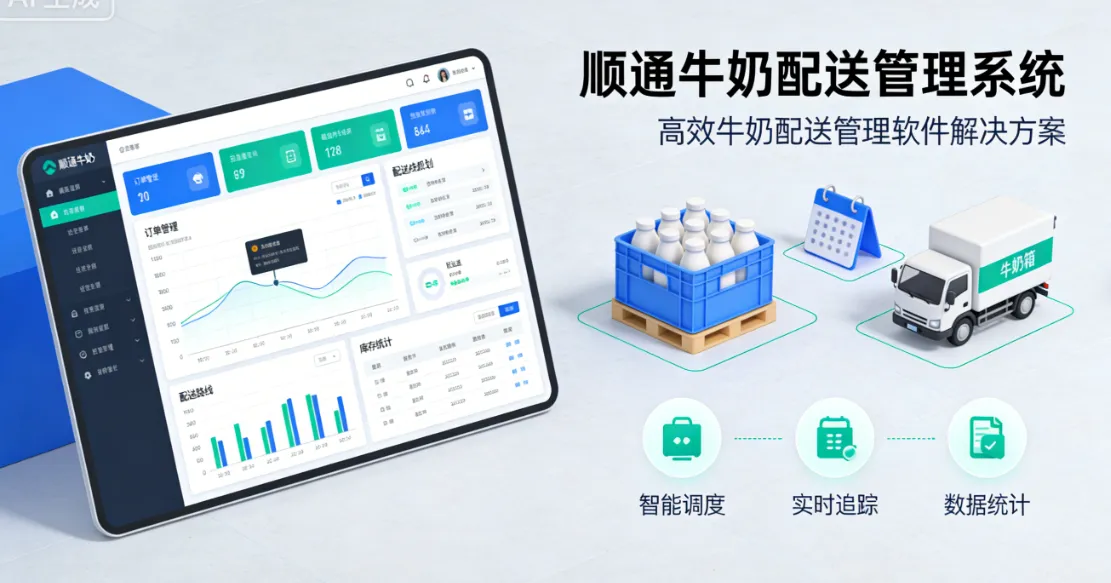
Automatic settlement of accounts: from confused accounts to clear accounts
The fund settlement chain of milk delivery business is long and involves multiple stakeholders, including end customers, delivery personnel, milk stations, and dairy factories at multiple levels. The daily delivery mode determines the characteristics of high-frequency, small-scale, and scattered orders, and traditional manual accounting methods are prone to errors and bad debts. The delivery person handles hundreds of yuan in change every day, and reconciling with the milk station is time-consuming and laborious; The settlement cycle between milk stations and dairy factories is long, and the capital occupation is large; The customer's deposit balance is not transparent, and complaints occur from time to time.
Shuntong System has built an automated sorting system covering the entire business chain. Customers pre charge and order milk through the WeChat mini program, and the system deducts fees on a transaction by transaction basis based on the actual delivery frequency, with real-time tracking of balance changes. After the delivery person completes the delivery, the system automatically calculates the daily delivery commission and generates a settlement list with the milk station. The milk station and dairy factory automatically summarize the delivery volume, product category, and settlement amount on a periodic basis, and support online reconciliation and invoice collaboration. The flow of funds resonates with the flow of orders and logistics throughout the entire process, and the origin and origin of each payment are clear and traceable. The financial reconciliation work has been reduced from two manual days per week in the past to automated completion every hour. The fund settlement cycle has been shortened from thirty days to seven days, and the customer's deposit balance has shifted from settling funds to actively managing resources. After the application of the system by a dairy enterprise in a certain region, the turnover days of accounts receivable decreased by 45 days, saving more than 500000 yuan in annual financial costs.
Temperature monitoring and quality traceability: safeguarding the safety of the tongue tip
Fresh milk delivery has strict temperature requirements. From the cold storage of the dairy factory, transportation by refrigerated trucks, temporary storage at the milk station to the last mile of delivery, the entire process must be maintained within a temperature control range of 2 to 6 degrees Celsius. Any temperature chain break at any stage may result in damage to the quality of the entire batch of products, and even lead to food safety accidents. The Shuntong system seamlessly integrates temperature control data into the delivery management loop through the use of IoT temperature sensors.
Install a temperature control terminal on the refrigerated truck to provide real-time feedback on the temperature curve of the cabin. If the temperature exceeds the threshold, the system will automatically sound an alarm; The milk station cold storage is equipped with environmental monitoring equipment, and any abnormal temperature is immediately reported to the responsible person; The delivery personnel use a temperature recording chip embedded in the insulated box, which can read the temperature history data inside the box through a mobile phone when arriving at the customer's location. All temperature control records are associated and archived with delivery orders to form a complete cold chain quality file. Once a customer complaint or food safety inspection abnormality occurs, the system supports reverse tracing from the finished product batch to the delivery route, delivery vehicle, outbound time, and storage temperature zone, accurately locating the problematic link. This transparent quality control not only reduces food safety risks, but also becomes a powerful endorsement for enterprises to convey trust to customers. A high-end fresh milk brand actively pushed the full temperature control report generated by the system to subscribers, resulting in a 15 percentage point increase in customer retention rate.
Building a sustainable digital ecosystem for fresh milk delivery
The value of the Shuntong Milk Delivery Management System lies not only in the efficiency improvement of individual functional modules, but also in connecting the originally fragmented links in the delivery chain - customers, delivery personnel, milk stations, and dairy factories - into an organic and collaborative digital ecosystem. The order information is converted into a delivery task at the moment the customer places the order, and the real-time delivery execution data is transmitted back as the settlement basis. The settlement result is automatically updated with the customer's balance, forming a complete data loop. In this ecosystem, the flow of every bottle of milk is accompanied by the flow of information, and every delivery is the accumulation of data assets.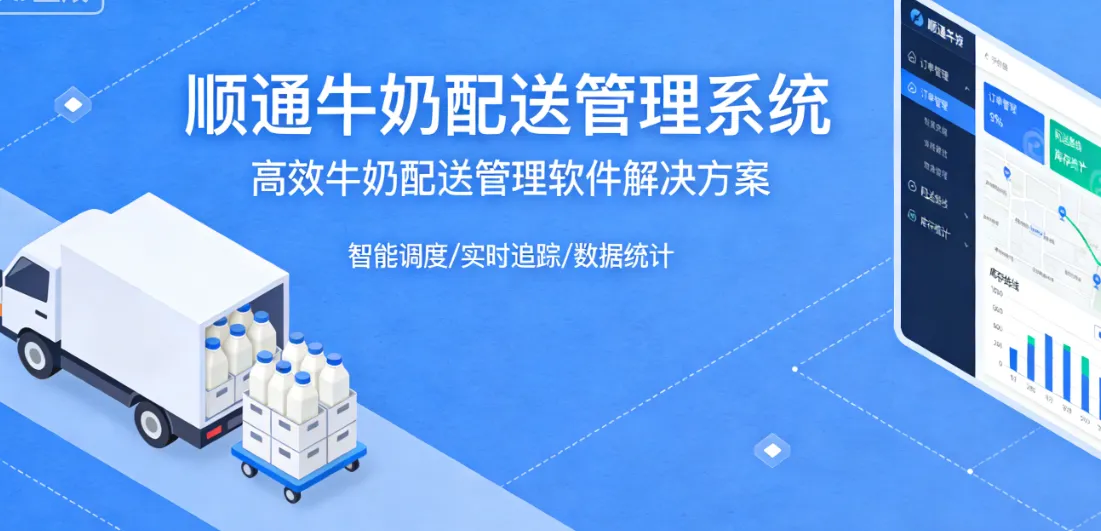
With the penetration of new retail models into the field of people's livelihood, fresh milk delivery is expanding from a single daily household delivery to a more diverse range of consumer scenarios. New business models such as enterprise community group buying, instant retail of office buildings, and delivery of school nutrition meals are constantly emerging. The Shuntong system adopts a platform architecture design, which can quickly access new channels, adapt to new scenarios, and accompany dairy enterprises to evolve together. When digital capabilities are deeply integrated into every capillary of milk delivery, this ancient livelihood industry is radiating new efficiency and warmth.