
What is a clothing ERP system
Understanding the starting point of clothing ERP from the birth of a piece of clothing
The most intuitive way to answer what a clothing ERP system is is to follow the complete lifecycle of a piece of clothing. This piece of clothing was originally just a sketch hand drawn by the designer. After confirming the sketch, it is necessary to purchase fabrics - possibly more than ten different colors and materials of fabrics, each of which requires inquiries, coloring, and confirmation of delivery time from different suppliers. After the fabric arrives at the factory, the cutting workshop needs to cut the fabric into pieces according to the paper pattern, and the layout of the pieces directly affects the material cost of the garment. The cut pieces are transferred to the sewing workshop and go through dozens of processes - sewing, edging, opening bags, installing zippers, and ironing. Each process is completed by different workers, and the piece rate salary accumulates for each completed process. After the finished garment is completed, it enters the finished product warehouse and waits to be shipped to an e-commerce warehouse, an offline store, or an overseas customer. In the end, this garment was purchased by the consumer, and if the size is not suitable, it may be returned, triggering quality inspection, relisting, or scrapping.
Each link in this chain generates data and relies on data generated by other links. The fabric procurement needs to know how many pieces of this garment are expected to be produced, the sewing process needs to know when the cut pieces will arrive, and the sales end needs to know how many pieces are still in stock. In the traditional mode, these data are recorded in different notebooks, Excel spreadsheets, and different people's brains, separated from each other and updated with lag. The clothing ERP system is a digital nervous system designed to undertake this complete chain. It is not a collection of independent software, but an integrated platform that integrates fabric procurement, cutting machine layout, process flow, inventory distribution, channel sales, and financial accounting.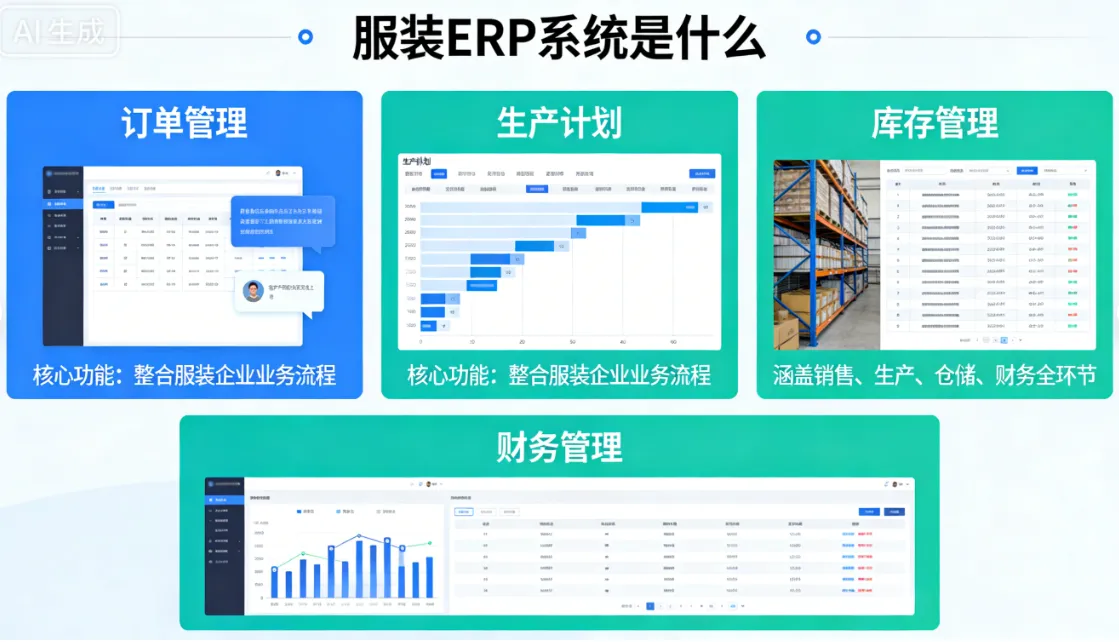
The particularity of clothing ERP: an industry proposition that cannot be solved by general ERP
Many people understand clothing ERP as a universal inventory system with a "clothing version" label added. This is a fundamental misjudgment of the complexity of clothing management. Universal ERP is designed for standardized industrial products, with fixed material lists, fixed process routes, and fixed inventory units. The clothing industry is precisely on the opposite side of standardization.
The first repetitive complexity that clothing ERP must handle is the three-dimensional matrix of color codes. Developing 5 colors and 5 sizes for each color of the same down jacket generates 25 inventory units. When purchasing, place orders by color, and suppliers pack and ship according to color codes. Sales analysis requires summarizing by price, comparing by color, and drilling down by code. General ERP treats each SKU as an independent file, which becomes invalid in the clothing scene. Clothing ERP establishes a hierarchical master-slave relationship for styles, colors, and sizes in the underlying data structure. All business documents support entry from the style and color dimension, automatic splitting to the color code dimension for execution, and then summary and analysis by any dimension.
The second repetitive complexity that clothing ERP must deal with is the procurement model that combines futures and spot materials. Clothing fabric procurement is not a standard product transaction, involving Pantone color matching, shrinkage rate testing, and door width utilization rate calculation. The same fabric may have cylinder differences in different batches, and cutting must be done in separate cylinders. The procurement module of general ERP cannot support the color code standard library, cannot associate shrinkage rate test reports, and cannot track the actual utilization rate of each batch of fabrics. Clothing ERP embeds these professional capabilities into standardized functional modules, linking fabric files with color card images, inspection reports, and supplier historical batches. Purchase orders can specify color code standards, and automatic comparison of cylinder difference levels during warehouse acceptance.
The third repetitive complexity that clothing ERP must handle is the real-time linkage between piece rate wages and process flow. In the cost structure of clothing factories, labor costs account for a very high proportion and are highly variable. The sewing cost of a shirt may vary several times due to the complexity of the style, fabric characteristics, and batch size. The salary module of the general ERP summarizes production on a monthly basis and centrally calculates at the end of the month. Workers cannot know their daily income in real time, and wage disputes accumulate and erupt on payday. The clothing ERP connects the process library, labor price library, worker files, and production line reporting terminals in real time. After each worker completes a process, they scan the code to confirm, and the system calculates the labor price for that process and accumulates it to their personal income account for the day. Disputes can be traced and verified on the spot when they occur.
The core functional modules of clothing ERP
Based on the industry specificity mentioned above, a complete clothing ERP system typically consists of six core functional domains.
The product development management module carries the technical transformation from design drafts to producible products. The designer uploads the style draft, and the system automatically generates a preliminary material list, linking it to the fabric library, accessory library, and pattern library. Online allocation of sampling tasks, real-time tracking of sample clothing production progress, and seamless integration of sample clothing cost estimation and pricing approval processes. After confirmation, the bill of materials will be automatically locked, and subsequent procurement, production, and cost accounting will be based on this version to prevent technical data from being disconnected from on-site execution.
The supply chain collaboration module integrates suppliers into a unified digital network. Brand owners will push rolling demand forecasts to the supplier portal, and based on this, material suppliers can prepare materials in advance and lock in production capacity. Purchase orders are issued online, and suppliers can confirm delivery dates, ship in batches, upload shipping notifications, and print box labels through self-service throughout the process. The brand warehouse arranges the receiving personnel in advance based on the delivery forecast, scans the code upon arrival to complete the storage, and automatically triggers the inspection task. The reconciliation between the two parties is completed online, and the automatic verification of the matching of the purchase receipt, supplier delivery note, and financial invoice is carried out.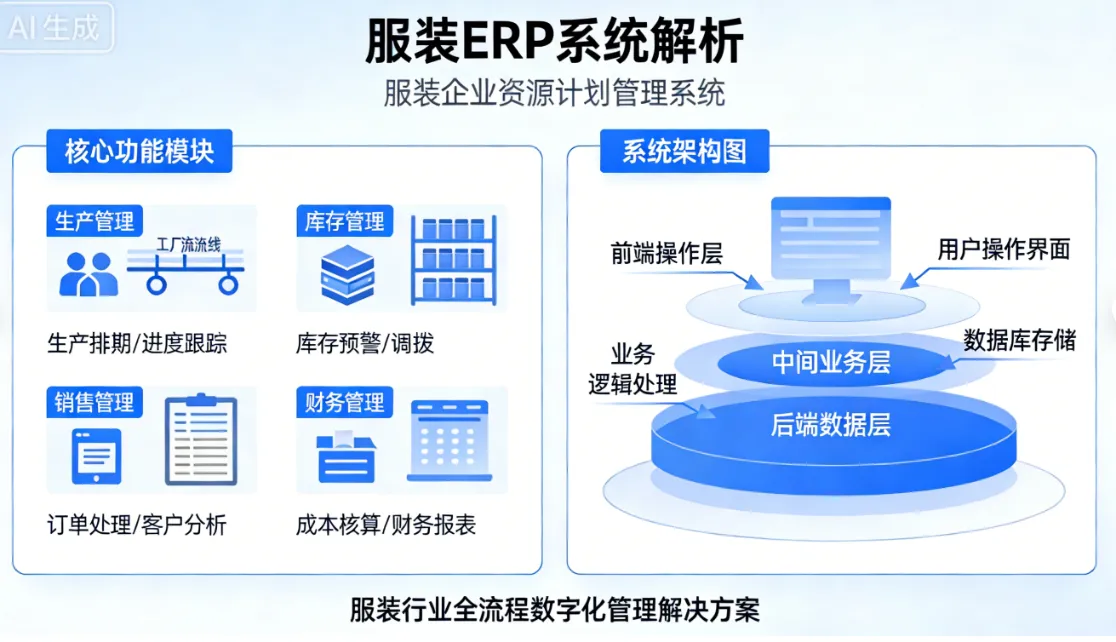
The production execution module makes the workshop black box transparent. The cutting process integrates typesetting software interfaces to automatically collect the typesetting utilization rate of each order and model, and provides real-time alerts for over consumption anomalies. Deploy workstation terminals in the sewing process, workers scan codes to report work, and the system records in real-time the completion quantity, labor consumption, and quality inspection results of each process. The forming and ironing process is connected to equipment sensors, collecting process parameter curves, comparing them with standard parameters, and automatically locking problem batches when exceeding the threshold. Piece rate wages are linked in real-time with production reporting, allowing workers to check their daily output and estimated income at any time.
The inventory management module solves the unique 3D inventory visualization problem in the clothing industry. The system automatically calculates the historical sales speed, safety stock days, and current available time for each SKU, and dynamically marks them according to five levels: hot selling, best-selling, flat selling, unsold, and dead stock. The omnichannel inventory sharing center integrates the real-time distribution of inventory in the main warehouse, sub warehouses, store warehouses, e-commerce warehouses, and outsourced warehouses, and automatically retrieves store inventory and generates transfer suggestions when the e-commerce code is broken. At the end of season clearance stage, the system automatically generates discount suggestions and clearance task lists based on inventory age, turnover rate, and gross profit margin.
The sales and distribution module connects the dual track of futures ordering and spot replenishment. During the futures ordering conference, dealers place orders online and the system summarizes the futures order structure of various regions, channels, and categories in real-time, providing input for capacity planning and material preparation. In the spot sales process, the system is directly connected to e-commerce platforms, store POS, and live streaming platform APIs to capture real-time omnichannel sales orders. The intelligent replenishment engine dynamically calculates the optimal replenishment time and quantity for each SKU on a per item basis.
The financial cost accounting module converts business data into financial data. The system adopts a step-by-step or activity-based costing approach, collecting direct materials, direct labor, and manufacturing costs by order, style, and batch. The material cost is accurate to the actual fabric consumption and corresponding purchase batch unit price of the garment, the labor cost is accurate to the piece rate corresponding to the actual operator of each process, and the manufacturing cost is dynamically allocated based on actual working hours. Managers can query the cost breakdown and gross profit contribution of any style or order at any time.
The essence of clothing ERP: from recording system to planning system
The fundamental difference between clothing ERP and inventory software lies not in the number of functions, but in whether it is positioned as a recording system or a planning system. Inventory management software is good at answering "what happened in the past" - how many items were sold yesterday, how many pairs are still in stock, and how much money was earned last month. Clothing ERP must answer the question of 'what should happen next' - whether there will be a shortage of popular products next week, how many fabric purchases should be issued to suppliers next month, and what should be the first stocking quantity for next season's new products.
This transition from recording to planning relies on algorithms rather than intuition. The demand forecasting engine built into the clothing ERP outputs single item level demand forecasts based on historical sales data of styles, seasonal factors, promotional calendars, traffic trends, and competitor intelligence. The intelligent replenishment engine takes prediction as input, comprehensively considers current inventory, in transit procurement, safety stock, and procurement cycle, and dynamically calculates the optimal replenishment time and quantity. The capacity planning engine takes predicted orders as input, combined with the capacity load curves of various suppliers and historical delivery rates, to output outsourcing capacity locking suggestions.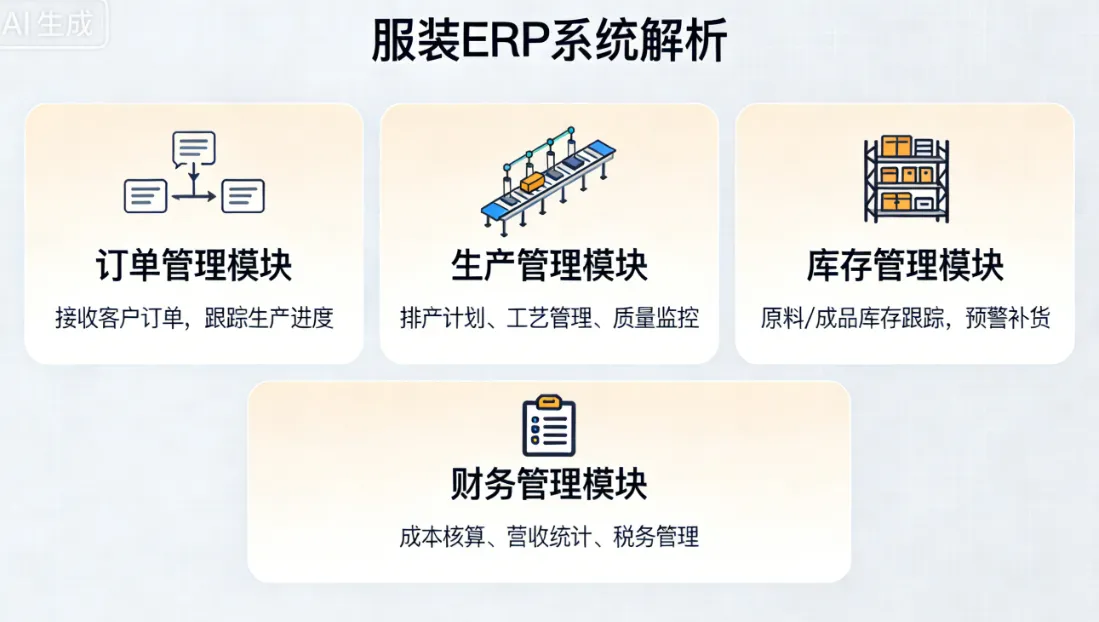
When clothing companies evolve from "placing orders based on experience" to "relying on data planning", ERP systems have undergone a qualitative change from cost items to asset items. It is no longer a software purchase that needs to be amortized, but a set of algorithmic assets that continuously generate decision value. The value of this asset does not decay over time, but continues to increase due to data accumulation and model iteration. This is the most essential definition of a clothing ERP system - it is not a mechanical combination of several functional modules, but a tangible carrier of the digital decision-making ability of clothing enterprises.