What is ERP? Definition, Function, Implementation, and Value Analysis of Enterprise Resource Planning
Enterprise resource planning, a management concept officially proposed by Gartner Group in 1990, has become a fundamental proposition that cannot be avoided in enterprise digitization 35 years later today. But strangely, the more core tools are, the easier they are to be simplified into abbreviations of concepts. In the eyes of many managers, ERP is the software used by the finance department for bookkeeping, the warehouse for shipping, and the boss for checking reports. This cognitive narrowing obscures the true face of ERP as one of the most profound carriers of management ideas in business history. It has never been the name of a set of software, but a continuous effort to systematically answer the ultimate question of enterprise resource allocation.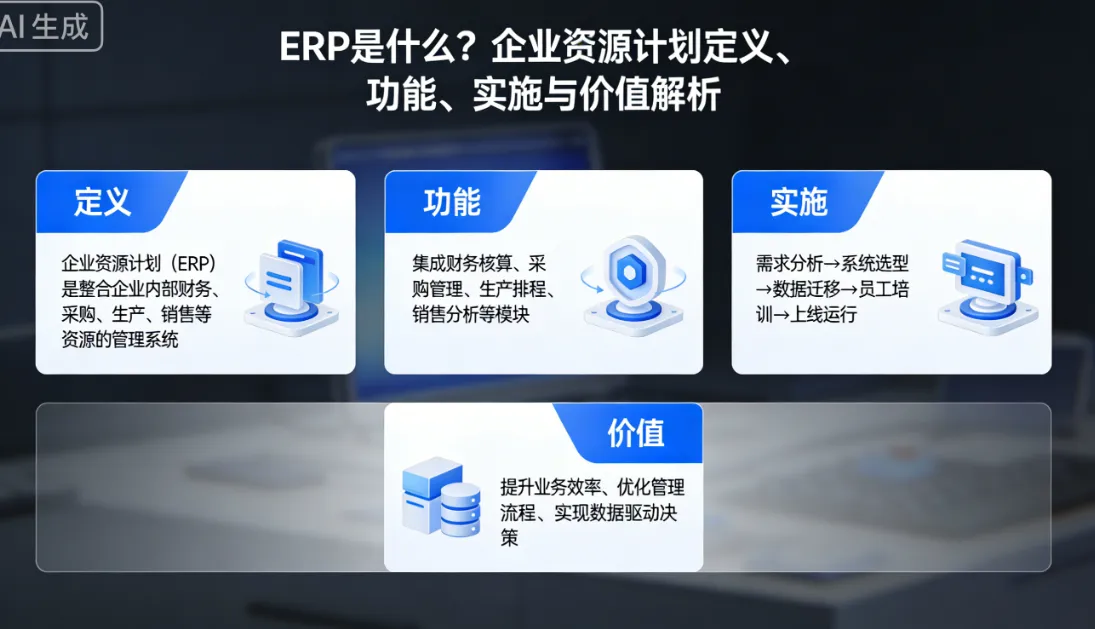
The essence of ERP is to integrate core business processes such as finance, supply chain, production, and human resources through a unified information platform, achieving real-time data sharing and cross departmental collaborative decision-making. This definition may not sound complicated, but the management philosophy leap behind it is revolutionary. Before the emergence of ERP, various functional departments of enterprises were like islands scattered across different continents, with financial systems managing accounts, procurement systems managing suppliers, and production systems managing work orders, all of which were language barriers and data disjointed. How long will it take for the salesperson to know if the warehouse has stock, if the production line can be arranged, and if the procurement can keep up with an urgent order? The answer is: waiting for emails, waiting for phone calls, waiting for meetings, waiting for the limit of all human resources. What ERP needs to do is to build a bridge between these islands, allowing data to flow freely and decision-making to no longer rely on layers of information transmission.
Understanding ERP requires returning to its evolutionary roots. In the 1960s, the birth of material requirements planning first introduced computers into production management, answering the simplest questions in manufacturing: what to produce, what is needed, how much is already available, and how much is still lacking. The closed-loop MRP of the 1970s gave the system the ability to provide feedback and correction, while the manufacturing resource planning of the 1980s embedded the financial module into the production process, allowing companies to finally see the outline of profits while scheduling production. Until 1990, the concept of ERP completely broke down the walls of enterprises, weaving suppliers, distributors, and customers in the supply chain into the same value network. This thirty year technological evolution, each leap is not simply a technological upgrade, but a continuous approach by humanity to the limit of resource allocation efficiency.
From a functional perspective, modern ERP systems have grown a functional network that covers the entire operational scenario of enterprises. Financial management is undoubtedly a core module, but it has long surpassed the original functions of bookkeeping and accounting. Mature ERP systems support parallel accounting with multiple criteria and multiple account books. The generation of accounts receivable is automatically triggered at the moment of sales order creation, and accounts payable confirmation is completed at the same time as purchasing and receiving goods. Business flow and fund flow are no longer two parallel lines that require month end reconciliation. After a certain group enterprise launched ERP, the monthly billing cycle was compressed from seven days to three days, and the financial personnel transformed from data entry personnel to business analysts.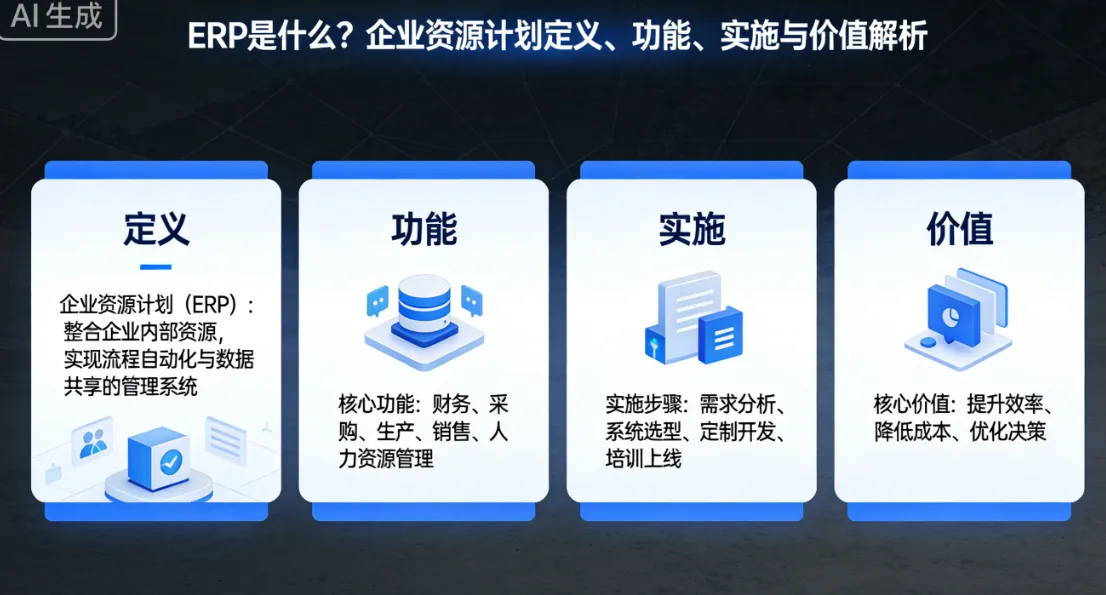
The supply chain management module is the main battlefield for ERP to eliminate information silos. It coordinates the three major functions of procurement, inventory, and sales, and uses material demand planning algorithms to weight sales forecasts, existing inventory, in transit orders, and safety stock comprehensively, generating accurate procurement recommendations and replenishment strategies. After cross-border retail enterprises connect to ERP, real-time sales data from overseas stores can directly trigger intelligent replenishment of domestic warehouses, reducing inventory backlog by 40% and synchronously decreasing out of stock rates. This agile response does not rely on human experience judgment, but on the system's millisecond level computation of the entire chain data.
Manufacturing management is the deepest penetration of ERP in the industrial field. It starts from the bill of materials and process route, undertakes sales order conversion as the main production plan, runs material demand planning to generate self-made work orders and purchase requests, and then schedules based on equipment capacity and labor load. A certain optical component enterprise has shortened the mold acceptance cycle by 42% and increased the on-time delivery rate of orders from 68% to 93% through the integration of ERP and workshop systems. However, it is important to recognize that traditional ERP has natural limitations in terms of granularity at the production execution level. It is good at answering what to do, how much to do, and when to do it, but not good at answering how well to do it, who is doing it, and whether the equipment is abnormal. This is precisely the fundamental reason why ERP must be deeply integrated with manufacturing execution systems - ERP is responsible for planning and accounting, while MES is responsible for execution and feedback. Both are like brains and nerve endings, indispensable.
The human resources management module integrates organizational structure, salary accounting, and performance evaluation into a unified data system. Information changes related to employee onboarding, job transfers, and resignations are automatically synchronized to the financial and business systems. People are no longer isolated management objects, but quantifiable and configurable production factors. Expansion modules such as customer relationship management and project management extend the boundaries of ERP from within the enterprise to customers and delivery sites. The arrangement and combination of these eight modules constitute the basic syntax of enterprise digitization.
The implementation of ERP is never technical engineering, but organizational change. Countless companies have invested millions of dollars in purchasing systems, only to end up with expensive Excel - data is entered, reports are exported, and decisions in between still rely on the intuition of managers. The root cause of failure is highly consistent: companies are trying to adapt their systems to the current situation, rather than using the system to force evolution. The successful implementation established a consensus on process reengineering from the requirements research stage. A multinational enterprise proactively merged 156 redundant processes when importing ERP, ultimately retaining 138 core processes and compressing procurement approval from jumping to five systems to a single platform. This kind of trade-off is painful, but without this pain, the system is just putting a digital coat on the old process.
Data migration is the most easily underestimated hurdle in the implementation process. The inconsistent format, missing coding rules, and blank key fields of historical data, which have been accumulated for many years, will cause a concentrated outbreak of management arrears in the moment of system launch. Mature project management typically adopts a dual system parallel strategy. After running the old and new systems synchronously for a period of time, the accuracy and completeness of the data are verified by actual business operations, and the switch is completed only after confirming that there are no errors. Employee training also determines success or failure, with about 30% of failure cases directly attributed to insufficient training. The launch of the system is not the end point, but the starting point for developing new management habits.
The cost structure of ERP is much more complex than a single quotation. The cloud deployment model significantly reduces the entry threshold for small and medium-sized enterprises, with annual subscription fees typically 40% lower than traditional on premises deployment, without the need to bear server procurement and operation team costs. Local deployment still dominates in high compliance industries due to its controllable data sovereignty, but it requires full cycle expenses such as software licensing, hardware procurement, implementation services, and annual maintenance. The implementation cycle for small and medium-sized enterprises is usually six to twelve months, with overall investment ranging from tens of thousands to millions; Large scale group projects may last for more than two years, with an investment scale of tens of millions of yuan. Enterprises should use full cycle cost rather than initial quotation as a benchmark when making decisions.
The enterprise value of ERP ultimately returns to three naive dimensions. In terms of efficiency, the inventory turnover days of electronic manufacturing enterprises have decreased from 45 days to 28 days after going online, and the raw material loss rate has decreased by 18 percentage points. In terms of decision-making, the retail group has shortened the market analysis cycle from weekly to hourly, resulting in a 40% increase in the turnover rate of unsold goods. In terms of customer dimension, the on-time delivery rate of orders has increased from the industry average of 50% to over 90%. These benefits are not achieved in isolation, but rather as management fruits that gradually grow after the system weaves finance, supply chain, production, and sales into the same digital network.
The misunderstanding about ERP has never stopped. Some people think it is a patent of large enterprises, but they do not know that the modular subscription of cloud ERP has enabled small and medium-sized enterprises with annual revenue of tens of millions to easily start. Some people expect an immediate return on investment after the system goes live, but overlook the need for organizational adaptation and habit formation to take a period of time. Some people view ERP as the responsibility of the technical department, without realizing that the real project leader should be the CEO or the general manager of the business unit. The common essence of these misunderstandings is to reduce ERP to a tool and forget that it is primarily a set of management philosophy.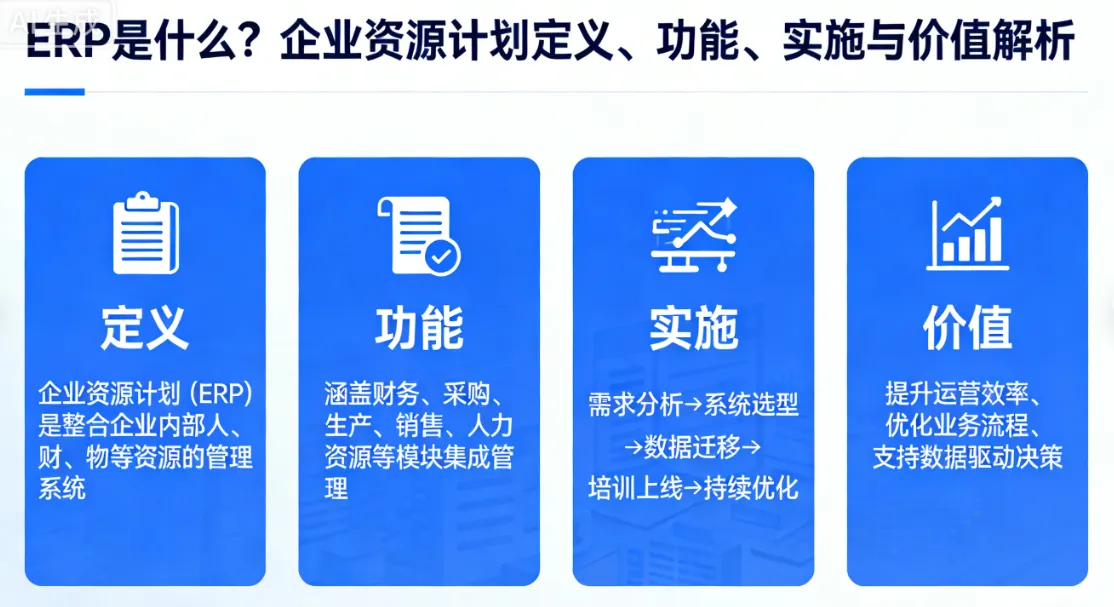
The boundary problem between ERP and MES is a watershed that manufacturing enterprises must cross in the digital process. Many enterprises attempt to make ERP carry workshop level process control, stacking a large amount of customized code beyond standard functions, ultimately falling into the quagmire of difficult upgrades and data chaos. A mature architecture follows a clear principle of separation of responsibilities: ERP maintains material master data, material lists, process routes, inventory accounting, and financial posting. It is a recording system for business transactions and macro plans; MES is responsible for real-time collection and feedback of micro data such as process execution, equipment status, operators, and quality parameters. When production orders are issued in ERP, MES decomposes them into executable process instructions upon receipt; When the batch production is completed, MES will send the actual material consumption, output quantity, and working hour data back to ERP for cost accounting and inventory updates. This closed-loop of planning execution feedback is the data foundation of intelligent manufacturing.
Looking back at 2026, the technological form of ERP is still undergoing rapid evolution. The cloud native architecture enables the system to have microservices and low code development capabilities. Enterprises can adjust module combinations at any time according to business changes, no longer constrained by rigid version releases. The embedding of artificial intelligence has shifted ERP from recording the past to predicting the future, with demand forecasting, anomaly detection, and intelligent recommendations becoming standard configurations. The integration of the Internet of Things enables real-time integration of device data into ERP asset management and maintenance plans, and predictive maintenance replaces post maintenance. But no matter how the technology iterates, the essence of ERP has never changed: it is one of the few determinacy that enterprises can grasp when facing uncertainty.
When an emergency insertion order comes in, ERP can answer within a few minutes whether it can be accepted, when it will be delivered, and what the profit will be; When a quality customer complaint occurs, ERP can trace the raw material batch, production work order, and inspection record within ten minutes; At the end of the month, ERP can accurately calculate the true cost of each order, product, and batch. The accumulation of these abilities constitutes the irreversible core competitiveness of enterprises in fierce market competition. It is not a decoration that makes enterprises look more digital, but a logical skeleton hidden behind every purchase order, every production schedule, and every financial statement.
The boundary of ERP is always the boundary of enterprise cognition. The height that an ERP system can achieve will not exceed the depth of understanding of the essence of management by enterprise managers. The companies that truly achieve excess returns from digital transformation are not because they bought the most expensive software or hired the most expensive consultants, but because they have a clear understanding that enterprise resource planning plans resources, reshapes organizations, and tests humanity.