A Comprehensive Analysis of Core Values, Management Ideas, and Implementation Benefits | In Depth Guide to Enterprise Resource Planning
Enterprise resource planning has been oscillating between misunderstandings and deification for over thirty years. Some people say that it is a panacea for enterprise digitization, and once it is implemented, it can be transformed; Some people also say that it is an expensive electronic shackle, rigid process, and tormenting employees. The commonality between these two voices is to narrow down ERP into one set of software, one procurement, and one IT project. However, truly penetrating the surface reveals that ERP is the most complete digital representation of complex organizations like enterprises in human history. It carries not only code and databases, but also the management philosophy accumulated over the past century of industrial civilization, as well as the entire obsession of enterprises seeking certainty in uncertain times.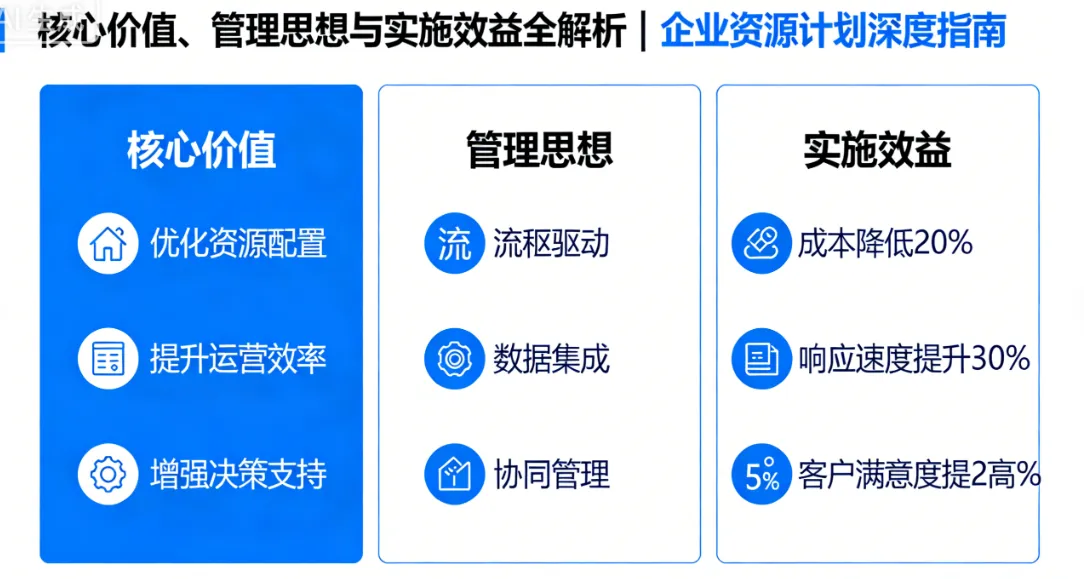
To understand ERP, one must start by divesting from its core values. The surface level is the value of data integration. Before the emergence of ERP, various functional departments of enterprises were like islands scattered across different continents, with financial systems managing accounts, procurement systems managing suppliers, and production systems managing work orders, all of which were language barriers and data disjointed. How long will it take for the salesperson to know if the warehouse has stock, if the production line can be arranged, and if the procurement can keep up with an urgent order? The answer is the limit of waiting for emails, phone calls, meetings, and all human resources. What ERP needs to do is to build a bridge between these islands, allowing each sales order to automatically trigger inventory verification, production scheduling, and procurement suggestions at the moment of creation, merging the purchasing records of the same customer from different channels into a complete profile file. This integration is not a technical data transfer, but a cognitive revolution at the management level - for the first time, enterprises have a global perspective and can answer questions from different departments with the same set of facts.
The deeper value lies in process standardization. There is a conflict between implicit knowledge and explicit rules in any enterprise. The master judge the timing of procurement based on experience, sales rely on personal relationships to maintain customers, and finance uses self-made Excel templates to calculate costs. These implicit knowledge are extremely valuable in the early stages of enterprise development, but as the scale expands, personnel changes, and business becomes more complex, they become a risk exposure and efficiency black hole. The underlying logic of ERP is to transform business processes from dependent individuals to dependent systems. Purchase requests must undergo budget verification, inventory issuance must be associated with production work orders, and cost accounting must follow unified calculation rules. This set of rigid constraints is not intended to deprive employees of their decision-making power, but to transfer routine decisions from the human brain to algorithms, freeing managers from tedious approvals to handle exceptional matters that truly require experience and insight.
Looking deeper, the core value of ERP is the leap in decision support capabilities. Under the traditional management model, decision-making relies on hierarchical reporting of summary reports, and information is delayed, distorted, and filtered during transmission. The monthly business meeting discusses the facts that occurred last month, and managers can only review them afterwards and cannot intervene in advance. ERP projects the real-time status of enterprise operations onto the digital plane, dynamically refreshing inventory levels, order progress, equipment load, and capital flow at a minute level frequency. When the inventory turnover rate of a certain product decreases for three consecutive weeks, the system automatically issues a warning to the commodity department; When the delivery rate of a supplier falls below the threshold, the procurement system automatically suspends issuing new orders to them. Decision making is no longer a passive response, but an active intervention; Management no longer relies on intuition, but on facts.
The management ideas carried by ERP are far more profound than the stacking of functional modules. One of its ideological foundations is supply chain management. The perspective of traditional enterprises is inward looking, focusing on what to purchase, how much to produce, and who to sell to, with suppliers and customers only at the two ends of the transaction chain. ERP straightens and extends this chain, weaving all nodes from suppliers to customers into the same value network. Inventory is no longer the private property of a company, but a buffer pool for the entire supply chain; Capacity is no longer a load table for a single factory, but a resource pool that can be dynamically allocated across legal entities and regions. This transition from "enterprise level optimization" to "network level optimization" is a disruptive contribution of ERP to traditional management theory.
Business process reengineering is another ideological pillar. In the 1990s, when Hammer and Qianpi proposed this concept, they clearly pointed out that many companies' processes had long been left behind by the times, and using computers to speed up old processes was like adding turbocharging to a carriage. The implementation of ERP should have been a catalyst for process reengineering, but too many companies have gone against the trend and adapted their systems to outdated habits. Managers who truly understand the principles of ERP will conduct a thorough review of existing processes before the system goes live: which nodes are redundant, which approvals are guarded against malicious individuals, and which documents are the product of departmental buck passing. They are not using ERP to solidify the status quo, but using ERP to force evolution.
The ideas of lean production and agile manufacturing are also deeply embedded in the genes of ERP. The material requirement planning algorithm itself is a digital expression of lean thinking - producing the required products only when needed, according to the required quantity. The advanced scheduling engine comprehensively weights dozens of parameters such as order priority, equipment status, mold availability, material completion time, and worker skill level to generate the globally optimal production plan within minutes. When the market trend changes, the system can quickly rearrange production and compress the mold changing time when switching between different products to the extreme. This flexible response capability is the landing form of agile manufacturing thinking in the digital age.
The idea of integrating business and finance runs through the bloodline of ERP. In the traditional mode, the business department manages the goods, the finance department manages the money, and the month end reconciliation is like a confrontation between two armies, with unclear explanations for differences and mutual shifting of responsibilities. ERP designs business events and financial accounting as two sides of the same transaction - sales outgoing automatically generates accounts receivable, procurement receiving automatically confirms accounts payable, and production completion automatically collects cost drivers. Financial personnel have transitioned from data loggers to business analysts, no longer busy with document preparation and reconciliation, but delving into the front-end of the business to analyze product profitability, customer contribution, and channel efficiency. This integration of business and finance is not only about improving efficiency, but also a shift in management focus - finance is moving from the backend of bookkeeping and accounting to the forefront of value creation.
The implementation benefits are the fruits of ERP values and ideas in the real soil. The operational efficiency is the most intuitive. After the electronic manufacturing enterprise went online with ERP, the inventory turnover days decreased from 45 days to 28 days, and the raw material loss rate decreased by 18 percentage points; The retail group has shortened the market analysis cycle from weekly to hourly, resulting in a 40% increase in the turnover rate of unsold goods; The fast reverse shoe factory has reduced the production time for emergency insertion orders from four hours to eight minutes, and the on-time delivery rate of orders has increased from 70% to over 90%. These numbers are not created by the software itself, but by the system connecting discrete links into a network, efficiency naturally emerges at the node connections.
The financial benefits can also be quantified. A certain optical component enterprise has shortened the mold acceptance cycle by 42% through the integration of ERP and workshop systems, saving over six million yuan in outsourcing costs annually. A cross-border retail enterprise relies on the intelligent replenishment model of ERP to reduce inventory backlog by 30% and significantly alleviate cash flow pressure. More importantly, there are implicit financial benefits - the improved bargaining power brought about by the shortened procurement lead time, the reduced customer complaint compensation due to the shortened quality traceability cycle, and the waste black hole intercepted by real-time warning of abnormal costs. These benefits never appear separately in financial statements, but are like air permeating every transaction, every production schedule, and every report gap.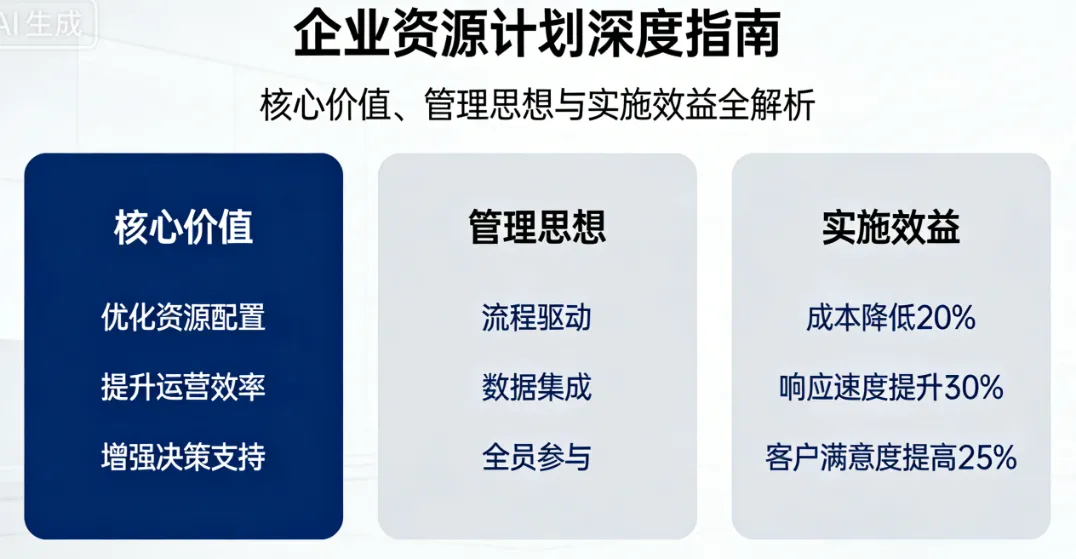
Strategic benefits are the most profound gift of ERP to enterprises. When enterprises can answer in real-time which product is most profitable, which type of customer contribution is the highest, and which channel has the best efficiency, there is a clear direction for resource allocation. When a company can complete the quality traceability from finished products to raw material batches within ten minutes, the brand reputation has a solid moat. When enterprises are able to connect their globally dispersed branches to the same set of digital nerves, cross-border operations have a replicable management chassis. These abilities will not be apparent on the day of the system's launch, but will gradually accumulate through continuous operation, ultimately settling into organizational assets that are difficult to replicate.
The realization of benefits is not inevitable, it requires crossing two deep hurdles. One is the data governance hurdle. The inconsistent coding rules of historical data, missing key fields, and multiple names for the same material, which have been accumulated for many years, can lead to a concentrated outbreak of management arrears when the system goes online. Those enterprises that skip data cleaning and rush to go online will eventually fall into the quagmire of "garbage in, garbage out" after several months of system operation. The second obstacle is organizational change. The launch of the system means transparency in processes, depersonalization of power, and dataization of decisions, which inevitably touches on vested interests and habitual comfort zones. The firm support of senior managers, the cognitive upgrading of middle-level managers, and the ability reshaping of grassroots employees are all indispensable.
Looking back at the evolution trajectory of ERP over the past thirty years, a clear thread runs through it: from recording past account books to predicting the future crystal ball, from department level application tools to enterprise level strategic centers, from internal resource optimization to industrial ecological collaboration. Cloud architecture enables ERP to have microservices and low code development capabilities, allowing enterprises to adjust module combinations at any time according to business changes; The embedding of artificial intelligence makes demand forecasting, anomaly detection, and intelligent recommendation standard configurations; The integration of the Internet of Things enables real-time integration of device data into asset management and maintenance plans. But no matter how the technology iterates, the mission of ERP has never changed - it is one of the few determinacy that enterprises can grasp when facing uncertainty.
When an emergency insertion order comes in, ERP can answer within a few minutes whether it can be accepted, when it will be delivered, and what the profit will be; When a quality customer complaint occurs, ERP can trace the raw material batch, production work order, and inspection record within ten minutes; At the end of the month, ERP can accurately calculate the true cost of each order, product, and batch. The accumulation of these abilities constitutes the irreversible core competitiveness of enterprises in fierce market competition. It is not a decoration that makes enterprises look more digital, but a logical skeleton hidden behind every purchase order, every production schedule, and every financial statement.
The boundary of ERP is always the boundary of enterprise cognition. The height that an ERP system can achieve will not exceed the depth of understanding of the essence of management by enterprise managers. The companies that truly achieve excess returns from digital transformation are not because they bought the most expensive software or hired the most expensive consultants, but because they have a clear understanding that enterprise resource planning plans resources, reshapes organizations, and tests humanity.