
Why can't factories do without ERP? The essential needs of production management in the digital age
Under the wave of digitization, factory production management has undergone a comprehensive transformation from "extensive control" to "refined operation". The traditional model of relying on manual recording and decentralized departmental control is no longer suitable for production scenarios with multiple processes, materials, and orders. Pain points such as low efficiency, data disconnection, and weak risk controllability continue to constrain capacity release and profit improvement. ERP system, as the core carrier of digital transformation in factories, is not an "optional tool", but a "essential infrastructure" covering the entire production, inventory, procurement, finance, and human resources chain. Through data collaboration, process standardization, and intelligent control, it breaks through traditional management bottlenecks, supports factories to achieve efficient operation, cost reduction, and efficiency improvement in fierce competition, and has become an essential support for the survival and development of factories in the digital age.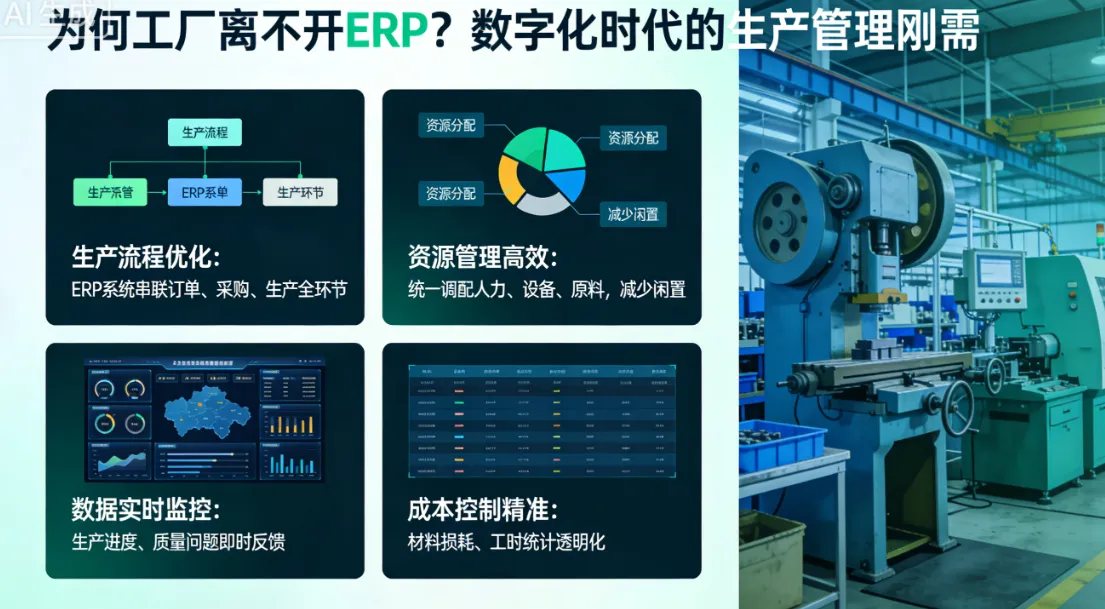
The many pain points of traditional factory management determine the rigid demand for ERP, which is particularly prominent in labor-intensive and complex manufacturing industries such as the footwear industry. In terms of production control, traditional factories rely heavily on manual scheduling, which makes it difficult to balance order priority, equipment load, and material availability. This can lead to production chaos, downtime for materials, lengthy order delivery cycles, and even delivery delays exceeding 30% for some small and medium-sized factories; Lack of effective control over process connections, high defect rates, and significant increase in production costs due to rework losses. At the inventory management level, the material specifications are complex (such as multi style, multi color, and multi size SKUs in the footwear industry), and manual recording is prone to errors and omissions, resulting in discrepancies between the book and actual inventory. Either shortages and supply disruptions affect production, or inventory backlog occupies funds. According to statistics, stagnant inventory in traditional factories often occupies more than 8% of revenue.
At the cross departmental collaboration level, departments such as procurement, production, sales, and finance work independently, forming data silos: the procurement department cannot accurately obtain production needs, which can lead to blind procurement or procurement lag; The sales department is unable to monitor inventory and production progress in real time, and cannot provide accurate feedback on delivery time to customers; The finance department relies on manual reconciliation, with tedious data entry and high error rates, making it difficult to quickly complete cost accounting and profit analysis. In addition, with the expansion of factory scale, cross workshop and cross regional operations have become the norm. The traditional decentralized management model cannot achieve global control, and decision-making lacks precise data support, which can easily lead to problems such as production and sales imbalance and resource waste. These pain points need to be solved by ERP systems through full chain collaboration.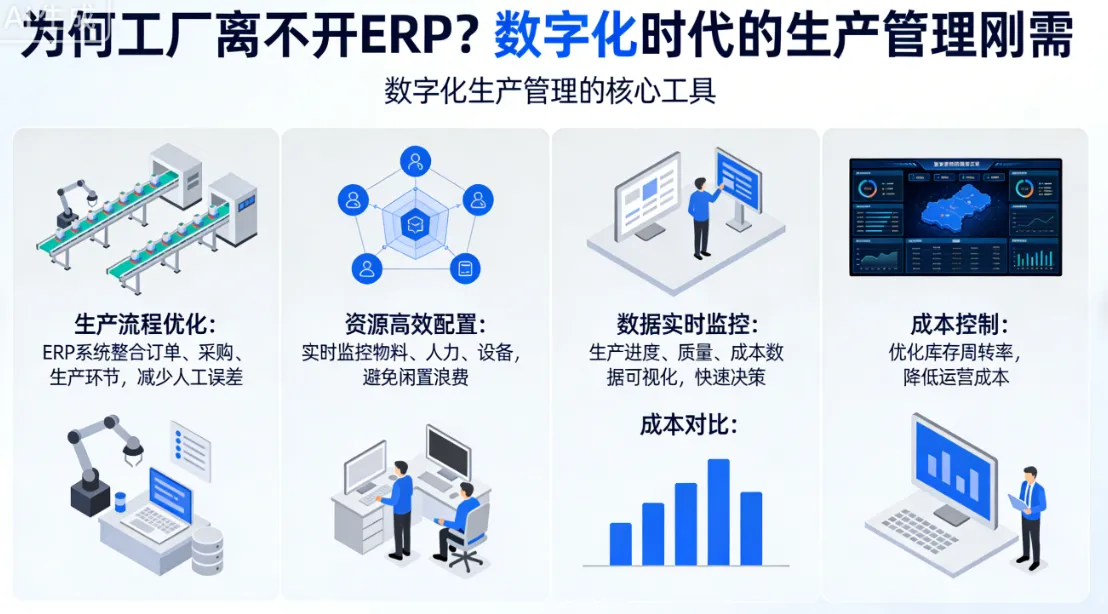
ERP, through intelligent control of the entire production process, solves the pain points of traditional low efficiency production and builds a solid foundation for efficient factory operation. In response to the difficulty of production scheduling, the ERP system is equipped with intelligent scheduling algorithms, which can automatically generate the optimal production plan based on order priority, process complexity, and equipment capacity, clarify the task allocation, time nodes, and responsible persons of each process, adapt to the production mode of multiple varieties and small batches, especially in line with the current industry trend of "small order quick response". During the production process, real-time collection of process progress and equipment operation status data is achieved through functions such as scanning codes to report work and device networking. Management personnel can monitor the entire production process in real-time in the system, quickly identify bottleneck links, allocate production resources, avoid downtime and material shortages, and shorten order delivery cycles by 20% -40%.
At the same time, the ERP system enables full traceability of production quality, with real-time retention of job data and quality inspection results for each process, facilitating quick identification of the cause of defective products, optimizing production processes, reducing defect rates by 15% -25%, and minimizing rework losses. Taking a shoe factory as an example, ERP can achieve full process control of multiple processes such as shoe upper cutting, sewing, and forming, and link material data to ensure accurate matching of shoe upper and sole materials, greatly improving production efficiency and product qualification rate.
ERP solves the problems of inventory chaos and procurement inefficiency by coordinating multidimensional inventory and procurement, and revitalizes enterprise cash flow. In response to the pain points of multi specification material management, ERP supports hierarchical coding by material type, specification, and purpose (such as the multi-dimensional coding of "style color size" in the footwear industry). All material inbound, outbound, transfer, and inventory are entered into the system in real time, and inventory data is automatically synchronized and updated to ensure that accounts match reality, and inventory accuracy is improved to over 99%. The system can set a safety stock threshold, which automatically triggers a replenishment warning when material inventory is insufficient, to avoid stockouts and supply interruptions; At the same time, through the inventory analysis function, we can accurately identify stagnant materials, push clearance suggestions, reduce capital occupation, and help factories optimize their inventory structure.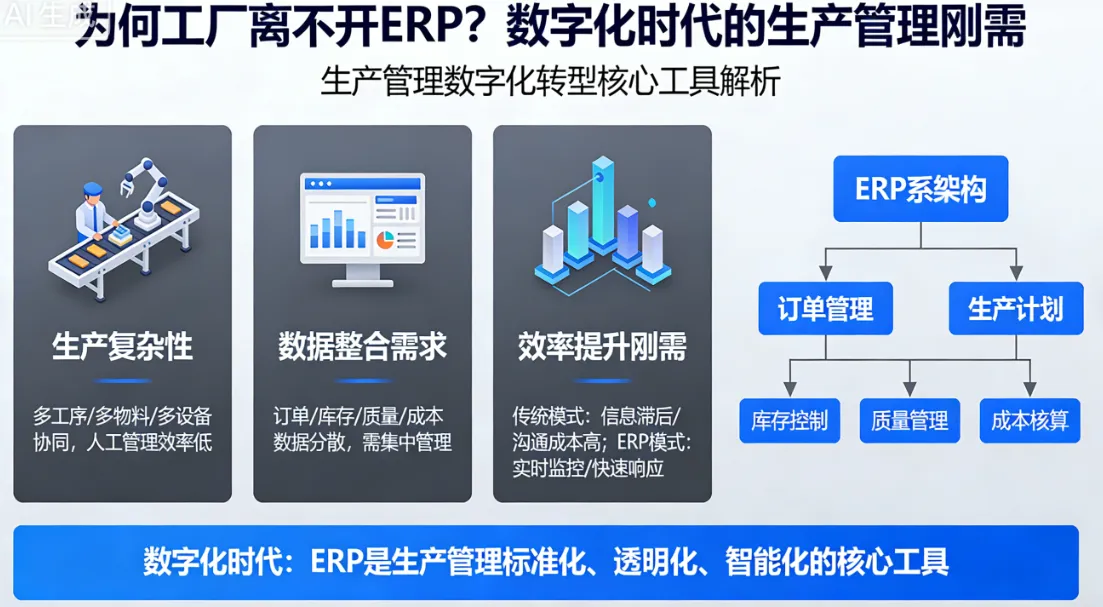
At the procurement collaboration level, the ERP system links production and inventory data, automatically generates procurement requirements, and accurately pushes them to suppliers to achieve synchronous procurement plans and production requirements, avoiding blind procurement and procurement lag; At the same time, it supports digital management of supplier files, comparison of procurement prices, real-time tracking of delivery progress, standardization of procurement processes, and reduction of procurement costs. Some factories can reduce procurement costs by 10% -15% after introducing ERP.
Breaking down data silos and achieving cross departmental and global collaboration is one of the core values that ERP has become a must-have for factories. The ERP system integrates core modules such as procurement, production, inventory, sales, finance, and human resources to achieve real-time flow and seamless connection between business data and financial data, completely breaking down departmental barriers. Automatically synchronize procurement data to the finance department to simplify the reconciliation process; Synchronize production and inventory data to the sales department to help them accurately connect with customers and improve customer satisfaction; Summarize and analyze data from the entire chain, generate multidimensional business reports, and provide accurate data support for management on order progress, cost structure, profit situation, etc., shifting decision-making from "experience judgment" to "data-driven" and reducing decision-making risks.
For factories operating on a large scale, the comprehensive control capability of ERP is particularly important, which can achieve cross workshop and cross regional inventory allocation, production collaboration, and resource coordination, ensuring efficient and orderly global operations. In addition, the compliance control function of ERP system can meet the requirements of factory financial audit, quality traceability, environmental compliance, etc. Especially in the context of global compliance tightening, it helps factories avoid compliance risks and adapt to industry regulatory norms, which is also an indispensable core requirement for modern factories.
In the digital age, the competition among factories has escalated into a competition for operational efficiency and refined management capabilities. ERP, as the core carrier of digital transformation, has a value far beyond simple resource management tools, becoming the "core engine" for factory cost reduction and efficiency improvement, risk prevention and control, and scale expansion. Whether it is solving management pain points and improving survival capabilities in small and medium-sized factories, or achieving global collaboration and digital upgrading in large factories, they all rely on the support of ERP systems. Especially in the context of the transformation and upgrading of the manufacturing industry, the popularization and deep application of ERP have become a necessary path for factories to achieve high-quality development, and an indispensable essential configuration for factories in the digital age.
It is worth noting that factories' demand for ERP is not "large and comprehensive", but rather "precise adaptation" that fits their own industry characteristics and development scale. For example, shoe factories need to focus on multi-dimensional inventory management and multi process production collaboration functions, heavy industry factories need to focus on equipment management and safety production control modules, and small and medium-sized factories can choose lightweight ERP to reduce investment costs while meeting core needs. However, regardless of the type or scale of factory, digital transformation is an inevitable trend, and ERP, as the core tool for full chain collaboration, its essential attributes will only continue to be highlighted, becoming the key support for factories to stand firm and achieve breakthroughs in the digital wave.