
Data driven decision-making: ERP systems assist enterprises in precise operations
In today's deeply penetrated digital economy, enterprise operations have shifted from "experience driven" to "data driven", and precise decision-making has become the key to breaking market uncertainty and enhancing core competitiveness. In traditional management models, business data such as finance, inventory, production, and sales are stored and manually circulated, forming an "information island" that leads to decision-making lag, resource waste, and inefficient operations, making it difficult to adapt to the large-scale and diversified development needs of modern enterprises. ERP (Enterprise Resource Planning) system, as the digital hub for integrating the entire business process of enterprises, provides solid support for data-driven decision-making by breaking down data barriers and activating data value, promoting the transformation and upgrading of operations from "extensive management" to "precise control".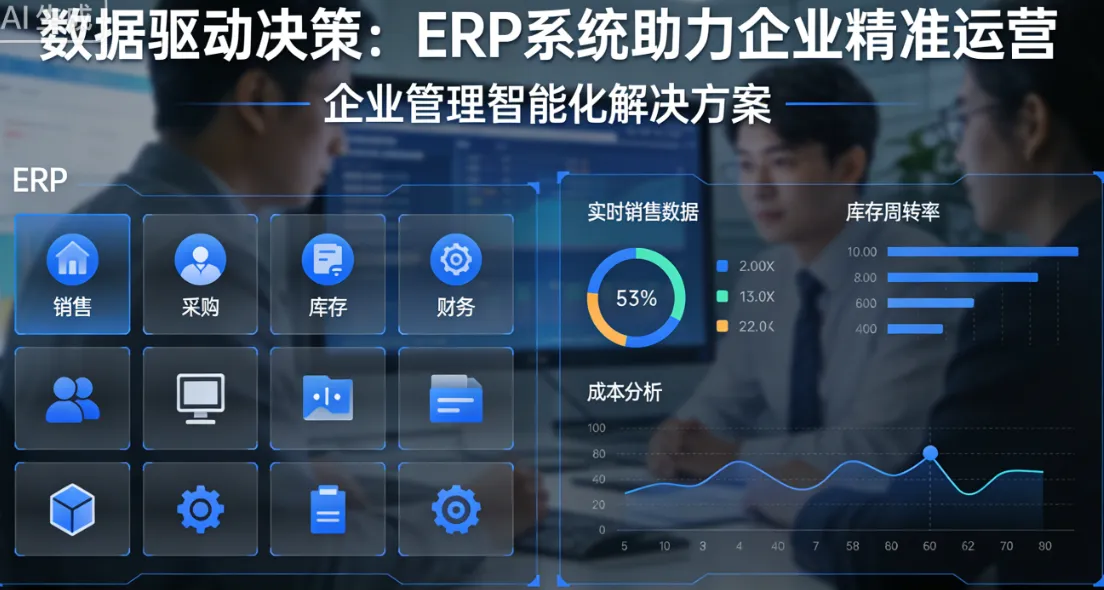
The core value of ERP system lies in building a unified intelligent data base, realizing the integration and standardization of enterprise wide data. In traditional enterprises, the use of independent accounting software for finance, Excel ledger for inventory, and paper documents for sales have led to a "fragmented" state, resulting in inconsistent data calibers, outdated updates, and the inability to form a complete view of operational data. The ERP system, through modular design, covers core areas such as financial management, supply chain management, production management, and human resource management. It aggregates business data scattered across departments in real-time, achieving "one-time data entry and full process sharing". At the same time, the system establishes unified data encoding rules and master data management mechanisms, standardizes data formats and flow processes, ensures data consistency and accuracy, and provides high-quality "fuel" for subsequent data analysis and decision-making. As shown in the report by the China Academy of Information and Communications Technology, enterprises deploying ERP systems have an average increase in data flow efficiency of 60% and a decrease in data error rates of over 90%, completely breaking down the data barriers of traditional management.
Relying on the ability to integrate global data, the ERP system achieves multi scenario implementation, injecting momentum into the precise operation of enterprises. In the field of supply chain management, ERP systems integrate the entire process of procurement, inventory, and sales, achieving automatic verification of purchase orders, warehouse receipts, and invoices through "three order matching" to avoid duplicate payments; At the same time, a safety stock threshold is set, and an alert is automatically pushed when the inventory is below the threshold. The procurement module is linked to generate a replenishment plan. After application, the inventory accuracy of a certain trading enterprise has increased from 75% to 98%, and the backlog inventory has been reduced by 40%. In the production management scenario, in response to the production characteristics of manufacturing enterprises with "multiple varieties and small batches", the ERP system uses MRP calculation combined with AI algorithm to automatically calculate raw material requirements based on sales orders and material lists, optimize production scheduling, and visually display equipment and manpower occupancy. After application, the production efficiency of a certain mechanical processing plant increased by 35%, and the equipment utilization rate increased from 60% to 85%. In the financial management process, ERP realizes the integration of business and finance, and business data can automatically generate financial vouchers, reducing 80% of manual input. At the same time, it generates multidimensional financial statements, supports data penetration queries, and helps managers to grasp the profitability status in real time, accurately judge which product has the highest profit and which customer has the fastest payment.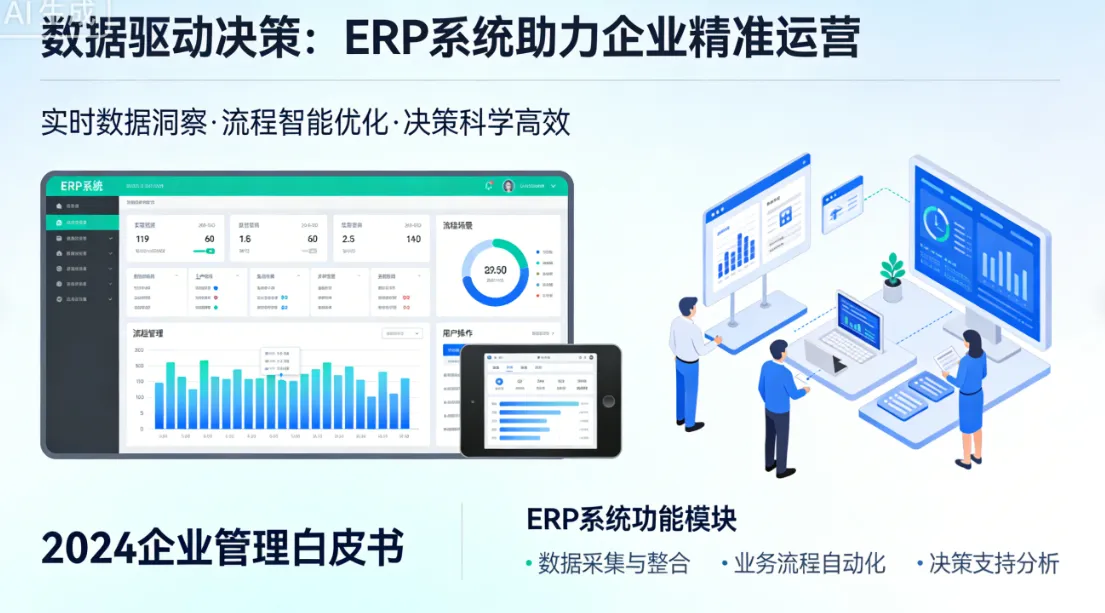
The core of data-driven is to transform data into decision-making basis. ERP systems achieve a leap from "data recording" to "intelligent insight" through embedded analysis capabilities. Traditional decision-making relies heavily on the experience of managers and is easily influenced by subjective judgments. However, ERP systems integrate historical business data with real-time operational data, generate multidimensional analysis reports on sales trends, cost composition, inventory turnover, and other factors through built-in analysis models and BI tools, and uncover operational patterns and potential risks behind the data. For example, a furniture company analyzed regional sales data through an ERP system and found that solid wood beds accounted for 60% of sales in the southern market. By adjusting production plans and distribution strategies in a timely manner, sales of this category increased by 20% in three months; A chemical company has reduced its safety stock of raw materials from 30 days to 20 days through inventory data analysis, releasing 1.5 million yuan in funds to expand production. In addition, the deep integration of AI and ERP further enhances the foresight of decision-making - the system can use machine learning to predict market demand, supply chain risks, and even automatically generate procurement suggestions and production plans, shifting decision-making from "remedial measures" to "pre optimization".
The ultimate value of ERP systems in assisting enterprises in precise operations is reflected in the dual breakthroughs of cost reduction, efficiency improvement, and competitiveness enhancement. From the perspective of cost control, the ERP system reduces labor costs and operational losses by optimizing processes and minimizing manual intervention. After a 50 person enterprise applied ERP, the workload of the HR department decreased by 70%, and the salary accounting time was shortened from 2 days to 3 hours; Most small and medium-sized enterprises achieve inventory optimization and financial compliance through ERP, reducing warehousing costs by 25% and significantly reducing fines and losses caused by financial errors. The average ERP investment cost can be recovered within 2 years. From the perspective of efficiency improvement, the order processing cycle has been shortened by 40%, the average financial processing efficiency has increased by 50%, cross departmental collaboration is no longer constrained by data barriers, and the speed of enterprise response to market changes has significantly accelerated. In the increasingly fierce market competition, this precise operational capability enables enterprises to quickly adapt to changes in consumer demand, optimize product structure and service models, and build differentiated competitive advantages. According to IDC research, over 70% of enterprises believe that data-driven decision-making supported by ERP systems is the core support for their digital transformation.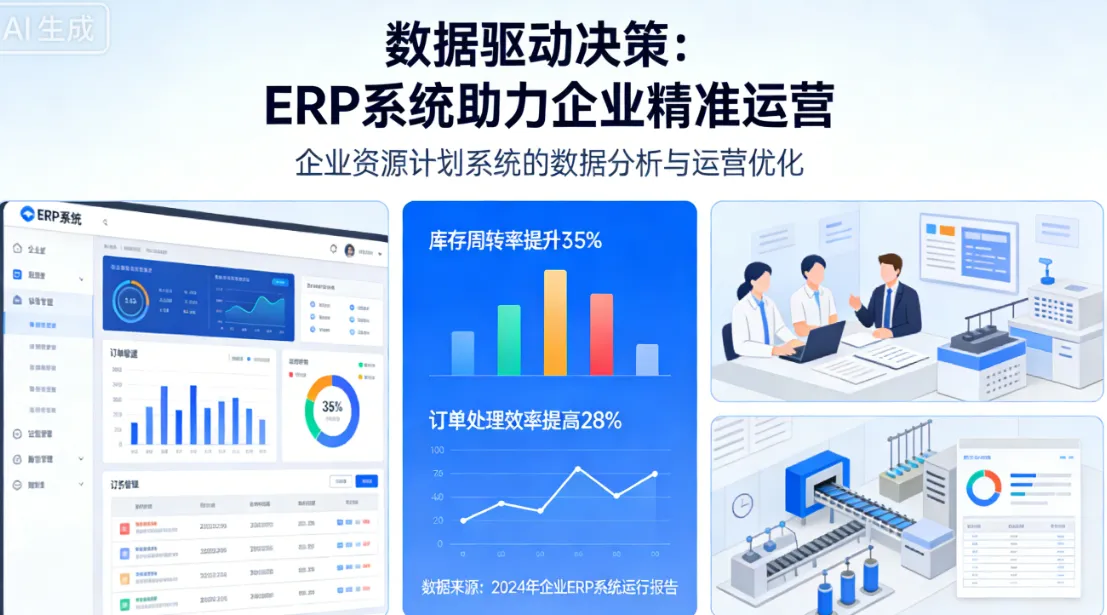
With the continuous iteration of digital technology, ERP systems are upgrading from "full process integration" to "open ecological collaboration", further expanding the boundaries of data-driven decision-making. The next generation ERP system will rely on cloud native and microservice architecture to achieve seamless integration with the Internet of Things, e-commerce platforms, and upstream and downstream partners, integrate a wider range of ecological data, and provide more comprehensive decision-making support for enterprises. At the same time, the ability to assemble business allows enterprises to flexibly configure modules according to their own needs, adapt to operational needs at different stages of development, and truly achieve "on-demand empowerment".
Conclusion: In the era where data has become the core production factor, the essence of precision operation is data-driven refined management. ERP systems help enterprises break through information silos, optimize resource allocation, reduce operating costs, and achieve a qualitative change from "experience management" to "scientific decision-making" by integrating global data, activating data value, and implementing intelligent decision-making. For enterprises, deploying and deeply applying ERP systems is not only an important measure for digital transformation, but also an inevitable choice to cope with market uncertainty and achieve long-term development. Only by integrating data throughout the entire operation process can they accurately exert their power and achieve stability in complex business environments.