
Shuntong Network Innovation Technology Enhances Network Service Quality: Cost benefit Balance, Real time Monitoring Optimization, and Talent Training Strategy Research
In the current era of deep penetration of the digital economy, network services have become the core infrastructure supporting industrial digitization and intelligent life. The service quality, operational efficiency, and sustainable development capability of network service providers are directly related to the operational efficiency of the digital ecosystem. As a professional service provider deeply involved in the field of network services, Shuntong Network is facing multiple challenges, including increasing demand for network bandwidth, stability, and low latency from users, intensified pressure on operating cost control, upgraded requirements for network fault response, and insufficient supply of professional technical talents. Relying on innovative technology to reconstruct the service system, focusing on the three core directions of cost-benefit balance, real-time monitoring and optimization of the entire chain, and cultivation of composite talents, it has become a key path for Shuntong Network to break through development bottlenecks and enhance core competitiveness, and an important support for empowering the high-quality development of the digital industry.
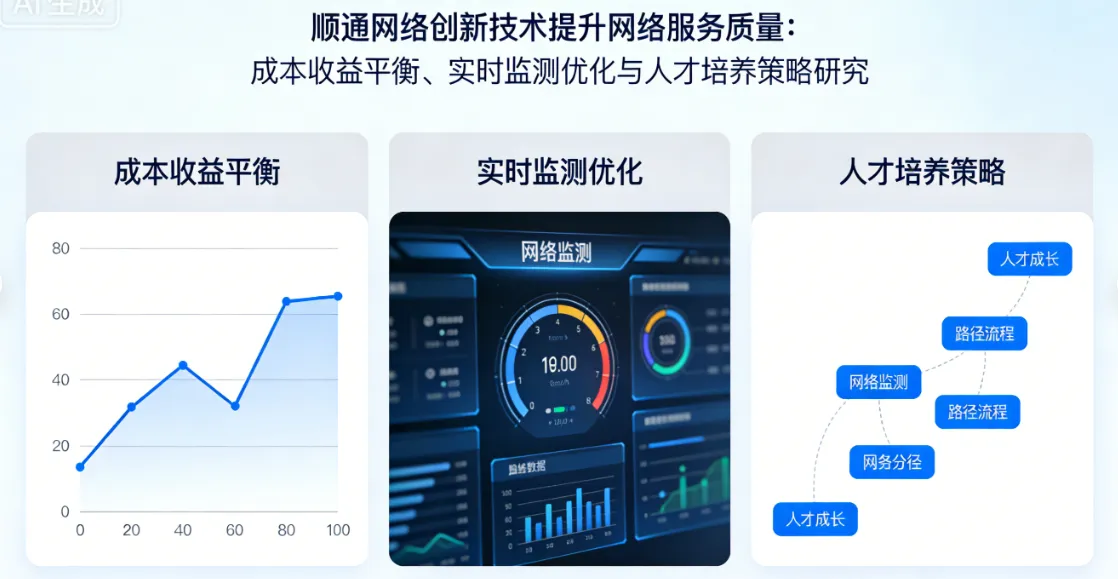
Cost benefit balance is a prerequisite for Shuntong Network to improve service quality through innovative technology. It abandons the traditional extensive hardware investment model and constructs a refined control system through technology intensive application, achieving the optimal matching of input and output. Traditional network services heavily rely on dedicated hardware equipment, with high initial investment in equipment procurement, data center construction, and operation and maintenance upgrades. Additionally, hardware expansion cycles are long and resource utilization is low, leading to an imbalance of high investment and weak output. This makes it particularly difficult to meet the lightweight service needs of small and medium-sized enterprises. Shuntong Network is making precise efforts in technological innovation, introducing cutting-edge technologies such as Software Defined Networking (SDN) and Network Function Virtualization (NFV), breaking down the functional barriers of traditional hardware devices, virtualizing core hardware functions such as routing, switching, and firewalls, significantly reducing the cost of purchasing dedicated hardware. At the same time, through the dynamic scheduling of network resources by centralized controllers, the utilization rate of network resources has been increased from 50% in the traditional mode to over 85%, effectively reducing waste of idle resources.
While controlling costs, Shuntong Network relies on cloud network integration technology to expand revenue channels and build a differentiated service system. By building an elastic computing power network platform, based on the peak traffic and normalized demand differences of enterprise and individual users, bandwidth and computing power resources can be allocated and flexibly scaled according to demand. High cost-effective lightweight packages are launched for small and medium-sized enterprises, and customized high reliability and low latency services are provided for large government and enterprise customers, taking into account both inclusive and high-end needs, promoting a two-way increase in customer renewal rate and revenue scale. In addition, Shuntong Network has established a full lifecycle cost accounting model to track the input-output ratio from technology selection, deployment and implementation to operation and maintenance iterations. It prioritizes the implementation of innovative technologies with low investment, fast results, and strong reusability, strictly controls non essential capital expenditures, and achieves a 20% reduction in unit bandwidth service costs through technological empowerment, building a sustainable cost-benefit loop of "technology cost reduction and service revenue increase".
Real time monitoring optimization is the core lever for Shuntong Network to improve network service quality. It relies on technologies such as the Internet of Things, big data, and artificial intelligence to build a full chain intelligent monitoring and self-healing system, completely changing the traditional passive response operation and maintenance mode. The stability of network services directly determines user experience. The traditional segmented monitoring mode has pain points such as data silos, delayed fault detection, and low disposal efficiency, which can easily lead to user complaints. Shuntong Network aims to solve this problem by deploying a massive number of micro monitoring sensors in the backbone network, metropolitan area links, and access nodes, building a perception network that covers the entire hierarchy of transmission, switching, and access, and achieving millisecond level collection of core indicators such as network latency, packet loss rate, bandwidth occupancy, and node operating status, forming a unified visual view of the entire network's operation and breaking the limitations of segmented monitoring.
Based on massive monitoring data, Shuntong Network builds an intelligent analysis platform and constructs a network operation benchmark model through machine learning algorithms to accurately predict abnormal traffic, node failures, network congestion, and other issues. The warning accuracy reaches over 95%, and compared to traditional manual monitoring modes, the fault detection time is more than 30 minutes earlier. In response to detected abnormal issues, the system automatically activates an intelligent self-healing mechanism, which quickly switches faulty links, schedules redundant resources, and optimizes routing paths through an SDN controller. Fault handling can be completed without manual intervention, compressing the recovery time of core node failures from hours to minutes, and promoting the network availability of home broadband and government enterprise dedicated lines to 99.99%. At the same time, by monitoring data and optimizing network planning in reverse, combined with regional traffic distribution and user usage habits, expansion nodes are pre arranged to reduce network congestion and failures from the source, achieving continuous iterative upgrading of network service quality.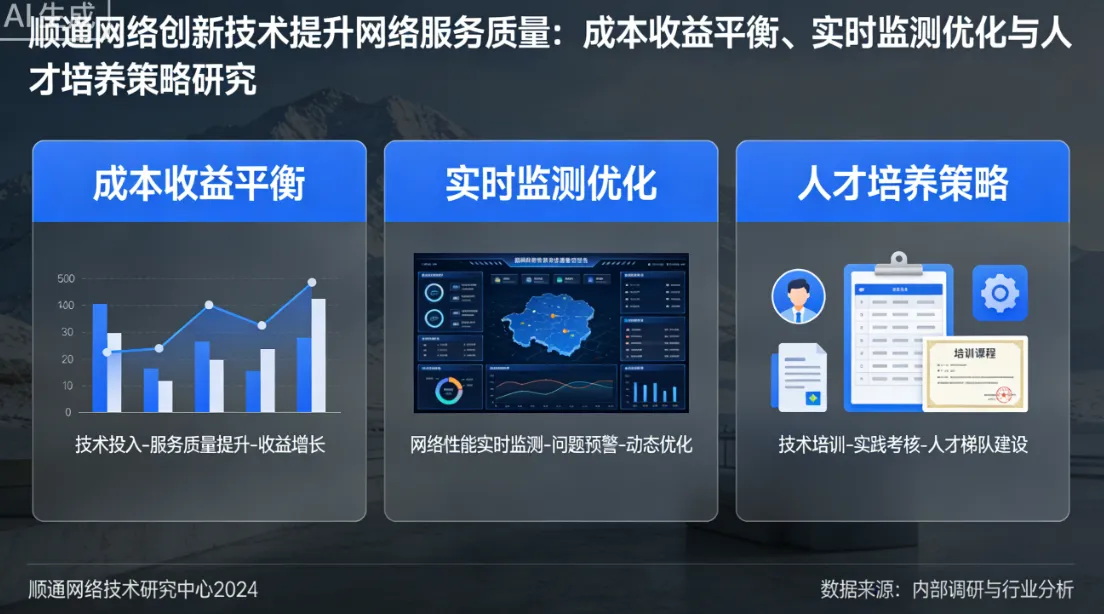
Talent cultivation is the fundamental guarantee for Shuntong Network's technological innovation and service upgrading. Faced with the industry situation of accelerated iteration of network technology and scarce compound talents, Shuntong Network has built an integrated talent cultivation system of "hierarchical training, school enterprise collaboration, and practical empowerment", and created a professional talent echelon that adapts to the needs of innovative technology. In terms of hierarchical training, technical talents are divided into R&D innovation layer, operation and maintenance practical layer, and customer service layer to accurately match the technical needs of different positions. For R&D talents, focus on cutting-edge technologies such as SDN, AI algorithms, and cloud network integration to carry out research-oriented training and promote the landing of technological innovation; For operation and maintenance talents, strengthen practical skills training in intelligent monitoring system operation, fault self-healing, virtualization equipment operation and maintenance, and improve operation and maintenance efficiency; Conduct comprehensive training on network problem diagnosis, customer demand matching, technical solution interpretation, and other skills for service talents to optimize user service experience.
At the level of school enterprise collaboration, Shuntong Network has established targeted talent training cooperation with communication and computer related universities, offering customized courses such as network virtualization and intelligent operation and maintenance, and setting up off campus training bases to allow students to experience real network scenarios of enterprises in advance, achieving seamless integration between talent training and enterprise needs. Every year, more than 100 professional talents are targeted to alleviate the pressure of insufficient talent supply. In terms of internal growth mechanism, we will establish a training platform that combines online and offline methods, regularly hold technical salons, case reviews, and skill competitions, establish a mechanism linking technical title promotion with salary incentives, and provide special rewards and equity incentives to outstanding talents in technological innovation and operation and maintenance. At the same time, we will introduce external industry experts to conduct advanced training and broaden the technical horizons of talents. Through systematic talent cultivation, the innovation ability and operation efficiency of Shuntong Network Technology Team have been significantly improved, and the implementation cycle of new technologies has been shortened by 40%, providing solid talent support for the upgrading of network service quality.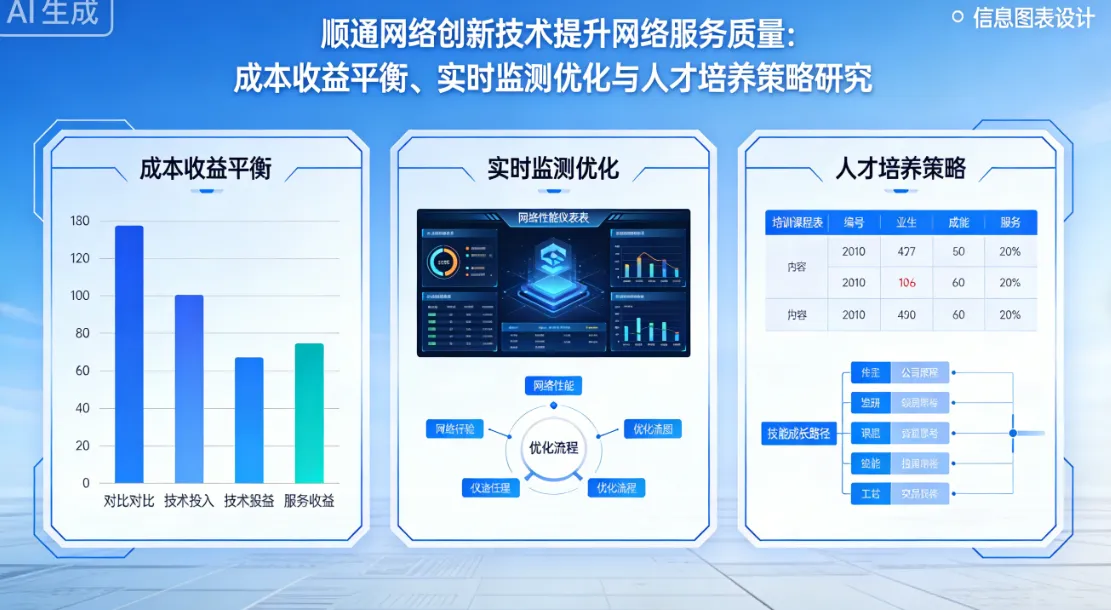
Through the collaborative efforts of cost-benefit balance, real-time monitoring optimization, and talent cultivation, Shuntong Network has achieved a dual improvement in network service quality and enterprise operational efficiency through technological innovation, setting a benchmark for technology enabled service upgrading in the industry. Currently, the construction of Digital China continues to advance, and the digital transformation of thousands of industries has put forward higher requirements for the quality and efficiency of network services. The iteration speed of network technology is also constantly accelerating. In the future, Shuntong Network needs to continue to deepen its technological innovation, further optimize its cost control model, upgrade its intelligent monitoring system, improve its talent training mechanism, continuously adapt to diversified and personalized network service needs, empower the digital transformation of the industry and the improvement of people's lives with high-quality network services, build core competitiveness in fierce market competition, and promote the continuous progress of the network service industry towards intelligence, intensification, and efficiency.