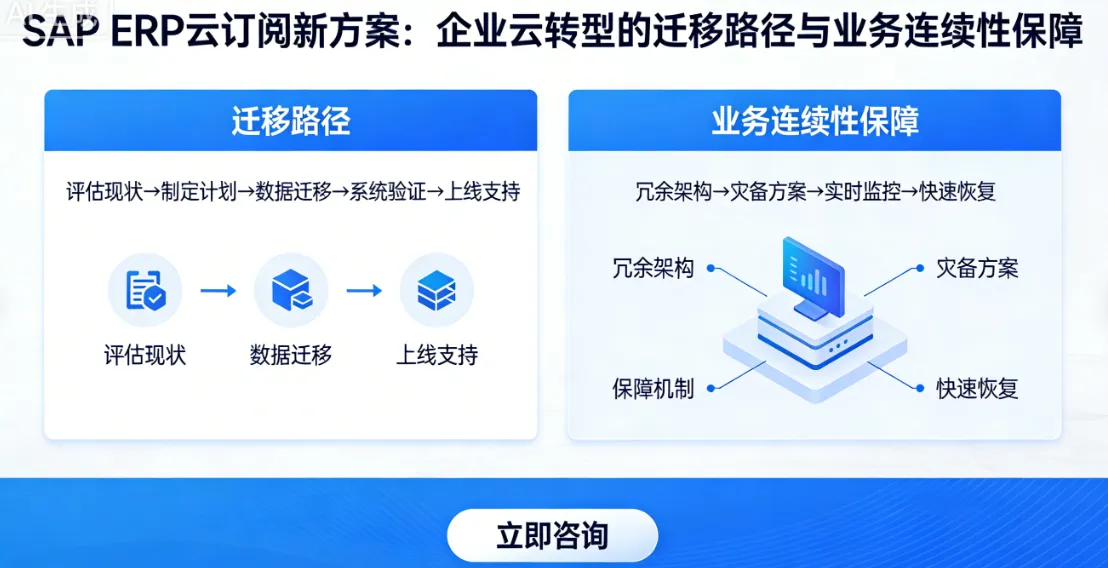
SAP ERP Cloud Subscription New Solution: Migration Path and Business Continuity Guarantee for Enterprise Cloud Transformation
Driven by the dual forces of global digital transformation and local "integration of data and reality" policies, the cloud migration of enterprise resource planning systems has become an irreversible strategic choice. As a global leader in enterprise management software, SAP's new generation ERP cloud subscription solution is not only a product, but also represents a complete methodology for enterprise cloud transformation. It aims to provide a clear path for enterprises from evaluation, migration to continuous optimization, and in this process, tocontinuity of businessPlacing it at the core, ensuring a smooth transition process, controllable risks, and predictable value.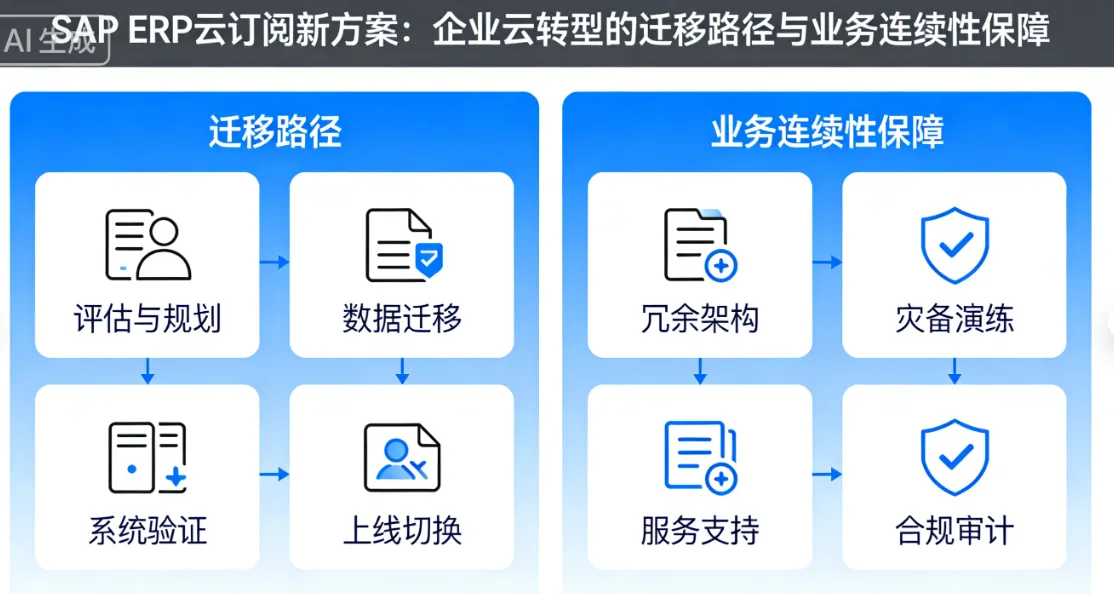
Transformation Core: The Core Value Proposition of SAP ERP Cloud Solution
The essence of SAP's next-generation ERP cloud solution, such as SAP S/4HANA Cloud, is to provide a subscription service that combines "standardized best practices and continuous innovation". Its core value lies in:
-
Agile and Innovation DrivenCloud native architecture enables enterprises to instantly access the latest features, security patches, and technology updates without the need for complex local upgrade projects. Enterprises can free up the energy of their IT teams from infrastructure maintenance and focus on driving business innovation through embedded intelligent technologies such as data analysis, artificial intelligence, and machine learning.
-
Total Cost of Ownership OptimizationThe subscription model converts the high initial capital expenditures of traditional models into predictable operating expenses, reducing the threshold for startup. At the same time, SAP is responsible for maintaining, upgrading, and securing the underlying hardware, helping enterprises reduce implicit IT operation and maintenance costs and achieve clearer financial planning.
-
Global compliance and local adaptationThe plan includes financial, tax, and legal compliance updates covering multiple countries and regions worldwide. For the Chinese market, its deep adaptation to local accounting systems, tax requirements (such as "replacing business tax with value-added tax" and electronic invoices), and industry regulatory norms ensures a balance between global operations and local compliance for enterprises.
Migration Path: A Scientific Journey from Planning to Going Online
Transitioning from a traditional on premises deployment environment to SAP ERP cloud is not simply about "moving" data, but rather a restructuring of business and technology. A typical successful migration path includes the following key stages:
-
Strategic evaluation and roadmap planningThis is the cornerstone of success. Enterprises need to conduct a comprehensive evaluation with SAP and implementation partners to clarify the business goals of transformation, such as improving supply chain resilience and achieving financial integration. The key decision is to choose a suitable migration scenario: it is a "Greenfield" that fully embraces cloud standardized processes to maximize efficiency; It is "selective data migration" (Brownfield), which retains some customized logic during migration; We will still adopt a 'hybrid architecture', allowing some core or special systems to remain locally. At this stage, detailed business scope, timeline, resource plan, and investment return analysis need to be output.
-
Preparation and pilot phaseIt is crucial to perform data purification and governance before a comprehensive migration. Enterprises need to clean and standardize master data (such as customers, suppliers, materials), and establish a continuous data quality management mechanism. At the same time, select representative business units or processes for pilot migration to verify the compatibility of technical solutions, migration tools, and business processes. Pilot testing is a key 'stress test' to reduce overall risk.
-
Hierarchical Migration and Parallel SupportFormal migration usually adopts a phased and modular strategy, such as migrating the financial core first, then covering the supply chain, and finally expanding to human resource management. During the critical "switching" window period, to ensure foolproof measures, enterprises will deployThe core measure for ensuring business continuity - parallel operationWithin a set period of time, the new and old systems synchronize the processing of business transactions, verify the accuracy, completeness, and performance of the cloud system through result comparison, and ensure that any differences can be identified and corrected in a timely manner.
-
Online and Value OptimizationAfter the system was successfully launched and running stably, the journey did not end. The enterprise enters a continuous stage of optimization and value mining. By leveraging the agility of cloud platforms, new digital scenarios can be quickly piloted and promoted, such as predictive analysis based on real-time data and strengthening connections with suppliers and customers through built-in collaboration tools, thereby continuously gaining business growth momentum from cloud investments.
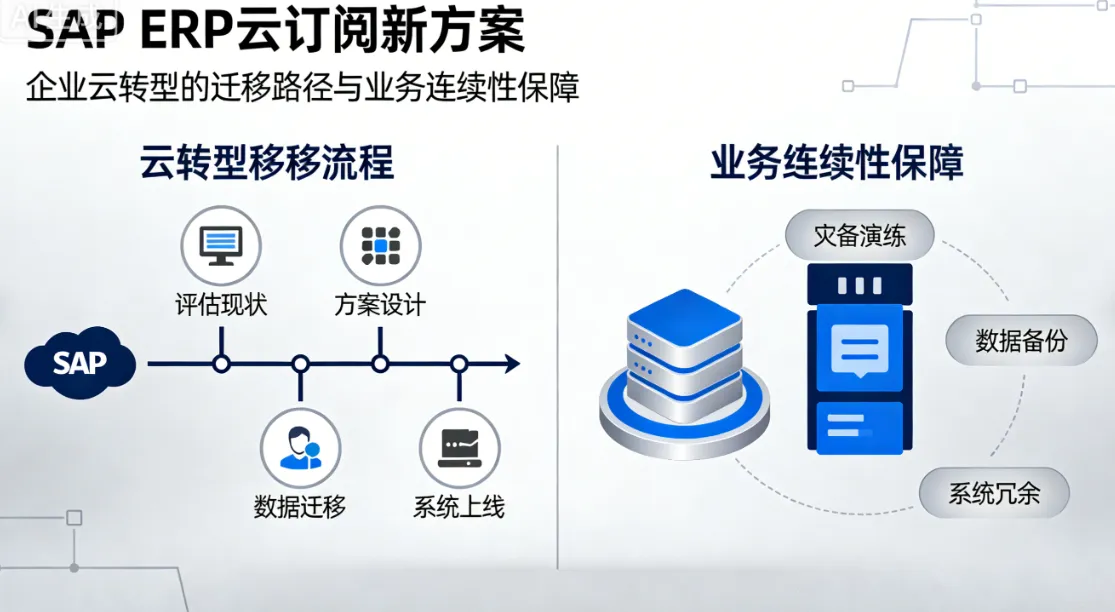
Continuity assurance: a risk prevention and control system that runs through the entire process
The guarantee of business continuity is the highest priority in the process of cloud migration, and it permeates every aspect:
-
High availability and disaster recovery at the technical levelSAP cloud services are based on globally leading cloud infrastructure, such as SAP's own data centers or partnerships with large public cloud vendors, providing built-in high availability architecture, cross availability data redundancy, and disaster recovery services. Their service level agreements typically promise a normal operating time of over 99.5%, providing a reliability benchmark that is difficult for local environments to match at the infrastructure level.
-
Data integrity and consistency during the migration processUse advanced migration tools and methodologies provided by SAP to ensure complete and accurate data migration. During the switching period, strict checklists, automated comparison tools, and phased rollback plans are used to ensure that once problems are identified, there are clear steps to return the business to a stable state and minimize the impact on operations.
-
Smooth transition between organization and processThe biggest challenge to business continuity often comes from 'people'. A comprehensive change management plan, including tiered training for end-users, communication, and an immediate support system after launch, is key to ensuring uninterrupted daily business operations. Familiarizing employees with new processes and trusting new systems is equally important as technology switching.
Prospects and Suggestions
Choosing SAP ERP cloud subscription solution means that the enterprise has chosen a modernization path guided by continuous innovation. For businesses that are planning or have already embarked on this journey, the recommendations are:
-
Consider transformation as a business engineering project, rather than a simple IT projectThe deep involvement of the top management and clear business value positioning are the first elements of success.
-
Embrace standardization, optimize instead of simply copying old processesFully utilizing the global best practices contained in the cloud, optimizing or even restructuring existing processes, is the key to unlocking the value of the cloud.
-
Choose experienced partnersAn implementation partner who is well versed in SAP technology and understands the characteristics of your industry can significantly reduce risks and accelerate value realization.
In summary, the SAP ERP cloud subscription solution provides enterprises with a solid bridge from the digital status quo to the intelligent future. Through scientific migration paths and comprehensive guarantees centered on business continuity, enterprises can effectively manage transformation risks, smoothly migrate operational cores to the cloud, and build future oriented agility, resilience, and innovation capabilities in the global economic landscape. This is not just a system upgrade, but also a strategic investment for the future.