
The Development History of ERP Systems: From Origin to Intelligent Transformation
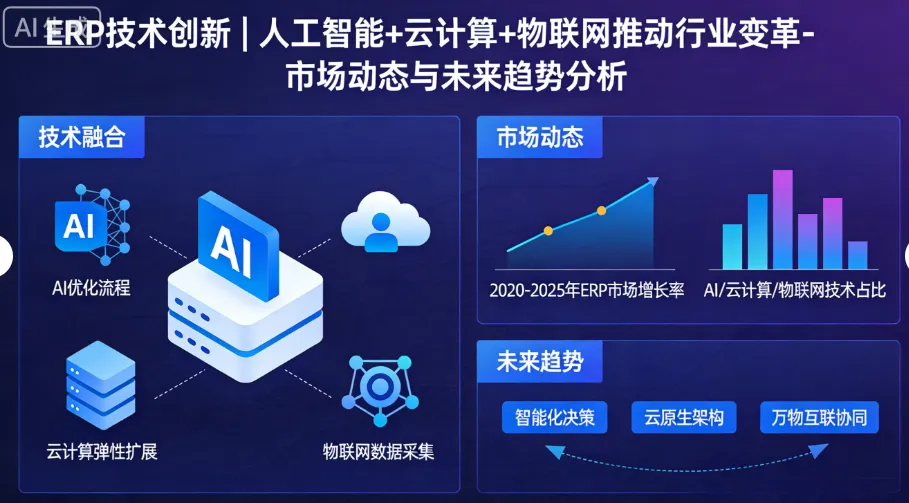
ERP Technology Innovation | Artificial Intelligence+Cloud Computing+Internet of Things Drive Industry Change - Market Dynamics and Future Trends Analysis
Today, with the deep penetration of the digital economy and the deepening of industrial digital transformation, ERP systems, as the core carrier of enterprise resource management, are undergoing unprecedented technological innovations. The "standardization, process oriented, and localized" model of traditional ERP systems is no longer suitable for the dynamic market environment, complex supply chain networks, and refined management needs faced by enterprises. However, the deep integration of the three cutting-edge technologies of artificial intelligence (AI), cloud computing, and the Internet of Things (IoT) is breaking the capacity boundaries of ERP systems, promoting their transformation from "process recording tools" to "intelligent decision-making centers", reconstructing resource management models in multiple industries such as manufacturing, retail, and service, and giving rise to new industry changes. This article will break down the three major technologies that empower innovation in ERP systems, analyze the current market dynamics of the ERP industry, predict future development trends, and provide reference for enterprises to seize technological opportunities and achieve digital upgrades. The entire process will balance professionalism and readability, and eliminate content duplication.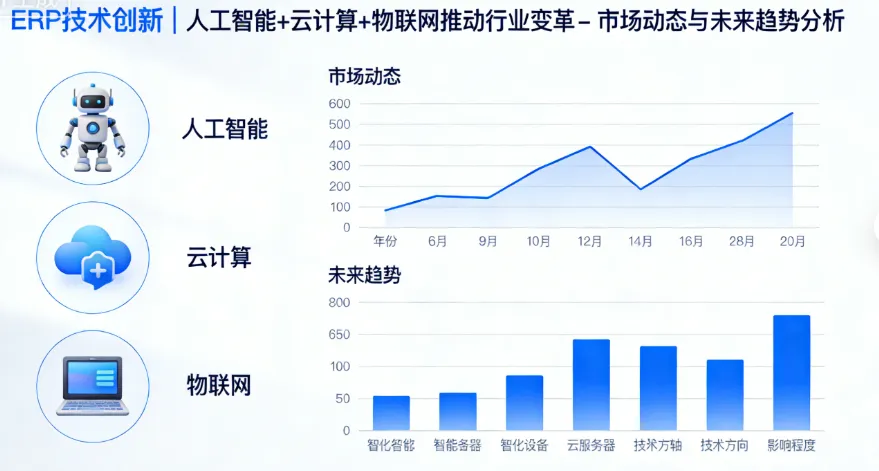
1、 Core of technological innovation: Three major technologies collaborate to reconstruct the core capabilities of ERP systems
Artificial intelligence, cloud computing, and the Internet of Things do not act in isolation on ERP systems, but form a complete closed loop of "data collection storage computing intelligent analysis decision execution", each playing a core role and exerting unique value, synergistically promoting the capability leap of ERP systems, breaking the pain points of traditional ERP such as data silos, response lag, and cumbersome deployment, and achieving a qualitative change from "passive response" to "active empowerment". The three have clear positioning and strong complementarity, effectively avoiding the homogenization and content duplication of technological applications.
(1) Artificial Intelligence: Empowering ERP with "Intelligent Decision making" Capability, Liberating Labor Costs
Artificial intelligence is the core engine for ERP systems to achieve "intelligent transformation". Its core value lies in the deep mining and self-learning of massive data, transforming the experience of manual decision-making into algorithm models, embedding them into the full business module of ERP, replacing tedious manual operations, optimizing decision-making efficiency, reducing decision-making errors, and completely changing the limitations of traditional ERP that only records without analysis. Compared with traditional ERP systems that rely on manual input and experience judgment, AI enabled ERP systems focus more on "predictability, automation, and personalization". Their application scenarios focus on decision support and process automation, forming a clear functional distinction from cloud computing and the Internet of Things.
In practical applications, AI's innovative empowerment of ERP is reflected in multiple scenarios: firstly, intelligent demand forecasting and planning optimization, relying on machine learning algorithms to integrate historical sales data, production data, and market data from the ERP system, combined with seasonal factors, consumption trends, and other variables, accurately predict product sales and material requirements, automatically generate production and procurement plans, and avoid blind production and inventory backlog. For example, manufacturing enterprises can improve demand forecasting accuracy to over 92% and optimize inventory turnover by over 20% through AI+ERP; Secondly, intelligent financial accounting and risk warning, through natural language processing (NLP) technology, automatically identify structured and unstructured data such as invoices and documents, complete voucher entry, accounting, tax declaration and other work, while monitoring data such as fund flow, accounts receivable, supplier credit through algorithms, real-time warning of fund risks and default risks, reducing repetitive labor for financial personnel; Thirdly, intelligent process mining and optimization. AI can automatically draw the actual business process diagram of the enterprise by analyzing the user's operation logs and data flow records in the ERP system, accurately identifying process bottlenecks and redundant links, actively proposing optimization suggestions, and even completing repetitive operations such as data verification and system entry through robotic process automation (RPA), forming a closed-loop optimization of "discovery analysis suggestion execution"; Fourthly, personalized service adaptation, independently adjusting algorithm models according to the management needs of different industries and enterprises, adapting to resource management needs in multiple scenarios, such as multi style and small batch production in shoe manufacturing enterprises, multi store and multi-channel inventory control in retail enterprises, etc.
It is worth noting that the application of AI in ERP is not a "technical pile up", but focuses on the core goals of "cost reduction, efficiency improvement, and quality improvement". For example, the "Little K Agent" built into Kingdee Cloud · Starry Sky allows employees to query business data and generate analysis reports through natural language, greatly reducing the threshold for data application and truly empowering every aspect of daily work with data insights, achieving deep integration of AI technology and ERP business rather than superficial application.
(2) Cloud computing: breaking down the deployment barriers of ERP, achieving lightweight and collaborative capabilities
Cloud computing is the fundamental support for ERP systems to achieve "scale popularization" and "cross regional collaboration". Its core value lies in solving the pain points of traditional ERP systems, such as high deployment costs, difficult operation and maintenance, and insufficient flexibility. Through cloud deployment, on-demand payment, and elastic expansion, ERP systems can break free from dependence on local servers and adapt to the needs of enterprises of different scales and development stages, especially lowering the threshold for digital transformation of small and medium-sized enterprises. Its core role focuses on "deployment mode innovation" and "resource collaboration", complementing the functions of AI's "intelligent analysis" and IoT's "data collection".
The innovation empowerment of cloud computing for ERP is mainly reflected in three aspects: firstly, the lightweight transformation of deployment mode. Traditional ERP systems require enterprises to invest a large amount of funds in building local servers and forming professional operation and maintenance teams, with deployment cycles lasting several months. Cloud ERP, on the other hand, has three deployment modes: public cloud, private cloud, and hybrid cloud. Enterprises can choose according to their needs without building their own servers, and the deployment cycle can be shortened to weeks or even days. Small and medium-sized enterprises can use the core functions of ERP systems at low cost through the "pay as you go" model, solving the dilemma of "high investment and difficult landing"; The second is to improve the ability of cross regional collaboration. Cloud ERP, based on Internet technology, supports multi terminal and multi regional access. The headquarters, branches, production bases, suppliers and customers of enterprises can share the data in the ERP system in real time, and achieve cross regional collaboration of procurement, production, sales, finance and other links. For example, through cloud ERP, multinational manufacturing enterprises can synchronize the capacity data and inventory data of global production bases in real time, and optimize resource allocation; The third is elastic expansion and low-cost operation and maintenance. Cloud ERP can flexibly expand system capacity and functional modules according to changes in the business scale of enterprises, without the need for large-scale system transformation. At the same time, cloud service providers are responsible for system upgrades, operation, and security protection, reducing the operation and maintenance costs and technical risks of enterprises. According to statistics, the penetration rate of cloud ERP in China has risen to 42% by 2025, an increase of 8 percentage points compared to the same period last year, becoming the mainstream deployment mode in the ERP market.
In addition, the collaboration between cloud computing, AI, and the Internet of Things provides powerful computing power support for ERP systems, enabling rapid iteration of AI algorithms and real-time processing of massive data in the Internet of Things. For example, Kingdee AI Star, as a cloud ERP product designed specifically for small and medium-sized enterprises, reduces deployment costs through cloud native architecture, while integrating AI and IoT technologies to achieve integrated management of "finance+business+taxation", becoming a cost-effective choice for digital transformation of small and medium-sized enterprises.
(3) Internet of Things: Connecting ERP "data silos" to achieve full chain digital control
The Internet of Things is the core link for ERP systems to achieve "full chain control", and its core value lies in "interconnectivity of all things and real-time collection". Through sensors, RFID tags, intelligent terminals and other devices, physical entities such as production equipment, materials, products, logistics vehicles, etc. of enterprises are connected to the ERP system to collect dynamic data of production, logistics, inventory and other links in real time, breaking the pain points of traditional ERP systems such as "data input lag and incomplete data", allowing the ERP system to "perceive" the dynamics of the physical world, achieve real-time synchronization and full chain traceability of data, and focus on "data collection and real-time linkage", forming a closed loop with AI's "intelligent analysis" and cloud computing's "cloud storage".
In industry applications, the integration of the Internet of Things and ERP has given rise to multiple innovative scenarios: in the manufacturing industry, IoT devices collect real-time operating parameters, energy consumption data, and process progress of production equipment, synchronize them to the ERP system, and use AI algorithms to monitor equipment failures and optimize production processes, achieving digital control of the production process. For example, a precision parts enterprise uses IoT+ERP to collect real-time equipment operation data, and uses AI algorithms to warn of failure risks in advance. Equipment downtime is greatly reduced, and material obsolescence losses caused by engineering changes are reduced by more than 70%; In the field of supply chain, IoT tags track the logistics trajectory of materials and products in real time, synchronized to the ERP system. Enterprises can grasp the real-time progress of material arrival and product delivery, optimize logistics routes, reduce logistics costs, and achieve full traceability of products from raw material procurement to finished product delivery; In inventory management, IoT devices real-time collect the quantity, location, and status of inventory materials, synchronize them to the ERP system, and automatically generate inventory warnings to avoid material shortages or backlogs. For example, a food retail enterprise can connect store intelligent POS data and warehouse temperature and humidity sensors, and the system can warn of approaching products and push promotional suggestions based on real-time sales speed and product shelf life, increasing inventory turnover by 30%; In the field of green manufacturing, IoT devices collect real-time energy consumption, wastewater, and exhaust emissions data from enterprises, synchronize them to ERP systems, achieve real-time monitoring and accurate accounting of environmental data, and help enterprises achieve their carbon reduction and consumption reduction goals.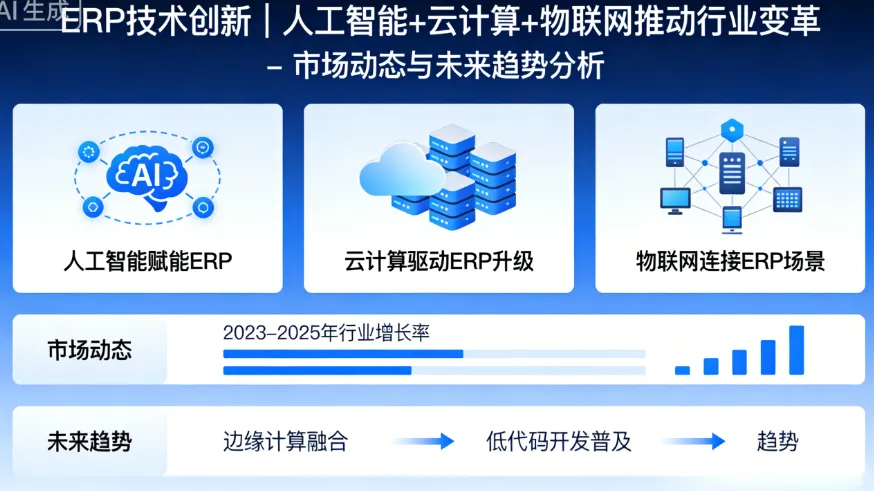
2、 Current market trends in the ERP industry: technology driven, pattern reconstruction, and demand upgrading
Driven by artificial intelligence, cloud computing, and the Internet of Things, the ERP industry is currently undergoing a new round of market transformation. The market size continues to expand, the competitive landscape continues to reconstruct, and user demands continue to upgrade, presenting three major characteristics of "technology dominance, domestic rise, and industry deepening". Combined with the latest industry data and vendor dynamics, this can be analyzed from three dimensions, taking into account the background of technological innovation throughout the process to avoid duplication with the previous technical application content.
(1) The market size continues to grow, and cloud ERP has become the core engine of growth
With the deepening of digital transformation, the demand for ERP systems from enterprises in various industries continues to rise, especially the awakening of digital awareness among small and medium-sized enterprises, which drives the steady growth of the ERP market size. According to industry data, the size of China's ERP market has exceeded 130 billion yuan by 2025, with a year-on-year growth of 11.5%. Among them, cloud ERP has become the core driving force of market growth, with penetration rate rising to 42%, an increase of 8 percentage points compared to the same period last year. From the perspective of market structure, large enterprises are still the core demanders of ERP systems, mainly choosing private cloud and hybrid cloud deployment models, focusing on the deep integration of AI, IoT, and ERP, and achieving full chain intelligent control; Small and medium-sized enterprises are more inclined to choose public cloud ERP, focusing on lightweight, low-cost, and easy-to-use core functions to quickly achieve digital management of basic business.
At the same time, the demand for ERP in different industries is showing differentiated growth. Manufacturing, as the main application area of ERP systems, accounts for over 40% of the demand, with a focus on intelligent control of production processes, supply chain optimization, and green manufacturing empowerment; The demand for ERP in the retail and service industries is growing rapidly, with a focus on scenarios such as multi-channel collaboration, customer relationship management, and inventory optimization; The ERP requirements of cross-border enterprises focus on multi currency accounting, cross-border logistics collaboration, compliance control and other functions. The differentiation of requirements drives the transformation of ERP systems towards industrialization and specialization.
(2) The restructuring of the competitive landscape, the rise of domestic manufacturers, and the accelerated transformation of foreign manufacturers
In the past, the ERP market was mainly dominated by foreign vendors such as SAP and Oracle, who held a major share in the large enterprise market with their mature products and technological advantages. But in recent years, with the technological breakthroughs and localization advantages of domestic ERP manufacturers, the market landscape is undergoing profound restructuring, and domestic manufacturers are gradually rising, completely rewriting the previous pattern dominated by international manufacturers. According to a joint survey conducted by EO Think Tank and Sina Finance, the market share of local ERP vendors has jumped from 52% in 2023 to 65% in the first half of 2025, achieving a breakthrough in core areas such as intelligent manufacturing. Among them, Dingjie Shuzhi has been deeply involved in the manufacturing industry for more than 40 years, ranking first in the Chinese manufacturing ERP market with a market share of 14.8%, and the market share of intelligent manufacturing ERP products continues to lead.
The core advantages of domestic manufacturers lie in "localization adaptation" and "high cost-effectiveness". They can accurately grasp the management habits and industry pain points of domestic enterprises, and combine AI, cloud computing, and IoT technologies to launch ERP products that are adapted to local enterprises. For example, cloud ERP products launched by UFIDA and Kingdee integrate domestic tax policies and supply chain characteristics, while also adapting to the low-cost needs of small and medium-sized enterprises; Kingdee AI Star won the "Best ERP Solution for Small and Medium sized Enterprises of the Year" award with its innovative practice of "AI+Internet of Things Empowering Digital Transformation of Small and Medium sized Enterprises". The user satisfaction score reached 92 points, significantly higher than the industry average. Foreign manufacturers, on the other hand, are accelerating their transformation, focusing on the high-end market of large enterprises, increasing research and development investment in technologies such as AI and IoT, launching intelligent and collaborative high-end ERP solutions, while gradually adapting to local conditions and engaging in differentiated competition with domestic manufacturers, forming a competitive pattern of "domestic dominance in small and medium-sized markets, foreign focus on high-end markets".
(3) User demand upgrade, transitioning from "basic management" to "intelligent collaboration"
With the continuous deepening of enterprise digital transformation, users' demand for ERP systems has upgraded from "basic financial, inventory, and production management" to "intelligent, collaborative, and full chain" comprehensive management needs. The single function of traditional ERP systems is no longer sufficient to meet enterprise needs, and users are more inclined to choose intelligent ERP systems that integrate AI, cloud computing, and IoT technologies to achieve "data-driven decision-making, full chain collaboration, and lightweight management".
Specifically, there are three clear trends in the current ERP needs of users: first, the intelligence of demand. Enterprises are no longer satisfied with the "data recording" function of ERP systems, but more need them to have intelligent functions such as demand forecasting, risk warning, and process automation to reduce manual decision-making costs; The second is the collaboration of demand. Enterprises need ERP systems to break down internal departmental barriers and achieve information collaboration with upstream and downstream supply chain, customers, and logistics service providers, building a full chain collaboration system; The third is the personalization of demand. Enterprises of different industries and scales have significant differences in their functional requirements for ERP systems. Enterprises tend to choose customizable and modular ERP solutions, selecting functional modules as needed to reduce investment costs. In addition, the demand for greenization is gradually becoming prominent. Enterprises hope to achieve energy management and environmental data control through ERP systems, which will help green manufacturing and sustainable development, and become a new growth point for ERP demand.
3、 The future trend of ERP industry: deep integration of technology, deep cultivation of the industry, and ecological synergy
Based on the current trend of technological innovation and changes in market demand, the ERP industry will continue to focus on the three major technologies of artificial intelligence, cloud computing, and the Internet of Things, and develop towards a direction of "smarter, more collaborative, lighter, and more industry-specific". At the same time, it will promote ecological collaboration and green transformation, forming a new industry development pattern. The following four trends are clear and concise, without content repetition, and in line with the core logic of technological innovation and market dynamics.
Trend 1: Deep integration of AI+IoT+cloud computing to create a "super automated" intelligent ERP
In the future, the three major technologies of artificial intelligence, the Internet of Things, and cloud computing will no longer be "individually empowered", but will achieve deeper collaborative integration, break technological boundaries, and create "super automated" intelligent ERP systems. Cloud computing will provide stronger computing power support for AI and the Internet of Things, enabling real-time storage and rapid processing of massive IoT data; The Internet of Things will provide AI with richer and more accurate data samples, optimizing AI algorithm models; AI converts the data collected by the Internet of Things into decision instructions, driving the ERP system to automatically complete the operations of production, procurement, finance, and other links, forming a full process automation loop of "data collection storage analysis decision-making execution". The future ERP system will shift from "passive response" to "active prediction and autonomous decision-making", becoming the "intelligent brain" of enterprises. For example, the system can automatically identify supply chain risks and adjust procurement and production plans in real time; Automatically optimize production processes to reduce energy consumption and costs; Automatically completing financial accounting and tax declaration, achieving full process unmanned intervention, and promoting the complete transformation of enterprise management from "manual driven" to "data-driven", which is highly in line with the current development trend of "super automated platforms".
Trend 2: Industry oriented and vertical cultivation, bidding farewell to the universal mode of "big and comprehensive"
In the future, ERP systems will completely bid farewell to the "big and comprehensive" universal model and deeply cultivate in the direction of industry and verticality. Manufacturers will focus on the characteristics and pain points of different industries, launch specialized ERP solutions, and enhance the adaptability and practicality of products. For example, in the manufacturing industry, we have launched intelligent ERP systems that are suitable for multi process and multi variety production, with a focus on strengthening production control, equipment linkage, and supply chain collaboration functions; Targeting the light manufacturing industries such as footwear and clothing, we have launched an ERP system that is suitable for small batch and fast turnover needs, optimizing material management and production scheduling functions; Introduce an ERP system that meets pharmaceutical compliance requirements and enables full traceability of drugs throughout the entire pharmaceutical industry; Targeting the cross-border e-commerce industry, we will launch an ERP system that is compatible with multiple platforms, currencies, and logistics channels, strengthening cross-border collaboration and compliance control functions; For small and medium-sized enterprises, we will launch a lightweight, low-cost, and easy-to-use cloud ERP system that focuses on core functions and reduces the threshold for digital transformation. This is consistent with the current trend of domestic manufacturers deepening their cultivation in the manufacturing and small and medium-sized enterprise markets.
Trend 3: Modular architecture becomes mainstream, achieving flexible adaptation through "on-demand customization"
In the face of personalized and diversified demands from enterprises, future ERP systems will gradually adopt a "composable architecture", decoupling enterprise management capabilities into a series of independent, reusable, and composable "business capability packages". Enterprises can quickly select, combine, and arrange these functional modules based on their own business needs, like building blocks, to construct personalized ERP applications that fully fit their own processes. This architecture will break the limitations of traditional ERP systems, such as fixed functionality and high customization costs. Enterprises can flexibly add and remove functional modules based on business scale expansion and business model adjustments, achieving "on-demand customization and flexible adaptation" while reducing system deployment and operation costs. In addition, low code/no code technologies will be deeply integrated with ERP. Business or IT personnel do not need to write complex code, and can quickly configure and connect different systems through drag and drop visual interfaces, achieving full business flow connectivity and further improving the flexibility and efficiency of ERP systems.
Trend 4: Ecological collaborative development, building a full chain digital ecosystem
In the future, ERP systems will no longer be isolated management tools, but will become the core hub of enterprise digital ecosystems, promoting seamless integration with MES (Production Execution System), PLM (Product Development Management System), CRM (Customer Relationship Management System), OA (Office Automation System), intelligent production equipment, logistics systems, etc., and building a full chain digital ecosystem. Through ecological collaboration, data sharing can be achieved throughout the entire process of human, financial, material, production, supply, and sales within the enterprise. At the same time, information collaboration can be achieved with upstream and downstream of the supply chain, customers, logistics service providers, and financial institutions, breaking down information silos and improving the collaborative efficiency of the entire industry chain. For example, the ERP system is integrated with the MES system to achieve real-time synchronization between production planning and execution; Integrate with CRM system to achieve precise matching between customer needs and production plans; Integrate with logistics systems to achieve real-time linkage between logistics trajectories and inventory data; Connect with financial institutions to achieve collaborative control of capital flow and business flow, form an "ERP+" ecological collaborative model, and promote the digital upgrading of the industrial chain.
Trend 5: Integrating green management concepts to empower sustainable development of enterprises
Against the backdrop of the deepening of the "dual carbon" strategy, future ERP systems will gradually integrate green management concepts, adding modules such as carbon accounting, energy management, environmental compliance, etc., becoming the core tools for enterprises to achieve green manufacturing and sustainable development. Real time collection of energy consumption, carbon emissions, waste disposal and other data of enterprises through IoT devices, synchronized to the ERP system, combined with AI algorithms to optimize energy efficiency and supply chain greening level, accurately calculate the carbon emissions of enterprises, establish enterprise carbon accounts, and connect with the carbon trading market to provide data support for carbon reduction and trading of enterprises. In addition, the ERP system will promote the procurement of green raw materials, optimize green logistics, reduce resource waste, help enterprises achieve the goals of carbon reduction, consumption reduction, and efficiency improvement, promote the transformation of the manufacturing industry from "high consumption and high emissions" to "low consumption and low-carbon", and achieve the unity of environmental benefits, economic benefits, and social benefits.
4、 Conclusion
The deep integration of three cutting-edge technologies, artificial intelligence, cloud computing, and the Internet of Things, is driving a comprehensive transformation in the ERP industry, restructuring the core capabilities, market landscape, and development model of ERP systems. From the perspective of technological innovation, the three major technologies are working together to upgrade the ERP system from a "process recording tool" to an "intelligent decision-making center", achieving data-driven, intelligent collaboration, and full chain control; From the perspective of market dynamics, cloud ERP has become the core of growth, with the rise of domestic manufacturers and the transformation of user demand towards intelligence, collaboration, and personalization; From the perspective of future trends, deep integration of technology, deep industry cultivation, ecological collaboration, and green transformation will become the core development direction of the ERP industry.
For enterprises, technological innovation in ERP systems is both an opportunity and a challenge for digital transformation. Enterprises need to combine their own industry characteristics, development scale, and management needs, grasp technological trends, choose suitable intelligent ERP systems, promote the deep integration of technology and business, and achieve the goals of cost reduction, efficiency improvement, and quality enhancement; For ERP vendors, it is necessary to focus on technology research and development and deep industry cultivation, launch more adaptable and intelligent products, strengthen ecological collaboration, and promote the high-quality development of the ERP industry. In the future, with the continuous iteration of technology and the upgrading of demand, ERP systems will continue to empower digital transformation in multiple industries, becoming the core support for enterprises to achieve sustainable development and enhance core competitiveness, opening a new chapter of intelligent, collaborative, and green development.