
ERP System: The Secret Weapon for Efficient Operation of E-commerce Backend | Say Goodbye to Overselling and Misdelivery, Improve Online Shopping Experience
In today's fiercely competitive e-commerce market, while traffic competition and marketing innovation on front-end pages are important, the fate and reputation of a company are often determined by the invisible back-end - whether orders can be delivered on time and without error. The cancellation of orders due to overselling and customer complaints caused by wrong shipments, every time these operational "accidents" occur, they directly damage the company's profits and reputation. Many e-commerce companies initially rely on multiple independent software to operate, but as their scale expands, data barriers and process breakpoints between systems become efficiency bottlenecks and sources of errors. At this point, a deeply integrated enterprise resource planning system has evolved from a backend support role to a core secret weapon that ensures efficient and precise operation of e-commerce. Its value is directly reflected in every aspect of bidding farewell to chaos and fulfilling consumer trust.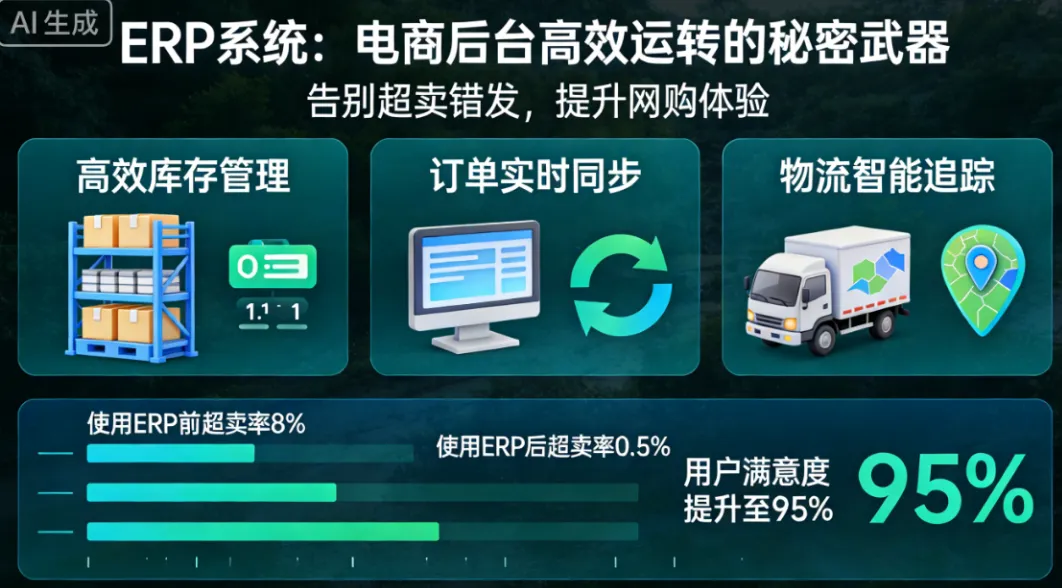
The core challenge of e-commerce operation lies first and foremost in the "visibility" and "accuracy" of inventory. When products are sold synchronously on multiple online platforms, self operated apps, and even offline stores, the traditional method of relying on manual or simple software to synchronize inventory is prone to delays and deviations, which is the root cause of the famous "oversold" problem. The customer successfully placed an order and made payment on platform A, but due to the lack of real-time inventory data updates, the same item may be simultaneously purchased by another buyer on platform B. As a central data hub, the ERP system seamlessly connects with major sales channels through application programming interfaces, building aOmnichannel, real-time synchronized global inventory poolAny transaction, regardless of which port it comes from, will instantly trigger the deduction and locking of the central inventory quantity. This means that the system has technically achieved "what you see is what you get", completely eliminating oversold caused by data synchronization and safeguarding the most basic transaction integrity.
Inventory can be seen as the foundation, while precise and efficient order fulfillment is the key to improving user experience. E-commerce orders have the characteristics of massive, volatile, and fragmented information. ERP system is like an intelligent systemOrder Processing and Scheduling CenterIt automatically aggregates orders from all channels and efficiently processes them according to pre-set intelligent rules. The system can automatically review order information, identify abnormal addresses or risky transactions; More importantly, it can allocate a suitable fulfillment path for each order based on the optimal algorithm of cost, efficiency, and experience. For example, if a product exists in both the North China central warehouse and the South China city warehouse, the system will comprehensively consider the shipping address, storage costs of each warehouse, express delivery time and fees, and automatically choose to ship from the warehouse closest to the customer. This intelligent scheduling not only greatly shortens the transit time of packages and improves customer experience, but also directly saves operating costs for enterprises by optimizing logistics paths. At the same time, ERP is deeply integrated with warehouse management systems to generate accurate picking lists, packing lists, and express delivery orders, ensuring that every item picked up from the warehouse corresponds accurately to the consumer's order, eliminating "wrong shipments" from the source.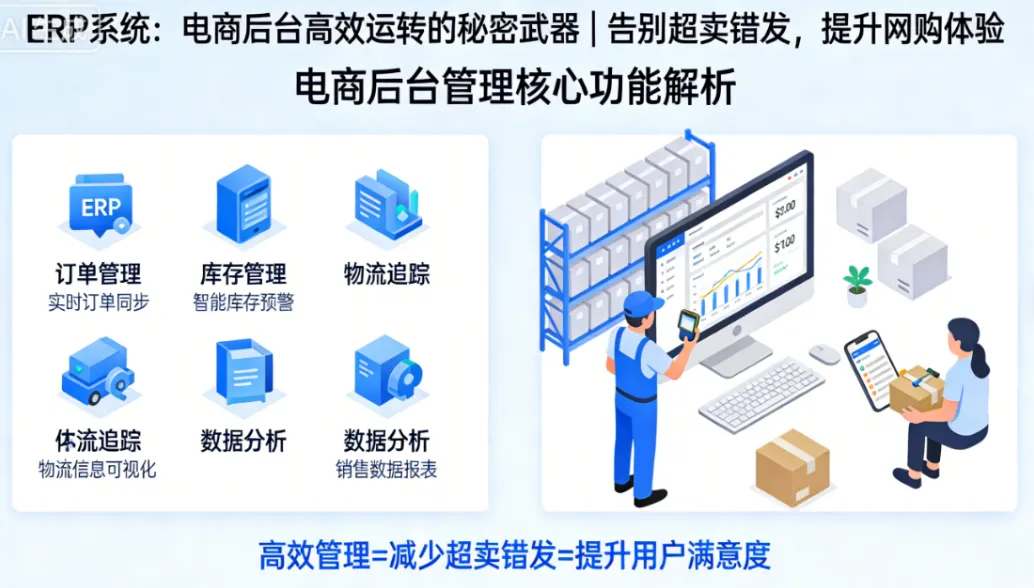
More profoundly, the ERP system upgrades e-commerce operations from a passive "order receiving shipping" model to an active one by integrating front-end and back-end data“Prediction Optimization Service”Intelligent cycle. In the sales front-end, clear inventory data supports setting more flexible and accurate promotional strategies to avoid hot selling items being hastily taken down due to insufficient physical inventory. In the backend of the supply chain, the system generates scientific sales forecasts based on historical sales data and market trends, drives intelligent replenishment suggestions, and maintains a healthy inventory structure, avoiding stockouts and loss of sales opportunities, as well as preventing unsold goods from occupying valuable funds. When customers need after-sales service, customer service personnel can quickly access complete order information, shipping logistics, and customer history records on the integrated interface, providing efficient and accurate responses and turning disputes into reputation.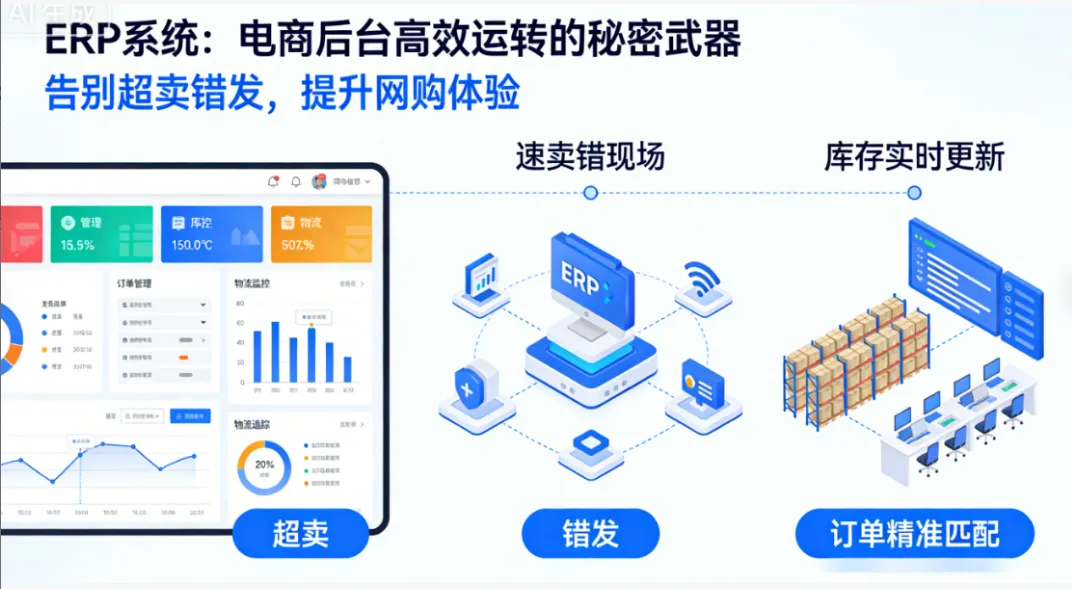
Therefore, the value of an ERP system deeply configured for e-commerce as a "secret weapon" goes far beyond solving the immediate problem of overselling and misdelivery. It connects the dispersed "limbs" of e-commerce enterprises (sales, warehousing, procurement, finance) to a "smart brain" nervous system. It ensures that despite the massive flow of transactions, enterprise operations can still maintain precision, orderliness, and agility. In an era where consumers have increasingly stringent requirements for experience, the excellent operational capability of this backend has become the infrastructure for e-commerce companies to build moats and achieve sustainable growth. It allows enterprises to innovate and compete in the market with confidence, because they know that there is a reliable system behind to ensure the fulfillment of every promise, and this is the most solid confidence to win market competition and customer loyalty.