
ERP Procurement New Year's Guide: Efficient Procurement for Enterprises and Personal Cost saving Techniques
When the systematic thinking of enterprise resource planning encounters the smoke filled New Year's procurement, what kind of intelligent sparks will collide? These two seemingly unrelated fields share the same precise resource optimization logic at their core: under limited budget constraints, achieving the optimal achievement of goals (meeting production/household needs) through scientific planning, efficient execution, and intelligent selection. Whether it's ensuring year-round production materials for enterprises or arranging a sumptuous New Year's Eve dinner for families, a set of procurement methods that draw on the core ideas of ERP can transform you from a flustered "firefighter" to a skilled "resource planning master".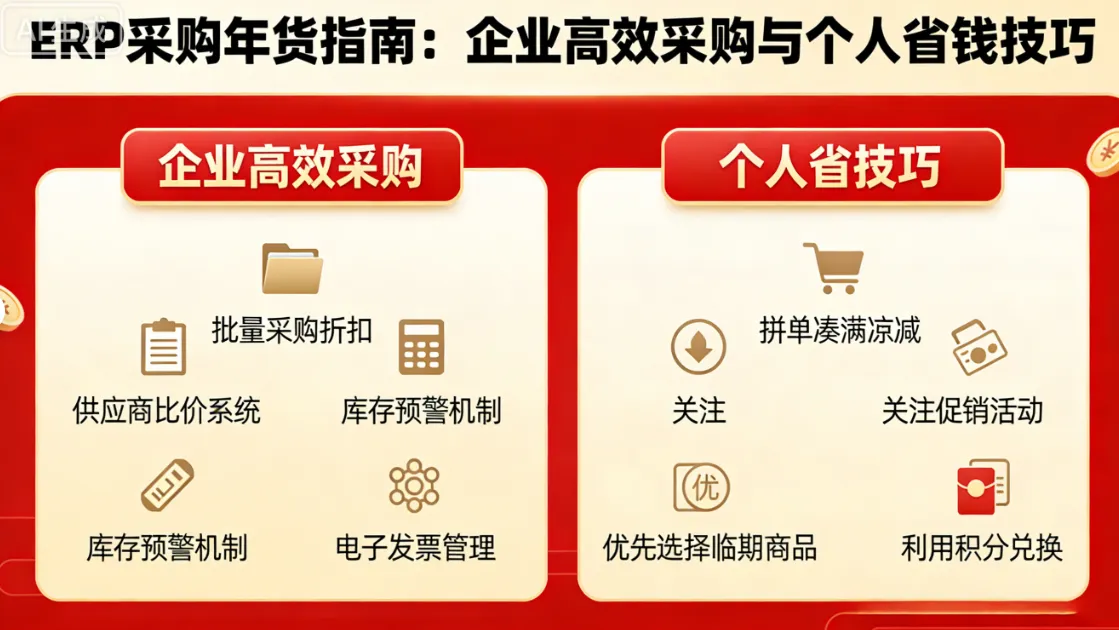
The starting point of procurement is precise demand insight and budget anchoring.In enterprises, this is known as' sales and operations planning ', which converts vague sales targets into precise material lists based on market forecasts and historical data. When it comes to purchasing family New Year's goods, the essence lies in bidding farewell to the feeling based "shopping" and starting precise planning based on the "menu". Why not hold a 'family operation meeting' before purchasing, combining the tastes of family members, the New Year's Eve dinner menu, and the frequency of entertaining guests during the Spring Festival, to generate a detailed reportAnnual Goods Demand ListThis list is your 'material list', which needs to specify the category (fresh, dry goods, gifts, decorations), estimated quantity (calculated by meal times and number of people), and demand time point (for New Year's Eve or for the entire January). More importantly, based on the annual household budget or monthly disposable income, set a clear "procurement budget" for this list, which is equivalent to the cost control target of the enterprise. By matching demand with budget in advance, impulsive consumption and overspending can be avoided from the source, achieving a clear understanding and balance in hand.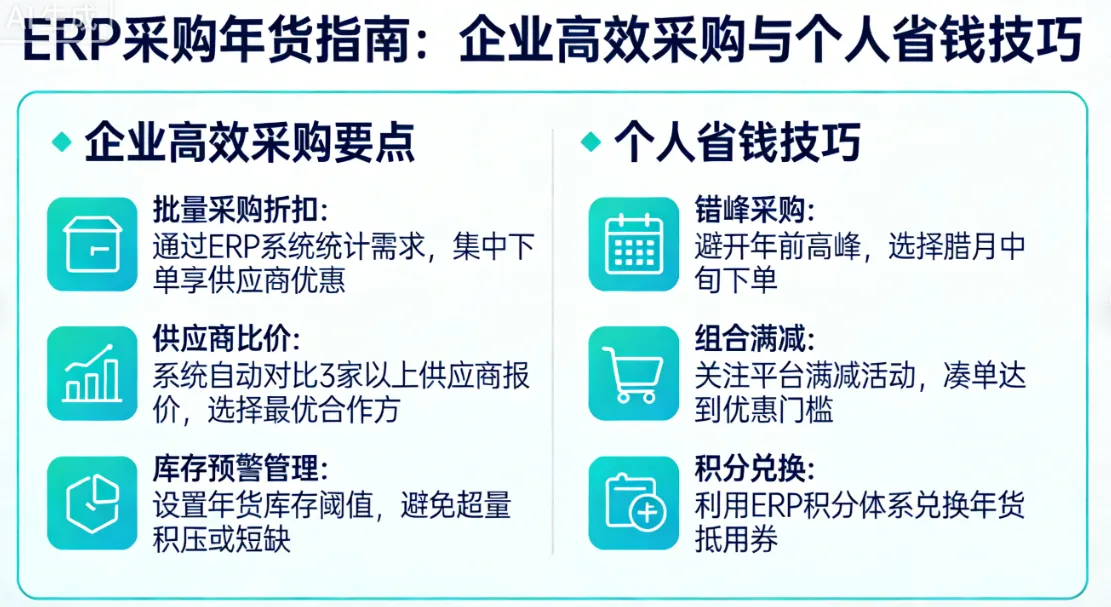
Next is the intelligent competition between supplier management and procurement sourcing.Enterprise procurement will establish a supplier evaluation system that comprehensively considers price, quality, delivery time, and service. We can also build our own in personal procurementNew Year's goods supplier matrixThis matrix should not be limited to a single market or supermarket, but should systematically include: local fresh agricultural markets (advantages include freshness and negotiable prices), large chain supermarkets (advantages include a wide range of categories, stable quality, and often standard promotions), online fresh platforms (advantages include convenience, comparability with multiple stores, and next day delivery services), and e-commerce stores in the origin of specialty products (used for purchasing specialty dry goods or gifts). The key lies in "comparing prices among three companies" and "timing". Just as companies analyze the price fluctuations of raw materials, we can pay attention to the price cycle of annual goods. Usually, fresh produce reaches its price peak 3-5 days before the holiday, while standard packaged dry goods, beverages, and gifts may have platform promotions starting two weeks before the holiday. Using the "supplier matrix" to place orders through different channels and locking in the optimal price at the best time is a vivid embodiment of the "strategic sourcing" and "procurement rationalization" ideas in ERP systems.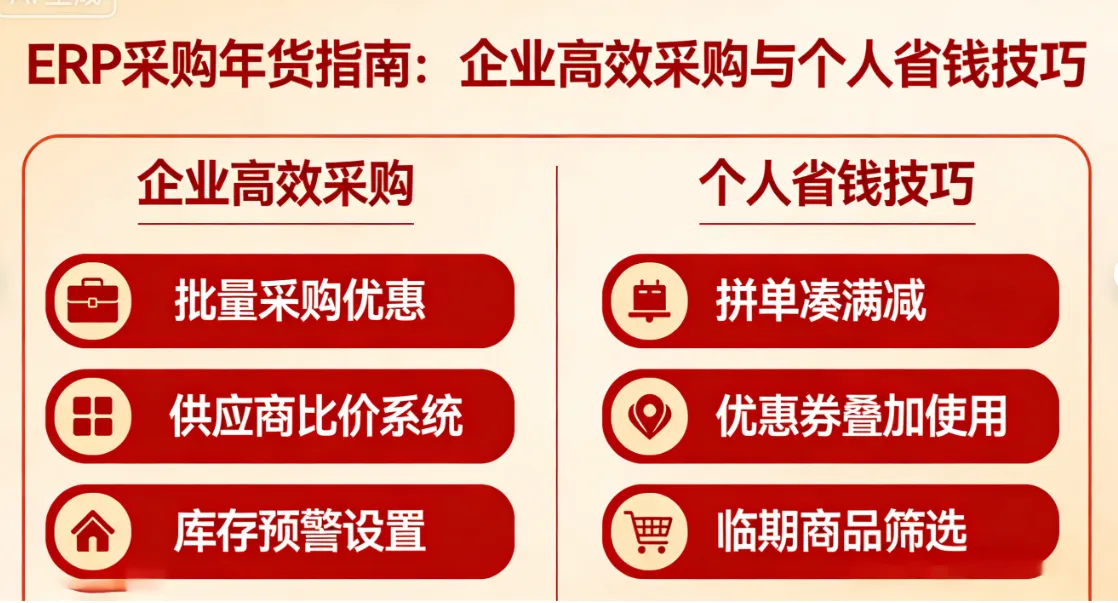
Efficient execution and fulfillment are the guarantees for the implementation of the plan.In enterprise procurement, a purchase order is associated with delivery time, acceptance criteria, and payment terms. Family procurement also needs to introduce similar measuresOrder and Performance ManagementThinking. For online orders, it is important to clearly record the expected delivery time and include it in your annual delivery plan to avoid leaving no one present when fresh food arrives at home. For offline procurement, the optimal procurement route and sequence can be planned based on the "demand list", starting with durable dry goods and beverages, and finally purchasing fresh fruits, vegetables, and seafood before the holiday. This is equivalent to optimizing the warehousing and logistics flow. For bulk or valuable gift purchases, keep the receipts and record their purpose, which not only facilitates possible returns and exchanges, but also provides data for the next year's review, equivalent to the management of the enterprise's procurement archives.
Finally, a often overlooked but crucial aspect is the review and knowledge accumulation.At the end of each fiscal year, enterprises analyze procurement data, evaluate supplier performance, and optimize strategies for the next year. After the end of the year, we may also take some time to conduct a simple review: which items have been severely surplus and caused waste? Which supermarket has the highest cost-effectiveness for a certain category? Which online platform offers the most reliable delivery service? What is the deviation between this budget and actual expenditure? These data obtained through experience and even lessons learned are the most valuable ones you have accumulated for the next procurement cycleMaster data and historical transaction dataRecording and optimizing them will make your procurement for the coming year more precise and easy, forming a positive cycle.
Therefore, the core of applying ERP thinking to annual procurement is not the introduction of complex software, but the adoption of aSystem planning, data-driven, process optimizationThe philosophy of modern life management. It makes trivial family affairs clear and orderly, and maximizes the use of limited funds. Whether managing a supply chain worth hundreds of millions or managing a warm family, the secret to success is so similar: starting with careful planning, becoming wise choices, and finally achieving a satisfactory outcome. Mastering this set of mindsets will not only bring you a table of abundant New Year's goods, but also a fundamental ability to make life and work more efficient and composed.