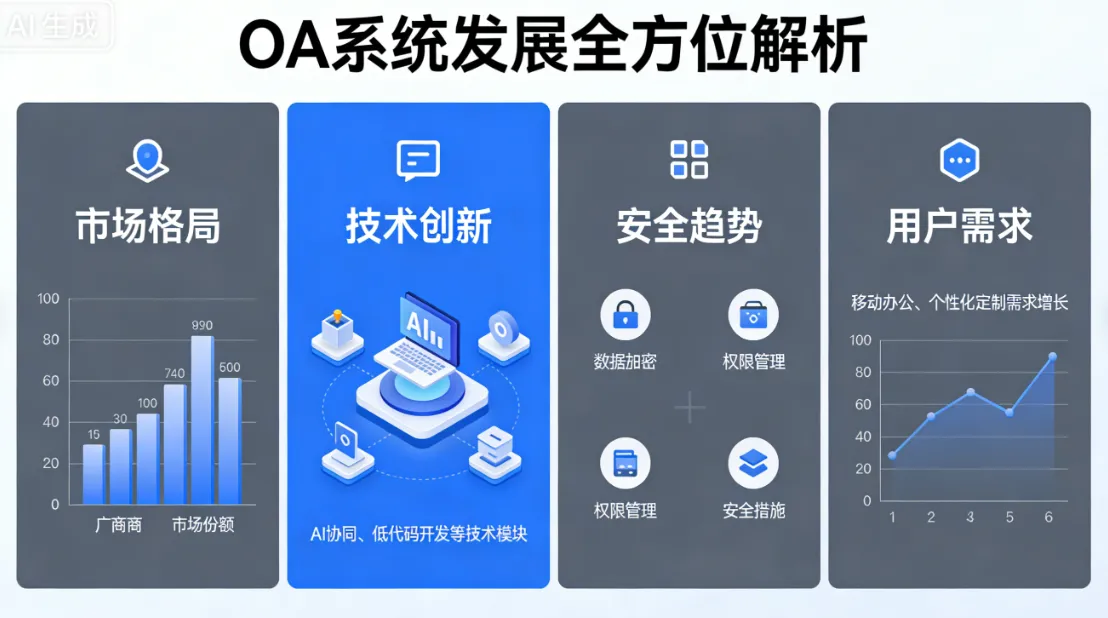
Comprehensive Analysis of OA System Development: Market Landscape, Technological Innovation, Security Trends, and User Needs
As the digital cornerstone of modern organizational operations, the evolution of office automation systems deeply reflects the changes in work methods and the migration of technological paradigms. From early document electronicization and process approval tools to today's intelligent work platforms that carry collaboration, decision-making, and knowledge management, the connotation and extension of OA systems have undergone tremendous changes. Currently, its development is presenting a complex multi-dimensional resonance landscape: market demand drives technological innovation, security challenges shape product forms, and the competitive landscape is constantly reshaping through integration and differentiation. A comprehensive analysis of this ecosystem is key to understanding future work forms and organizational efficiency.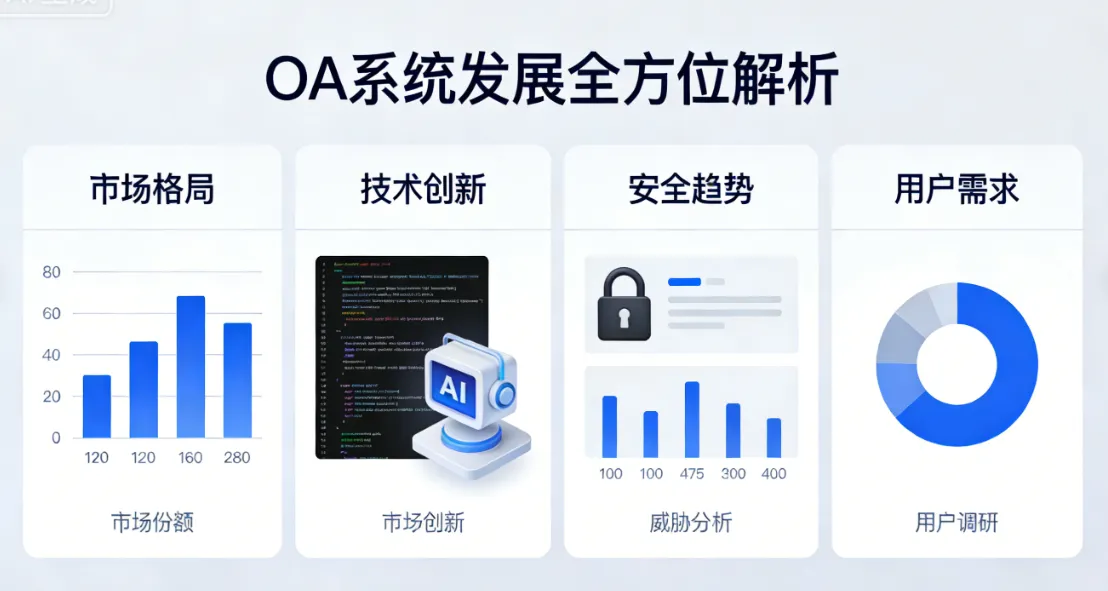
The market landscape is rapidly evolving from homogeneous competition at the "tool level" to a polarization between "platform level" ecologicalization and "industry level" verticalization.In the general market, top manufacturers and integrated digital platforms such as DingTalk, Enterprise WeChat, and Feishu are establishing their "entry level" platform status by building strong foundational collaboration capabilities and open application markets. They no longer provide just a set of OA software, but a fusion of instant messaging, meetings, documentation, low code development, and third-party SaaS integrationDigital work environmentThis forces traditional OA vendors to either deepen their platform capabilities to compete with it, or focus on providing deep professional applications within their ecosystem. At the same time, in fields such as government, finance, healthcare, and large-scale manufacturing that have extremely high requirements for process compliance and business coupling, the value of specialized and vertical OA solutions is highlighted. These solutions deeply encapsulate industry-specific approval processes, compliance rules, document templates, and business system integration requirements, and their competitiveness stems from a deep understanding of the industry's "know how" rather than generic functionality. The market presents a distinct pattern of "platform ubiquity" and "solution verticalization" coexisting.
Technological innovation is the core engine driving this round of development, and its direction is mainly reflected in intelligence, scenarization, and integration.Intelligence has moved from concept to core scenario: intelligent assistants based on natural language processing can automatically draft meeting minutes and generate work report summaries; By utilizing machine learning to analyze process data, it is possible to proactively identify approval bottlenecks, alert for anomalies, and recommend process optimization solutions; Integrated RPA (Robotic Process Automation) can automatically perform repetitive tasks such as cross system and rule-based data filling and verification for employees. Scenarization means that OA is shifting from stacking "functional modules" toTask solving centered on peopleFor example, in a new employee onboarding scenario, the system can automatically connect cross departmental actions such as HR processes, IT permission opening, access control settings, team introduction, and knowledge push, providing a one-stop and guided experience. Integration refers to the increasingly blurred boundary between OA and business systems (ERP, CRM, project management), where data and processes are interconnected through secure authorization, workflow and business flow are integrated, and OA gradually evolves into a unified enterpriseBusiness Operations and Decision Collaboration Portal。
Security and compliance have never been like today, moving from backend security to frontend, becoming the core constraints and key selling points of product design.With the normalization of remote work, mobile access, and data becoming a core asset, the security situation has fundamentally changed. The zero trust security architecture is being deeply integrated, following the principle of "no trust, continuous verification", and conducting dynamic risk assessments for each access request. End to end encryption ensures that communication and file content cannot be intercepted by third parties even during transmission and storage. In terms of privacy protection, the system needs to have comprehensive data classification and grading, fine-grained control of permissions, and compliance capabilities for querying, exporting, and deleting user personal information. For the government and state-owned enterprises, localization adaptation, security evaluation at level three or even higher have become entry barriers. Security is no longer just about firewalls and antivirus software, but is inherent in system architecture and permeates every interactionBasic AttributesCompliance capability itself has become an important component of product competitiveness.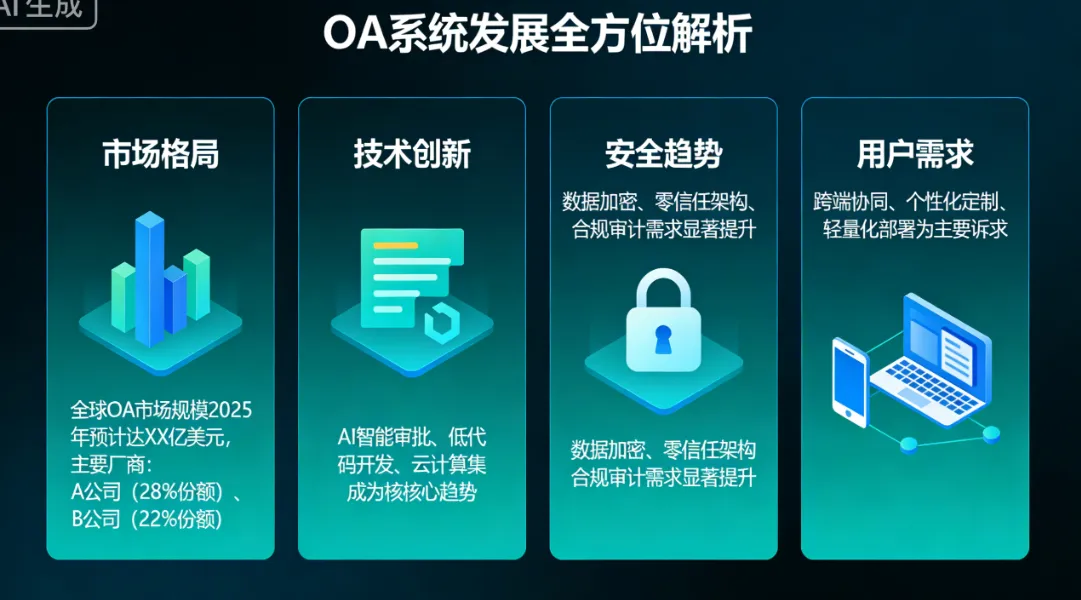
The evolution of user needs has deepened from "improving efficiency" to "empowering employees, activating organizations, and driving innovation".Users are no longer satisfied with smooth processes, but pursue the ultimateUser experience and empowering valueThis requires an intuitive and user-friendly interface, complete mobile functionality, and seamless and unified user experience across all devices. The deeper demand lies in whether OA can become the "living water" of organizational knowledge, allowing employees to quickly find the information and experts they need through intelligent search and personalized push? Can it become a catalyst for team collaboration, supporting flexible project teams, transparent goal management, and effective asynchronous communication? Can it becomeThe 'sensor' of organizational vitalityThrough anonymous feedback, public opinion analysis, and collaborative data, provide managers with insights into organizational health? The future OA system will increasingly resemble an organization's "digital nervous system", not only transmitting instructions, but also sensing states, stimulating collaboration, and supporting intelligent decision-making.
In summary, the development of OA systems has entered a new stage driven by intelligence, based on security, centered on user experience, and expanded by ecological collaboration. The ultimate goal is to build a secure, intelligent, user-friendly, and deeply integrated digital workspace with the business. This space not only improves operational efficiency, but also aims to unleash the creativity of every employee and enhance the agility and resilience of the organization. For organizations, choosing and building an OA system is essentially choosing their own work style and collaborative culture for the next few years, and its importance is self-evident. Only by deeply understanding the multidimensional interaction between market, technology, security, and demand can we make wise choices for the future in this profound digital transformation.