
How does an ERP system assist in business management?
As the core of modern enterprise digital operation, enterprise resource planning system has evolved from the initial production resource management tool to a comprehensive platform supporting overall business decision-making. The helpful role of ERP systems in enterprise management is not only reflected in the automation of specific business processes, but also in core management areas such as strategic planning, resource allocation, and risk control, fundamentally reshaping the operation mode and management paradigm of enterprises.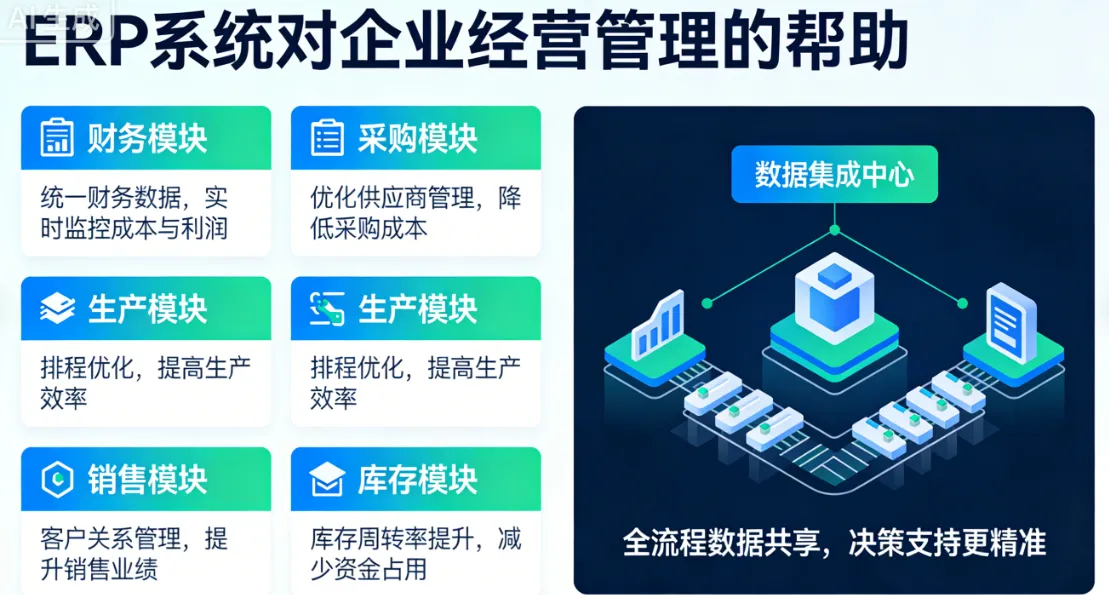
Integrated data platform breaks information silos
The most prominent problem faced by traditional enterprise management is information fragmentation. Each department uses independent systems to isolate key data such as finance, procurement, production, and sales, creating insurmountable information barriers. The ERP system integrates all key business processes of the enterprise into one system by building a unified data platform, achieving centralized storage and real-time sharing of data. When the sales department enters an order, the production department can immediately see the demand information, the procurement department can synchronously obtain material requirements, and the finance department can track accounts receivable and cash flow changes in real time. This data integration breaks down the information barriers between departments, enabling management to make decisions based on complete and consistent data, avoiding misjudgments caused by incomplete or outdated information.
After implementing an ERP system, a medium-sized manufacturing enterprise integrated data that was originally scattered across five independent systems, reducing the time for management to obtain comprehensive business reports from three days to real-time availability. This data transparency not only improves decision-making efficiency, but also helps enterprises gain significant information advantages in market competition, enabling them to respond more quickly to market changes and customer demands.
Standardization of processes and improvement of operational efficiency
ERP systems help businesses establish standardized and efficient operational systems by solidifying best practices into standard processes. The system guides enterprises to re-examine and optimize existing business processes, eliminate redundant links, reduce non value added activities, and achieve standardization and automation of business processes. From procurement request to payment, from sales orders to receipts, from production planning to cost accounting, every key process is designed as an efficient and controllable standardized operation.
In terms of inventory management, ERP systems help enterprises achieve optimal inventory levels through precise demand forecasting and inventory control algorithms. The system automatically calculates safety stock and reorder points based on sales forecasts, production plans, and procurement cycles, avoiding the risk of stockouts and reducing capital occupation. A certain consumer goods enterprise increased the overall inventory turnover rate by 40% through the inventory optimization module of the ERP system, released a large amount of working capital, and controlled the out of stock rate below 1%, significantly improving customer satisfaction.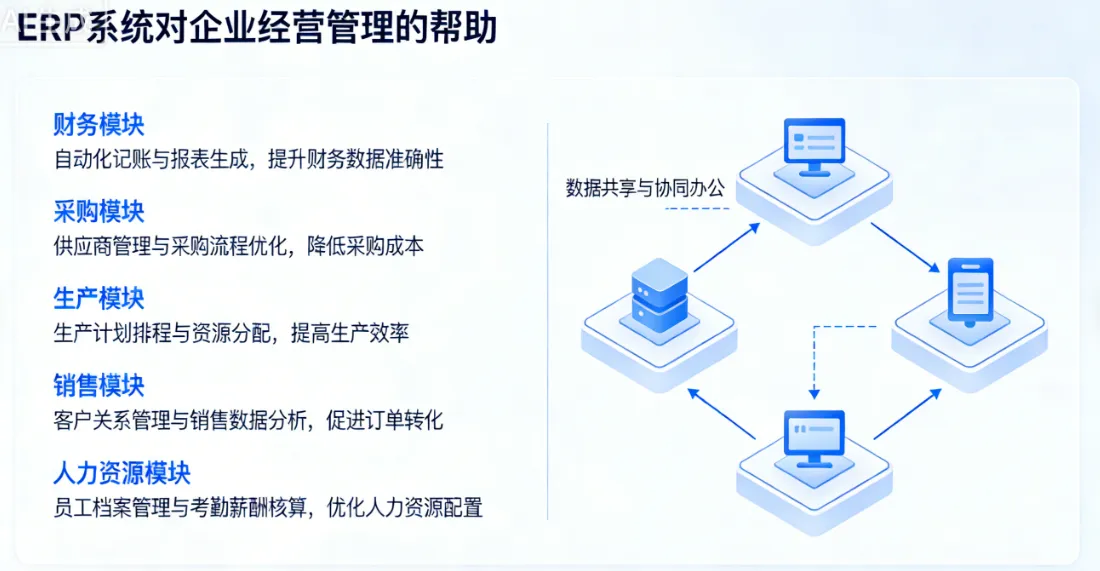
Deep integration of finance and business
One of the core values of ERP system is to achieve deep integration of finance and business. Under traditional models, financial data often lags behind business operations and is disconnected from business processes. The ERP system ensures that every business activity generates corresponding financial records in real-time through a business driven financial mechanism. When the goods are released from the warehouse, the system automatically generates sales revenue and cost transfer vouchers; When raw materials are received, the system synchronously updates accounts payable and inventory value.
This integration of business and finance enables enterprises to achieve truly comprehensive budget management and real-time cost control. The management can view financial reports based on the latest business data at any time to understand the true profitability and cash flow situation of the enterprise. A certain engineering enterprise has achieved real-time cost tracking and profit analysis for each engineering project through the project cost accounting module of the ERP system, improving the accuracy of project profit margin prediction by 35% and greatly enhancing the enterprise's profitability and risk control capabilities.
Decision Support and Strategic Planning
Modern ERP systems are not only execution platforms for business processes, but also support systems for enterprise management decisions. Through built-in business intelligence and analysis tools, ERP systems can deeply mine and analyze massive business data from multiple dimensions, providing valuable business insights for management. The system can identify sales trends, analyze customer behavior, evaluate product profitability, monitor supply chain risks, and provide data support for enterprise strategic planning and daily business decisions.
A retail enterprise utilized the customer analysis module of an ERP system to conduct in-depth analysis of the purchasing behavior and preferences of different customer groups. Based on this, precise marketing strategies and product mix plans were developed, resulting in a 25% increase in high-value customer retention and an 18% increase in overall sales. This data-driven decision-making model enables enterprises to more scientifically formulate and execute business strategies, and occupy a favorable position in market competition.
Supply Chain Collaboration and Risk Management
ERP system helps enterprises build a more collaborative and flexible supply chain system through extended supply chain management functions. The system supports information sharing and business collaboration with suppliers, distributors, and customers, enabling the entire supply chain to respond more quickly and accurately to changes in market demand. In terms of risk management, ERP systems provide comprehensive risk monitoring and early warning mechanisms to help enterprises detect and respond to operational risks in a timely manner.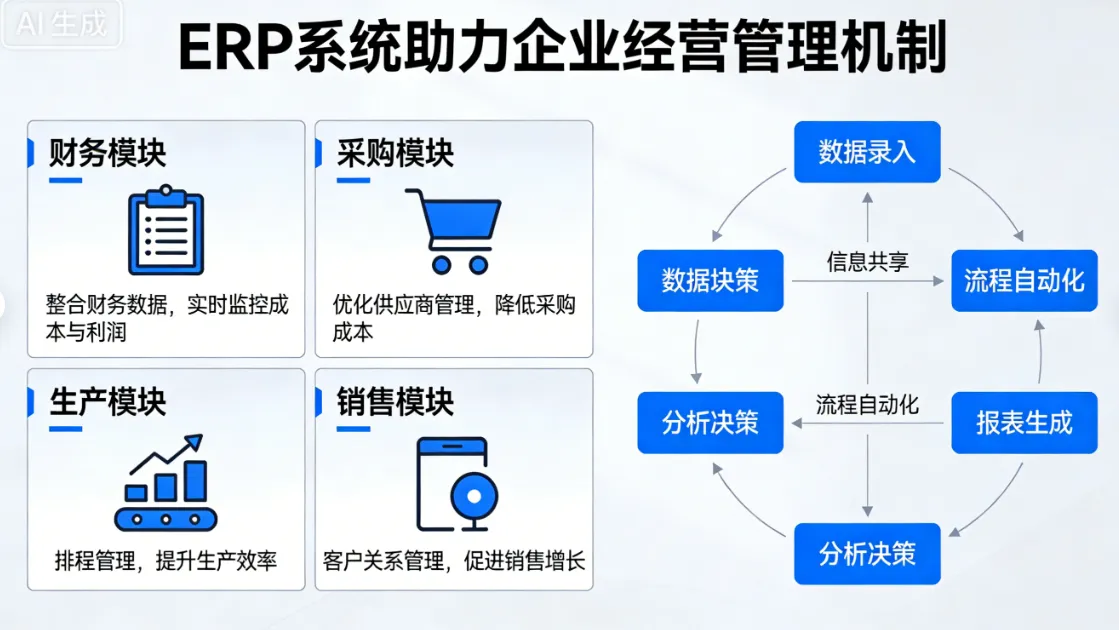
A certain automotive parts manufacturer has established a real-time information sharing mechanism with major suppliers through the supply chain collaboration platform of the ERP system. When market demand changes, companies can quickly adjust their procurement plans, and suppliers can respond in a timely manner, reducing the response time of the entire supply chain by 50% and lowering inventory levels by 30%. This efficient supply chain collaboration not only reduces operating costs, but also greatly enhances the enterprise's ability to resist risks in market fluctuations.
Organizational Capability Enhancement and Continuous Improvement
The implementation and application process of ERP system itself is also a process of enhancing the organizational capability of enterprises. The system promotes the establishment of a data-driven management culture in enterprises and cultivates employees' analytical and systematic thinking. At the same time, the business process monitoring and performance analysis functions provided by the ERP system help enterprises establish a continuous improvement mechanism. The management can monitor key performance indicators in real-time through the system, identify process bottlenecks and improvement opportunities, and promote the continuous improvement of the company's operational level.
More importantly, ERP systems provide a digital foundation for enterprises to adapt to business changes and scale expansion. With the development of enterprises, ERP systems can support new business models and operational needs through module expansion and functional enhancement, becoming the technical support for sustainable development of enterprises. A rapidly growing technology company, in the process of developing from a start-up to a multinational corporation within five years, has always effectively supported the global operational and management needs of the enterprise through flexible expansion and configuration of its ERP system.
Conclusion
The assistance of ERP system to enterprise management is comprehensive, from basic data integration to deep decision support, from process optimization to risk control, from efficiency improvement to strategic empowerment. In today's era where digital transformation has become a necessary path for the survival and development of enterprises, ERP systems are no longer an optional IT tool, but a key infrastructure for enterprises to build core competitiveness and achieve sustainable development. For enterprises pursuing excellence, a deep understanding and effective application of ERP systems, transforming technological advantages into management and competitive advantages, is an important guarantee for winning the future in a complex and ever-changing market environment.