
Shuntong Footwear ERP System - Digital Management Solution for All Business Processes
The complexity dilemma of shoe manufacturing management
The footwear manufacturing industry is a typical hybrid of complex discrete manufacturing and process manufacturing. A pair of sports shoes, from design drawings to finished product packaging, needs to go through dozens of stages including raw material procurement, cutting, sewing, molding, vulcanization or cold bonding, quality inspection, warehousing, and distribution, involving hundreds of types of materials, dozens of processes, and multiple outsourcing manufacturers. What's even more tricky is that the fast-paced fashion industry compresses the product lifecycle to a few months, with multiple varieties, small batches, and short delivery times becoming the norm. Meanwhile, labor-intensive production models demand extremely high requirements for personnel scheduling and piece rate compensation. Under the traditional management mode, ERP、 The production execution system, warehouse management system, and financial software operate independently, forming new data silos; The progress of the workshop relies on verbal reports from the team leader, and the promise of order delivery time is virtually non-existent; The two major cost black holes of material utilization and labor efficiency have existed for a long time but cannot be quantitatively controlled. The Shuntong Footwear ERP system was born to solve this systemic dilemma. It takes the unique business logic of footwear manufacturing as the starting point, connects the entire value chain from research and development sampling, supply chain collaboration, production execution, quality control to cost accounting, and builds an integrated, real-time, and intelligent digital operation center for footwear enterprises.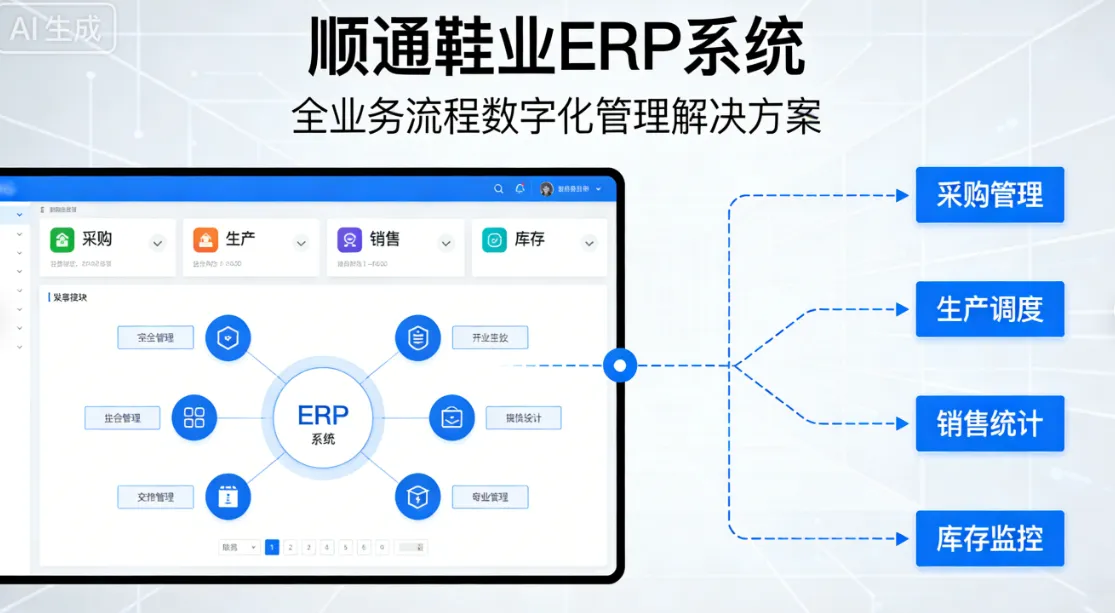
Research and Development Data Integration: Seamless Conversion from Design Draft to BOM
The source of footwear manufacturing is research and development, and the accuracy of research and development data directly affects all subsequent processes. In the traditional mode, after the designer completes the style development, the cost accountant needs to manually enter the material list, the pattern designer independently manages the data, and the process flow is prepared by the craftsman. Multiple systems, multiple forms, and multiple maintenance personnel have led to inconsistent data becoming the norm - the material list received by the purchaser is misaligned with the version of the process sheet executed by the workshop, and the cost accounting is based on a deviation between the labor price and the financial settlement caliber. The Shuntong Footwear ERP system places research and development data management at the strategic core, building a digital mainline from design concepts to mass production instructions.
The system supports bidirectional integration with shoe specific design software and grading software. After the designer confirms the color scheme, the bill of materials can be imported into ERP with one click and automatically associated with material images, supplier information, and usage quotas; After the pattern maker completes the grading, the net usage of each size is automatically written back to the corresponding field in the material list. The process route module has a built-in shoe industry exclusive process library, covering more than a thousand standard processes such as cutting, batch leather, folding, sewing, climbing, and forming. Craftsmen can quickly complete the new product process layout through drag and drop, and the system automatically calculates standard working hours and labor cost budgets. Once the R&D data is released, the procurement, production, and cost departments immediately synchronize and obtain the latest version, completely eliminating errors in procurement, production, and calculation caused by confusion in data versions. After a certain sports shoe brand imported this module, the average R&D to mass production cycle was shortened by 9 days, and the stagnant inventory caused by material list errors decreased by 56%.
Supply Chain Collaboration: From Game Relationships to Ecological Partners
The supply chain of the footwear industry is complex, with multiple layers of supply networks surrounding brand merchants, including leather suppliers, fabric suppliers, substrate factories, accessory suppliers, and outsourced processing factories. Traditional procurement management regards suppliers as external game opponents, with information transmitted only through purchase orders in one direction. Brand owners cannot predict the supplier's production capacity status, and suppliers cannot know the brand's demand plan. The bullwhip effect amplifies inventory fluctuations. Shuntong Footwear ERP system upgrades supply chain management from single point control to ecological collaboration.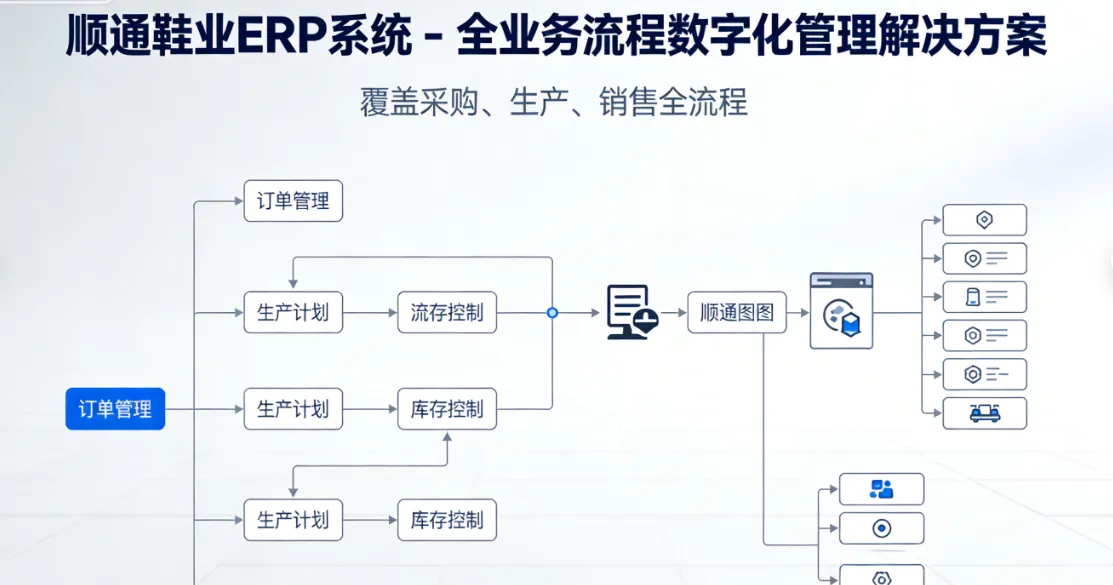
The supplier portal is the core interactive interface of this collaborative system. Brand owners will push the rolling demand forecast to the portal after desensitization by the system, and suppliers can lock in raw materials and reserve production capacity 6 to 8 weeks in advance. After the purchase order is issued online, the supplier confirms the delivery time, ships in batches, prints the box label, and generates a shipping notification through self-service. The brand warehouse predicts the arrival plan based on the shipping notification, and the receiving efficiency is improved by more than 50%. Double directional transparency of quality data - real-time synchronization of incoming inspection results with suppliers, automatic triggering of rectification requirements for non-conforming batches; Suppliers can upload material certification and testing reports through the portal, and brand quality inspectors can verify them online. After a certain export shoe company applied the supplier collaboration module, the procurement cycle of materials and accessories was compressed by 12 days, and the emergency air freight costs caused by information lag decreased by 74%. The satisfaction of core supplier cooperation reached a historical high.
Transparency in Production Execution: From Black Box Workshops to Digital Twins
The production workshop is the core of value creation in footwear manufacturing and also the largest information black box under traditional management models. After the manager issues the production order, the order disappears deep in the workshop - until the finished product is taken offline, during which the progress is unclear, bottlenecks are unclear, and abnormalities are not reported. The Shuntong Footwear ERP system maps physical workshops into digital twins through process level data collection and visualization dashboards.
The cutting workshop deploys a typesetting terminal, and the operator uploads the knife mold diagram. The system automatically generates the optimal typesetting plan based on the grade and width of the leather material. The utilization rate data is transmitted in real time to the ERP cost accounting module, and any abnormal consumption is immediately alerted. Each workstation of the needle car assembly line is equipped with industrial tablets or barcode scanners. Workers scan work tickets for each completed process, and the system records the processing person, processing time, and inspection results. Piece rate wages are synchronously accumulated to the individual's daily income. The molding production line collects the actual output of the vulcanization tank and cold bonding line through an infrared counter, and compares it with the planned output in real time. Workshop managers can monitor the progress of each order, the work in progress of each process, and the efficiency of each workstation at any time through three levels of visual dashboards: production line level, team level, and machine level. Any abnormal stays at any stage will be automatically highlighted and pushed in red by the system. After applying transparent modules in the production of a certain vulcanized shoe factory, the order delivery rate increased from 67% to 91%, the workshop management personnel were reduced from 12 to 7, and the communication and coordination time was reduced by more than 60%.
Quality traceability loop: from passive response to active prevention
The pain point of shoe quality issues lies not in the inspection process, but in the traceability and improvement process. In the traditional mode, when batch defects are found during finished product inspection, managers cannot quickly identify the source of the problem - is it due to insufficient strength of a certain batch of leather material? Is it due to abnormal tension in a certain sewing machine? Is it due to a new employee's improper operation? Only the entire batch of products can be inspected and reworked, which is costly and cannot be cured. Shuntong Footwear ERP system builds a forward and backward traceability system covering the entire supply chain, production, and warehousing process.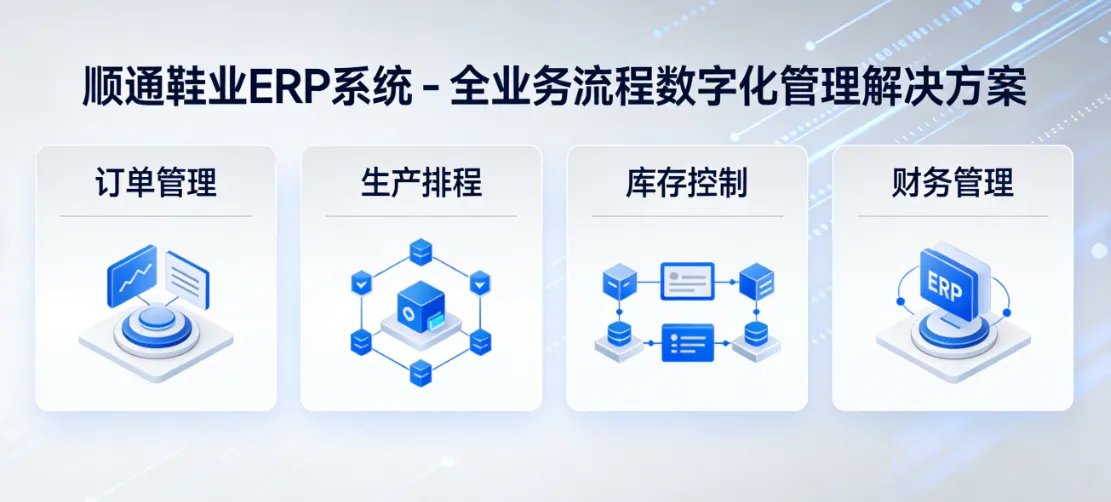
When each batch of raw materials is received, the supplier, purchase order, and inspection report are bound. When cutting and feeding, the raw material batch is associated with the cutting work ticket. The needle sewing process records the association between the cutting and sewing work tickets. The forming process records the association between the shoe upper and the forming work ticket. When assigning codes to finished products, the system automatically establishes a complete lineage of the shoe with all raw material batches, process operators, and inspection data. When there are after-sales customer complaints or production line abnormalities, scanning the finished product code allows for a complete traceability within three minutes: who used the leather material for this pair of shoes, who cut it, who helped with the car, who formed it, and who inspected the quality. Tracing upwards to identify the root cause of the problem, tracing downwards to lock in the affected product range of the same batch, and controlling the recall scale to the smallest unit. After applying the traceability module to a certain children's shoe brand, the processing cycle for major quality accidents has been reduced from an average of 5 days to 4 hours, the cost of a single recall has decreased by 80%, and the pass rate of foreign customer factory inspections is 100%.
Fine cost accounting: from comprehensive allocation to single shoe penetration
The cost accounting of the footwear industry has long been in a fuzzy zone. The fluctuation of material prices, differences in layout utilization rates, fluctuations in process labor prices, and the allocation of manufacturing costs, combined with many other variables, make the actual cost of a single shoe a black box that is difficult to solve. Enterprises often evaluate category performance based on comprehensive gross profit margins, without realizing that some styles are clearly profitable but actually losing money. The Shuntong Footwear ERP system penetrates the granularity of cost accounting from category level and batch level to single shoe level.
The system is linked in real-time with the procurement, production, and compensation modules, and the actual material costs, labor costs, and shared manufacturing expenses for each pair of shoes are collected at the moment they are packaged. The material cost is accurate to the actual leather area occupied by the shoe cutting piece and the corresponding purchase batch unit price, rather than the average cost of the entire leather piece; The labor cost is accurate to the piece rate corresponding to the actual operators in each process of the pair of shoes, rather than the average cost of each process; Manufacturing costs are dynamically allocated based on actual working hours, rather than being roughly allocated in a fixed proportion under traditional models. Managers can query the cost breakdown and gross profit contribution of any style, order, or customer at any time, accurately identifying profit pillars and profit traps. After applying the refined cost module, a certain footwear group found that the actual gross profit of the main category, which had been growing for three consecutive years, was negative. The root cause was that the outsourcing unit price of a special process continued to rise but the selling price was not adjusted. After timely price adjustments, the category's annual revenue increased by more than 8 million yuan.
From Tools to Abilities: The Continuous Evolution of Digitalization in the Footwear Industry
The ERP system of Shuntong Footwear not only carries offline processes to online, but also builds a set of perceptible, analyzable, and optimizable digital nerves for shoe enterprises. This set of nerves transforms research and development inspiration, material flow, equipment pulse, manpower input, and capital turnover into real-time flowing data, upgrading managers from a decision-making model that relies on experience, reporting, and post firefighting to a new governance capability that is data-driven, real-time perception, and predictive intervention. When the time required for each process is recorded, the consumption of each material is collected, and every source of profit is penetrated, footwear manufacturing, a millennium old craft, achieves efficiency and precision that resonates with modern industrial civilization while retaining craftsmanship. In an era where labor costs continue to rise, order fragmentation is irreversible, and consumer sovereignty is increasingly strengthened, such digital capabilities are evolving from a competitive advantage for excellent shoe companies to a survival baseline.