Introduction and Definition of Enterprise Resource Planning (ERP)
Integration of management ideas and technical tools
Enterprise resource planning is one of the most influential concepts in the field of enterprise management, and also one of the most commonly misunderstood terms. Many people equate it with a set of financial software, or a inventory management system, or even simply understand it as "management software for enterprises". These understandings have touched upon some superficial aspects, but have not reached the essence. The true essence of ERP goes far beyond technical tools. It is a product of the deep integration of management ideas and information technology, and a systematic methodology for modern enterprises to cope with complex operational environments. Understanding ERP requires three progressive dimensions: firstly, it is a management philosophy, secondly, it is an integrated application architecture, and finally, it is the software interface for users' daily operations.
Dimensions of Management Philosophy: From Resource Optimization to Global Collaboration
ERP, as a budding management concept, can be traced back to material requirement planning in the 1960s. At that time, the core issue facing the manufacturing industry was how to obtain the correct quantity of materials at the right time, while meeting production needs without causing inventory backlog. The material requirement planning provides the mathematical optimal solution through product structure expansion and time phased planning. In the 1980s, manufacturing resource planning extended this logic from materials to broader manufacturing resources such as equipment, manpower, and funds, forming the embryonic form of internal resource coordination within enterprises.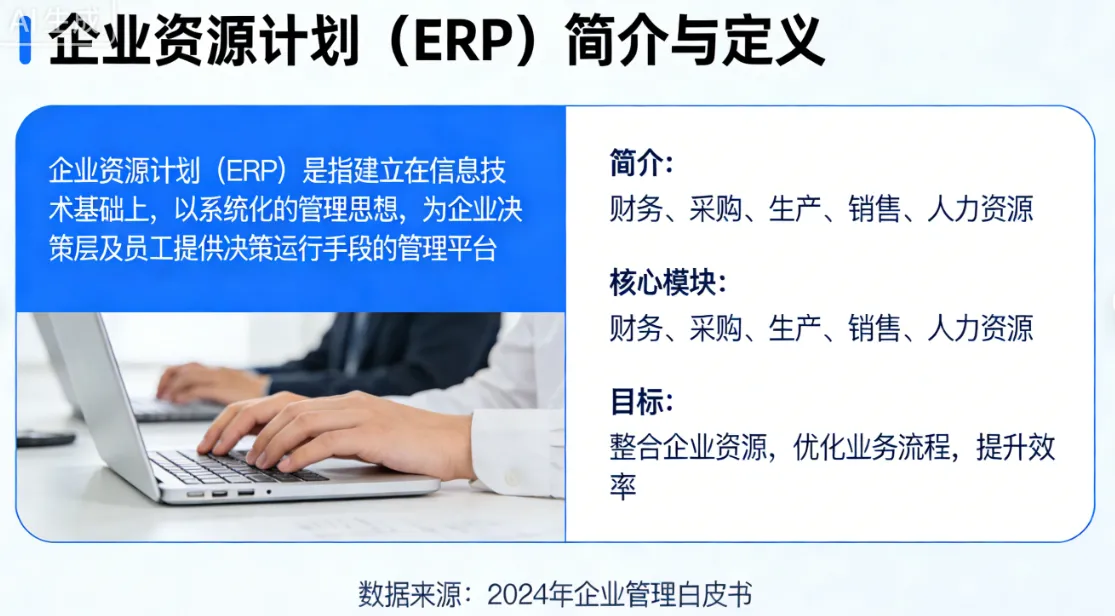
However, the watershed that truly sets ERP apart from all previous management theories is its redefinition of the 'enterprise boundary'. Under the traditional management model, departments, subsidiaries, and business units are considered relatively independent accounting entities, pursuing local optima. The core breakthrough of ERP thinking is that it regards the enterprise as an inseparable organic whole - sales orders are not only the performance of the sales department, but also the instructions of the production department, the needs of the procurement department, and the accounts receivable of the finance department. Any business activity will have a chain reaction throughout the system, and only by coordinating resources and collaborative processes from a global perspective can we achieve maximum overall benefits. This management philosophy of "global over local, collaboration over division of labor" is the first connotation of ERP beyond the level of technical tools.
Dimension of Integrated Architecture: System Engineering to Break Information Isles
Translating management philosophy into executable business capabilities requires the support of technological architecture. The essential feature of ERP at the technical level can be summarized in one word: integration. Traditional enterprise information construction often follows the path of "local first, connected later" - the finance department first uses financial software, the warehouse department uses warehousing systems, and the sales department uses customer relationship management later. These systems were built by different vendors at different times, with varying data standards and incompatible interfaces, forming insurmountable information islands. At the end of the financial month, Excel needs to be exported from the warehouse and manually processed before importing into financial software; To check inventory for sales, you need to call the warehouse keeper; Production planners spend a lot of time verifying conflicting data across different systems. Integration is not an efficiency issue, but a correctness issue - when data sources are inconsistent, enterprises actually do not have a reliable operational view.
ERP eliminates information silos at the root through a unified data model and shared database. It does not "connect" modules such as finance, procurement, production, inventory, and sales, but considers them as organic components of the same system from the beginning of design. At the moment a sales order is entered into the interface, its data simultaneously flows to the inventory module to pre occupy available quantity, flows to the production module to trigger planned demand, and flows to the finance module to update accounts receivable forecasts. All modules work based on the same set of data, without interface conversion, manual verification, or delayed synchronization. This native integrated architecture not only brings efficiency improvements, but also a qualitative change in decision quality - for the first time, managers can obtain consistent, real-time, and trustworthy business data from the entire enterprise at any time.
Dimension of process standardization: the carrier for solidifying best practices
Another essential aspect of ERP is the carrier for standardizing and optimizing business processes. Any enterprise will form a set of customary practices in its long-term operation, which not only contains the essence of condensed experience, but also contains redundant links due to personnel compromise and historical inertia. Under the traditional model, process optimization heavily relies on the personal abilities and driving forces of managers, making it difficult to solidify solutions and often resulting in the loss of improvement outcomes with personnel turnover.
The ERP system designs validated business processes into pre-set rules and operational paths. What levels of approval are required for procurement requests, how much amount needs to be tendered, and what acceptance criteria apply to different supplier categories - these management rules are written into the system configuration, enforced, and traceable throughout the entire process. New employees can complete standard tasks according to system guidelines without the need for direct instruction from their mentors; Branch expansion does not require reinventing processes, and replicating the headquarters system configuration can achieve the same level of control. More importantly, the processes carried by ERP are not rigid and unchanging. When enterprises adjust their strategies and innovate their business models, process parameters can be adjusted through system configuration to adapt to new management requirements. The balance between process standardization and flexible adaptation is the core capability that distinguishes ERP from customized development software.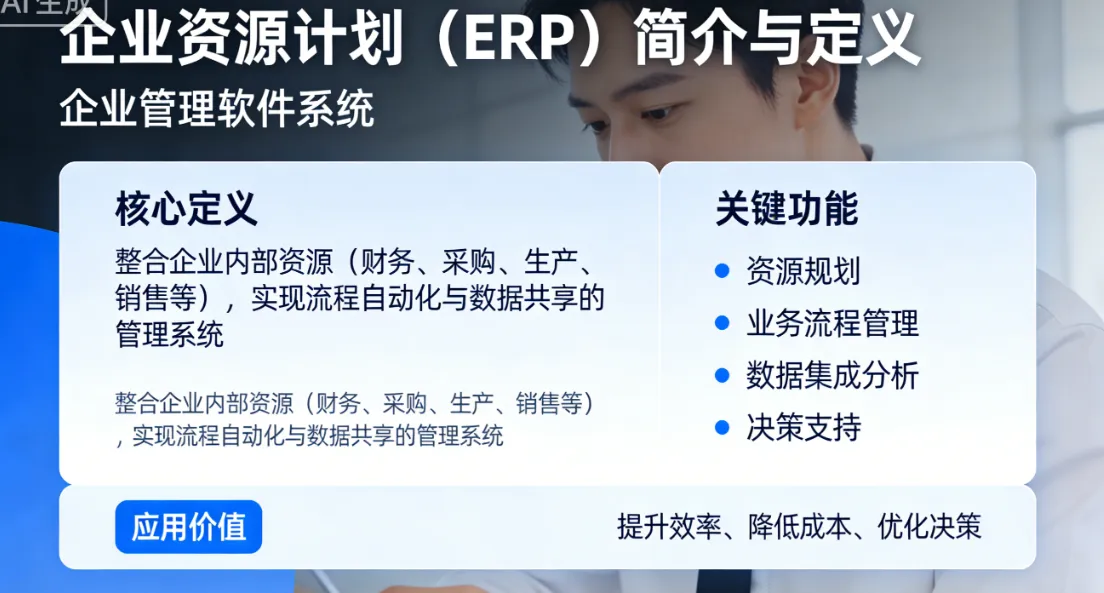
The dimensions of real-time and predictability: from recording history to driving the present
The core function of traditional management software is "recording" - transaction occurrence, document entry, report generation. Management sees the history of three days ago, a week ago, or even the previous month. ERP shifts the management perspective from 'post event' to 'in event' and even 'pre event'. This transformation stems from two technological breakthroughs: the integration of business and finance, and the closed-loop planning and execution.
In the traditional mode, the purchase receipt is entered by the warehouse keeper, the purchase invoice is entered by the financial accounts payable accountant, and the payment request is initiated by the purchaser. The three sets of data are checked at the end of the month, and the reasons for differences are identified one by one. ERP realizes real-time linkage between business events and financial accounting. At the moment of confirmation of procurement and warehousing, the system automatically generates estimated payable vouchers; At the moment when the invoice verification is passed, the estimated offset and input tax confirmation are completed in one step. Financial personnel are no longer post event recorders of business activities, but rather in-process supervisors of business processes.
The evolution of planning functions is more strategically significant. The material requirement planning and advanced scheduling module of ERP automatically calculates when to purchase what materials, arrange production, and deliver to customers in the future based on real-time data such as sales forecasts, existing inventory, in transit purchases, and production capacity loads. Managers do not passively respond to problems, but actively intervene under system warnings - this is not an upgrade of efficiency tools, but a leap in management paradigms.
From Definition to Essence
In summary, the connotation of enterprise resource planning can be expressed as follows: it is a comprehensive enterprise management concept and software system characterized by integration, standardization, and real-time. Through a unified data platform and business process framework, it realizes the global optimization configuration of all resources such as manpower, materials, equipment, and funds within the enterprise and extended supply chain, providing integrated support for multi-level managers in planning, execution, control, analysis, and decision-making.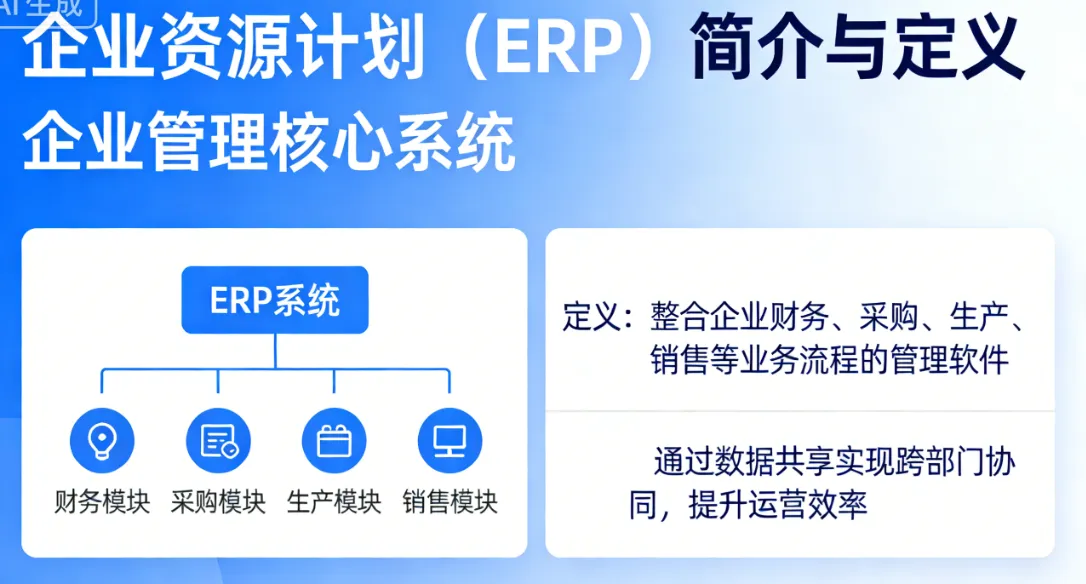
This definition reveals four essential attributes of ERP: a global collaborative perspective at the philosophical level, native integration at the architectural level, process standardization at the application level, and real-time decision-making at the value level. Any so-called ERP that deviates from these essential attributes, regardless of the length of the function list or the size of the implementation team, is just a traditional management software disguised as ERP. For enterprises that are currently or will soon embark on the journey of ERP, understanding these essences is much more important than studying the functional list - the direction is correct, and speed is meaningful; Clear in essence, selection will not be lost.