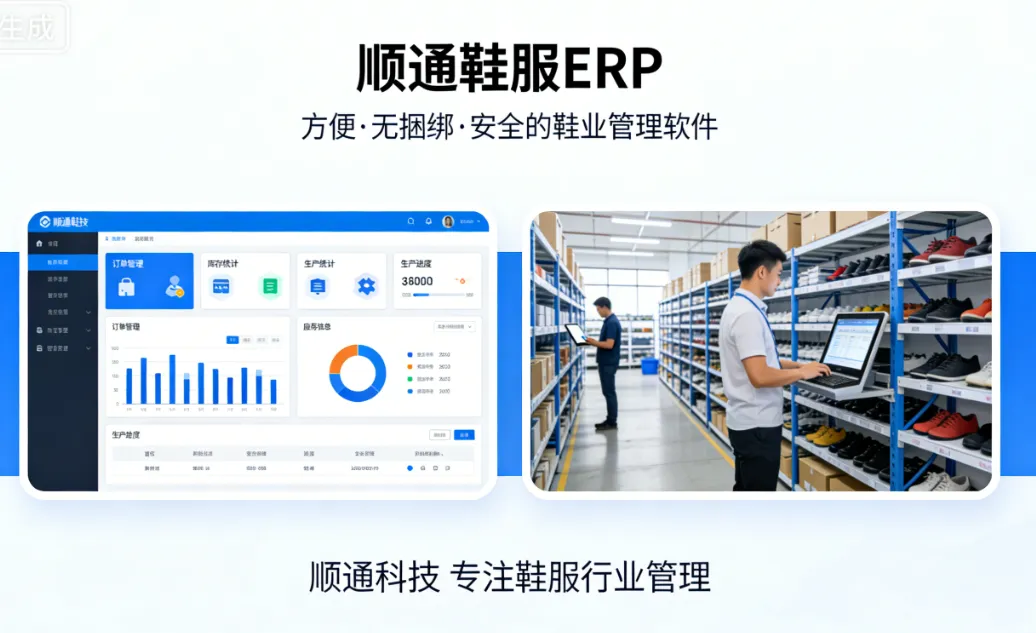
A convenient shoe management software without bundled security - Shuntong Shoe and Clothing ERP
Hidden pitfalls in shoe software selection
When a shoe company decides to introduce an ERP system, decision-makers often focus on whether the functionality is complete, the price is reasonable, and the implementation cycle is controllable. However, after half a year of online operation, an unexpected problem gradually emerged: the system, which was promised a "permanent license" when purchasing software, now needs to pay a high "service fee" every year to continue using it; I want to connect with a popular e-commerce platform, but I was told that I need to purchase an additional "interface authorization module"; Attempting to export core business data for independent analysis, it was found that the format was encrypted and locked; What is even more disturbing is that the software backend frequently automatically connects to unknown servers, and after investigation by the IT department, it was confirmed that it is the software manufacturer's built-in "data return" module. These are not scaremongering, but rather the increasingly common "bundled security" chaos in the footwear ERP market in recent years - manufacturers use technology lock-in, implicit charging, data hijacking, and other means to transform customers' system selection decisions into long-term hijacked starting points. Shuntong Shoe and Clothing ERP was born to break the unwritten rules of this industry. Its product philosophy is "permanent authorization, open interface, data autonomy, and uninterrupted operation", providing shoe companies with a truly convenient, pure, and controllable management software.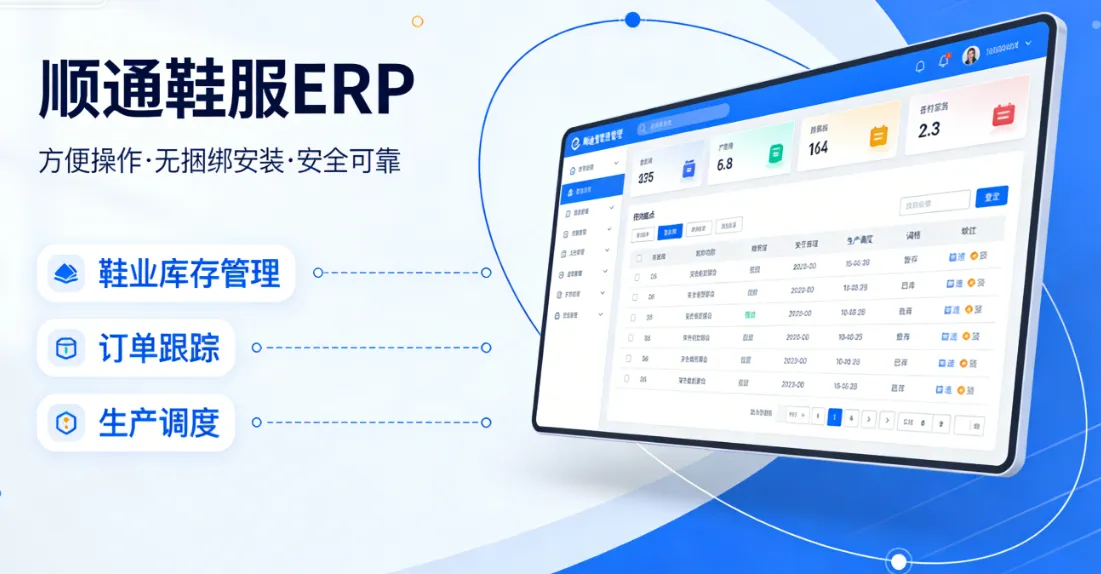
Permanent authorization: passive renewal to end the annual fee cycle
The charging model in the footwear software market is undergoing dangerous alienation. Some manufacturers attract companies to sign contracts with extremely low initial quotes, with a vague definition of "first-year service fee" in the contract, which suddenly increases when renewed in the second year; The customer found that the renewal amount has approached or even exceeded the initial purchase cost, but due to deep data locking and skilled personnel dependence, it cannot be easily replaced, falling into the dilemma of "affordable but not usable". Some manufacturers have completely cancelled permanent licenses and switched to an annual subscription system. The total expenditure of enterprises using the five-year model far exceeds the traditional buyout model, but they have not gained any new value.
Shuntong Shoe and Clothing ERP adheres to the tradition of permanent authorization. Enterprises pay a one-time software fee to obtain full usage rights for the corresponding functional modules, without the need to pay annually for "continuing to use purchased functions". In the following year and beyond, only the operation and maintenance service fee agreed upon in the contract needs to be paid - this fee is used to ensure system bug fixes, server security protection, version compatibility adaptation, rather than paying for duplicate authorized functions. The upper limit of the operation and maintenance service fee is written into the contract and will not increase for ten years. The enterprise can decide whether to renew the purchase independently. When customers need to suspend the use of the system due to business adjustments, there is no need to worry about the annual fee being idle; When an enterprise expands its scale and needs to add new users, it should only pay reasonable expansion fees based on the number of new users added, rather than forcing the upgrade to a higher priced package. The boss of a certain Fujian shoe company bluntly stated, "Before choosing Shuntong, we were troubled by the 'lifetime upgrade service fee' of the previous manufacturer for three years, which was 30000 yuan per year. If we didn't pay, we would lock the system. Now we know that the software can really be bought out in one go
Fully open interface: Reject channel monopoly and secondary extortion
The footwear ERP system has never been a software that runs in isolation. It must interface with e-commerce platforms to obtain orders, with warehousing equipment to execute shipments, with financial systems to generate vouchers, and with production equipment to collect data. Some ERP vendors use this dependency relationship to artificially create interface barriers - to connect with Taobao, they need to purchase module A; to connect with JD.com, they need to purchase module B; to connect with WMS, they need to purchase module C. Each module is priced separately, and the price even exceeds that of the main software product. In more extreme cases, manufacturers set interface permissions as exclusive features of the enterprise version, forcing small and medium-sized enterprises that do not require other complex functions to pay the entire upgrade fee for a single interface.
Shuntong Shoe and Clothing ERP regards interface openness as the bottom line principle of the product. The system natively presets the standard interfaces of mainstream e-commerce platforms such as Taobao, Tmall, JD, Pinduoduo, Tiktok, Kwai, Dewu, and WeChat applet, without additional payment or secondary development. After the store authorization is completed, enterprises can automatically pull orders and synchronize inventory. Standard configuration of voucher interfaces with mainstream financial software such as Kingdee, UFIDA, and Housekeeper, enabling one click generation of purchase payment, sales receipt, and cost transfer vouchers. The warehousing and logistics interface is connected to the electronic waybill systems of mainstream express delivery companies such as SF Express, YTO Express, ZTO Express, and Yunda, making the entire process of issuing and shipping seamless. More importantly, Shuntong provides customers with complete API interface documentation, allowing the enterprise IT team to develop and integrate with third-party systems such as MES, PLM, WMS, CRM, etc. without paying any interface authorization fees to Shuntong or waiting for Shuntong to arrange scheduling. The IT manager of a certain sports shoe brand commented, "We need to connect with a set of automated cutting equipment imported from Italy. Shuntong provided the interface document, and our engineers were able to connect it in two days. If it were another manufacturer, we would probably have to submit a budget and wait for six months
Complete autonomy of data: ownership and corporate sovereignty
After running for three to five years, the value of data assets accumulated within the footwear ERP system often exceeds that of the software itself - material list data for tens of thousands of shoe models, performance data for thousands of suppliers, purchasing behavior data for millions of consumers, and sales trend data from various channels over the years. These data are the core achievements of enterprise digital construction, and their ownership should be indisputable. However, some ERP vendors have hidden clauses in their user agreements, claiming to have the "right to use" or "right to analyze" customer business data. A more radical approach is for the system backend to package customer data at regular intervals and send it back to the manufacturer's server for training their industry analysis model and optimizing their competitor recommendation algorithm. Customers not only do not receive any benefits, but may also become the target of precise harvesting by the algorithm.
Shuntong Shoe and Clothing ERP clarifies the principle of data sovereignty ownership in product design. All business data is stored on servers purchased or leased by the enterprise, supporting three modes: local deployment, private cloud deployment, and dedicated cloud hosting. The Shuntong server is only used for software authorization verification and version update reminders, and does not access, collect, or transmit any customer business data. Customers can export full structured data to common formats such as Excel, CSV, SQL Server, etc. at any time without the need for any decryption tools or vendor authorization, completely eliminating the risk of data locking. The system provides self-service tools for data backup and recovery, allowing enterprises to set their own backup policies, storage locations, and retention periods. When the customer decides to terminate the use of the Shuntong system, there is no need to pay any data "ransom", and all historical data can be fully migrated to other systems. Before signing the contract, a shoe owner in Wenzhou specifically inquired, "If I think another system is better in three years, can I take all my data with me?" The sales manager demonstrated the entire process of exporting data on the spot, and the customer signed the contract on the same day.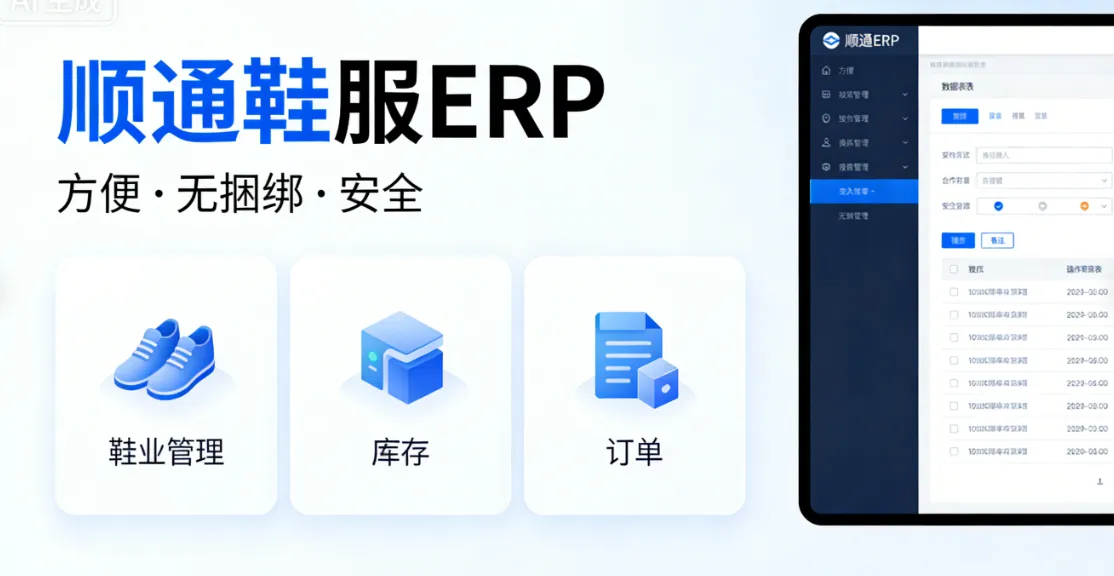
Non disruptive operation: Reject background silence and resource preemption
The footwear ERP system requires year-round support for business operations, and its stability and purity directly affect the operational efficiency of the enterprise. Some manufacturers have built-in a large number of additional modules in their software that are unrelated to their core business, such as manufacturer news pop ups, product upgrade advertisements, user training activity push notifications, and ecosystem partner product recommendations. These contents not only interfere with employees' normal work, but also continuously occupy computing resources and consume network bandwidth in the background. A more hidden issue is the improper design of the software's automatic update strategy, where new versions are forcibly pushed to the production environment without sufficient testing, resulting in misalignment of adapted print templates, invalidation of stable interface protocols, and changes to solidified report formats.
Shuntong Shoe and Clothing ERP regards "non-interference" as the core indicator of user experience. The system interface only presents authorized functional modules for customer procurement, without any advertising spaces, pop ups, or promotional links unrelated to the business. Version updates strictly follow the principle of "enterprise control" - customers can freely choose three modes: automatic update, manual update, and pause update. The production environment system will never change the core logic without confirmation from the enterprise administrator. Continuous optimization of backend process resource utilization, with Shuntong ERP's response speed leading the industry average by 37% under the same hardware configuration. The IT supervisor of a Guangzhou shoe trading enterprise gave feedback: "Our previous ERP system had a pop-up window pushing manufacturer training courses at 10 am every day, which was very annoying for frontline order workers and couldn't be turned off. After switching to Shuntong, the world becomes cleaner
Lightweight and convenient: seamless learning, quick to get started
Another manifestation of 'bundled security' in footwear software is the implicit binding of learning costs. Some manufacturers deliberately design system operations to be complex and obscure, in order to extend implementation cycles and increase training person day fees; Enterprise employees spend months learning and develop path dependence, facing significant resistance when replacing systems. Shuntong Shoe and Clothing ERP prioritizes "convenience" in product design, and interface interaction follows the cognitive habits of clothing industry practitioners, without forcibly applying the complex logic of general ERP.
The purchase receipt page is completely consistent with the physical operation process of the warehouse, and employees do not need to understand the financial associations of "purchase receipt", "purchase invoice", and "purchase payment". They can scan the delivery note to complete the receipt entry. The sales billing interface is based on the e-commerce order list, and customer service personnel can operate it independently in five minutes. The report center pre-set shoe specific statistical dimensions - by season, by band, by series, by category, by color scheme, by size, without the need to drag and drop configurations, it can directly target the core of business operations. When a certain Dongguan shoe company implemented the Shuntong system, the training time was only arranged for half a day. On the second day, the store manager was able to independently complete the transfer application and inventory query. In the third week, the financial supervisor completed the gross profit analysis table that required IT assistance for the past two days through a custom reporting tool.
From tool attributes to contractual spirit
Shuntong Shoe and Clothing ERP redefines the contractual relationship between shoe software suppliers and customers beyond product functionality. The core of this contract is not about the number of functions or technological advancement, but about respect - respecting the customer's permanent right to use the purchased functions, respecting the customer's complete ownership of their own data, respecting the customer's independent choice of technical architecture, and respecting the customer's right to clean the work interface. As more and more shoe companies are trapped by the hidden chains of manufacturers, overdrawn by increasing annual fees, and exposed to commercial privacy through mandatory data collection, Shuntong has chosen a simpler and more difficult path: to let software return to its tool nature and enable enterprises to control their decision-making sovereignty. This is not only the design concept of an ERP system, but also a re examination of the underlying logic of digital construction in the footwear industry - tools should serve people, rather than turning people into mere appendages of tools.